

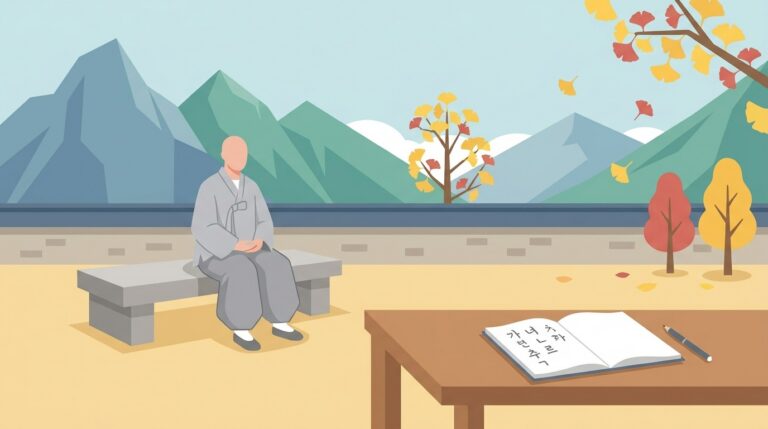
Trading Skinny Jeans for Temple Pants: Your Essential Korean Temple Stay Arrival Guide
Phase 1: Empathy (Story-driven Opening)
안녕하세요! 매일한글 에디터입니다. (Hello! It’s your Daily Hangul editor.)
Picture this: after a two-hour winding bus ride up a mist-covered Korean mountain, you finally step through the Iljumun (One Pillar Gate) of a serene Buddhist temple. The pine air smells magical, wind chimes tinkle under curved wooden eaves, and the hustle of Seoul vanishes into thin air. But then, reality hits. A smiling temple coordinator hands you a neatly folded set of oversized, slate-gray quilted clothes—a baggy vest and wide balloon pants—and points toward a wooden hall while speaking in gentle, rapid Korean.
You stand there clutching the bundle, wondering: Wait, do I wear my shirt underneath? Which way is front? Why is everyone walking with their hands clutched over their stomachs? And if a monk walks by, do I bow to the floor right now?
If your heart is racing just imagining this, take a deep breath. You are not alone! Over the past decade guiding international travelers through Korean temple stays, I have seen countless visitors panic when shedding their street wear for temple life. Temple etiquette is not a test designed to fail you; it is a mindful ritual designed to help you let go of everyday stress. By mastering just a few authentic arrival expressions and non-verbal customs, you will glide through the entrance halls with effortless grace, respect, and deep cultural connection. Let’s dive in together!
Phase 2: Core 3 Expressions Deep Dive
Let’s break down the three most crucial phrases you will hear and use within your first thirty minutes at the temple.
1. 수련복으로 갈아입으시면 돼요 (Suryeonbog-euro gar-a-ib-eusimyeon dwaeyo)
- Pronunciation: [Su-ryeon-bo-geu-ro ga-ra-im-eu-si-myeon dway-yo] (Think: “Soo-ryun-bo-goo-row” spoken smoothly like flowing mountain water)
- Meaning: Literal: “You may change into the training clothes.” | Real Nuance: “Please go ahead and change into your temple stay uniform whenever you’re ready.”
- K-Culture Moment: You’ll see this classic scene in shows like I Live Alone (나 혼자 산다) whenever celebrities escape city burnout. The moment they switch from designer street wear into baggy gray suryeonbok, their posture instantly relaxes.
- Editor’s Insight: The ending
-(으)시면 돼요is a gentle, polite suggestion frequently used by staff in hospitality and service contexts. It tells you what to do without sounding like a military command. - Situation Spectrum: Casual: ⚠️ (Too formal for friends) | Semi-formal: ✅ | Formal: ✅
- 🤔 Think About It: In many Western retreats, people wear personal athletic gear like yoga leggings. Why do you think Korean temples require everyone to wear identical, loose-fitting cotton uniforms?
2. 두 손을 모으고 합장해 주세요 (Du son-eul mo-eugo hapjanghae juseyo)
- Pronunciation: [Du son-eul mo-eu-go hap-jang-hae ju-se-yo] (Rhymes roughly with “Doo sohn-ool mow-goo hahp-jahng-hay joo-say-yo”)
- Meaning: Literal: “Gather two hands and do Hapjang, please.” | Real Nuance: “Please bring your palms together in a respectful Buddhist greeting.”
- K-Culture Moment: In historical dramas (사극) and modern healing variety shows, whenever someone crosses paths with a monk, dialogue stops and they silently bring both palms together at chest level with a slight bow.
- Editor’s Insight: Hapjang (합장) symbolizes bringing your scattered mind, body, and dualistic thoughts into one unified center of respect. It replaces shaking hands or waving.
- Situation Spectrum: Casual: 🚫 (Puzzling in daily life unless teasing) | Semi-formal: ✅ (In temple settings) | Formal: ✅ (Temple standard)
- 🤔 Think About It: How does placing your hands palm-to-palm physically change your breathing and the way you greet another human being compared to a handshake?
3. 이동할 때는 차수 자세를 유지하세요 (Idonghal ddaeneun chasu jasereul yujihaseyo)
- Pronunciation: [I-dong-hal ddae-neun cha-su ja-se-reul yu-ji-ha-se-yo] (Rhythm: “Ee-dong-hahl dday-noon chah-soo jah-say-rool yoo-jee-hah-say-yo”)
- Meaning: Literal: “When moving, maintain the Chasu posture.” | Real Nuance: “Please keep your hands folded across your belly whenever walking around the temple grounds.”
- K-Culture Moment: Watch any temple footage on Korean travel shows: visitors walking between temple halls do not swing their arms freely; their hands are calmly crossed over their navels, creating a quiet, contemplative atmosphere.
- Editor’s Insight: Chasu (차수) means placing your right hand gently over your left hand resting against your lower abdomen (danjeon). It prevents loud arm-swinging and promotes silent, grounded walking.
- Situation Spectrum: Casual: 🚫 | Semi-formal: ✅ | Formal: ✅
- 🤔 Think About It: In your home country, is walking with your hands folded across your stomach seen as nervous, bored, or respectful?
Phase 3: Textbook Korean vs. Real Korean
When you arrive at a mountain temple, rigid textbook phrases can sound surprisingly cold or robotic. Here is how to speak like a thoughtful, natural guest.
Situation 1: Asking where to change into your temple clothes
- 📖 교과서 한국어 (Textbook): 탈의실이 어디에 위치해 있습니까? (Tal-uisil-i eodie wichihae isseumnikka? / Where is the changing room situated?)
- 🗣️ 진짜 한국어 (Real-Life): 옷은 어디서 갈아입으면 되나요? (Ot-eun eodiseo gar-a-ib-eumyeon doenayo? / Where should I go to change my clothes?)
- 💡 왜 다를까? (Why the difference?): Temples are residential quarters, not shopping malls with marked “fitting rooms” (tal-uisil). Asking naturally where you should change (ot gar-a-ip-da) sounds warmer and matches the communal atmosphere of temple dormitories.
Situation 2: Asking for a different clothing size
- 📖 교과서 한국어 (Textbook): 이 바지는 저에게 너무 작습니다. (I baji-neun jeo-ege neomu jakseumnida. / These pants are excessively small for me.)
- 🗣️ 진짜 한국어 (Real-Life): 혹시 바지 한 치수 큰 거 있을까요? (Hoksi baji han chisu keun geo isseulkkayo? / By any chance, could I get one size larger for the pants?)
- 💡 왜 다를까? (Why the difference?): Direct negative statements like “too small” can sound blunt. Using
혹시(by any chance) with indirect phrasing softens your request and shows gracious humility.
Phase 4: K-Culture Deep Dive & Non-Verbal Manners
4-1. Nunchi & Silent Temple Etiquette
- Mind the Threshold (문턱 – Munteok): Whenever entering a wooden dharma hall (Beopdang), never step directly on the raised wooden door sill. Step cleanly over it. In Korean tradition, stepping on the threshold brings bad luck and physically damages traditional wooden architecture.
- The Side Door Rule: The grand central doors of a main hall (Daeungjeon) are traditionally reserved for monks and formal rites. Regular visitors should enter quietly through the side doors on the left or right, removing shoes and placing them neatly facing outward toward the courtyard.
- Footwear Respect: Never walk barefoot inside temple halls! Always wear clean, neutral socks. Bare skin on feet is considered disrespectful in sacred spaces.
4-2. Cultural Code: The Healing Power of Baggy Pants
In contemporary K-Culture, a temple stay is known as “휴식형 템플스테이” (Rest-style Temple Stay). Young Koreans flock to mountain temples after grueling corporate weeks or intense college entrance exams. Putting on the oversized suryeonbok—which flattens fashion labels, makeup, and social status—is a psychological reset button. In the eyes of the temple, nobody is a CEO, student, or tourist; everyone is simply an equal pilgrim seeking peace.
Phase 5: Real-Life Roleplay Scenario
- Setting: The arrival office at Woljeongsa Temple, surrounded by towering fir trees. Incense drifts softly in the crisp air.
- Characters:
- Alex (알렉스): An excited intermediate learner arriving for his first weekend stay.
- Bosal-nim (보살님): The warm, gray-robed temple coordinator managing visitor check-ins.
[Scene Start]

Alex: [🎭 Hands placed neatly together, bowing slightly at 30 degrees]
안녕하세요! 템플스테이 예약하고 왔어요.
(Annyeonghaseyo! Temple stay yeyakhago wasseoyo.)
"Hello! I made a reservation for the temple stay and just arrived."

Bosal-nim: [🎭 Welcoming with a warm smile and checking the guest registry]
어서 오세요, 알렉스 님! 먼 길 오시느라 고생 많으셨어요.
(Eoseo oseyo, Alex-nim! Meon gil osineura gosaeng maneusyeosseoyo.)
"Welcome, Alex! You must be tired after such a long journey."

Alex: [🎭 Smiling with relief]
아니에요, 공기가 정말 맑아서 좋아요.
(Anieyo, gong-giga jeongmal malgaseo joayo.)
"Not at all, the air is so clear and wonderful here."

Bosal-nim: [🎭 Handing Alex a neatly folded gray vest and oversized pants]
여기 수련복이에요. 방에 가서 편하게 갈아입으시면 돼요.
(Yeogi suryeonbok-ieyo. Bang-e gaseo pyeonhage gar-a-ib-eusimyeon dwaeyo.)
"Here is your temple uniform. You can go to your room and change comfortably."

Alex: [🎭 Looking at the thick layers with curiosity]
감사합니다! 혹시 안에 티셔츠를 입고 입나요?
(Gamsahamnida! Hoksi an-e tisyeocheureul ipgo imnayo?)
"Thank you! By any chance, do I wear a t-shirt underneath this?"

Bosal-nim: [🎭 Nodding reassuringly]
네, 편한 티셔츠 위에 조끼를 덧입으시면 딱 좋아요.
(Ne, pyeonhan tisyeocheu wie jokkireul deos-ib-eusimyeon ddak joayo.)
"Yes, slipping the vest over a comfortable t-shirt is just right."

Alex: [🎭 Holding the clothes respectfully with both hands]
네, 알겠습니다. 옷 갈아입고 어디로 모이면 될까요?
(Ne, algesseumnida. Ot gar-a-ipgo eodiro moimyeon doelkkayo?)
"Understood. Where should I gather after changing?"

Bosal-nim: [🎭 Pointing gently toward the lecture hall across the courtyard]
두 손을 모으고 차수 자세로 저 앞 보광당으로 오세요. 사찰 예절을 배울 거예요.
(Du son-eul mo-eugo chasu jasero jeo ap Bogwangdang-euro oseyo. Sachal yejeor-eul baeul geoyeyo.)
"Please come to Bogwangdang Hall over there in Chasu posture. We will learn temple manners."

[Scene End]
🔀 Interactive Choice Point
You change your clothes and step into the temple courtyard to walk over to Bogwangdang Hall. As you walk, an elderly monk in gray robes approaches from the opposite path. What do you do?
- Option A: Stop walking immediately, bring your palms together in Hapjang (합장), gently bow at the waist, and say: “스님, 성불하십시오” (Seunim, seongbulhasipsio) or simply bow in quiet reverence.
- Option B: Smile broadly, wave your right hand high in the air, and call out: “안녕하세요, 스님!” (Annyeonghaseyo, Seunim!).
- Option C: Turn your back quickly, look at your phone, and walk fast so you don’t disturb the monk’s meditation.
[Feedback Analysis]
* Choice A is BEST! Monks appreciate quiet, composed respect. A silent or soft Hapjang bow honors their practice without breaking the mountain's silence.
* Choice B is a RISK! While friendly, waving your hand casually like meeting a pal at a university campus feels startling and overly casual in sacred temple halls.
* Choice C is BAD! Turning away abruptly makes you seem frightened or disrespectful. Monks are welcoming teachers; simple mindfulness is all that is needed.
Phase 6: 10-Second Emotion Shadowing Drill
Practice these core spoken lines out loud! Follow the slashes / for natural breath pauses and adopt the emotional stage directions.
[🧘 차분하고 공손하게 - Calm & Polite]
저기요, / 옷은 어디서 / 갈아입으면 되나요?
(Jeogiyo, / ot-eun eodiseo / gar-a-ib-eumyeon doenayo?)
“Excuse me, / where / should I change my clothes?”-
[🤔 조심스럽게 확인하며 - Careful & Inquiring]
혹시 / 바지가 조금 큰데, / 한 치수 작은 거 있을까요?
(Hoksi / bajiga jogeum keunde, / han chisu jageun geo isseulkkayo?)
“By any chance, / the pants are a bit big, / would you have one size smaller?” -
[🙏 정중하게 감사하며 - Mindful & Respectful]
안내해 주셔서 감사합니다. / 말씀대로 차수하고 이동할게요.
(Annaehae jusyeoseo gamsahamnida. / Malsseumdaero chasuhago idonghalgeyo.)
“Thank you for guiding me. / I will move around keeping the Chasu posture as instructed.”
Phase 7: K-Culture Mini Dictionary
-
수련복 (Suryeonbok) – Temple Training Clothes
The standard uniform provided to temple stay participants, typically consisting of wide-leg cotton pants and a matching front-button vest. Designed to enable comfortable cross-legged meditation (chamseon) and prostrations (108-bae). -
합장 (Hapjang) – Palm-to-Palm Greeting
The fundamental Buddhist posture where both hands are brought flat together in front of the heart center. It represents respect, inner harmony, and mindful presence. -
차수 (Chasu) – Abdominal Hand Folding
The walking posture used on temple grounds. The right hand covers the back of the left hand over the lower belly, helping visitors move quietly and humbly. -
보살님 (Bosal-nim) – Temple Coordinator / Lay Buddhist Woman
Originally derived from “Bodhisattva,” this title is politely used to address female temple staff, coordinators, and female practitioners at Korean temples.
Phase 8: Traveler’s Survival Kit
Top 3 Survival Phrases
- 화장실이 어디예요? (Hwajangsir-i eodiyeyo?)
“Where is the restroom?” (Pro tip: At traditional temples, restrooms are often named Haeuso [해우소], meaning “the place where worries are relieved”!) - 신발은 어디에 둘까요? (Sinbar-eun eodie dulkkayo?)
“Where should I place my shoes?” - 몇 시까지 모이면 되나요? (Myeot sikkaji moimyeon doenayo?)
“By what time should we gather?”
Editor’s Travel Note
- Booking: Book your experience directly through the 대한불교조계종 한국 템플스테이 공식 웹사이트 (Official Korean Templestay Website). Choose between “Freestyle (휴식형)” for quiet relaxation or “Experience (체험형)” for monastic meal training (Baru Gongyang) and 108 bows.
- What to Pack: Pack thick white or neutral socks, an easy-to-slip-on pair of shoes, warm base layers (temple mountain nights get chilly even in autumn/spring), and non-scented toiletries.
Phase 9: “Going One Step Deeper”
When you pull on the baggy gray suryeonbok, you might giggle in front of the mirror at your newfound “potato shape.” But take a moment to reflect: in Korean society, outward appearance, fashion status, and personal styling carry immense weight.
The temple uniform is an intentional cultural equalizer. Within these temple walls, the clothes strip away your corporate title, income bracket, and ego. Everyone wears the same earth-toned fabric, sits on the same wooden floor, and eats the same rice and greens. It is one of the rare places in Korea where you are invited to completely abandon performance and just be.
💬 Your Turn: Have you ever participated in an experience where clothing helped you release your identity and social stress? Share your thoughts below in the comments!
Phase 10: FAQ & Common Mistakes
Q: Can I wear my own clothes instead of the temple uniform?
A: In general, temples expect all participants to wear the provided vest and pants during official schedules (orientations, meditation, meals, and ceremonies). You can, however, wear your own comfortable t-shirt under the vest and warm thermal leggings underneath the pants.
Q: How do I address monks and lay staff correctly?
A: Address ordained monks as 스님 (Seu-nim), never by their personal names or as “선생님 (teacher).” Lay staff and women coordinating temple activities can be addressed respectfully as 보살님 (Bo-sal-nim).
Q: Is talking completely prohibited during the temple stay?
A: Not at all! Normal conversation in common areas is completely fine, provided you use a quiet, lowered voice. However, during silent meditation (Chamseon), bedtime (Muk-eon), and monastic meals (Baru Gongyang), total noble silence is observed.
🚨 Common Mistakes Alert (흔한 실수)
- ❌ Mistake 1: Wearing shorts or sleeveless shirts under the vest.
✅ Correct Action: Keep shoulders and knees covered at all times. Bring simple, plain short-sleeved or long-sleeved crew-neck shirts. - ❌ Mistake 2: Stepping on the wooden door frame (문턱).
✅ Correct Action: Always step high over the threshold with one clean motion. - ❌ Mistake 3: Putting shoes haphazardly outside the hall.
✅ Correct Action: Always align your shoes neatly facing away from the door (pointing toward the outside) so you can easily step back into them when leaving.
Phase 11: Action Missions & K-Culture Challenge
- 🥉 Bronze Mission (Solo Practice): Stand in front of your mirror. Practice crossing your hands into Chasu (right hand resting over left hand at navel) and bowing in Hapjang (palms flat at chest level) while saying: “안녕하세요, 보살님!”
- 🥈 Silver Mission (Social Share): Find a scene of a Korean temple stay on YouTube or Netflix (e.g., Hospital Playlist Season 2 temple retreat) and identify the suryeonbok colors and postures used by the actors.
- 🥇 Gold Mission (Real Life Execution): Next time you visit a Korean Buddhist temple, enter through the side door, step over the threshold without touching it, and offer a silent Hapjang bow toward the Buddha statue!
- 🎮 K-Culture Mission: Look up the word 발우공양 (Baru Gongyang) on Instagram or Naver and find out why temple dining leaves zero food scraps behind!
Phase 12: Interactive Quiz Challenge
Test your new temple knowledge! Choose your answer, then open the spoiler tab below to check your score.
- Situational Judgment: You receive your temple stay pants, but the elastic waistband is squeezing your waist too tightly. What is the most natural way to ask the coordinator for help?
- A) 이 바지 너무 작아서 못 입어요! (I can’t wear these pants because they’re too small!)
- B) 혹시 바지 한 치수 큰 걸로 바꿀 수 있을까요? (By any chance, could I exchange the pants for one size larger?)
- C) 바지 다시 주세요. (Give me pants again.)
- Fill-in-the-Blank: While walking quietly across the temple courtyard, you should keep your hands folded across your belly in the ______ posture.
- (A) 합장 (Hapjang)
- (B) 차수 (Chasu)
- (C) 배례 (Baerye)
- True or False: When entering the main temple hall (대웅전), it is proper etiquette to step firmly on the center of the wooden threshold to show confidence.
- (True / False)
🔍 Click here to view answers and explanations!
- Answer: B — Using
혹시(by any chance) with an indirect question (-ㄹ 수 있을까요?) is the most polite, natural B1-level request format. - Answer: B (차수 – Chasu) — Chasu is the walking hand posture (right hand covering left hand at belly). Hapjang is palms together for bowing/greeting.
- Answer: False — Stepping on the threshold (문턱) is considered bad luck and disrespectful in Korean temple culture; you must always step over it cleanly!







