

Mastering Korean Policy Debates: Critiquing Institutional Path Dependency Like a Policy Insider
Phase 1: Empathy (Story-Driven Opening)
안녕하세요! 매일한글 에디터입니다. (Hello! It’s your Daily Hangul editor.)
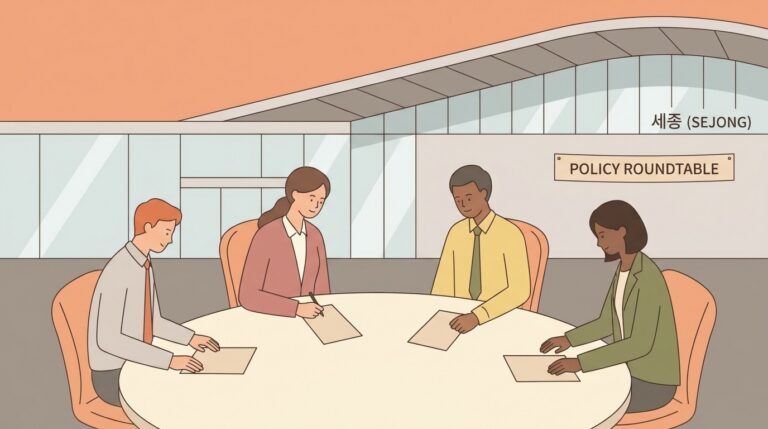
Picture this: You are seated in a high-ceilinged conference room overlooking the Sejong Government Complex. Across the mahogany table sit senior fellows from a national research institute (국책연구기관) and legislative directors from the National Assembly. You’ve just reviewed an exhaustive policy white paper proposing the direct adoption of a cutting-edge European regulatory framework into the Korean commercial code. The room nods in polite agreement with the buzzwords—until you speak up.
Instead of offering generic praise, you want to respectfully argue that simply transplanting foreign statutes without considering Korea’s unique regulatory legacy will trigger administrative gridlock. You want to say: “I noted where transplanting foreign laws could clash with Korea’s institutional path dependency.” But how do you voice such a sophisticated critique without sounding confrontational or linguistically awkward? In high-stakes Korean policy circles, expressing institutional friction demands a careful balance of academic gravitas, deference, and strategic rhetoric.
Many C1 learners stumble here, relying on literal translations like “외국 법을 그냥 복사하면 문제가 생겨요” which sounds jarringly unsophisticated in a parliamentary committee room. This guide draws directly on real debriefs with foreign legal consultants and policy analysts in Seoul, offering you the precise lexical tools and cultural instincts needed to challenge orthodoxies and command respect at the highest levels of governance.
Phase 2: Top 3 Core Expressions in Depth
1. 제도적 경로의존성 (Jedojeok gyeongro-uijonseong)
- Pronunciation: [Jedojeok gyeong-no-ui-jon-seong] (Think: “Je-doh-jeok gyeong-no-we-jon-seong”—remember the nasal assimilation where ‘ng’ + ‘r’ shifts to ‘ng-n’)
- Meaning: Institutional path dependency (Lit. Institutional path-reliance)
- K-Culture Moment: In the political thriller drama The Whirlwind (돌풍) or Stranger (비밀의 숲), reformist characters often sigh over systemic corruption or bureaucratic inertia, citing historical precedent that blocks legislative innovation.
- Editor’s Insight: This is premier academic and policy vocabulary. “경로의존성” indicates that decisions made in the past limit choices in the present. Pairing it with “제도적” (institutional) signals that you understand Korea’s economic development models (like chaebol governance or civil law administrative traditions) cannot be overhauled overnight.
- Situation Spectrum: Casual 🚫 | Semi-formal ⚠️ | Formal ✅
- 🤔 Think About It: Does your native legal culture view legislation as a clean slate, or does it also wrestle with the ghost of historical institutional choices?
2. 단순 이식에 따른 부작용 (Dansun isik-e ttareun bujagyong)
- Pronunciation: [Dan-sun i-sig-e tta-reun bu-ja-gyong] (Sounds like “Dahn-soon ee-sheek-eh ttah-reun boo-jah-gyong”)
- Meaning: Unintended consequences / side effects stemming from uncritical or direct transplantation.
- K-Culture Moment: In political commentary shows like Ssulzun (썰전), panelists use this phrase when debating why Western welfare or labor policies produce drastically different results when applied to Korea’s hyper-dense, fast-paced society.
- Editor’s Insight: While “이식” literally means surgical organ transplantation or plant grafting, in legal and administrative Korean, it refers to borrowing overseas statutory mechanisms. The modifier “단순” (simple/mere) implies a lack of localization and critical evaluation.
- Situation Spectrum: Casual 🚫 | Semi-formal ⚠️ | Formal ✅
- 🤔 Think About It: Why does Korean use biological metaphors like “transplantation” (이식) for legal systems rather than mechanical metaphors like “importing” or “installing”?
3. 충돌 지점을 짚다 (Chungdol jijeom-eul jipda)
- Pronunciation: [Chung-dol ji-jeom-eul jip-dda] (Sounds like “Choong-dohl jee-jeom-eul jeep-tah”)
- Meaning: To pinpoint the points of friction / To identify areas of conflict.
- K-Culture Moment: A senior investigative advisor in a legal drama pointing a fountain pen at a whiteboard diagram to reveal where two competing jurisdictions collide.
- Editor’s Insight: “짚다” (jipda) literally means to touch with a finger or lean on a cane, but idiomatically it means to accurately diagnose, pinpoint, or highlight a critical vulnerability. It is far more proactive and analytical than simply “말하다” (to say) or “찾다” (to find).
- Situation Spectrum: Casual ⚠️ | Semi-formal ✅ | Formal ✅
- 🤔 Think About It: Compare “지점을 짚다” with the English idiom “to put one’s finger on something.” Both share a tactile metaphor for intellectual precision!
Phase 3: Textbook Korean vs. Real Korean
Situation 1: Highlighting that foreign laws will not fit the Korean situation
- 📖 교과서 한국어 (Textbook): 외국 법률을 그대로 가져오면 한국에서 문제가 많이 생깁니다.
(Oeguk beobryul-eul geudaero gajyeoomyeon hanguk-eseo munjega mani saenggimnida. / If we bring foreign laws as they are, many problems will occur in Korea.) - 🗣️ 진짜 한국어 (Real Policy Korean): 해외 선진 법제를 무비판적으로 직도입할 경우, 국내 실정과의 제도적 괴리 및 수용성 저하가 우려됩니다.
(Haeoe seonjin beopjereul mubipan-jeogeuro jikdo-iphwal gyeong-u, gungnae siljeong-gwaui jedojeok goeri mit suyongseong jeohwaga uryeodoemnida. / If we unselectively adopt advanced foreign legislation, there are concerns over an institutional disconnect with domestic realities and diminished field receptivity.) - 💡 왜 다를까? (Why the difference?): At level C1, policy discourse in Korea relies on Sino-Korean nominal compounds (수용성 저하, 제도적 괴리) and cautious epistemic modality (우려됩니다) rather than blunt declarative warnings.
Situation 2: Emphasizing that existing administrative habits cannot be changed easily
- 📖 교과서 한국어 (Textbook): 한국 공무원들과 법은 옛날 방식에 익숙해서 바꾸기 어렵습니다.
(Hanguk gongmuwondeulgwa beobeun yennal bangsik-e iksukhaeseo bakkugi eoryeopseumnida. / Korean civil servants and laws are used to old ways, so they are hard to change.) - 🗣️ 진짜 한국어 (Real Policy Korean): 기존 행정 관행의 경로의존성이 워낙 견고하여, 입법 취지가 현장에서 형해화될 위험이 큽니다.
(Gijon haengjeong gwanhaeng-ui gyeongro-uijonseong-i wonak gyeon-gohayeo, ipbeop chwijiga hyeonjang-eseo hyeong-haehwadoel wiheom-i keumnida. / Because the path dependency of existing administrative practices is so deeply entrenched, there is a high risk that the legislative intent could become a hollow formality in practice.) - 💡 왜 다를까? (Why the difference?): High-level policy professionals avoid blaming people directly (“공무원들”). Instead, they attribute inertia to systemic constructs like “행정 관행” (administrative custom) and use legal terms like “형해화” (becoming an empty shell).
Phase 4: K-Culture Deep Dive & Non-Verbal Manners
4-1. Nunchi & Physical Posture in Policy Consultations
When delivering critical feedback on a white paper produced by a prestigious institute like KDI (Korea Development Institute) or the National Assembly Research Service (NARS), critique is an art form:
* The Fountain Pen Tap (펜 끝 신호): Avoid pointing your finger at the document or speaker. Instead, hold your pen with both hands or lightly touch the specific clause in the white paper with the cap of your pen while slightly leaning forward.
* The Honorific Cushioning: Never open a critique with “하지만” (But) or “틀렸습니다” (That is wrong). Begin with deference: “보고서의 입법 취지에는 전적으로 공감합니다만…” (While I fully concur with the legislative intent of the report…).
* Eye Contact Regulation: Maintain soft eye contact when acknowledging the chair’s remarks, but lower your gaze thoughtfully to the text when delivering the substantive counterpoint. This projects deep reflection rather than adversarial challenge.
4-2. The Cultural Backdrop of Policy Transplants
Korea experienced compressed modernization (압축성장), jumping from agrarian poverty to an industrial and technological titan in mere decades. To accomplish this, early Korean legislators frequently “transplanted” legal structures from Germany, Japan, and the United States. Today, however, Korea has matured into a standard-setter. When foreign advisors merely cite “global standards” without respecting established local jurisprudence, it can trigger national defense mechanisms. Demonstrating that you understand Korea’s institutional path dependency shows you recognize Korea as a nuanced sovereign system, not an empty vessel awaiting Western templates.
Phase 5: Real-World Roleplay Scenario
Setting: A policy advisory conference room at the National Assembly Members’ Office Building (국회의원회관) in Yeouido.
Characters:
* You (Foreign Legislative Advisor): Specialist in comparative digital regulations.
* Dr. Park (박 수석연구원): Senior Fellow at a government policy think tank, who drafted the legislative white paper on adopting strict EU-style AI regulations.
Dr. Park: 이번 정책 백서에서는 EU의 인공지능 법안을 벤치마킹하여 선제적 규제 프레임워크를 마련하는 방안을 제안했습니다.
(Ibeon jeongchaek baekseo-eseoneun EU-ui in-gong-jineung beobaneul benchimaking-hayeo seonjejeok gyuje peureim-wokeureul maryeonhaneun bang-aneul jean-haess-eumnida.)
“In this policy white paper, we have proposed establishing a preemptive regulatory framework by benchmarking the EU AI Act.”
🎭 [Hands over the bound white paper with both hands and tilts his head respectfully.]
You: 네, 유럽의 최신 입법 동향을 면밀히 분석해 주셔서 입법자들에게 매우 유의미한 기초 자료가 될 것 같습니다.
(Ne, yureop-ui choesin ipbeop donghyang-eul myeonmilhi bunseokhae jusyeoseo ipbeobjadeul-ege maeu yu-uimihan gicho jaryoga doel geot gatseumnida.)
“Yes, you have thoroughly analyzed the latest European legislative trends, which will serve as very meaningful foundational material for lawmakers.”
🎭 [Receives the document with both hands, turning directly to Chapter 4.]
Dr. Park: 감사합니다. 특히 고위험 AI에 대한 사전 인증 제도는 국내 입법에도 즉각 반영할 수 있을 것으로 보입니다.
(Gamsahamnida. Teukhi gowiheom AI-e daehan sajeon injeung jedoneun gungnae ipbeobedo jeukgak banyeonghal su isseul geoseuro boimnida.)
“Thank you. In particular, it appears that the prior certification system for high-risk AI can be immediately reflected in domestic legislation.”
🎭 [Nods confidently while adjusting his glasses.]
You: 다만, 해외 선진 입법 사례를 단순 이식할 때 발생할 수 있는 국내 고유의 제도적 경로의존성과의 충돌 지점을 몇 군데 짚어보았습니다.
(Daman, haeoe seonjin ipbeop saryereul dansun isik-hal ttae balsaenghal su inneun gungnae goyu-ui jedojeok gyeongro-uijonseonggwaui chungdol jijeom-eul myeot gunde jipeoboasseumnida.)
“However, I noted a few points of conflict where transplanting foreign advanced legislative models could clash with Korea’s institutional path dependency.”
🎭 [Uses the cap of a fountain pen to gently indicate Section 4.2.]
Dr. Park: 아, 경로의존성이라 하시면… 구체적으로 어떤 규제 집행 관행과의 충돌을 의미하십니까?
(A, gyeongro-uijonseong-ira hasimyeon… Guchejeogeuro eotteon gyuje jiphaeng gwanhaenggwaui chungdoreul uimihasimnikka?)
“Ah, when you say path dependency… specifically which regulatory enforcement practices do you see it clashing with?”
🎭 [Leans in with genuine curiosity, his tone turning serious.]
You: 한국의 경우 포괄적 네거티브 규제보다는 포지티브 방식의 행정 지도가 오랫동안 고착화되어 온 경로의존성이 있습니다.
(Hanguk-ui gyeong-u pogwaljeok negeotibeu gyujebodaneun pojitibeu bangsik-ui haengjeong jidoga oraedong-an gochakhwadoeeo on gyeongro-uijonseong-i isseumnida.)
“In Korea’s case, there is a path dependency where positive administrative guidance has long been entrenched rather than comprehensive negative regulation.”
🎭 [Speaks in a measured, calm tone with an open-palm gesture.]
Dr. Park: 일리가 있는 지적이십니다. 자칫 현장에서는 실효성 없는 옥상옥 규제가 될 우려가 있겠군요.
(Illiga inneun jijeog-isimnida. Jachit hyeonjang-eseoneun silhyoseong eomneun oksang-ok gyujega doel uryeoga itgetgunyo.)
“That is a valid point. There is indeed a concern that it might become redundant ‘roof-upon-roof’ regulation lacking practical efficacy in the field.”
🎭 [Jots down notes on his legal pad.]
You: 맞습니다. 따라서 해외 법제를 무조건 수용하기보다는, 기존 특별법 체계와의 정합성을 고려한 단계적 제도 설계가 필요하다고 봅니다.
(Masseumnida. Ttaraseo haeoe beopjereul mujogeon suyonghagibodaneun, gijon teukbyeolbeop chegyewaui jeonghabseong-eul goryeohan dangyejeok jedo seolgyega piryohadago bomnida.)
“Precisely. Therefore, rather than unconditional adoption of foreign laws, I believe we need a phased institutional design that ensures coherence with the existing special act framework.”
🎭 [Concludes with a decisive, polite bow of the head.]
🔀 Interactive Decision Point
How would you formulate your concluding recommendation to Dr. Park?
- Option A: “유럽 법은 우리 현실에 전혀 안 맞으니까 백서를 처음부터 전면 재검토해야 합니다.”
(Feedback: Bad. Confrontational and dismissive. Suggesting a complete rewrite of a state-funded white paper directly insults the research committee.) - Option B: “단순 이식보다는 국내 산업계의 수용성과 현행 규제 거버넌스를 연계한 절충적 모델을 제언하는 것이 바람직합니다.”
(Feedback: Best! Highly professional, employs balanced rhetoric, and offers constructive synthesis using high-level legal terminology.) - Option C: “그냥 법안 발의를 미루고 나중에 국회 분위기를 보시죠.”
(Feedback: Risk. Sounds cynical and politically opportunistic, which is inappropriate for an expert policy advisory position.)
Phase 6: 10-Second Emotional Shadowing Drill
Practice these lines focusing on natural cadence, appropriate pauses (/), and strategic emotional delivery.
[🧐 진중하고 학구적으로 - Solemn and Scholarly]
해외 선진 법제를 / 단순 이식할 경우, / 국내 고유의 제도적 경로의존성과 / 심각하게 충돌할 수 있습니다.
(Haeoe seonjin beopjereul / dansun isik-hal gyeong-u, / gungnae goyu-ui jedojeok gyeongro-uijonseonggwa / simgakhage chungdolhal su isseumnida.)-
[💡 단호하면서도 예의 바르게 - Firm yet Courteous]
입법 취지에는 공감하지만, / 현행 법체계와의 정합성을 위해 / 규제 샌드박스 등을 활용한 / 단계적 실증이 선행되어야 합니다.
(Ipbeop chwijieneun gonggamhajiman, / hyeonhaeng beopchegyewaui jeonghabseong-eul wihae / gyuje saendeubeokseu deung-eul hwalyonghan / dangyejeok siljeung-i seonhaengdoeeoya hamnida.) -
[🤝 경청을 유도하며 차분하게 - Persuasive and Calm]
기존 관행을 간과한 법률 도입은 / 현장 수용성을 떨어뜨려 / 법안의 형해화를 초래할 위험이 큽니다.
(Gijon gwanhaeng-eul gangwahan beobryul do-ibeun / hyeonjang suyongseong-eul tteoreotteuryeo / beoban-ui hyeong-haehwareul chorahwal wiheom-i keumnida.)
Phase 7: K-Culture Mini Dictionary
-
경로의존성 (Gyeongro-uijonseong)
- Translation: Path Dependency.
- Usage: Widely used in policy white papers, academic papers, and macroeconomic briefings to describe structural inertia where traditional administrative mechanisms resist sudden legislative overhaul.
- 형해화 (Hyeong-haehwa)
- Translation: Becoming an empty shell / De-actualization.
- Usage: A classical legal and administrative term indicating that while a statute remains on the books, its actual enforcement has vanished or lost its substance due to non-compliance.
- 옥상옥 (Oksang-ok)
- Translation: A roof upon a roof (Redundancy / Superfluous bureaucracy).
- Usage: Idiomatic phrase used frequently in the National Assembly to criticize policies that add unnecessary regulatory oversight on top of already existing supervisory agencies.
- 정합성 (Jeonghabseong)
- Translation: Coherence / Compatibility / Consistency.
- Usage: Essential in statutory design. Refers to how smoothly a newly introduced law integrates with the overarching constitutional and legal codes without creating contradictory stipulations.
Phase 8: Expat Policy Professional Survival Kit
Top 3 Formal Expressions for Committee Meetings:
- “입법 취지는 십분 이해합니다만…” (Ipbeop chwijineun sipbun ihaehamnidaman…)
- Pro Tip: “십분” (sipbun) here means “fully/ten-tenths,” not 10 minutes! It softens your upcoming critique magnificently.
- “현장 수용성을 제고할 보완책이 요구됩니다.” (Hyeonjang suyongseong-eul jegohal bowanchaek-i yogudoemnida.)
- Pro Tip: Use this to suggest amendments without declaring the draft a failure.
- “사후 입법 영향 평가를 반드시 병행해야 합니다.” (Sahu ipbeop yeonghyang pyeong-gareul bandeusi byeonghaenghaeya hamnida.)
- Pro Tip: Calls for mandatory post-legislative impact assessments, demonstrating foresight.
Editor’s Field Note: Navigating Legislative Research
- When preparing briefings in Seoul, rely on institutional archives: install the 국가법령정보센터 앱 (National Law Information Center App) for immediate comparisons of parent laws and subordinate decrees.
- To travel to government hearings in Sejong, book the KTX to Osong Station via the 코레일톡 앱 (KorailTalk App), followed by the B0 or B2 BRT bus which takes you straight to the Government Complex Sejong in 15 minutes.
Phase 9: “One Step Deeper” (Critical Thinking)
In Korean public administration, the struggle between importing global regulatory standards and preserving domestic institutional heritage is profound. Because of the rapid post-war reconstruction under state-directed capitalism, Korea’s administrative agencies developed an intimate, guidance-heavy relationship with private industries. Western statutory models assume an adversarial, litigious relationship governed by strict, self-executing rules. Transplanting these statutes without remodeling Korea’s administrative enforcement culture creates institutional rejection symptoms. When you speak of “경로의존성” (path dependency), you are acknowledging decades of collective administrative effort while encouraging modern statutory evolution.
💬 Your Turn: Has your home country ever attempted to adopt an overseas legal or policy framework that clashed with entrenched local customs? Share your comparative perspective in the comments below!
Phase 10: FAQ & Common Mistakes
Q: Can I use “카피하다” (to copy) instead of “이식하다” (to transplant) in a policy meeting?
A: Absolutely avoid “카피하다” in formal meetings. It sounds colloquial and accusatory. Always use “이식하다” (to transplant), “직도입하다” (to directly adopt), or “단순 차용하다” (to borrow simplistically).
Q: What is the exact difference between “충돌 지점” and “문제점”?
A: “문제점” (problem/defect) implies that one side is defective or wrong. “충돌 지점” (point of collision/friction) is neutral and academic—it frames the issue as an objective friction between two systems, which protects the face of the policymakers.
Q: How do I address a Senior Research Fellow during a formal policy review?
A: Always append their institutional title: “박 수석연구원님” (Senior Fellow Park) or “위원장님” (Committee Chair). Avoid addressing them simply by name or as “선생님” in parliamentary settings.
🚨 Common Mistakes Warning Board
- Mistake: Saying “그 법은 현실성이 없어요” (That law is unrealistic).
- Correct Action: Say “현장 적용 시 규제 순응도가 떨어질 우려가 있습니다” (There is concern that regulatory compliance in the field may drop upon implementation).
- Mistake: Overusing Western acronyms without Korean statutory naming.
- Correct Action: When discussing GDPR or the AI Act, introduce the accepted Korean legislative translation first: “EU 인공지능법안(AI Act)의 사례처럼…”
- Mistake: Confusing “의존성” (dependency) with “중독” (addiction).
- Correct Action: Keep “경로의존성” as a fixed sociological term; never substitute it with casual terms like “습관” (habit) or “매달림” (clinging).
Phase 11: Action Missions & Cultural Immersion
- 🥉 Bronze Mission (Solo Practice): Read the Phase 6 Shadowing Drill aloud 5 times until you can articulate “제도적 경로의존성” smoothly in under 3 seconds.
- 🥈 Silver Mission (Social Application): Draft a 2-sentence policy critique in Korean on LinkedIn or your study blog discussing a regulatory shift in your country using the phrase “단순 이식에 따른 부작용”.
- 🥇 Gold Mission (Real-World Execution): Attend a public policy webinar (hosted by institutions like KDI, Asan Institute, or Korea Legislation Research Institute) and formulate a question in the Q&A box employing the term “정합성” or “충돌 지점”.
- 🎮 K-Culture Mission: Watch Episode 3 of the political drama Chief of Staff (보좌관) and note down how legislative aides negotiate revisions during National Assembly sub-committee markups.
Phase 12: Interactive Quiz Challenge
1. Contextual Judgment
You want to advise a government director that blindly copying a foreign sandbox regime will fail due to existing civil law liability practices. Which sentence is the most professional?
* (A) 외국 샌드박스를 복사하면 공무원들이 싫어할 거예요.
* (B) 해외 선진 제도의 단순 이식은 국내 배상 책임 체계의 경로의존성과 충돌할 가능성이 높습니다.
* (C) 다른 나라 법은 우리나라와 안 맞으니 절대 도입하면 안 됩니다.
🔍 Click to view Answer & Explanation
Correct Answer: (B)
Explanation: Option (B) employs elevated administrative vocabulary (“단순 이식”, “배상 책임 체계”, “경로의존성”) and maintains an objective, diplomatic tone. Option (A) is too casual, and Option (C) is rigid and dogmatic.
2. Fill-in-the-Blank
기존 규제 체계 위에 새로운 규제를 계속 덧붙여 행정적 비효율을 낳는 현상을 사자성어에 빗대어 ‘_______ 규제’라고 비판합니다.
(Hint: A roof upon a roof)
🔍 Click to view Answer & Explanation
Correct Answer: 옥상옥 (Oksang-ok)
Explanation: “옥상옥” literally means building a roof upon an already completed roof, symbolizing redundant bureaucracy.
3. True / False Cultural Check
True or False: In a Korean legislative hearing, pointing out “경로의존성” implies that the policymakers did their research poorly.
🔍 Click to view Answer & Explanation
Correct Answer: False
Explanation: Citing “경로의존성” is recognized as a sophisticated institutional critique. It frames friction not as an individual failure of the researcher, but as an inherent systemic challenge between historical structures and incoming policy innovations.







