

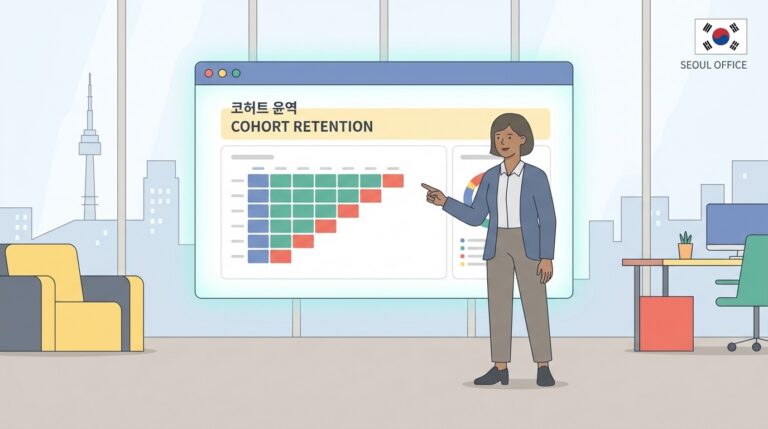
Phase 1: Empathy (스토리 몰입형 오프닝)
안녕하세요! 매일한글 에디터입니다. (Annyeonghaseyo! It’s your Daily Hangul editor here!)
Picture this: You are sitting in a sleek, glass-walled conference room in Pangyo (판교), the Silicon Valley of South Korea. Your team lead—iced Americano in hand, blue-light glasses perched on his nose—pulls up your SQL dashboard on the giant monitor. The graphs are glowing with steep peaks followed by sudden drops. Everyone turns to you, waiting for the verdict on the Q4 marketing campaign. You know what happened in your head: the users who signed up during the 50% off Black Friday promotion converted like crazy on day one, but churned massively by Month 3 compared to everyday users. But as you open your mouth to explain this in Korean, your mind blanks out into rigid textbook grammar. How do you say “cohort retention” without sounding like an automated translation bot?
Navigating data-driven meetings in a Korean tech office isn’t just about vocabulary; it’s about framing critical insights without sounding overly blunt or defensive. Today, based on real feedback from international data analysts working at top Korean startups, we’ll master how to break down metrics, interpret cohorts, and sound like a seasoned Pangyo insider!
Phase 2: 핵심 표현 3선 심층 분석
1. 초기 결제율은 높았지만 (Chogi gyeoljeyureun nop-atjiman)
- Pronunciation: [Cho-gi gyeol-je-yoo-reun no-pat-ji-man] (Sounds like “choke-key” + “gal-je-yule” with a quick rising tone on ‘nop’ and a reflective linger on ‘man’)
- Meaning: Literal: “Although the initial payment rate was high” | Real Nuance: “While first-time conversion looked promising on paper… (here comes the catch)”
- K-Culture Moment: Seen in startup K-Dramas like Start-Up when tech founders pitch their MVP numbers to skeptical venture capitalists before revealing their post-launch challenges.
- Editor’s Insight: The particle -은/는 (-eun/neun) attached to 결제율 (payment/conversion rate) creates a sharp contrast. It sets an expectation in your listener’s mind that what follows will contrast with the initial success.
- Situation Spectrum: Casual: ⚠️ | Semi-formal: ✅ | Formal: ✅
- 🤔 Think About It: In Korean business communication, starting with the positive aspect before introducing the drop softens the blow. How does your language set up contrasting business realities?
2. 3개월 뒤 잔존율은 평달 가입자보다 낮았어요 (Samgaewol dwi janjonyureun pyeongdal gaiptaboda najasseoyo)
- Pronunciation: [Sam-gae-wol dwi jan-jon-yoo-reun pyeong-dal ga-ip-ja-bo-da na-jas-seo-yo] (Think: “Sam-gay-wall” followed by “jan-zone-yule” and a smooth slide into “pyeong-dahl”)
- Meaning: Literal: “The retention rate after 3 months was lower than regular month sign-ups.” | Real Nuance: “Our 3-month cohort retention clearly underperformed compared to baseline organic users.”
- K-Culture Moment: Typical data review meeting at an e-commerce giant like Coupang or Kurly after a massive seasonal sale.
- Editor’s Insight: The word 평달 (pyeongdal) is an invaluable business insider term! Rather than saying ‘보통 달’ (normal month), native professionals use 평달 to describe regular, off-peak months without heavy promotions.
- Situation Spectrum: Casual: 🚫 | Semi-formal: ✅ | Formal: ✅
- 🤔 Think About It: Why do you think Korean business vocabulary has specific compound nouns like 평달 (pyeongdal) for comparison baseline metrics?
3. 코호트별로 뜯어보면 (Kohoteubyeollo tteudeobomyeon)
- Pronunciation: [Ko-ho-teu-byeol-lo tteu-deo-bo-myeon] (The double ‘tt’ in ‘tteudeo’ has a crisp, pop sound like tapping a pencil on a desk)
- Meaning: Literal: “If we tear it apart by cohort” | Real Nuance: “When we segment the data cohort by cohort / When we drill down into the cohort view…”
- K-Culture Moment: When a product manager leans in toward the monitor with a stylus to dissect weekly retention curves.
- Editor’s Insight: The verb 뜯어보다 (tteudeoboda) literally means ‘to tear apart and examine’. In tech culture, it implies an analytical deep dive rather than just skimming surface-level numbers.
- Situation Spectrum: Casual: ✅ | Semi-formal: ✅ | Formal: ⚠️
- 🤔 Think About It: Contrast “분석하면” (if we analyze) with “뜯어보면” (if we dissect). Which one conveys more hands-on curiosity?
Phase 3: 교과서 한국어 vs 진짜 한국어
Situation 1: Highlighting an unexpected drop in dashboard metrics
- 📖 교과서 한국어 (Textbook):
11월 가입자의 유지율 지표가 감소했습니다. (11-wol gaiptaui yujiyul jipyoga gamsohaessseumnida.)
“The maintenance rate indicator of November subscribers decreased.” - 🗣️ 진짜 한국어 (Real-World Tech Korean):
11월 유입 유저들은 잔존율이 확 빠졌어요. (11-wol yuip yujeodeureun janjonyuri hwak ppajyeosseoyo.)
“November cohort retention dropped off a cliff.” - 💡 왜 다를까? (Why the difference?): Textbook Korean uses passive, formal Sino-Korean nouns like ‘유지율’ and ‘감소’. Real tech teams in Korea borrow terms like ‘유입’ (inflow), ‘잔존율’ (retention), and the sensory adverb ‘확 빠지다’ to capture steep graphical declines vividly.
Situation 2: Proposing a segment comparison
- 📖 교과서 한국어 (Textbook):
두 집단을 서로 비교하여 검토합시다. (Du jipdaneul seoro bigyohayeo geomtohapsida.)
“Let us compare and examine the two groups mutually.” - 🗣️ 진짜 한국어 (Real-World Tech Korean):
프로모션 유저랑 오가닉 유저를 발라내서 보시죠. (Peuromosyeon yujeorang oganik yujeoreul ballanaeseo bosijyo.)
“Let’s isolate promotional users from organic users and look at them separately.” - 💡 왜 다를까? (Why the difference?): Korean startup culture loves active culinary-adjacent metaphors! ‘발라내다’ (to debone a fish / scrape off meat) is slang for cleanly separating a target segment from noisy aggregate data.
Phase 4: K-Culture 딥다이브 & 비언어적 매너
4-1. 눈치 (Nunchi) & Non-Verbal Manners: Presenting Bleak Retention Metrics
When your SQL query reveals that a heavily funded campaign brought in users with terrible retention, your delivery requires 눈치 (Nunchi – social situational awareness):
1. The Posture: Do not aggressively point at the dip on the screen with a sharp index finger. Instead, use an open palm facing slightly upward to guide the team lead’s eyes toward the cohort matrix.
2. The Voice Modulation: Keep your pitch steady. Deliver the drop as an intriguing finding rather than a personal or team failure: “지표를 뜯어보니 흥미로운 차이가 발견됐는데요…” (Looking closely at the metrics, an interesting variance emerged…).
3. The Eye-Contact Check: Glance briefly at the marketing manager (the person who ran the Black Friday sale) before stating the retention drop. Giving them a respectful nod signals that you are evaluating data trends, not attacking their effort.
4-2. Cultural Code: The ‘Cherry Picker’ (체리피커) Phenomenon in Korean E-Commerce
In South Korea’s hyper-convenient digital landscape, consumers are known for their meticulous bargain hunting—often dubbed 체리피커 (Cherry Pickers). During massive flash sales like ‘블랙프라이데이’ (Black Friday) or ‘빅스마일데이’ (Big Smile Day), hundreds of thousands sign up solely to grab half-price electronics or meal kits using initial coupon bundles. Korean product teams are acutely aware of this “hit-and-run” behavior. When explaining lower cohort retention, acknowledging this cultural habit validates the data: “할인 혜택만 노린 체리피커 유입이 많았던 것으로 보입니다.” (It appears we had a heavy influx of cherry-pickers looking exclusively for discount benefits).
Phase 5: 실전 롤플레이 시나리오
Setting: A 4:00 PM sprint review at a tech venture hub in Seongsu-dong. Team Lead Min-woo (민우 팀장님), a sharp data PM with rolled-up sleeves, is reviewing the Q4 dashboard.
- Turn 1 (Min-woo):
지민 씨, 대시보드 보니까 11월 유저 획득 단가(CAC)는 엄청 낮아졌던데요? 대성공 아닌가요?
(Jimin ssi, daeshibodeu bonikka 11-wol yujeo hoekdeuk danga(CAC)neun eomcheong najajyeotdeondeyo? Daeseong-gong anin-gayo?)
🎭 Leans back with his pen, eyebrow raised with cautious optimism.
(Jimin, looking at the dashboard, our November CAC dropped drastically. Isn’t this a massive success?) -
Turn 2 (You):
겉으로 보이는 수치는 좋은데요, 코호트별로 뜯어보면 다른 그림이 나와요.
(Geoteuro boineun suchineun joeundeyo, kohoteubyeollo tteudeobomyeon dareun geurimi nawayo.)
🎭 Bringing up the retention heatmap tab on the presentation screen.
(The surface numbers look great, but if we break it down by cohort, a different picture emerges.) -
Turn 3 (Min-woo):
그래요? 리텐션 그래프에 무슨 문제라도 있나요?
(Geuraeyo? Ritensyeon geuraepeue museun munjerado innayo?)
🎭 Leaning forward, adjusting his spectacles to focus on the heatmap.
(Really? Is there an issue with the retention curve?) -
Turn 4 (You):
예를 들어 블랙프라이데이 반값 할인 기간에 가입한 11월 코호트 유저들은 초기 결제율은 높았지만 3개월 뒤 잔존율은 평달 가입자보다 낮았어요.
(Yeoreul deureo beullaekpeuraidei ban-gap halin gigane gaiphan 11-wol kohoteu yujeodeureun chogi gyeoljeyureun nop-atjiman samgaewol dwi janjonyureun pyeongdal gaiptaboda najasseoyo.)
🎭 Using an open hand to outline the steep downward diagonal trend on the matrix.
(For example, the November Black Friday cohort showed high initial purchases, but their 3-month retention was lower than regular monthly signups.) -
Turn 5 (Min-woo):
아… 반값 쿠폰 소진되고 다 이탈했다는 뜻이군요. 평달 대비 얼마나 빠졌어요?
(A… Ban-gap kupon sojindoego da italhaetdaneun tteus-igunyo. Pyeongdal daebi eolmana ppajyeosseoyo?)
🎭 Sighing lightly while jotting down a note in Notion.
(Ah… So they all churned once the 50% discount coupon was exhausted. How much lower compared to regular months?) -
Turn 6 (You):
평달 가입자의 M3 잔존율은 평균 28% 선인데, 11월 코호트는 12%에 그쳤습니다.
(Pyeongdal gaiptaui M3 janjonyureun pyeong-gyun 28% seon-inde, 11-wol kohoteuneun 12%e geucheossseumnida.)
🎭 Speaking calmly, highlighting the cell with clear contrast metrics.
(Organic M3 retention averages around 28%, but the November cohort stopped at just 12%.) -
Turn 7 (Min-woo):
확실히 체리피커 유입이 많았네요. 다음 프로모션 땐 락인(Lock-in) 장치를 먼저 짜야겠어요.
(Hwaksilhi cheri-pikeo yuibi mananneeyo. Daeum peuromosyeon ttaen rak-in jangchireul meonje jjayagesseoyo.)
🎭 Nodding appreciatively at the clarity of your analysis.
(Indeed, we had a lot of cherry-pickers. Next campaign, we must structure lock-in mechanisms first.) -
Turn 8 (You):
네, 맞아요. 다음 스프린트 때 리텐션 개선 액션 아이템 같이 공유드릴게요.
(Ne, majayo. Daeum seupeurinteu ttae ritensyeon gae-seon aeksyeon aitem gachi gong-yudeurilgeyo.)
🎭 Wrapping up with a confident, supportive smile.
(Exactly. I’ll share action items to improve retention during our next sprint.)
🔀 인터랙티브 분기점 (Interactive Branching Point)
Imagine Min-woo asks: “이 코호트 유저들을 다시 살려낼 방법이 있을까요?” (Is there a way to revive this cohort of churned users?)
- Option A: “이미 다 떠났는데 굳이 돈 들여서 다시 부를 필요 없을 것 같습니다.” (They’re already gone; no point spending money to call them back.)
- Feedback: ❌ Bad. Too dismissive. In a Korean collaborative environment, this sounds like you are shutting down strategic ideation without alternatives.
- Option B: “푸시 알림이나 추가 재구매 쿠폰을 대량 발송해서 반응률을 테스트해보면 어떨까요?” (How about mass-sending push notifications or repeat purchase coupons to test response rates?)
- Feedback: ⚠️ Risk. While proactive, proposing more discounts to coupon-sensitive churned users may burn marketing budget on repeat cherry-pickers.
- Option C: “이탈 유저 중에서도 LTV 잠재력이 있는 특정 세그먼트만 추려서 리인게이지먼트 CRM을 태워보는 걸 추천합니다.” (I recommend isolating only segments with LTV potential among the churned users and routing them through re-engagement CRM.)
- Feedback: 🌟 Best! Demonstrates sophisticated analytical insight, strategic caution, and uses natural business Korean jargon (세그먼트, CRM 태우다).
Phase 6: 10초 감정 섀도잉 드릴
Practice these 3 data delivery beats. Follow the emotion markers and breathing slashes (/).
- [📊 차분하고 객관적으로 / Calm & Fact-Driven]
초기 결제율은 / 눈에 띄게 높았지만, / 3개월 뒤 잔존율은 / 평달 가입자보다 / 낮게 나타났습니다.
(Chogi gyeoljeyureun / nune ttwige nop-atjiman, / samgaewol dwi janjonyureun / pyeongdal gaiptaboda / nakke natanasseumnida.) -
[💡 인사이트를 강조하며 / Highlighting the Critical Insight]
단순히 가입자 수만 볼 게 아니라, / 코호트별 잔존율을 / 뜯어봐야 / 진짜 유저가 보입니다.
(Dansunhi gaiptasuman bol ge anira, / kohoteubyeol janjonyureul / tteudeobwaya / jinjja yujeoga boimnida.) -
[🤝 해결책을 모색하며 건설적으로 / Constructive & Solutions-Oriented]
단기 프로모션보다는 / 평달 수준의 리텐션을 유지할 수 있는 / 락인 장치가 / 필요해 보입니다.
(Dangi peuromosyeonbodaneun / pyeongdal sujuni ritensyeoneul yujihal su inneun / rak-in jangchiga / piryohae boimnida.)
Phase 7: K-Culture 미니 사전 (Core Vocabulary)
-
평달 (Pyeong-dal) | Regular/Off-Peak Month
- Definition: Standard trading or operating months without major seasonal promotions, holidays, or anomalous marketing events.
- Usage: “이번 달 MAU는 이벤트 효과를 걷어내고 평달 기준으로 비교해야 맞아요.” (We should compare this month’s MAU against regular month baselines, stripping away event effects.)
- 체리피커 (Cheri-pikeo) | Cherry Picker / Discount Chaser
- Definition: Consumers who extract maximum promotional benefits (coupons, free trials, cashback) and leave immediately before generating revenue.
- Usage: “할인율이 너무 높으면 진성 유저보다 체리피커 비중이 커집니다.” (If the discount is too steep, cherry-pickers will outnumber genuine core users.)
- 잔존율 (Janjon-yul) | Retention Rate
- Definition: The percentage of users who continue using or subscribing to an app/service over a given window (Day 1, Day 7, M3).
- Usage: “D+30 잔존율 그래프가 완만해지는 구간을 찾아야 해요.” (We need to identify the plateau where our D+30 retention curve stabilizes.)
- 락인 효과 (Rak-in Hyo-gwa) | Lock-In Effect
- Definition: Strategic product features (points, ecosystem benefits, personalized feeds) preventing users from switching to competitors.
- Usage: “네이버페이 포인트 적립이 대표적인 락인 장치죠.” (Naver Pay points accumulation is a textbook lock-in mechanism.)
Phase 8: 여행자를 위한 생존 키트 (Working & Thriving in Tech Korea)
Survival Expressions for Business Meetings
- 지표 공유드릴게요. (Jipyo gong-yudeurilgeyo.)
- Meaning: “I will share the metrics / screens.”
- Pro Tip: Use this when sharing your screen on Google Meet or Zoom before opening redash or Tableau.
- 세그먼트를 나눠서 보시죠. (Segeumeonteureul nanwoseo bosijyo.)
- Meaning: “Let’s look at this by dividing into segments.”
- Pro Tip: Instantly positions you as an analytical thinker rather than a passive observer.
- 이상치(Outlier)가 감지되었습니다. (Isangchiga gamjidoeeosseumnida.)
- Meaning: “An anomaly/outlier has been detected.”
- Pro Tip: Great phrase when sudden traffic spikes distort your cohort averages.
Editor’s Travel & Remote Work Note
If you are working remotely or visiting Korea on a digital nomad visa, you will spend substantial time in tech corridors like Gangnam (테헤란로) or Seongsu (성수 밸리).
* Check out shared office hubs like FastFive or Sparkplus for lightning-fast gigabit connections.
* To navigate seamlessly to tech meetup locations, download the Naver Map app on your phone instead of Google Maps, which lacks real-time walking and transit route accuracy in South Korea.
Phase 9: “한 발 더 깊이” (Cultural Nuance)
In Western tech settings, analysts often celebrate raw spikes in acquisition first: “We acquired 100k users in 48 hours!” In contrast, mature Korean tech culture places strong skepticism on vanity metrics (겉핥기 지표). Because the Korean market is compact, densely interconnected, and saturated, acquiring a low-quality user who immediately uninstalls the app hurts app store algorithms and brand equity. Consequently, Korean PMs obsess over 진성 유저 (genuine, sticky users). When you present declining cohort metrics with humility and strategic foresight, colleagues respect you not just as someone who runs SQL queries, but as someone who protects company runway.
💬 Your Turn: Have you ever seen a marketing campaign with high initial conversion but terrible long-term retention in your home country? How would you explain that dynamic to your Korean team? Leave your thoughts in the comments below!
Phase 10: FAQ & 오해 방지
Q: Is it rude to say that a marketing campaign resulted in ‘낮은 잔존율’ (low retention) to the team that ran it?
A: Not if you frame it analytically! Avoid saying “마케팅팀 때문에 망했어요” (It failed because of marketing). Instead, attribute the drop to consumer behavior dynamics: “프로모션 특성상 반값 할인 유저들의 특수성이 반영된 것 같습니다” (Due to the nature of the promotion, it seems the specific traits of discount-seeking users were reflected in the data).
Q: Can I use English words like ‘Cohort’, ‘Retention’, and ‘Dashboard’ directly in Korean meetings?
A: Absolutely! Pangyo and Teheran-ro startup hubs use Konglish loanwords constantly. However, pronounce them with Korean phonetics: 코호트 (ko-ho-teu), 리텐션 (ri-ten-syeon), 대시보드 (dae-shi-bo-deu), 오가닉 유저 (o-ga-nik yoo-jeo).
Q: What is the exact difference between ‘이탈률’ and ‘잔존율’?
A: They are opposite sides of the same coin! 잔존율 (Retention Rate) is the percentage of users who stay, whereas 이탈률 (Churn/Bounce Rate) represents those who leave. High churn means low retention.
🚨 Common Mistakes Board (흔한 실수 TOP 3)
- Mistake: Using “보통 달” when comparing monthly baselines.
- Correct Action: Use 평달 (pyeong-dal) in professional reporting.
- Mistake: Saying “그래프가 떨어졌어요” (The graph fell down) during formal presentations.
- Correct Action: Say “잔존율 지표가 하향 곡선을 그리고 있습니다” (The retention metric is tracing a downward curve) or “급격히 감소했습니다”.
- Mistake: Forgetting the contrast marker and saying “결제율이 높았고 잔존율이 낮았어요” with -고 (and).
- Correct Action: Always connect contrasting data trends with -았지만/-었지만 (high conversion, but low retention).
Phase 11: 액션 미션 & 참여 유도
- 🥉 Bronze Mission (Solo Shadowing): Read the Phase 5 dialogue out loud twice, focusing on matching the slash
/pauses in Phase 6. - 🥈 Silver Mission (Community Practice): Write a one-sentence SQL summary in the comments below using the structure:
[이벤트/기간]에 가입한 코호트는 초기 [지표]는 높았지만, [기간] 뒤 [지표]는 낮았어요. - 🥇 Gold Mission (Real-World Application): In your next standup or Korean language exchange, describe an app you stopped using after an initial discount promotion, using the term 체리피커 (cherry picker)!
- 🎮 K-Culture Mission: Watch an episode of a Korean workplace or startup drama (like Start-Up or Search: WWW). Spot how product managers use physical body language and polite honorifics when delivering tough analytical findings.
Phase 12: 인터랙티브 퀴즈 챌린지
Test your mastery of Korean cohort analysis terminology!
1. Situation Judgment (상황 판단)
During a sprint meeting, your colleague notices a huge drop in D+30 retention for holiday signups. Which phrase best analyzes the cause constructively?
* (A) “이 프로모션은 완전히 실패작이라서 다 지워야 합니다.”
* (B) “할인 혜택 중심 유입이라 평달 대비 잔존율이 낮게 나타난 것 같아요. 락인 전략을 보완하시죠.”
* (C) “개발팀 서버가 다운되어서 사용자들이 다 도망갔습니다.”
2. Fill-in-the-Blank (빈칸 채우기)
11월 블랙프라이데이 코호트 유저들은 초기 결제율은 높았______ (although), 3개월 뒤 잔존율은 평달 가입자______ (compared to) 낮았어요.
3. True / False Cultural Check
True or False: In a Korean tech company, using loanwords like ‘리텐션’ (retention) or ‘코호트’ (cohort) is considered poor Korean and should always be strictly translated to pure Korean words.
👉 Click here to reveal Answers & Explanations! (정답 및 해설)
- Answer: (B)
- Explanation: Option B professionally explains the behavioral rationale (promotional discount influx) and constructively proposes a strategic remedy (lock-in strategy) without pointing fingers.
- Answer: -지만 (또는 높았지만) / 보다 (또는 평달 가입자보다)
- Full Sentence: 초기 결제율은 높았지만, 3개월 뒤 잔존율은 평달 가입자보다 낮았어요.
- Answer: False
- Explanation: Modern Korean tech hubs (Pangyo, Gangnam, Seongsu) seamlessly combine Korean structural grammar with English tech jargon. Words like 코호트, 세그먼트, and 리텐션 are standard office vernacular!
- Explanation: Modern Korean tech hubs (Pangyo, Gangnam, Seongsu) seamlessly combine Korean structural grammar with English tech jargon. Words like 코호트, 세그먼트, and 리텐션 are standard office vernacular!







