

Phase 1: Empathy (Story-Driven Opening)
안녕하세요! 매일한글 에디터입니다. (An-nyeong-ha-se-yo! Mae-il Han-geul e-di-teo-im-ni-da. / Hello! It’s your Daily Hangul editor.)
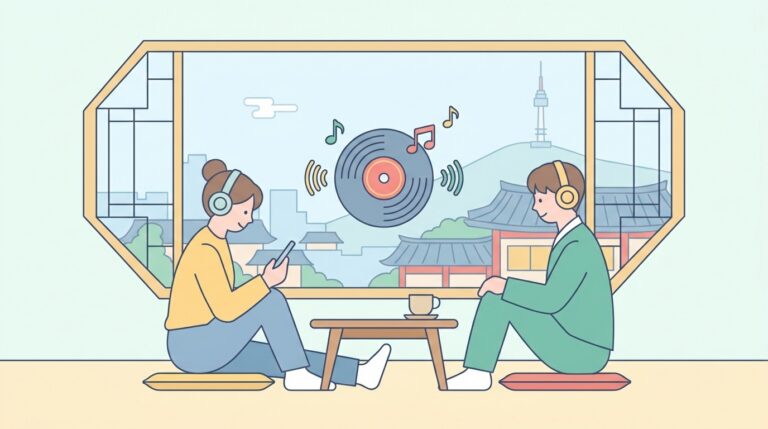
Picture this: It is 11:59 PM KST. You are sitting at your desk with your headphones on, refreshing your favorite K-POP group’s YouTube channel like your life depends on it. The clock strikes midnight, and the notification pops up: ‘[Artist Name] 5th Mini Album Highlight Medley’. Your heart races. Track 1 begins with a gritty guitar riff, Track 2 drops an infectious synth-pop groove, Track 3 introduces a haunting vocal harmony, and by the time Track 5 plays, you are clutching your desk. It’s not just the title track that sounds incredible—every single B-side sounds like an instant classic.
You immediately open Weverse or X (formerly Twitter) to join Korean fans screaming in the comments, but your fingers freeze. You want to type something epic, but all you know is textbook Korean like “이 앨범의 노래들이 매우 좋습니다” (This album’s songs are very good). It sounds like you are writing an academic report for a music board rather than freaking out with fellow fans! Based on years of feedback from international K-POP lovers in our Daily Hangul community, mastering the exact words Korean fans use to describe a “zero-skip masterpiece album” is the single biggest upgrade you can make to your fan life. Let’s learn how to express that breathtaking musical excitement like a true Seoul insider!
Phase 2: Core Expressions Deep Dive (핵심 표현 3선)
1. 명반 (Myeong-ban)
- Pronunciation: [Myeong-ban] (Think of ‘myung’ sounding like ‘young’ with an ‘m’, followed by ‘bahn’ like the German Autobahn.)
- Meaning: Literal: Renowned record / Real Nuance: A certified masterpiece album with zero skippable tracks from start to finish.
- K-Culture Moment: Seen under album review threads on Melon and community boards like Instiz whenever an idol group drops an album where the concept, storytelling, and track sequencing are flawless.
- Editor’s Insight: While ‘명곡’ (myeong-gok) refers to a single legendary song, ‘명반’ (myeong-ban) elevates the entire project. When you call an album a ‘명반’, you are acknowledging the artists and producers as visionary album artists, not just single-hit wonders.
- Situation Spectrum: Casual: ✅ | Semi-formal: ✅ | Formal: ✅
- 🤔 Think About It: In your native language, do you have a specific term that distinguishes a single great song from an entire unified masterpiece album?
2. 수록곡 맛집 (Su-rok-gok mat-jip)
- Pronunciation: [Su-rok-gok mat-jip] (Pronounce ‘su-rok-gok’ crisply, and ‘mat-jip’ sounds like ‘maht-jeep’.)
- Meaning: Literal: An included-songs delicious restaurant / Real Nuance: An album famous for having insanely high-quality B-sides.
- K-Culture Moment: Korean fans often tease, “타이틀곡 들으러 왔다가 수록곡에 치이고 갑니다” (I came for the title track, but got run over by how good the B-sides are), followed by calling the group a ‘수록곡 맛집’.
- Editor’s Insight: In modern Korean slang, ‘맛집’ (mat-jip) no longer just means a great foodie spot. You will hear phrases like ‘셀카 맛집’ (master of selfies) or ‘얼굴 맛집’ (visual powerhouse). Calling an album a ‘수록곡 맛집’ is the ultimate compliment to an idol’s musical depth.
- Situation Spectrum: Casual: ✅ | Semi-formal: ⚠️ | Formal: 🚫
- 🤔 Think About It: Why do you think Korean youth culture uses culinary metaphors (like ‘delicious restaurant’) to describe artistic and aesthetic satisfaction?
3. 전곡 다 타이틀감이에요 (Jeon-gok da ta-i-teul-gam-i-e-yo)
- Pronunciation: [Jeon-gok da ta-i-teul-gam-i-e-yo] (Roll smoothly from ‘jeon-gok’ to ‘ta-i-teul-gam’.)
- Meaning: Literal: Every song has title-track material / Real Nuance: “Every single track on this album is so good it could be promoted as the main single!”
- K-Culture Moment: You will hear this phrase shouted in album reaction videos right around the 2-minute mark of a highlight medley preview.
- Editor’s Insight: The suffix ‘-감’ (-gam) indicates “material” or “qualifications” (e.g., ‘신랑감’ – good marriage material). Saying a B-side is ‘타이틀감’ (title-track material) conveys that it feels wasted as just a background track because it’s too iconic!
- Situation Spectrum: Casual: ✅ | Semi-formal: ✅ | Formal: ⚠️
- 🤔 Think About It: How does your culture express that a hidden track or secondary piece outshines the main event?
Phase 3: Textbook Korean vs. Real Korean
Situation 1: Talking about an album with no bad tracks
- 📖 교과서 한국어 (Textbook):
이 음반의 모든 음악이 매우 마음에 듭니다.
(I eum-ban-ui mo-deun eum-ag-i mae-u ma-eum-e deum-ni-da. / I like all the music on this record very much.) - 🗣️ 진짜 한국어 (Real Korean):
버릴 곡이 하나도 없어요. 전곡 스킵 불가!
(Beo-ril go-gi ha-na-do eop-seo-yo. Jeon-gok seu-kip bul-ga! / There isn’t a single track to throw away. The whole album is unskippable!) - 💡 왜 다를까? (Why the difference?): Textbook Korean uses passive, formal adjectives like ‘마음에 듭니다’. Real fans use active, visceral phrases like ‘버릴 곡이 없다’ (not a single track to discard) and English-derived buzzwords like ‘스킵 불가’ (skip-impossible).
Situation 2: Expressing initial hype right after a preview teaser
- 📖 교과서 한국어 (Textbook):
미리 듣기 영상이 아주 훌륭해서 기대가 됩니다.
(Mi-ri deut-gi yeong-sang-i a-ju hul-lyung-hae-seo gi-dae-ga doem-ni-da. / The preview video is very great, so I have expectations.) - 🗣️ 진짜 한국어 (Real Korean):
하메만 들었는데 벌써 대박 냄새 나요.
(Ha-me-man deu-reon-neun-de beol-sseo dae-bak naem-sae na-yo. / I only listened to the highlight medley, but it already smells like a massive hit.) - 💡 왜 다를까? (Why the difference?): Fans shorten ‘하이라이트 메들리’ (highlight medley) to ‘하메’ (Ha-me), and rely on intuitive sensory idioms like ‘대박 냄새가 난다’ (it smells like a smash hit).
Phase 4: K-Culture Deep Dive & Non-Verbal Manners
4-1. 눈치 (Nunchi) & Fandom Body Language
When watching a highlight medley release in Korea with local fan friends (or reacting on live video):
1. The ‘Jaw-Drop Headphone Grab’: When a snippet transitions into an unexpected genre shift (like an acoustic intro dropping into heavy bass), fans physically press their headphones into their ears with both hands and widen their eyes. Interrupting someone during these 15-second previews is considered a major faux pas!
2. The Rhythm Nunchi: Koreans nod solemnly—not headbanging wildly right away—to show deep musical appreciation. A slow, respectful nod accompanied by a low hum of “와… 미쳤다…” (Whoa… insane…) shows that you are analyzing the production value.
4-2. Cultural Code: The Art of the ‘Hame’ (하이라이트 메들리)
In the early generations of K-POP, highlight medleys were simple 30-second audio clips laid over static concept photos. Today, the Hame is an artistic pillar of the comeback lore. Groups film live-band acoustic sessions, theatrical concept shorts, or 3D animations specifically for the preview.
Korean fans view loving B-sides as a badge of authentic fandom (찐팬 / jjin-paen). Anyone can stream a trendy title track playing on TikTok, but appreciating the lore embedded in Track 4 or Track 6 proves you understand the group’s thematic universe. Hence, when you say an album is a ‘명반’ (masterpiece), you aren’t just praising the music; you are validating the artists’ world-building.
Phase 5: Real-Life Roleplay Scenario
Setting: A cozy K-POP themed cafe in Hongdae, Seoul. Alex (a global fan) meets Minji (a seasoned Korean fan) with their earbuds plugged into a headphone splitter right after their favorite group’s album preview just dropped.
- 민지 (Minji): (손을 떨며 이어폰을 건넨다) 알렉스, 방금 하메 떴어! 빨리 들어봐!
(Al-lek-seu, bang-geum ha-me tteot-eo! Ppal-li deu-reo-bwa!)
🎭 Hands over an earbud with trembling hands.
“Alex, the highlight medley just dropped! Listen to this right now!” - 알렉스 (Alex): (이어폰을 끼고 집중해서 듣는다) 와… 첫 번째 트랙 비트 들었어요? 도입부부터 소름 돋아요!
(Wa… cheot beon-jjae teu-raek bi-teu deu-reot-eo-yo? Do-ip-bu-bu-teo so-reum do-da-yo!)
🎭 Puts in the earbud and widens eyes.
“Whoa… did you hear the beat on Track 1? Goosebumps from the very intro!” - 민지 (Minji): 내 말이! 근데 3번 수록곡 들어봐. 청량한 밴드 사운드 미쳤지?
(Nae mar-i! Geun-de sam-beon su-rok-gok deu-reo-bwa. Cheong-ryang-han baen-deu sa-un-deu mi-chyeot-ji?)
🎭 Taps the table to the rhythm excitedly.
“Right?! But wait till you hear Track 3’s B-side. Isn’t that refreshing band sound insane?” - 알렉스 (Alex): 진짜 대박이에요. 솔직히 이 노래는 전곡 다 타이틀감이에요!
(Jin-jja dae-bag-i-e-yo. Sol-jik-hi i no-rae-neun jeon-gok da ta-i-teul-gam-i-e-yo!)
🎭 Shakes head in sheer disbelief.
“Seriously epic. Honestly, every single track feels like a title track!” - 민지 (Minji): 인정! 진짜 이번 앨범 버릴 곡이 하나도 없다. 완전 수록곡 맛집이야.
(In-jeong! Jin-jja i-beon ael-beom beo-ril go-gi ha-na-do eop-da. Wan-jeon su-rok-gok mat-jib-i-ya.)
🎭 Clenches fists in passionate agreement.
“Totally agreed! There is literally zero skip on this album. An absolute B-side feast.” - 알렉스 (Alex): 맞아요. 이건 단순한 컴백이 아니라 역사에 남을 명반 느낌이에요.
(Ma-ja-yo. I-geon dan-sun-han keom-bae-gi a-ni-ra yeok-sa-e na-meul myeong-ban neu-kkim-i-e-yo.)
🎭 Clutches chest emotionally.
“Exactly. This isn’t just a comeback; it feels like a historic masterpiece album.” - 민지 (Minji): (감동한 눈빛으로) 와, 너 한국 팬 다 됐네! 우리 당장 앨범 예약 구매하러 가자!
(Wa, neo han-guk paen da dwaen-ne! U-ri dang-jang ael-beom ye-yak gu-mae-ha-reo ga-ja!)
🎭 Grabs Alex’s arm and laughs enthusiastically.
“Whoa, you’re practically a local fan now! Let’s go pre-order the album right away!” - 알렉스 (Alex): 콜! 전 버전 다 소장해야겠어요!
(Kol! Jeon beo-jeon da so-jang-hae-ya-get-seo-yo!)
🎭 Grins broadly and pulls out phone.
“Deal! I’m definitely collecting all versions!”
🔀 Interactive Branch Point: How do you react to Track 5?
Minji asks you: “5번 트랙 알앤비(R&B) 발라드는 어때?” (What do you think of the Track 5 R&B ballad?)
- Option A: “타이틀곡보다 더 좋아요! 완전 숨은 띵곡 발견한 기분이에요!”
(Ta-i-teul-gok-bo-da deo jo-a-yo! Wan-jeon su-meun tting-gok bal-gyeon-han gi-bun-i-e-yo! / I like it even more than the title track! I feel like I just unearthed a hidden masterpiece!)
👉 [Best]: Flawless native-level compliment! Uses ‘띵곡’ (masterpiece song) and shows deep appreciation for non-promoted tracks. Minji will be thrilled. - Option B: “음악이 나쁘지 않고 들을 만합니다.”
(Eum-ag-i na-ppeu-ji an-ko deu-reul man-ham-ni-da. / The music isn’t bad and is listenable.)
👉 [Bad]: Too cold and lukewarm! While grammatically correct, in fan culture this sounds like you dislike the song and are being passive-aggressive. - Option C: “이 노래는 야광봉 흔들기에는 너무 느려요.”
(I no-rae-neun ya-gwang-bong heun-deul-gi-e-neun neo-mu neu-ryeo-yo. / This song is too slow to wave a lightstick to.)
👉 [Risk]: Shows a superficial understanding of album flow. Ballads in K-pop albums are meant for emotional healing and fan vocal appreciation, not just lightstick choreography.
Phase 6: 10-Second Emotion Shadowing Drill
Practice these natural rhythm pauses (/) with the designated emotions!
[🔥 심장 터질 듯 흥분해서 / Heart-pounding excitement]
“하메 들었어요? / 버릴 곡이 / 단 하나도 없어요!”
(Ha-me deu-reot-eo-yo? / Beo-ril go-gi / dan ha-na-do eop-seo-yo!)
“Did you hear the highlight medley? / There isn’t / a single skip!”-
[🥺 감동에 벅차올라 진지하게 / Deeply touched and sincere]
“타이틀곡뿐만 아니라 / 수록곡 전체가 / 완전 명반이에요.”
(Ta-i-teul-gok-ppun-man a-ni-ra / su-rok-gok jeon-che-ga / wan-jeon myeong-ban-i-e-yo.)
“Not only the title track / but all the B-sides / are a total masterpiece.” -
[😎 당당하게 자부심을 담아 / Proud and confident fandom flex]
“우리 애들 / 이번 앨범으로 / 음원 차트 찢을 것 같아요!”
(U-ri ae-deul / i-beon ael-beom-eu-ro / eum-won cha-teu jji-jeul geot ga-ta-yo!)
“Our idols / with this album / are totally going to tear up the music charts!”
Phase 7: K-Culture Mini Dictionary
- 하메 (Ha-me) | Highlight Medley
An indispensable portmanteau (하이라이트 메들리). Widely used across Korean social platforms to designate the comeback teaser video that previews snippet audio tracks. - 최애곡 (Choe-ae-gok) | Ultimate favorite track
Combines ‘최애’ (ultimate bias) + ‘곡’ (song). Used when singling out your #1 favorite song across an album tracklist: “제 최애곡은 4번 트랙이에요!” (My ultimate favorite track is track 4!) - 띵반 (Tting-ban) | God-tier masterpiece album
Internet slang originating from the typographic visual resemblance between the Korean character ‘명’ (myeong) and ‘띵’ (tting). Used on platforms like X and DC Inside to describe universally acclaimed records. - 음원 깡패 (Eum-won kkang-pae) | Digital charts monster
Literal: Digital music gangster. An artist or release whose tracklist dominates the Melon Top 100 instantly, beating out all competition without needing aggressive promotion.
Phase 8: Traveler’s Survival Kit
Top 3 Survival Phrases for Record Hunting
- “이번 신보 앨범 재고 남아 있나요?”
(I-beon sin-bo ael-beom jae-go na-ma in-na-yo?)
Pro Tip: Use ‘신보’ (sin-bo – new release) at official record shops like Hottracks (핫트랙스) in Gwanghwamun to immediately sound polite and well-informed. - “포토카드 미개봉 앨범으로 주실 수 있나요?”
(Po-to-ka-deu mi-gae-bong ael-beom-eu-ro ju-sil su in-na-yo?)
Pro Tip: Ensure your album is factory-sealed so your randomized collectible photocards are untouched. - “포스터 지관통에 넣어주시나요?”
(Po-seu-teo ji-gwan-tong-e neo-eo-ju-si-na-yo?)
Pro Tip: Prevents your pre-order bonus poster from being folded in your luggage by requesting a protective cardboard tube (지관통).
Editor’s Travel Note
When hunting for idol albums in Seoul, head straight to the underground music shops of Myeongdong Station or the vinyl-friendly record stores in Hongdae. Before heading out, make sure you have installed the official 네이버 지도 앱 다운로드 (Naver Map App Download) rather than Google Maps, as Google Maps does not provide accurate real-time walking directions or underground shopping exits in South Korea. For payment, foreign Visa/Mastercard credit cards work almost everywhere, but small fan-run merchandise pop-ups near concerts may require cash or Korean domestic bank transfers.
Phase 9: “한 발 더 깊이” (Cultural Insight)
In many Western music industries, the single reigns supreme, with streaming platforms encouraging standalone hits over full-album listening. In Korea, however, idol fandoms hold a unique reverence for the full album format. A complete tracklist is treated as a narrative arc—an emotional journey reflecting the artists’ internal world and growth.
Calling an album a ‘명반’ (masterpiece) is an act of communal pride. It serves as social armor in fan discussions, proving that your favorite group has artistic integrity beyond synchronized dancing and visuals. By learning to discuss tracklists as a holistic work of art, you aren’t just engaging in idol culture—you are participating in Korea’s rich contemporary discourse on musical curation.
💬 Your Turn: Which K-POP album made you think “버릴 곡이 하나도 없다” (There’s not a single skip) the very first time you heard its highlight medley? Share your favorite B-side below in Korean!
Phase 10: FAQ & Common Mistakes
Q: Can I use the English word ‘B-side’ when talking to Korean fans?
A: While Koreans understand ‘비사이드’ (bi-sa-i-deu), the native term 수록곡 (su-rok-gok) is used 90% of the time in real fan spaces. If you say “수록곡이 진짜 좋다”, you will sound much more natural than saying “비사이드 트랙이 좋다”.
Q: What is the difference between ‘명곡’ and ‘명반’?
A: ‘명곡’ (myeong-gok) refers to an individual great song (e.g., “Spring Day is a 명곡”). ‘명반’ (myeong-ban) refers specifically to the complete record or physical album as a collective work of art.
Q: Is ‘띵반’ considered disrespectful or inappropriate to say?
A: Not at all! ‘띵반’ (tting-ban) is affectionate internet slang. However, avoid using it in ultra-formal settings like university essays or formal job interviews. In fan spaces, YouTube comment sections, or among friends, it is warmly welcomed.
🚨 Common Mistakes Alert
- Saying ‘모든 노래가 타이틀이에요’ (X): While understandable, native fans say ‘전곡 다 타이틀감이에요’ (O). The suffix ‘-감’ conveys that each song possesses the caliber or quality of a title single.
- Confusing ‘타이틀곡’ with the Album Name: In K-POP, the ‘타이틀곡’ (title track) is the lead promotional single with the music video, not necessarily the name of the album itself. Don’t call the entire album ‘타이틀’!
- Overusing ultra-formal ‘-ㅂ니다’ endings on Weverse: Typing “이 앨범은 대단히 훌륭합니다” creates distance. Switch to polite conversational endings like “완전 명반이에요!” to build friendly rapport with Korean fans.
Phase 11: Action Missions
- 🥉 Bronze Level: Open the voice recorder on your phone and practice saying: “전곡 다 타이틀감이에요!” three times with dramatic excitement.
- 🥈 Silver Level: Go to YouTube, search for your favorite idol group’s latest highlight medley preview, and leave a Korean comment: “하메만 들었는데 벌써 명반 냄새 나요! 버릴 곡이 없네요!”
- 🥇 Gold Level: During a live stream (Weverse or Instagram Live), recommend your favorite non-title track by typing: “[Track Name] 수록곡 꼭 들어보세요, 완전 숨은 명곡이에요!”
🎮 K-Culture Mission: Find a tracklist image from your bias group. Identify the title track (marked with 타이틀 or TITLE) and count how many 수록곡 there are. Write down the title of your absolute 최애곡 in Korean!
Phase 12: Interactive Quiz Challenge
1. Situation Judgment
Your friend listens to a 10-second highlight medley snippet of Track 4 and says the beat is legendary. You want to enthusiastically agree that this group always releases albums with incredible B-sides. What do you say?
* (A) “이 식당은 음식이 참 맛있네요.”
* (B) “역시 믿고 듣는 수록곡 맛집이에요!”
* (C) “타이틀곡만 듣고 끌게요.”
2. Fill-in-the-Blank
Complete the sentence using the correct slang for “not a single skip”:
* “이번 앨범은 정말 ( ______ ) 곡이 하나도 없어요! 완전 명반이에요.”
3. Cultural True or False
- True or False: Calling an album a ‘명반’ (myeong-ban) means you only like the lead radio single and dislike the rest of the album.
👉 Click here to reveal answers & explanations!
-
Answer: (B)
Explanation: “믿고 듣는 수록곡 맛집” (A trustworthy B-side powerhouse) is the gold-standard phrase Korean fans use to praise musical quality. (A) is about actual restaurant food, and (C) means you will turn off the preview right after the title track! -
Answer: 버릴 (beo-ril)
Explanation: The phrase ‘버릴 곡이 없다’ (literally: there are no songs to discard/throw away) is the quintessential Korean equivalent of “a zero-skip album”. -
Answer: False
Explanation: Calling an album a ‘명반’ means the entire collection of songs—from intro to outro—is of extraordinary quality and cultural value.







