

Master Native Korean Numbers: Hana, Dul, Set (1, 2, 3)
Phase 1: Empathy (Welcome to the K-Culture Counting Club!)
안녕하세요! (Annyeonghaseyo!) I’m your Daily Hangul editor and your local cultural companion.
Imagine this classic Seoul moment: You are squeezed into a brightly lit photo booth in Hongdae with your travel buddies, neon sunglasses on, prop plushies in hand. The digital countdown starts ticking down on the screen: 하나, 둘, 셋! (Hana, dul, set!) Flash! Or perhaps you’re standing in front of a sizzling street cart on a crisp autumn night, the aroma of sweet red bean filling the air, and the vendor asks how many warm pastries you want. If you freeze up wondering whether to say “Il” or “Hana,” take a deep breath. You are not alone!
One of the biggest hurdles beginner learners face is discovering that Korean actually has two distinct counting systems: Sino-Korean (numbers of Chinese origin) and Native Korean numbers. Native numbers are the heart and soul of everyday life—used for counting objects, people, taking photos, and starting group dances. In this guide, tailored specifically from years of real classroom breakthroughs at Daily Hangul, we are going to unlock the magic trio: 하나 (Hana – 1), 둘 (Dul – 2), and 셋 (Set – 3). Master these three, and you will navigate street stalls, photo booths, and idol countdowns with total confidence.
Phase 2: Core Expressions Deep Dive
Let’s break down the foundational trio you will hear and use constantly.
1. 하나 (Hana)
- Pronunciation: [Hana] (Sounds just like the English name Hannah with a slightly lighter ‘h’).
- Meaning: Literal: “One” | Everyday Nuance: The starting point of unity, taking turns, or asking for single items.
- K-Culture Moment: Before an idol group introduces themselves to the press, the team leader whispers, “Hana, dul, set!” to synchronize everyone’s greeting bow.
- Editor’s Insight: When paired directly with counting units (counters), 하나 shifts form to 한 (Han), as in 한 개 (Han gae – one piece). Keep this secret weapon in mind!
- Situation Spectrum: Casual: ✅ | Semi-formal: ✅ | Formal: ✅
- 🤔 Think About It: In your native language, does the number “one” also carry the emotional meaning of “unity” or “togetherness” like it often does in Korean pop culture?
2. 둘 (Dul)
- Pronunciation: [Dul] (Rhymes with English wool, but with a soft ‘d’ sound as in door).
- Meaning: Literal: “Two” | Everyday Nuance: The rhythm bridge in countdowns, pairing up, or ordering for a duo.
- K-Culture Moment: At a classic street food cart, ordering two skewers of warm fishcake is the universal standard for sharing a casual bite with a close friend.
- Editor’s Insight: Just like 하나 becomes 한, 둘 softens into 두 (Du) when attached to counters (e.g., 두 명 – Du myeong – two people).
- Situation Spectrum: Casual: ✅ | Semi-formal: ✅ | Formal: ✅
- 🤔 Think About It: Notice how short and punchy 둘 (Dul) is. Why do you think languages favor single-syllable sounds for essential numbers?
3. 셋 (Set)
- Pronunciation: [Set] (Sounds like English set, but with a crisp, closed ending where your tongue touches the roof of your mouth without releasing air).
- Meaning: Literal: “Three” | Everyday Nuance: The climax of almost every countdown before action takes place.
- K-Culture Moment: When posing in iconic sticker booths (인생네컷 – Life4Cuts), the automated booth voice chirps “하나, 둘, 셋, 김치~!” (Hana, dul, set, gimchi~) right before the shutter snaps.
- Editor’s Insight: When followed by a counter noun, 셋 transforms into 세 (Se) (e.g., 세 잔 – Se jan – three cups). Don’t let the dropped final consonant surprise you!
- Situation Spectrum: Casual: ✅ | Semi-formal: ✅ | Formal: ✅
- 🤔 Think About It: English speakers say “Say Cheese!”; Koreans say “Kimchi!” right on count three. What food word does your culture use for photo smiles?
Phase 3: Textbook Korean vs. Real Korean
Situation 1: Ordering Food at a Street Vendor
- 📖 Textbook Korean: 사과 일 개 주세요. (Sagwa il gae juseyo.) – Give me 1 item of apple.
- 🗣️ Real Korean: 사과 하나 주세요! (Sagwa hana juseyo!) – One apple, please!
- 💡 Why the difference? Textbooks sometimes confuse beginners by introducing Sino-Korean numbers first. However, real Koreans always use native numbers (하나, 둘, 셋) when asking for items or food on the fly.
Situation 2: Snapping a Commemorative Photo
- 📖 Textbook Korean: 일, 이, 삼, 촬영합니다. (Il, i, sam, chwal-yeonghamnida.) – 1, 2, 3, taking the picture.
- 🗣️ Real Korean: 하나, 둘, 셋, 찰칵! (Hana, dul, set, chalkak!) – One, two, three, snap!
- 💡 Why the difference? Countdowns in active social settings are inherently lively and personal. Native Korean numbers evoke warmth and human rhythm, whereas Sino-Korean numbers sound administrative.
Phase 4: K-Culture Deep Dive & Non-Verbal Manners
4-1. Nunchi & Korean Finger Counting
Did you know Koreans count on their fingers differently depending on whether they are counting for themselves or showing numbers to someone else?
* When showing a quantity to a clerk across the counter: Do not raise your thumb for “one.” Instead, raise your index finger straight up. For “two,” show index and middle fingers (peace sign). For “three,” raise index, middle, and ring fingers.
* Eye Contact & Smile: When holding up your fingers, accompany it with a pleasant nod. Korean service staff appreciate clear visual cues since loud street stalls can drown out spoken words.
4-2. The “Life4Cuts” (인생네컷) Phenomenon
Korean youth culture is obsessed with four-frame instant photo booths. Outside train stations, you’ll see friends lining up, grabbing silly animal headbands, and rushing into the booth. The machine gives you only 8 to 10 seconds between takes, announcing 하나, 둘, 셋! loud and clear. If you hesitate, you get caught blinking! Mastering the rhythm of Hana, Dul, Set ensures your poses look effortlessly cute every single round.
Phase 5: Real Role-Play Scenario
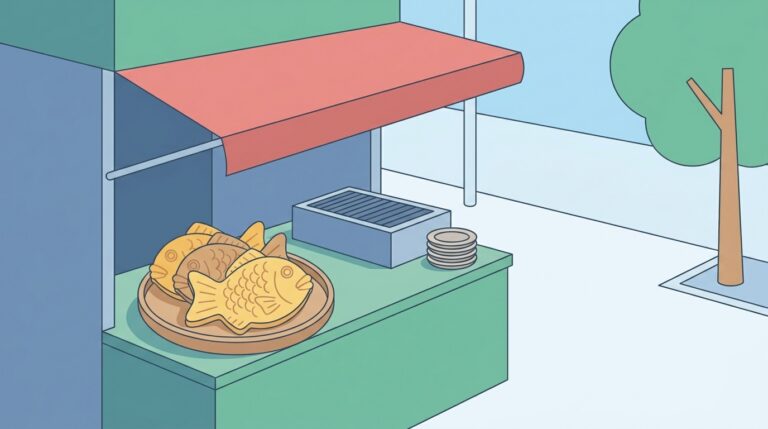
Setting: A popular winter street stall in Myeongdong selling warm fish-shaped red bean pastries (붕어빵 – Bungeoppang).
Characters:
* You (A1 Explorer): Hungry traveler eager to practice basic Korean.
* Imo (이모 – Auntie): Energetic street vendor with a warm smile.
Turn 1
이모 (Imo): 어서 오세요! 붕어빵 맛있어요. 몇 개 드릴까요?
(Eoseo oseyo! Bungeoppang masisseoyo. Myeot gae deurilkkayo?)
“Welcome! Bungeoppang is delicious. How many can I get you?”
🎭 Waving her tongs warmly toward the hot iron mold
Turn 2
You: 저기요, 붕어빵 얼마예요?
(Jeogiyo, bungeoppang eolmayeyo?)
“Excuse me, how much is the bungeoppang?”
🎭 Peeking excitedly into the display box
Turn 3
이모 (Imo): 세 개에 삼천 원이에요!
(Se gaee samcheon won-ieyo!)
“It is 3,000 won for three pieces!”
🎭 Holding up three fingers with a friendly grin
Turn 4
You: 와, 좋아요! 둘… 아니, 셋 주세요!
(Wa, joayo! Dul… ani, set juseyo!)
“Wow, great! Two… no, give me three, please!”
🎭 Holding up three fingers with a polite nod
Turn 5
이모 (Imo): 네! 팥 붕어빵으로 세 개 맞죠?
(Ne! Pat bungeoppang-euro se gae matjyo?)
“Sure! Three red bean pastries, right?”
🎭 Bagging three piping hot pastries into a brown paper sack
Turn 6
You: 네, 맞아요! 감사합니다.
(Ne, majayo! Gamsahamnida.)
“Yes, that’s right! Thank you.”
🎭 Offering payment with two hands politely
Turn 7
이모 (Imo): 자, 여기요. 뜨거우니까 조심해서 먹어요!
(Ja, yeogiyo. Tteugeounikka josimhaeseo meogeoyo!)
“Here you go. It’s hot, so be careful eating!”
🎭 Handing over the fragrant paper bag
Turn 8
You: 맛있게 먹겠습니다! 하나, 둘, 셋, 냠!
(Masitge meokgetseumnida! Hana, dul, set, nyam!)
“I will eat well! One, two, three, yum!”
🎭 Taking a playful bite and laughing
🔀 Interactive Decision Point
The vendor asks: “더 필요한 거 있어요?” (Deo piryohan geo isseoyo? – Do you need anything else?) How do you ask for just one cup of hot fishcake broth?
- Option A: “일 개 주세요!” (Il gae juseyo!)
- Option B: “국물 하나 주세요!” (Gungmul hana juseyo!)
- Option C: “셋 주세요!” (Set juseyo!)
Feedback:
* Option A (Risk): While the vendor might guess what you mean, using 일 (Il) with general items sounds robotic and grammatically mismatched in daily speech.
* Option B (Best!): Perfect! 하나 (Hana) is natural, polite, and universally understood at street stalls.
* Option C (Bad): You will end up with three steaming cups of broth all by yourself! Save 셋 (Set) for when you have company.
Phase 6: 10-Second Emotion Shadowing Drill
Practice reading these out loud to internalize rhythm and emotional tone. The slashes / indicate brief pauses.
[😊 Cheerful & counting down for a photo]
하나, / 둘, / 셋, / 김치~!
(Hana, / dul, / set, / gimchi~!)
“One, / two, / three, / smile~!”-
[😋 Hungry & polite ordering]
이모, / 이거 / 둘 주세요!
(Imo, / igeo / dul juseyo!)
“Auntie, / two of these / please!” -
[🤝 Encouraging team countdown]
하나, / 둘, / 셋, / 파이팅!
(Hana, / dul, / set, / paiting!)
“One, / two, / three, / let’s do this!”
Phase 7: K-Culture Mini Dictionary
-
인생네컷 (Insaengnekeot)
Literal translation: Life’s Four Cuts.
Usage: The ubiquitous self-photo studio phenomenon found throughout Korean entertainment districts where 하나, 둘, 셋 is heard every second. -
이모 (Imo)
Literal translation: Maternal Aunt.
Usage: A warm, culturally affectionate title used to address middle-aged female restaurant or street food owners without sounding overly formal. -
붕어빵 (Bungeoppang)
Literal translation: Carp bread.
Usage: A beloved winter street snack filled with sweet red bean paste or custard cream, almost always ordered in sets of 하나, 둘, or 셋. -
개 (Gae)
Literal translation: Item / Unit piece.
Usage: The most universal counter in the Korean language. When combined with 1, 2, 3, it creates 한 개 (1 piece), 두 개 (2 pieces), 세 개 (3 pieces).
Phase 8: Traveler’s Survival Kit
Top 3 Survival Phrases
- 하나 주세요. (Hana juseyo.)
RR: [Hana juseyo]
Pro Tip: Use this at convenience stores, bakeries, or street stands whenever ordering a single quantity of anything. - 둘이요. (Duriyo.)
RR: [Duriyo]
Pro Tip: When entering a busy Korean restaurant and the host asks “몇 분이세요?” (How many people?), simply reply with 둘이요 (Table for two). - 하나, 둘, 셋, 찍어요! (Hana, dul, set, jjigeoyo!)
RR: [Hana, dul, set, jjigeoyo!]
Pro Tip: Perfect line to say right before you take a picture of your friends in front of Gyeongbokgung Palace!
Editor’s Travel Note
Before stepping into bustling night markets, be sure to install the Naver Map navigation application to search out famous food stalls. While credit cards are accepted almost everywhere in Korea today, small traditional food carts occasionally prefer mobile transfer or simple cash. Keep a few small bills ready, flash your fingers with a bright 하나 주세요, and watch the vendor light up!
Phase 9: One Step Deeper
Languages reflect how societies perceive their surrounding world. While Sino-Korean numbers (일, 이, 삼) were adopted for official record-keeping, dates, money, and precise measurements, Native Korean numbers (하나, 둘, 셋) have survived for thousands of years as the communal language of touch, appetite, and human interaction. When you count using 하나, 둘, 셋, you are speaking the language that ancient Koreans used around hearth fires to share loaves of bread and celebrate harvests. It is personal, tangible, and wonderfully human.
💬 Your Turn: Which Korean dish or snack are you most excited to order using 하나, 둘, 셋 on your next trip? Drop your answer in the comments below!
Phase 10: FAQ & Avoiding Misunderstandings
Q: Can I use “하나, 둘, 셋” when reciting my phone number or giving a date?
A: No! For phone numbers, calendar dates, minutes, and currency prices, Korean strictly uses Sino-Korean numbers (일, 이, 삼). Reserve 하나, 둘, 셋 for physical counts of items, people, hours on a clock, or counting down.
Q: Why do I see “한, 두, 세” instead of “하나, 둘, 셋” on menus?
A: When native numbers are placed directly before a counter word (like 개 for items, 명 for people, or 잔 for drinks), the last letter drops: 하나 → 한, 둘 → 두, 셋 → 세. Both forms refer to the exact same numbers!
Q: How do I pronounce the final ‘t’ in 셋 (Set)?
A: In standard Korean, when 셋 is spoken on its own, the bottom consonant ‘ㅅ’ is unreleased. Do not say “Set-uh” or a sharp English “Set-t”. Simply bring your tongue to the position of an English ‘t’ and stop the airflow cleanly.
🚨 Common Mistakes Board
- Mistake 1: Saying “일 개 주세요” (Il gae juseyo) when ordering food.
👉 Correct Action: Always say “하나 주세요” (Hana juseyo) or “한 개 주세요” (Han gae juseyo). - Mistake 2: Forgetting to drop consonants before counters (e.g., saying “하나 명”).
👉 Correct Action: Say “한 명” (Han myeong) for one person, and “두 명” (Du myeong) for two people. - Mistake 3: Saying “삼, 이, 일” for quick photo snaps.
👉 Correct Action: Count forward! Real Koreans count 하나, 둘, 셋! before smiling for the camera.
Phase 11: Action Missions
- 🥉 Bronze Mission (Solo Practice): Stand in front of your bathroom mirror, raise your fingers one by one, and say 하나, 둘, 셋! with three different facial expressions.
- 🥈 Silver Mission (Social Share): Find a K-pop idol group greeting video on YouTube or Instagram, identify the team leader counting 하나, 둘, 셋, and comment the timestamp below!
- 🥇 Gold Mission (Real-Life Action): Visit your local Korean supermarket, bakery, or boba cafe, and order your favorite item using “[Item name] 하나 주세요!”
🎮 K-Culture Mission: Watch an episode of any Korean variety show (like Running Man). Listen for the host starting games with 하나, 둘, 셋! and see how quickly you recognize the cue!
Phase 12: Interactive Quiz Challenge
1. Situational Challenge: You are standing in an elevator in Seoul, holding the door for someone who rushes in. You hold up two fingers to ask if they are two people. What should you say?
* A) 일 사람이에요? (Il saram-ieyo?)
* B) 두 분이세요? (Du bun-iseyo?)
* C) 셋 개예요? (Set gae-yeyo?)
2. Fill-in-the-Blank: Before taking a friendly group selfie, what is the natural phrase to complete this countdown?
* “자, 찍습니다! ____, 둘, 셋, 김치~!”
3. True or False Culture Check: In Korea, you should use Sino-Korean numbers (일, 이, 삼) when counting down for a photo shoot. (True / False)
👉 Click here for answers & explanations
- 1. Correct Answer: B) 두 분이세요?
Explanation: For counting people respectfully, native numbers are used with the honorific counter 분 (bun). 둘 changes to 두 before a counter. - 2. Correct Answer: 하나 (Hana)
Explanation: The classic photo countdown begins with 하나 (Hana), followed by 둘 (Dul) and 셋 (Set)! - 3. Correct Answer: False
Explanation: Photo countdowns always use Native Korean numbers (하나, 둘, 셋) to create a warm and rhythmic cue!







