

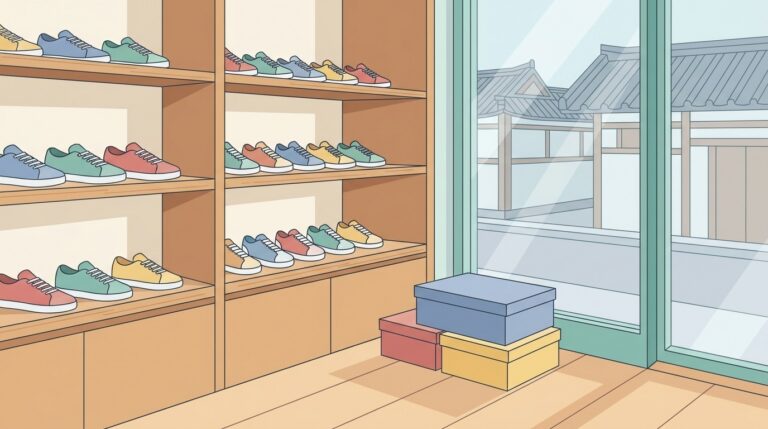
How to Shop for Shoes in Korea Without Breaking a Sweat: Asking for Two Sizes Naturally
Phase 1: Empathy (Story Immersion Opening)
“안녕하세요! 매일한글 에디터입니다.” (Hello! It’s your Daily Hangul editor here!)
Picture this: You are strolling through the trendy backstreets of Seongsu-dong or Hongdae. Through the glass window of a sleek boutique, a stunning pair of sneakers catches your eye. You walk inside, your heart racing. The polite store clerk smiles, bows slightly, and approaches you. You look down at the display shoe—it’s labeled “240.” In your home country, you usually wear a US 7 or EU 37.5, but you know that sneaker fits in Korea can run slightly slim. You want to compare size 240 and 245 side-by-side to make sure your toes don’t pinch after a full day of exploring Seoul.
Suddenly, your mind freezes. How do you ask to try on both sizes without sounding demanding or awkward? Do you have to ask for one, test it, hand it back, and ask again? What if the clerk thinks you’re being troublesome?
Take a deep breath! Many of our Daily Hangul learners have felt that exact same hesitation. The great news is that Korean retail culture loves efficiency and attentive service. In fact, staff members prefer bringing out two boxes at once so you can find the perfect match right away. By mastering today’s target phrase, you will glide through Korean shoe stores with pure ease and zero stress. Let’s step into this together!
Phase 2: Top 3 Core Expressions in Depth
1. 이 운동화 240 사이즈랑 245 사이즈 둘 다 신어 볼게요. (I’d like to try on both size 240 and 245 in these sneakers.)
- Pronunciation: I undonghwa i-baek-sa-sip sa-i-jeu-rang i-baek-sa-sip-o sa-i-jeu dul da sin-eo bol-ge-yo. (Sounds like: ee oon-dong-hwa ee-baek-sah-sheep sah-ee-jeu-rahng… Notice how “-rang” rolls softly off your tongue, sounding like the “rang” in “meringue”).
- Meaning: Literally “These sneakers, size 240 and size 245, both I will try wearing.” In natural nuance: “I’d like to try on both sizes 240 and 245 in this pair, please.”
- K-Culture Moment: In modern lifestyle K-dramas like Search: WWW or Business Proposal, characters visiting boutique shops use the ending -ㄹ게요 (-l-ge-yo) to politely state an immediate intention rather than giving a stiff command.
- Editor’s Insight: The particle ~랑 (~rang) means “and” in friendly, natural speech. Coupling it with 둘 다 (dul da) (“both”) clearly sets expectations so the clerk only has to make one trip to the back stockroom.
- Situation Spectrum: Casual ⚠️ | Semi-formal ✅ | Formal ✅
- 🤔 Think About It: Why do you think Korean expresses trying on shoes using -아/어 보다 (“to see/try”) rather than a direct verb for test? What does this say about experiencing and tasting the moment before deciding?
2. 발볼이 좀 좁게 나왔나요? (Does this run narrow around the toes/ball of the foot?)
- Pronunciation: Bal-bor-i jom jop-ge na-wat-na-yo? (Think of bal-bol like “ball-ball” where the “l” floats near the roof of your mouth).
- Meaning: Literally “Did the foot width come out a bit narrow?” Culturally: “Does this model have a narrow toe-box?”
- K-Culture Moment: Seen constantly on YouTube sneaker review vlogs (like Wadism or Shoeker), where hosts slip their feet in and immediately analyze the bal-bol for their viewers.
- Editor’s Insight: In Korea, footwear is manufactured with specific silhouettes. Asking this question instantly makes you sound like an experienced buyer rather than a bewildered tourist.
- Situation Spectrum: Casual ✅ | Semi-formal ✅ | Formal ⚠️
- 🤔 Think About It: Notice the passive phrase “나왔나요?” (Did it come out?). In Korean, products often “come out” from design rather than the brand “making them narrow.” How does this soften the question?
3. 다른 색상도 볼 수 있을까요? (Could I see this in other colors too?)
- Pronunciation: Da-reun saek-sang-do bol su iss-eul-kka-yo? (Pronounce saek-sang like “sack-sahng” with a crisp k snap).
- Meaning: “Could I perhaps see other colors as well?”
- K-Culture Moment: When shopping in Seoul’s multi-brand sneaker spots like ABC-Mart or Foot Locker, display walls often showcase only the hero colorway. This polite phrase unlocks the stock tucked away behind the counters.
- Editor’s Insight: Using ~도 (~do) means “also/too”, and -을 수 있을까요? (-eul su iss-eul-kka-yo?) adds an ultra-polite cushion that shows deep respect for the staff’s time.
- Situation Spectrum: Casual 🚫 | Semi-formal ✅ | Formal ✅
- 🤔 Think About It: In English, we often say “Show me other colors.” In Korean, asking “May I see?” places the action on your own eyes, creating an unpretentious, gentle tone.
Phase 3: Textbook Korean vs. Real-World Korean
Situation 1: Asking permission to try something on
- 📖 Textbook Korean: 이 신발을 신어 보아도 됩니까? (Is it permissible for me to wear these shoes?)
- 🗣️ Real-World Korean: 이거 신어 봐도 돼요? (Can I try this on?)
- 💡 Why is it different? The textbook version uses -ㅂ니까, which sounds like an official military inspection. Real everyday Korean relies on the friendly, polite -아/어 봐도 돼요? accompanied by a light nod.
Situation 2: Asking for two sizes
- 📖 Textbook Korean: 240 밀리미터와 245 밀리미터를 모두 가져다주십시오. (Please bring both 240 millimeters and 245 millimeters to me.)
- 🗣️ Real-World Korean: 240이랑 245 둘 다 신어 볼게요! (I’ll try on both 240 and 245!)
- 💡 Why is it different? Koreans routinely drop the measurement unit “밀리미터 (mm)” because numbers in the 200s are implicitly understood as shoe sizes. Using direct imperative commands (-십시오) creates unnecessary distance.
Phase 4: K-Culture Deep Dive & Non-Verbal Etiquette
4-1. Nunchi (눈치) & Body Gestures
When trying on shoes in Korea, non-verbal respect goes a long way.
1. The Fitting Stool: Never balance precariously on one leg while putting on display shoes. Look around for a small ottoman or low bench (스툴 or 의자). Sit down first.
2. The Shoehorn Grace: You will almost always find a long shoehorn (구두주걱 / gudu-jugeok) nearby. Using it signals that you respect the merchandise by not crushing the heel counter. Staff love customers who use the shoehorn!
3. Sock Check: Walking barefoot into a new display shoe is considered bad manners. If you are wearing sandals or bare feet in summer, politely ask the staff for a disposable try-on sock (덧신 / deot-sin).
4-2. Cultural Code: The Millimeter Measurement System
Korea measures shoe sizes strictly in millimeters (mm). Forget US 6.5 or UK 5!
* 230 mm ≈ US Women’s 6 / EU 36
* 240 mm ≈ US Women’s 7 / EU 37.5
* 250 mm ≈ US Women’s 8 / Men’s 7
* 265 mm ≈ US Men’s 8.5 / EU 42
* 275 mm ≈ US Men’s 9.5 / EU 43
Korean sneaker designs often focus on a streamlined, snug profile. If you have wider feet, Koreans affectionately refer to standard narrow sneakers as having a “칼발 (blade-foot)” silhouette. Don’t be shy about asking to compare half-sizes—it is expected and encouraged!
Phase 5: Real-Life Roleplay Scenario
Setting: Sneakers Lab, a sleek streetwear boutique in Hongdae. Clean ambient lofi music plays.
Characters: You (an excited traveler) and Min-su (a friendly 20-something sneaker specialist wearing a stylish black apron).
- Turn 1 (Min-su): 어서 오세요! 편하게 둘러보세요.
(Eoseo oseyo! Pyeonhage dulleoboseyo.)
“Welcome! Please feel free to look around.”
🎭 Smiles warmly and slightly bows with both hands clasped in front. -
Turn 2 (You): 저기요, 이 운동화 다른 색상도 볼 수 있을까요?
(Jeogiyo, i undonghwa dareun saeksangdo bol su iss-eul-kkayo?)
“Excuse me, could I see this sneaker in other colors too?”
🎭 Points gently with an open palm toward the display shelf. -
Turn 3 (Min-su): 네, 이 모델은 화이트랑 베이지도 있어요. 베이지 보여 드릴까요?
(Ne, i modeureun hwaiteurang beijido isseoyo. Beiji boyeo deurilkkayo?)
“Yes, this model also comes in white and beige. Shall I show you the beige?” -
Turn 4 (You): 네, 좋아요! 그리고 이 운동화 240 사이즈랑 245 사이즈 둘 다 신어 볼게요.
(Ne, joayo! Geurigo i undonghwa i-baek-sa-sip sa-i-jeu-rang i-baek-sa-sip-o sa-i-jeu dul da sin-eo bol-ge-yo.)
“Yes, please! And I’d like to try on both size 240 and 245 in these sneakers.”
🎭 Shows two fingers comfortably with a bright, friendly smile. -
Turn 5 (Min-su): 네! 잠시만 기다려 주세요. 금방 가져다드릴게요.
(Ne! Jamsiman gidaryeo juseyo. Geumbang gajyeodadeurilgeyo.)
“Sure! Please wait just a moment. I’ll bring them right out.”
🎭 Heads swiftly to the stockroom and returns with two neat shoe boxes. -
Turn 6 (Min-su): 여기 있습니다. 천천히 신어 보세요. 구두주걱 여기 있어요!
(Yeogi itseumnida. Cheoncheonhi sineo boseyo. Gudu-jugeok yeogi isseoyo!)
“Here they are. Please take your time trying them on. The shoehorn is right here!”
🎭 Sets the boxes on the rug and places the shoehorn within arm's reach. -
Turn 7 (You): 240은 발볼이 좀 좁네요. 245가 착화감이 훨씬 편해요!
(I-baek-sa-sibeun bal-bor-i jom jomneyo. I-baek-sa-sip-oga chak-hwa-gam-i hwol-ssin pyeon-haeyo!)
“Size 240 is a bit tight on the sides. Size 245 feels so much more comfortable!”
🎭 Wiggles toes slightly and looks up happily. -
Turn 8 (Min-su): 맞아요, 그 신발이 살짝 얄렵하게 나왔거든요. 245 사이즈로 도와드릴까요?
(Majayo, geu sinbar-i saljjak yallyeophage nawatgeodeunyo. I-baek-sa-sip-o sa-i-jeuro dowa-deurilkkayo?)
“Exactly, that shoe was designed a bit slender. Shall I help you ring up the 245?”
🔀 Interactive Decision Fork
Imagine Min-su comes back and places the boxes down. What do you do next?
- Option A: You immediately stand on your bare feet on the dirty wooden floor, force your heel into the shoe without untying the laces, and say: “야, 이거 작아!” (Hey, this is small!)
- Outcome (Bad): High cringe factor! Standing barefoot without socks violates store etiquette, ruining shoe counters causes damage, and using informal language (반말) shocks the clerk.
- Option B: You politely slip into both sizes while seated on the stool, test the walk on the store rug, and state: “245가 딱 맞아요. 이걸로 할게요!” (245 fits just right. I’ll take this one!)
- Outcome (Best): Perfect customer etiquette! Staff will admire your clear communication, and you leave with shoes that fit your feet like a glove.
- Option C: You say nothing, stay silent because you are nervous, try on one shoe halfway, take it off, and quickly walk out the store.
- Outcome (Risk): You leave empty-handed and miss out on a pair you loved. Don’t worry about making grammatical mistakes; staff are eager to assist!
Phase 6: 10-Second Emotion Shadowing Drill
Say these aloud! Follow the pause markers (/) and embody the emotion tag:
[👟 호기심 가득하고 친근하게 / Inquiring & friendly]
저기요, / 이 운동화 / 다른 색상도 볼 수 있을까요?
(Jeogiyo, / i undonghwa / dareun saeksangdo bol su iss-eul-kkayo?)-
[💡 똑 부러지고 자신감 있게 / Confident & clear]
이 운동화 / 240 사이즈랑 / 245 사이즈 / 둘 다 신어 볼게요!
(I undonghwa / i-baek-sa-sip sa-i-jeu-rang / i-baek-sa-sip-o sa-i-jeu / dul da sin-eo bol-ge-yo!) -
[😌 편안함을 느끼며 감탄하듯 / Relieved & satisfied]
245가 / 발볼도 안 아프고 / 착화감이 / 진짜 좋아요.
(I-baek-sa-sip-oga / bal-bol-do an apeugo / chak-hwa-gam-i / jinjja joayo.)
Phase 7: K-Culture Mini Dictionary
- 발볼 (Bal-bol) | Noun: Foot width / Toe box
- Real-world usage: Essential when shopping in Asia. You can say: “제가 발볼이 넓은 편이에요” (I have relatively wide feet).
- 칼발 (Kal-bal) | Noun: “Blade foot” (narrow/slender foot profile)
- Real-world usage: Slang used in fashion blogs and online reviews. If a shoe is marked “칼발 추천” (recommended for blade feet), wide-foot buyers know to size up.
- 착화감 (Chak-hwa-gam) | Noun: Underfoot feel / Fit & comfort when worn
- Real-world usage: A high-frequency review buzzword combining 착화 (wearing shoes) and 감 (feeling). Example: “착화감이 푹신해요” (The cushioning feels pillowy).
- 깔창 (Kkal-chang) | Noun: Insole / Height-increasing lift
- Real-world usage: Commonly found at checkouts and convenience stores. Whether you need extra arch support or a subtle boost in height, asking for a 깔창 is super common in Korea.
Phase 8: Traveler’s Survival Kit
Top 3 Survival Expressions
- 한 사이즈 큰 거 있어요? (Han sa-i-jeu keun geo isseoyo?)
- “Do you have one size bigger?”
- Pro Tip: Use this when your toes hit the front tip.
- 신발 벗고 신어 봐야 하나요? (Sinbal beotgo sineo bwaya hanayo?)
- “Should I take off my shoes here to try it on?”
- Pro Tip: Useful in fitting rooms or boutique stages with raised wooden platforms.
- 새 상품으로 주실 수 있나요? (Sae sangpum-euro jusil su innayo?)
- “Could I get a fresh, boxed pair (not the display)?”
- Pro Tip: Standard practice before you pay at checkout.
Editor’s Travel Note
- Navigation Guide: When exploring Seongsu’s boutique shoe ateliers, avoid Google Maps as walking routes in Korea are often outdated. Instead, make sure to download the Naver Map application or use KakaoMap to pinpoint underground sneaker pop-ups.
- Tax Refund Ease: Most urban sneaker chains (like ABC-Mart Grand Stage) offer immediate tax refunds on-site. Simply show your physical passport at the cash register and say: “택스 리펀 되나요?” (Taekseu ripeon doenayo?)
Phase 9: “한 발 더 깊이” (One Step Deeper)
Have you ever noticed how Koreans soften their requests with -아/어 볼게요 (“I will try doing…”)? In many Western languages, shopping interactions can be very direct: “Bring me size 8 and 8.5.” But in Korean society, where mutual consideration (배려 / baeryeo) shapes retail spaces, declaring your personal trial (“I will try them on”) acknowledges the clerk’s effort without sounding like a boss barking an order. Language is not just grammar; it is a mirror of how a culture values everyday harmony.
💬 Your Turn: In your home country, do shoppers usually ask clerks for multiple sizes at once, or do you grab boxes straight off the shelf yourself? Tell us your funniest shopping story in the comments below!
Phase 10: FAQ & Avoiding Misunderstandings
Q: Can I try on high-end leather shoes the same way as sneakers?
A: With leather shoes (구두 / gudu), clerks are extra sensitive to creasing the vamp. Always sit down, ask first (“신어 봐도 돼요?”), and never bend your toes forward while wearing them, as permanent creases make the shoe unsellable.
Q: What if the shoe comes in unisex sizing and feels too large?
A: Korean sneaker models often specify unisex (공용 / gong-yong), women’s (여성용 / yeo-seong-yong), or men’s (남성용 / nam-seong-yong). Unisex models tend to have a wider heel cup and larger toe box, so you may need half a size smaller.
Q: How do I say half sizes like 245 in Korean?
A: Koreans read shoe sizes as pure Sino-Korean numbers: 240 is 이백사십 (i-baek-sa-sip), 245 is 이백사십오 (i-baek-sa-sip-o), and 270 is 이백칠십 (i-baek-chil-sip). You don’t need to say “point five”!
🚨 Common Mistakes (흔한 실수)
- Mistake: Saying “이거 입어 볼게요” for shoes.
- Correction: Clothes are 입다 (ip-da), but shoes, socks, and footwear are 신다 (sin-da). Always say: “신어 볼게요” (sineo bol-ge-yo).
- Mistake: Trying to convert sizes in inches.
- Correction: Staff will not know shoe sizes in inches. Convert your foot length to millimeters before walking into the store.
- Mistake: Leaving tried-on shoes scattered on the rug.
- Correction: Turn the shoes around so the toes face away from the bench, neatly side-by-side. Staff will be amazed by your manners!
Phase 11: Action Missions
- 🥉 Bronze Mission (Solo Practice): Stand in front of your shoe rack at home. Hold up two different shoes and practice saying out loud: “240 사이즈랑 245 사이즈 둘 다 신어 볼게요!” 5 times smoothly.
- 🥈 Silver Mission (Social Share): Snap a photo of your favorite Korean kicks or current sneakers and post it on your Instagram Story or Korean study account. Tag it with the Korean vocabulary
#발볼and#착화감! - 🥇 Gold Mission (Real-world Challenge): Next time you visit a Korean shoe shop (or an online Korean apparel website like Musinsa), filter shoes by millimeter measurements and spot whether reviewers describe the fit as 칼발 or 정사이즈 (true to size).
🎮 K-Culture Mission: Watch an episode of a Korean variety show or a Hongdae street fashion vlog. Spot whenever someone checks their foot comfort using the words 편하다 (pyeon-hada) or 딱 맞다 (ttak mat-da)!
Phase 12: Interactive Quiz Challenge
1. Situation Judgement
You are at a store in Myeongdong. The sneaker you want is on display, but you want to try sizes 235 and 240 together. Which phrase is the most natural and polite?
* A) 235하고 240을 빨리 가져와라.
* B) 235 사이즈랑 240 사이즈 둘 다 신어 볼게요.
* C) 235 사이즈 이거 입어 봐도 돼요?
2. Fill-in-the-Blank
Fill in the blank with the correct verb for trying on shoes:
“저기요, 이 로퍼 한번 ( ) 봐도 돼요?”
3. True / False Cultural Fact
In Korea, shoe sizes are typically measured using US or UK numbered sizes on retail tags.
* (True / False)
👉 Click here for Answers & Explanations!
-
Answer: B
Explanation: B is the perfect friendly, polite phrase. Option A is an impolite command (반말), and Option C incorrectly uses 입다 (for wearing clothes) instead of 신다 (for footwear). -
Answer: 신어 (sineo)
Explanation: The base verb is 신다 (to wear on feet). Combined with -아/어 보다, it becomes 신어 보다 (to try on footwear). -
Answer: False
Explanation: Korea strictly uses millimeters (mm) for footwear sizing (e.g., 230, 245, 270 mm).






