

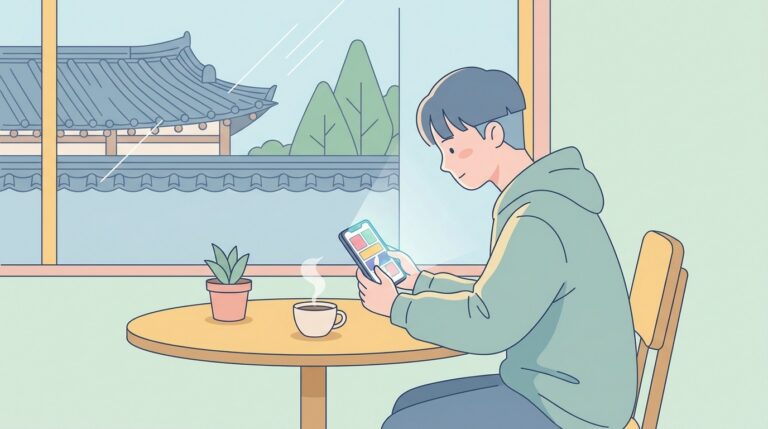
Falling for Webtoon Heroes: How to Fangirl and Fanboy in Natural Korean
Phase 1: Empathy (Story Opening)
안녕하세요! (Annyeonghaseyo!) I’m your Daily Hangul editor.
Picture this: It is midnight, your room is dark, and you are glued to your phone screen scrolling through the latest chapter of a hit Korean webtoon. Suddenly, the male lead walks into the panel. Crisp black suit, piercing eyes, flowing hair, and a signature smirk that practically breaks the digital canvas. Your heart does a flip, your jaw drops, and you frantically open the comments section to squeal with fellow readers. But wait—you freeze. You want to shout to the world how breathtakingly cool he is, yet the only Korean word you know is the stiff dictionary phrase you saw in a textbook months ago. Leaving an awkward “He is handsome” just doesn’t capture the hype!
If this has happened to you, take a deep breath: you are definitely not alone. Over 80% of our beginner learners tell us that while they fell in love with Korean pop culture through webtoons and dramas, they struggle to bridge the gap between rigid grammar rules and the electrifying, emotion-packed slang that real fans use every single day. Today, we are unlocking the ultimate A1 beginner starter pack to react to your favorite webtoon characters. By the end of this guide, you will be able to comment, squeal, and chat like a true Seoul insider!
Phase 2: Top 3 Essential Expressions
1. 너무 멋있어요! (Neomu meosisseoyo!)
- Pronunciation: [Neomu meos-iss-eo-yo] (Sounds like: No-moo muh-she-so-yo)
- Meaning: Literal: “Too stylish/cool” vs Actual Nuance: “He/She is so incredibly cool!”
- K-Culture Moment: Used when a protagonist jumps into a fight scene to defend someone or reveals their hidden identity.
- Editor’s Insight: In classical Korean, “너무” (neomu) strictly meant a negative excess (“too much”). But in modern casual Korean, it has become the default amplifier for extreme admiration, equivalent to “super” or “so much”!
- Situation Spectrum: Casual: ✅ | Semi-formal: ✅ | Formal: ⚠️
- 🤔 Think About It: Why do you think modern Koreans use a word that originally meant “excessive” to give compliments? How does your native language exaggerate beauty or coolness?
2. 주인공 (Juingong)
- Pronunciation: [Ju-in-gong] (Sounds like: Zoo-in-gong)
- Meaning: Literal: “Master/Host of the work” vs Actual Nuance: “Main character / Protagonist”
- K-Culture Moment: Debating online who the real center of the storyline is, or praising the hero’s development.
- Editor’s Insight: You can make this gender-specific with simple prefixes! Add ‘남’ (nam – male) to get 남주 (nam-ju / male lead), or ‘여’ (yeo – female) to get 여주 (yeo-ju / female lead).
- Situation Spectrum: Casual: ✅ | Semi-formal: ✅ | Formal: ✅
- 🤔 Think About It: In English, we say “main character.” The Korean word uses “주” (master/owner). What does that say about how Korean storytelling views the central figure’s agency?
3. 심쿵했어요! (Simkunghaesseoyo!)
- Pronunciation: [Sim-kung-haess-eo-yo] (Sounds like: Sheem-koong-he-so-yo)
- Meaning: Literal: “Heart thumped!” vs Actual Nuance: “My heart skipped a beat! / Total heartthrob moment!”
- K-Culture Moment: The romantic lead stares right out of the panel, offering a rare gentle smile.
- Editor’s Insight: This is an iconic portmanteau of “심장” (sim-jang, heart) and “쿵” (kung, a heavy thumping onomatopoeia). It captures romantic heart flutter in just two punchy syllables.
- Situation Spectrum: Casual: ✅ | Semi-formal: ✅ | Formal: 🚫
- 🤔 Think About It: Onomatopoeia plays a massive role in Korean emotional expression. Why is physical sound so effective in conveying emotion?
Phase 3: Textbook Korean vs. Real Korean
Let’s see how standard textbook phrasing transforms into vivid street Korean!
Situation 1: Praising a Character’s Jaw-Dropping Appearance
- 📖 교과서 한국어: 그 남자는 대단히 잘생겼습니다. (Geu namjaneun daedanhi jalsaenggyeotseumnida.) — “That man is exceptionally handsome.”
- 🗣️ 진짜 한국어: 주인공 비주얼 진짜 미쳤어요! (Juingong bijueol jinjja michyeosseoyo!) — “The main character’s visuals are literally insane!”
- 💡 왜 다를까?: Native speakers use English loanwords like “비주얼” (visuals) paired with “미쳤다” (crazy/insane) to express disbelief at unreal beauty.
Situation 2: Expressing Romantic Attraction to a Hero
- 📖 교과서 한국어: 저는 이 캐릭터를 좋아합니다. (Jeoneun i kaerikteoreul joahamnida.) — “I like this character.”
- 🗣️ 진짜 한국어: 완전 내 스타일이에요! (Wanjeon nae seutairieyo!) — “He is totally my type!”
- 💡 왜 다를까?: Rather than the formal verb “좋아하다”, young fans use “스타일” (style) to express romantic compatibility and aesthetic preference.
Phase 4: K-Culture Deep Dive & Non-Verbal Manners
4-1. Nunchi & Physical Gestures
When discussing webtoons with Korean friends, non-verbal language amplifies your excitement:
* The Double-Hand Heart Clutch: When saying “심쿵했어요!”, lightly press both hands flat over your chest and lean backward slightly. It signals playful vulnerability.
* The Screen-Angling Courtesy (눈치 – Nunchi): If you are reading romantic or action-packed webtoons on the Seoul Metro Line 2 during rush hour, keep your screen slightly tilted down. Koreans practice public nunchi (situational awareness) so graphic or intense illustrations do not startle the elderly passengers standing next to you!
4-2. The Cultural Code: From Webtoons to Global Dramas
In South Korea, webtoons are not just comics—they are the R&D engine of K-Content. Massive hit K-Dramas like Business Proposal, Itaewon Class, and Marry My Husband all began as weekly web panels. When reading, you will constantly encounter the classic archetype of the “K-Chaebol Heir” or the brooding, cold exterior hero who is secretly devoted only to the lead—known culturally as a 츤데레 (Cheundere). Understanding this trope helps you anticipate storylines and speak the shared language of millions of fans.
Phase 5: Real-Life Roleplay Scenario
Setting: A trendy, quiet Manhwa (Comics) Cafe in Hongdae, Seoul. Warm wooden booths, fluffy cushions, and iced Americanos on the table. You are chatting with Minji (민지), your Korean university friend who recommended a top-ranking fantasy romance webtoon.
- Turn 1 (Minji): 이 웹툰 지금 보고 있어요? (I weptun jigeum bogo isseoyo?)
Are you reading this webtoon right now?
🎭 Peeks over your shoulder with an excited grin. - Turn 2 (You): 네! 지금 3화 보고 있어요. (Ne! Jigeum sam-hwa bogo isseoyo.)
Yes! I am reading episode 3 right now.
🎭 Taps the tablet screen excitedly. - Turn 3 (Minji): 어때요? 재미있어요? (Eottaeyo? Jaemiisseoyo?)
How is it? Is it fun?
🎭 Leans in with anticipation. - Turn 4 (You): 네, 남주인공이 너무 멋있어요! (Ne, namjuingongi neomu meosisseoyo!)
Yes, the male lead is so cool!
🎭 Shows the panel of the hero drawing a glowing sword. - Turn 5 (Minji): 맞죠! 완전 얼굴 천재예요. (Matjyo! Wanjeon eolgul cheonjaeyeyo.)
Right! He is a total face genius.
🎭 Nods vigorously in agreement. - Turn 6 (You): 얼굴 천재요? 무슨 뜻이에요? (Eolgul cheonjaeyo? Museun tteusieyo?)
Face genius? What does that mean?
🎭 Tilts head with curious eyes. - Turn 7 (Minji): 얼굴이 너무 잘생겨서 천재라는 뜻이에요! (Eolguri neomu jalsaenggyeoseo cheonjaeraneun tteusieyo!)
It means someone so handsome their face is literally a work of genius!
🎭 Giggles and claps hands together. - Turn 8 (You): 아! 진짜 심쿵했어요! (A! Jinjja simkunghaesseoyo!)
Ah! My heart really skipped a beat!
🎭 Clutches chest playfully.
🔀 Interactive Choice Point
Minji asks you: “다음 화도 바로 결제해서 볼래요?” (Do you want to unlock the next chapter right away with coins?)
- Choice A: “네! 다음 화 진짜 궁금해요!” (Ne! Daeum hwa jinjja gunggeumhaeyo! – Yes! I am so curious about the next episode!)
- Feedback [BEST]: Perfect enthusiasm! You will instantly bond as fellow binge-readers.
- Choice B: “아니요, 돈이 아깝습니다.” (Aniyo, doni akkapssumnida. – No, it is a waste of money.)
- Feedback [BAD]: Too harsh and overly formal. It abruptly kills the lighthearted fan atmosphere.
- Choice C: “주인공이 바보예요.” (Juingongi baboyeyo. – The main character is an idiot.)
- Feedback [RISK]: Risky banter! Unless Minji also dislikes the character’s choices, this can sound overly critical.
Phase 6: 10-Second Emotion Shadowing Drill
Repeat these lines out loud! Follow the rhythm breaks marked by / and channel the emotion tags:
[😍 Heart-fluttered & Dreamy]
주인공이 / 너무 / 멋있어요!
(Juingongi / neomu / meosisseoyo!)
The main character is so cool!-
[😱 Gasping in Awe]
비주얼 / 진짜 / 대박이에요!
(Bijueol / jinjja / daebagieyo!)
The visuals are seriously epic! -
[🥺 Cute & Convincing]
완전 / 제 / 스타일이에요!
(Wanjeon / je / seutairieyo!)
He is totally my type!
Phase 7: K-Culture Mini Dictionary
-
남주 (Nam-ju)
- Meaning: Male Protagonist (Short for 남자 주인공).
- Usage: Used constantly in fan communities when comparing characters (e.g., “이번 작품 남주 성격 진짜 좋아요!” – The male lead’s personality in this work is amazing!).
- 여주 (Yeo-ju)
- Meaning: Female Protagonist (Short for 여자 주인공).
- Usage: Common when praising strong, independent heroines (e.g., “여주가 진짜 똑똑해요!” – The female lead is super smart!).
- 최애 (Choe-ae)
- Meaning: Ultimate Bias / Absolute Favorite Character.
- Usage: Beyond K-Pop idols, webtoon fans use this to crown their #1 beloved character.
- 덕질 (Deok-jil)
- Meaning: Fanboying / Fangirling Activities.
- Usage: Refers to collecting webtoon merchandise, attending pop-up cafes, or re-reading series.
Phase 8: Traveler’s Survival Kit
Survival Expressions TOP 3
- 추천해 주세요. (Chucheonhae juseyo.)
- Pronunciation: Choo-chun-he joo-se-yo.
- Pro Tip: Walk into any comic store in Seoul and say: “인기 웹툰 추천해 주세요” (Please recommend a popular webtoon).
- 굿즈 어디에 있어요? (Gutjeu eodie isseoyo?)
- Pronunciation: Good-jeu uh-dee-eh ee-ssuh-yo?
- Pro Tip: Use this at pop-up stores when hunting for character acrylic stands and photocards.
- 사진 찍어도 돼요? (Sajin jjigeodo dwaeyo?)
- Pronunciation: Sah-jeen jee-guh-doh dway-yo?
- Pro Tip: Always ask before snapping photos of life-sized character standees in themed retail spaces.
Editor’s Travel Note
Heading to Seoul? Check out the vibrant youth districts of Hongdae and Seongsu, home to rotating webtoon pop-up stores. Before you go, explore the Naver Webtoon App official download guide to browse series in Korean with built-in preview images. Most pop-up stores require mobile queuing, so make sure your international credit card or T-money transport balance is ready at payment terminals.
Phase 9: A Step Deeper (Reflective Essay)
Korean webtoons have evolved from simple entertainment into a mirror reflecting changing societal desires. While traditional media often favored humble, self-sacrificing heroes, modern webtoon protagonists are celebrated for self-confidence, competence, and vocal clarity about their desires. When Korean readers praise a character by calling them “사이다” (cider, meaning crisp and refreshing like soda, rather than frustratingly slow), they are expressing a collective yearning for directness in everyday life. By learning how Koreans celebrate their favorite characters, you are not merely learning vocabulary—you are tapping into the evolving emotional heartbeat of South Korea.
💬 Your Turn: Who is your all-time favorite webtoon or drama character? Would you describe them as “너무 멋있어요” or “완전 내 스타일”? Tell us in the comments below!
Phase 10: FAQ & Common Mistakes
Q: Can I use “멋있어요” (Meosisseoyo) for women too?
A: Absolutely! While “예뻐요” (yeppeoyo) means pretty, “멋있어요” means cool, charismatic, or stylish. Calling a female character or friend “멋있어요” is a huge compliment celebrating confidence and capability.
Q: Is “너무” (neomu) strictly positive now?
A: In spoken Korean, yes! You will hear “너무 좋아요” (so good) and “너무 맛있어요” (so delicious) everywhere. However, in formal essay writing or university tests, strict examiners still prefer words like “매우” (maeu) or “정말” (jeongmal).
Q: How do I say a character is cute instead of cool?
A: Simply swap the adjective to “귀여워요” (gwiyeowoyo). For example: “주인공이 너무 귀여워요!” (The main character is so cute!)
🚨 Common Mistakes Warning Board
- Mistake: Using 반말 (informal talk) with store staff (e.g., shouting “멋있다!”).
Correct Action: Always attach “-요” when talking to people you don’t know: “너무 멋있어요!” - Mistake: Saying “주인” (juin) instead of “주인공” (juingong).
Correct Action: “주인” means shop owner or landlord; always add “-공” (gong) for characters. - Mistake: Over-pronouncing the ‘ㅅ’ in “멋있어요” as an English ‘S’ at the end of the first block.
Correct Action: Follow liaison rules! It sounds like meo-si-sseo-yo.
Phase 11: Action Missions
- 🥉 Bronze Mission (Solo Shadowing): Stand before your mirror or open your favorite webtoon chapter. Look at the hero and say out loud with enthusiasm: “주인공이 너무 멋있어요!”
- 🥈 Silver Mission (Social Media Fan): Find a screenshot of your favorite webtoon hero and leave a comment or caption: “완전 내 스타일! 심쿵했어요!”
- 🥇 Gold Mission (Live Action): Next time you chat with a Korean speaker or tutor, recommend your favorite comic by saying: “이 웹툰 주인공 진짜 대박이에요!”
- 🎮 K-Culture Mission: Scroll down to the Korean comment section of any chapter on the Naver Webtoon app. Find at least two comments containing “남주” or “심쿵” and screenshot them for your study notes!
Phase 12: Interactive Quiz Challenge
1. Situational Judgment: Your Korean friend shows you a panel of an impeccably dressed, sword-wielding protagonist saving a town. What is the most natural, enthusiastic reaction?
(A) 주인공이 매우 착합니다.
(B) 와, 남주인공 비주얼 진짜 미쳤어요!
(C) 책이 아주 깁니다.
2. Fill in the Blank: Complete the sentence to say “My heart skipped a beat!”:
“주인공 미소에 완전 _________!”
3. True or False: You can only use the word “멋있어요” for male characters. (True / False)
👉 Click here to check the answers and explanations!
-
Answer: (B)
Explanation: (B) captures the natural excitement of modern Korean pop culture fans. (A) sounds like a robotic primary school essay, and (C) is unrelated. -
Answer: 심쿵했어요 (simkunghaesseoyo)
Explanation: “심쿵했어요” is the ultimate slang for your heart fluttering due to someone’s stunning charm or smile. -
Answer: False
Explanation: “멋있어요” describes charisma, coolness, and style regardless of gender! A badass female lead is regularly praised with “언니 너무 멋있어요!” (Unnie is so cool!).







