

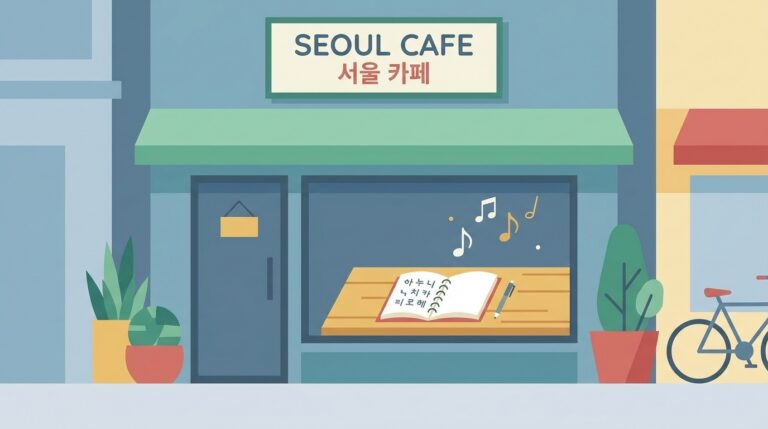
Playing K-Pop in Your Store or Vlogs? Avoid Costly Music Copyright Traps in Korea
Phase 1: Empathy (Immersive Story Opening)
안녕하세요! 매일한글 에디터입니다.
Imagine this: You finally fulfilled your dream of opening a chic, sunlit boutique cafe in the bustling alleys of Yeonnam-dong, or perhaps you just finished editing an aesthetic vlog capturing the sunset along the Han River. To set the ultimate vibe, you queue up your personal Melon playlist or slip NewJeans’ latest hit into your YouTube background. Customers are vibing, views are ticking up, and everything feels cinematic. But two weeks later, an official white envelope marked 내용증명 (Certification of Contents) lands on your counter, demanding hundreds of thousands of won in unpaid performance royalties and unauthorized commercial usage damages. Your heart drops. Was your personal streaming subscription not enough? Why are you suddenly being accused of copyright infringement?
This is one of the most stressful pitfalls foreign entrepreneurs, creators, and professionals encounter in South Korea. The line between personal enjoyment and commercial broadcast is strictly enforced by organizations like KOMCA (Korea Music Copyright Association). As a B2 intermediate learner, mastering the vocabulary surrounding business licensing, commercial background music (매장 BGM), and legal settlements isn’t just about sounding fluent—it is a vital shield that protects your creative work, your wallet, and your peace of mind in Korea’s fast-moving business landscape.
Phase 2: Top 3 Core Expressions Deep Dive
1. 매장에서 틀어도 저작권 문제없나요? (Maejang-eseo teureodo jeojakkwon munje eopnayo?)
- Pronunciation: [Mae-jang-e-seo teu-reo-do jeo-jak-kwon mun-je eom-na-yo?] (Think: ‘Mae-jang’ sounds like ‘May-jong’, and ‘munje eopnayo’ flows rhythmically like ‘moon-jay-up-nah-yo’)
- Meaning: Literal: “Even if played in the store, is there no copyright problem?” | Nuance: “Is this track legally cleared for commercial background use on our premises?”
- K-Culture Moment: You hear this when an indie cafe owner consults a commercial music curation platform agent or when a retail manager double-checks their store’s smart tablet playlist before the morning rush.
- Editor’s Insight: In Korean business etiquette, framing the question with
~틀어도 문제없나요?(~is it okay if we play it?) politely nudges the counterparty to verify the legal clearance without sounding accusatory or overly formal. - Situation Spectrum: Casual ⚠️ | Semi-formal ✅ | Formal ✅
- 🤔 Think About It: In Western casual settings, people often assume personal streaming accounts cover small retail spaces. In Korea, store size (especially over 50㎡ in designated retail categories) triggers strict performance rights (공연권). How does your home country balance artist royalties with small business music streaming?
2. 상업용 음원 라이선스를 확인해 볼게요. (Sang-eob-yong eum-won raiseonseureul hwaginhae bolgeyo.)
- Pronunciation: [Sang-eom-yong eum-won rai-seon-seu-reul hwa-gin-hae bol-ge-yo.] (The ‘b’ in ‘sang-eob’ naturally assimilates to an ‘m’ sound before ‘yong’ -> ‘Sang-eom-yong’)
- Meaning: Literal: “I will check the commercial sound source license.” | Nuance: “Let me verify whether our commercial usage license covers this specific track.”
- K-Culture Moment: A video production agency editor calming a sponsor during a pre-launch meeting for a branded web drama.
- Editor’s Insight: Using
~해 볼게요(I will try/look into doing) projects proactive responsibility and professional calm, instantly de-escalating anxiety when copyright ambiguities arise. - Situation Spectrum: Casual ⚠️ | Semi-formal ✅ | Formal ✅
- 🤔 Think About It: Notice the direct loanword
라이선스(license) paired with Sino-Korean상업용(commercial use) and음원(sound source). Why do you think modern Korean business combines English technical jargon with precise Sino-Korean compounds?
3. 내용증명을 받았는데 어떻게 대응해야 하죠? (Naeyong-jeungmyeong-eul bad-eonneunde eotteoke daeeunghaeha hajyo?)
- Pronunciation: [Nae-yong-jeung-myeong-eul ba-deon-neun-de eo-tteo-ke dae-eung-hae-ya ha-jyo?]
- Meaning: Literal: “I received a certification of contents; how should I respond?” | Nuance: “I’ve received an official legal notice regarding an alleged infringement; what is the proper protocol to handle this?”
- K-Culture Moment: A dramatic scene in an office drama where an entrepreneur consults their trusted mentor after receiving an aggressive settlement demand letter from a predatory copyright agency.
- Editor’s Insight: A
내용증명is not an immediate court judgment; it is a postal record proving claims were formally served. Saying어떻게 대응해야 하죠?asks for strategic response procedures rather than panicking. - Situation Spectrum: Casual ⚠️ | Semi-formal ✅ | Formal ✅
- 🤔 Think About It: Why does receiving a formal letter in Korea often trigger immediate panic, and how does understanding official administrative terminology protect you from copyright trolls exploiting that fear?
Phase 3: Textbook Korean vs. Real-World Korean
Situation 1: Asking if a music track will trigger a copyright strike
- 📖 교과서 한국어 (Textbook Korean): 저작권법에 위배되지 않는 음원입니까? (Jeojakkwonbeobe wibaedoeji anneun eumwon-imnikka?) – “Is this a sound recording that does not violate the Copyright Act?”
- 🗣️ 진짜 한국어 (Real-World Korean): 이거 유튜브에 올리면 저작권 안 걸려요? (Igeo yutyubeu-e ollimyeon jeojakkwon an geollyeoyo?) – “If I upload this to YouTube, won’t it get flagged for copyright?”
- 💡 왜 다를까? (Why the difference?): Native speakers rarely cite statutory compliance (
저작권법에 위배되다). Instead, they use the vivid colloquial verb걸리다(to get caught/flagged/tripped up), reflecting the algorithm’s real-time detection systems.
Situation 2: Cautioning someone not to rush into paying settlement fees
- 📖 교과서 한국어 (Textbook Korean): 과도한 합의금 요구에 응하지 마십시오. (Gwadohan hab-uigeum yogu-e eunghaji masipsio.) – “Do not comply with excessive demands for settlement money.”
- 🗣️ 진짜 한국어 (Real-World Korean): 겁먹고 섣불리 합의금 물어주지 마세요. (Geommeokgo seotbulli hab-uigeum mureojuji maseyo.) – “Don’t get intimidated and rush to pay them off.”
- 💡 왜 다를까? (Why the difference?): Aggressive legal firms exploit fear. Locals use
겁먹다(to be spooked) and물어주다(to cough up compensation), framing premature payouts as an emotional mistake rather than a legal duty.
Phase 4: K-Culture Deep Dive & Non-Verbal Manners
4-1. 눈치 (Nunchi) & Professional Composure
When faced with copyright questions or receiving a formal notice in Korea, physical posture and verbal pacing signal your negotiation leverage. If an investigator or copyright association representative visits your venue:
* Maintain Calm Eye Contact: Lowering your gaze or stuttering conveys guilt or lack of operational knowledge. Maintain steady, polite eye contact.
* Avoid Immediate Admission of Fault: Do not say “죄송합니다, 몰랐어요” (I’m sorry, I didn’t know). In Korean dispute negotiation, an immediate apology can be documented as a verbal admission of liability. Instead, use neutral deferral phrases like: “담당 부서 및 계약 대행사를 통해 사실관계를 확인한 뒤 회신드리겠습니다” (I will verify the facts through our management agency and follow up).
* Two-Handed Document Exchange: When accepting any formal letter or business card, accept it with both hands (양손 쓰기). It reflects professional respect without surrendering legal ground.
4-2. The Culture Code: Why Korean Cafes Obsess Over BGM
Korean cafe culture is legendary—cafes are not just beverage counters; they function as remote workstations, date spots, and aesthetic sanctuaries (감성 카페). Soundscapes make or break a cafe’s brand identity. Because of this, the Korean Music Copyright Association (KOMCA) and the government revised enforcement decrees regarding Performance Rights (공연권). Cafes, fitness centers, and pubs over 50 square meters face strict monthly commercial royalty tiers. Playing your personal Spotify, Melon, or YouTube playlist through the cafe speakers is technically classified as unauthorized public performance (무단 공연). To thrive, Korean store owners subscribe to dedicated B2B store music providers (매장 음악 전문 서비스) like Shop & BGM or Melon Biz, which automatically clear performance rights.
Phase 5: Real-World Roleplay Scenario
- Setting: Sarah, an expat running an aesthetic brunch cafe in Mapo-gu, is reviewing store operations with Min-jun, a veteran Korean hospitality consultant.
-
Turn 1 (Sarah): 🎭 Looking slightly worried while looking at the tablet playlist
민준 씨, 매장에서 제 개인 멜론 계정으로 최신 K-Pop 틀어도 괜찮을까요?
(Min-jun ssi, maejang-eseo je gae-in Mellon gyejeong-euro choesin K-Pop teureodo gwaenchaneulkkayo?)
“Min-jun, is it okay if I play the latest K-Pop hits using my personal Melon account in the store?” -
Turn 2 (Min-jun): 🎭 Shaking his head gently and lowering the tablet volume
아, 사라 씨, 그건 위험해요. 개인 스트리밍은 매장용 공연권이 포함 안 되어 있거든요.
(A, Sarah ssi, geugeon weiheomhaeyo. Gae-in seuteuriming-eun maejang-yong gong-yeongwoni poham an doe-eo itgeodeunyo.)
“Ah, Sarah, that’s risky. Personal streaming accounts do not include store public performance rights.” -
Turn 3 (Sarah): 🎭 Surprised, tapping her temple
정말요? 전 제가 매달 돈 내고 듣는 거라 상업용으로도 되는 줄 알았어요.
(Jeongmalyo? Jeon jega maedal don naego deunneun geora sang-eob-yong-eurodo doeneun jul arasseoyo.)
“Really? Since I pay monthly for it, I thought it could be used commercially as well.” -
Turn 4 (Min-jun): 🎭 Opening his phone to show a service page
매장 면적이 50제곱미터 이상이면 공연사용료 납부 대상이에요. 잘못하면 저작권 침해 경고장을 받아요.
(Maejang myeonjeogi osip-jegom-miteo isang-imyeon gong-yeon-sayong-ryo napbu daesang-ieyo. Jalmot-hamyeon jeojakkwon chimhae gyeong-go-jang-eul bad-ayo.)
“If the store floor space is 50 square meters or more, you’re required to pay performance royalties. Otherwise, you could get a copyright infringement warning notice.” -
Turn 5 (Sarah): 🎭 Sighing with relief that she asked before opening day
미리 물어보길 정말 잘했네요. 그럼 매장 전용 BGM 서비스를 신청해야겠어요.
(Miri mureobogil jeongmal jal-haenneyo. Geureom maejang jeon-yong BGM seobiseureul sincheong-hae-ya-getseoyo.)
“I’m so glad I asked in advance. Then I should apply for a dedicated commercial store BGM service.” -
Turn 6 (Min-jun): 🎭 Nodding approvingly, smiling
네, 월 2만 원 안팎이면 저작권 분쟁 걱정 없이 합법적으로 최신곡을 틀 수 있어요.
(Ne, wol iman won an-pakk-imyeon jeojakkwon bunjaeng geokjeong eopsi hapbeopjeog-euro choesin-gog-eul teul su isseoyo.)
“Yes, for around 20,000 KRW a month, you can legally play all the latest tracks without worrying about copyright disputes.” -
Turn 7 (Sarah): 🎭 Taking notes in her planner
유튜브 브이로그 채널에 올릴 카페 홍보 영상도 라이선스 프리 음원만 골라 써야겠네요.
(Yutyubeu beuilrogeu chaeneol-e ollil kape hongbo yeongsangdo raiseonseu peuri eum-wonman golla sseoyagetneyo.)
“For the cafe promotional videos I upload to my YouTube vlog, I should strictly select royalty-free music too.” -
Turn 8 (Min-jun): 🎭 Giving a firm thumbs-up
완벽해요! 문제가 생기기 전에 미리 방지하는 게 가장 현명한 대처법입니다.
(Wanbyeokhaeyo! Munjega saeng-gigi jeone miri bangjihaneun ge gajang hyeonmyeonghan daecheobeob-imnida.)
“Spot on! Preventing problems before they arise is the smartest way to manage risk.”
🔀 Interactive Decision Point
If someone drops by your cafe claiming your background music violates copyright and demands immediate cash compensation, what do you say?
- Option A: “어머, 죄송해요! 바로 계좌로 50만 원 입금해 드릴게요.” (Oh, I’m so sorry! I will transfer 500,000 won to your bank account immediately.)
- Option B: “명함과 공식 공문을 남겨주시면, 법률 자문 및 담당 기관 확인 후 공식 회신하겠습니다.” (Please leave your business card and official document; I will formally respond after legal consultation and verification with authorized bodies.)
- Option C: “우리는 외국 음악만 틀었으니까 당신 협회랑은 상관없어요! 나가세요!” (We only played foreign pop tracks, so it has nothing to do with your association! Get out!)
[Decision Feedback]
- Option A (Bad): Never transfer settlement money on the spot. Many rogue agencies exploit fear to extort unearned settlements.
- Option B (Best): Perfect B2-level poise! You remain polite, demand verification and documentation, and defer comment until obtaining professional counsel.
- Option C (Risk): Extreme legal hazard. Korean copyright associations manage reciprocal reciprocal treaties with foreign performance rights organizations (ASCAP, BMI, PRS). Foreign music is also protected.
Phase 6: 10-Second Emotion Shadowing Drill
Practicing pauses (/) and emotional tone is crucial for projecting composure during licensing discussions.
- Drill 1
[😰 당황스럽지만 침착하게 - Flustered but remaining composed]
갑자기 / 합의금을 요구하셔서 / 당황스러운데요, / 서면으로 먼저 보내주시겠어요?
(Gapjagi / hab-uigeum-eul yoguhasyeoseo / danghwangseureoundeyo, / seomyeon-euro meonjeo bonaejusigesseoyo?)
“You are suddenly / demanding a settlement fee, / so I am caught off guard; / could you send that / in writing first?” -
Drill 2
[💼 비즈니스적이고 단호하게 - Professional, firm, and polite]
저희는 / 매장 전용 합법 BGM 라이선스를 / 정상적으로 계약하여 / 사용 중입니다.
(Jeohineun / maejang jeon-yong hapbeop BGM raiseonseureul / jeongsangjeog-euro gyeyakhayeo / sayong jung-imnida.)
“We have / lawfully contracted / a dedicated commercial store BGM license / and are currently using it in full compliance.” -
Drill 3
[🧐 꼼꼼하고 신중하게 - Detail-oriented and prudent]
영상 업로드 전에 / 상업적 이용 가능 여부와 / 저작권 범위를 / 다시 확인해 볼게요.
(Yeongsang eopeurodeu jeone / sang-eopjeok iyong ganeung yeobuwa / jeojakkwon beomwihreul / dasi hwaginhae bolgeyo.)
“Before uploading the video, / whether it allows commercial use / and the scope of the copyright / I will double-check.”
Phase 7: K-Culture Mini Dictionary
- 공연권료 (Gong-yeon-gwon-ryo) | Public Performance Royalty
- Usage: The legal royalty fee paid to copyright holders when recorded music is played publicly in physical spaces (cafes, lounges, gyms, retail stores) where patrons gather.
- 음원 스트리밍 (Eum-won seuteuriming) | Music Streaming Service
- Usage: Subscription digital music delivery (e.g., Melon, Genie, Spotify). Always clarify if a subscription is 개인용 (for personal use) or 상업용/매장용 (for commercial store use).
- 내용증명 (Naeyong-jeungmyeong) | Certification of Contents
- Usage: A standardized post office record confirming sender, recipient, and exact content delivered. Often used by law firms to establish a legal dispute timeline before filing litigation.
- 합의금 (Hab-ui-geum) | Settlement Money / Out-of-court Compensation
- Usage: Financial compensation negotiated to resolve a civil or criminal dispute without going through formal trial proceedings.
Phase 8: Expat & Business Survival Kit
TOP 3 Survival Phrases
- 상업용 라이선스가 포함되어 있나요? (Sang-eob-yong raiseonseuga pohamdoe-eo innayo?)
- Meaning: “Does this include a commercial license?”
- Pro Tip: Ask this before purchasing stock audio, font packages, or digital photo assets in Korea.
- 공식 공문으로 보내주세요. (Gongsik gongmun-euro bonaejuseyo.)
- Meaning: “Please send that as an official formal document.”
- Pro Tip: Shuts down pushy phone calls from aggressive copyright firms fishing for fast verbal concessions.
- 한국저작권위원회에 문의해 보겠습니다. (Hanguk-jeojakkwon-wiwonhoe-e mun-uihae bogetseumnida.)
- Meaning: “I will check with the Korea Copyright Commission.”
- Pro Tip: Mentioning this official government authority immediately deters predatory copyright trolls.
Editor’s Travel & Business Note
When opening a commercial space or producing monetized content in Korea, do not rely on standard consumer apps. Subscribe through verified store music platforms such as the Shop & BGM official store subscription portal or business tiers on Korean music apps. If you receive an intimidating infringement claim, consult the Korea Copyright Commission dispute mediation service before paying any money.
Phase 9: A Step Deeper (한 발 더 깊이)
Korea transformed from a country that battled widespread software and music piracy in the 1990s into one of the world’s strictest, most automated digital intellectual property landscapes. This rapid legal evolution creates a unique cultural friction: while Korean pop culture thrives on viral dance challenges and cafe aesthetics, legal enforcement agencies aggressively pursue unauthorized commercial use. In Korean society, respecting intellectual property (지식재산권 존중) is increasingly viewed as basic business morality (상도의). However, this high vigilance has also nurtured an aggressive “copyright settlement hunting” culture, where minor inadvertent infractions are met with disproportionate legal threats. Navigating this environment requires understanding both the letter of the law and the cultural value of formal mediation.
💬 Your Turn: Have you ever experienced a copyright strike or unexpected licensing fee when editing videos or playing music in your country? How does the enforcement compare to Korea? Share your story in the comments below!
Phase 10: FAQ & Common Mistakes
Q: Can I play YouTube playlists on my cafe iPad if the video says ‘Royalty Free BGM’?
A: Proceed with extreme caution. While the YouTube video uploader may claim the tracks are copyright-free, many compile music without formal commercial public performance licenses (공연권). If an automated crawler or copyright inspector visits, YouTube’s platform terms do not legally indemnify your brick-and-mortar store in Korea. Use an authorized B2B commercial store music service.
Q: Does the music royalty rule apply to tiny cafes under 50 square meters (약 15평)?
A: Under current South Korean Copyright Law Enforcement Decrees, small cafes and beverage specialty shops with a business floor area under 50㎡ are generally exempt from mandatory public performance royalty payments (공연권료). However, this exemption depends strictly on your exact business classification code, so always verify your registered business license (사업자등록증).
Q: I received a certified letter (내용증명) demanding 2,000,000 KRW for using an unlicensed font or music track. Must I pay immediately?
A: No. A 내용증명 is not a court verdict or an arrest warrant; it is an assertion of claim. Many copyright enforcement agencies inflate initial settlement figures. Do not ignore the letter, but never wire money immediately. Consult the Korea Copyright Commission’s free counseling center (한국저작권위원회 무료 상담실) to evaluate actual market licensing rates and fair settlement limits.
🚨 Common Mistakes Warning Board
- Mistake 1: Assuming personal Spotify/Melon accounts cover business venues.
- Correct Action: Contract with a certified commercial BGM provider (매장 음악 서비스).
- Mistake 2: Apologizing and admitting fault in writing before confirming facts.
- Correct Action: Send a neutral written response acknowledging receipt and stating you are verifying the facts through legal counsel.
- Mistake 3: Using commercial fonts or stock photos found on search portals for promotional flyers.
- Correct Action: Strictly download fonts with verified Open Font Licenses (OFL) like Noonnu (눈누) and keep documentation of their license terms.
Phase 11: Action Mission & Engagement
- 🥉 Bronze Mission (Solo Practice): Read the 10-Second Shadowing Drills aloud 3 times, paying close attention to the pause markers (
/) and assertive professional tone. - 🥈 Silver Mission (Community Share): Write a sentence in the comments explaining your favorite background music genre for studying, using the phrase: “저는 집중할 때 주로 ~ BGM을 틀어요.”
- 🥇 Gold Mission (Real-World Application): Audit your own social media channels, YouTube videos, or workplace playlists. Identify one audio track or font, verify its commercial licensing status, and summarize your findings in Korean: “이 음원의 상업용 라이선스를 확인해 봤어요.”
- 🎮 K-Culture Mission: Watch an episode of a Korean business or legal drama (such as Extraordinary Attorney Woo or Start-Up). Spot a scene where business contracts, copyright, or official notifications (내용증명) are mentioned, and note how the characters maintain composure!
Phase 12: Interactive Quiz Challenge
Test your knowledge before you hit play on that next track!
- Situational Judgement: You manage a 70㎡ cafe in Gangnam. A representative hands you an infringement notice regarding store music. Which response is the most appropriate?
- (A) “제가 외국인이라 법을 몰랐어요. 지금 현금 드릴게요.”
- (B) “공문 내용을 확인한 후, 저희 법률 대리인을 통해 정식으로 연락드리겠습니다.”
- (C) “저희는 손님이 별로 없어서 노래 틀어도 돈 낼 필요 없어요.”
- Fill in the Blank: 매장에서 손님들에게 음악을 들려줄 때 발생하는 권리를 라고 합니다.
- (A) 복제권 (Bokjegwon)
- (B) 공연권 (Gong-yeongwon)
- (C) 배포권 (Baepogwon)
- True or False: An official postal notice called a
내용증명(Certification of Contents) carries the same immediate legal effect as an enforceable court verdict requiring immediate bank transfer.- [True / False]
Click here to reveal answers & explanations!
- Correct Answer: (B)
- Explanation: Never pay cash immediately or plead ignorant as an excuse. Politely request formal documentation and defer responses until you consult an expert.
- Correct Answer: (B) 공연권 (Gong-yeongwon – Public Performance Rights)
- Explanation: Playing music in commercial stores and public venues falls under the legal classification of public performance (공연).
- Correct Answer: False
- Explanation: A
내용증명is merely documented proof of a claim sent by one party to another via the post office. It is not an enforceable court judgment, so you should remain calm and seek official legal guidance.
- Explanation: A







