Master Karrot Market: How to Politely Ask for a Discount in Korean Like a Local
Phase 1: Empathy (Story-Immersive Opening)
안녕하세요! 매일한글 에디터입니다. (Hello! This is your Daily Hangul editor.)
Picture this: You’ve just settled into your cozy studio in Seoul. You’re browsing 당근 (Karrot), Korea’s wildly popular neighborhood secondhand app, and you spot it—a sleek retro Bluetooth speaker in mint condition, priced at 30,000 KRW. You’ve seen Korean YouTubers and characters in K-dramas joyfully meeting outside subway exits for quick, warm neighborhood trades. You think to yourself, “Could I maybe get this for 25,000 KRW?”
You open the chat box, but your fingers freeze. What if you sound rude? What if you accidentally insult the seller and your 매너온도 (Manner Temperature) plummets, or worse, they report you? Many of our international students tell us they used automated translators to type “깎아 주세요” (Cut the price), only to be left on “read” or immediately blocked.
Bargaining in Korea isn’t forbidden, but it is an art of nunchi (눈치, social intuition), linguistic softening, and mutual respect. Learning how to navigate price negotiations won’t just save you a few thousand won—it will unlock genuine cultural connection and give you the confidence to trade like a real Seoul resident. Let’s turn that awkward chat into a friendly, successful deal!
Phase 2: Core Expressions Deep Dive
1. 혹시 가격 네고 조금 가능할까요? (Hoksi gagyeok nego jogeum ganeunghalkkayo?)
- Pronunciation: Hok-si ga-gyeok ne-go jo-geum ga-neung-hal-kka-yo? (Think: “Hoke-she gah-gyuck neh-go joh-geum gah-neung-hahl-kkah-yoh?”)
- Meaning: Literal: “By any chance, is price nego a little possible?” | Real Nuance: “Would you mind if we gently negotiated the price a bit?”
- K-Culture Moment: Seen whenever someone reaches out on Karrot or Bungaejangteo for vintage furniture, electronics, or K-pop concert goods.
- Editor’s Insight: The word 네고 (nego) is Korean digital slang derived from the English word negotiation. Notice the magic pair: 혹시 (by any chance) and 조금 (a little). Together, they act as an emotional airbag that softens your request.
- Situation Spectrum: Casual ✅ | Semi-formal ✅ | Formal ⚠️
- 🤔 Think About It: In English, we often say “Can you do 25?” directly. Why does Korean culture value embedding two buffer words (by any chance and a little) before making a simple financial request?
2. 쿨거래 하시면 에누리해 드릴게요. (Kul-geo-rae hasimyeon enuri-hae deurilgeyo.)
- Pronunciation: Kul-geo-rae ha-si-myeon e-nu-ri-hae deu-ril-ge-yo. (Think: “Cool-guh-reh hah-she-myun eh-noo-ree-heh deu-reel-geh-yoh”)
- Meaning: Literal: “If you do a cool deal, I will give you a discount.” | Real Nuance: “If we can make this quick and hassle-free, I’m happy to knock a little off!”
- K-Culture Moment: Busy sellers who want to declutter before moving apartments love using this phrase to reward fast, polite buyers.
- Editor’s Insight: 쿨거래 (Cool trade) means no endless questions, instant payment, and sticking strictly to the meetup schedule. 에누리 (Enuri) is a traditional Korean word for discount, carrying a much warmer, community-minded feeling than cold commercial terms.
- Situation Spectrum: Casual ✅ | Semi-formal ✅ | Formal 🚫
- 🤔 Think About It: How does the Korean idea of “coolness” (쿨함) in business contrast with Western ideas of tough haggling?
3. 죄송하지만 네고는 어려워요. (Joesonghajiman negoneun eoryeowoyo.)
- Pronunciation: Joe-song-ha-ji-man ne-go-neun eo-ryeo-wo-yo. (Think: “Jweh-song-hah-jee-mahn neh-go-noon uh-ryuh-wo-yoh”)
- Meaning: Literal: “I am sorry, but nego is difficult.” | Real Nuance: “I really appreciate your interest, but the price is firm.”
- K-Culture Moment: Sellers declining offers on rare, mint-condition collectibles like signed albums or vintage film cameras.
- Editor’s Insight: Notice that native Koreans rarely say “안 돼요” (No / You cannot). Saying something is 어려워요 (difficult) saves face for both sides and prevents interpersonal tension.
- Situation Spectrum: Casual ⚠️ | Semi-formal ✅ | Formal ✅
- 🤔 Think About It: When saying “no,” why do you think Korean society defaults to describing personal difficulty rather than flat-out prohibition?
Phase 3: Textbook Korean vs. Real Korean
Situation 1: Inquiring about a discount on a chat app
- 📖 교과서 한국어: 값을 깎아 주세요. (Gaps-eul kkak-a ju-se-yo. / Please cut the price.)
- 🗣️ 진짜 한국어: 혹시 네고 조금 가능할까요? ^^ (Hoksi nego jogeum ganeunghalkkayo? ^^ / By any chance, would a small nego be possible? ^^)
- 💡 왜 다를까?: “깎아 주세요” sounds very direct and is usually reserved for traditional outdoor markets (like Namdaemun) when talking to elderly vendors. In peer-to-peer app trading, using “네고” paired with smiley eyes (
^^) is the gold standard of digital politeness.
Situation 2: Promising a hassle-free pickup
- 📖 교과서 한국어: 제가 오늘 살 테니 싸게 해주세요. (Je-ga oneul sal te-ni ssa-ge hae-ju-se-yo. / I will buy it today, so give it to me cheap.)
- 🗣️ 진짜 한국어: 제가 오늘 바로 갈게요, 쿨거래 부탁드려요! (Je-ga oneul baro gal-ge-yo, kul-geo-rae bu-tak-deu-ryeo-yo! / I can come over today immediately; let’s do a smooth, cool deal!)
- 💡 왜 다를까?: Korean sellers value their time. Instead of demanding a cheaper price, framing your quick arrival as a “쿨거래” flatters the seller and motivates them to shave off 2,000 to 5,000 KRW willingly.
Phase 4: K-Culture Deep Dive & Non-Verbal Manners
4-1. 눈치 (Nunchi) & Digital Gestures
In Korean secondhand apps, tone is conveyed through punctuation. Ending a sentence with a flat period can feel cold or aggressive to local ears. Adding ^^ (smiling eyes), ~ (friendly wave of intonation), or a cute bow sticker instantly builds goodwill. When meeting in person:
* The Two-Handed Exchange: When handing over cash or picking up the item, hold it with both hands or support your right forearm with your left hand.
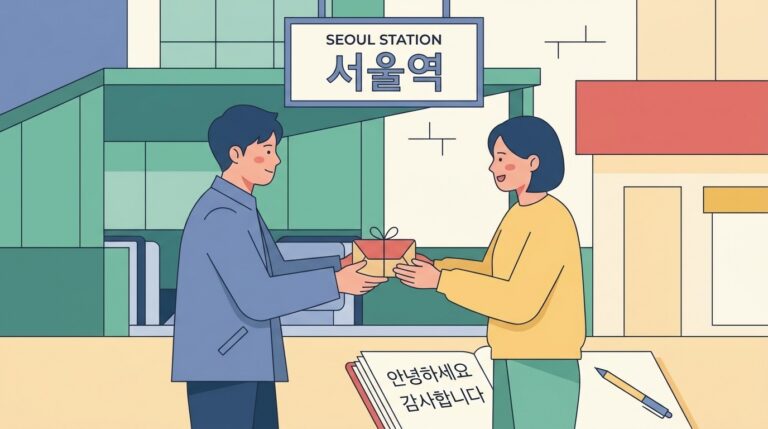
* The Punctuality Bow: Arrive 3 to 5 minutes early. Meetups usually happen outside subway exits or convenience stores. When the seller approaches, offer a gentle 15-degree nod and say: “안녕하세요! 당근이세요?” (Hello! Are you from Karrot?).
4-2. Cultural Code: 매너온도 (Manner Temperature)
Every user on the Karrot app starts at 36.5°C—the normal human body temperature. When you receive compliments, arrive on time, and communicate politely, your temperature rises. Pushy bargaining, ghosting, or rude remarks lead to negative reviews, causing your temperature to drop below freezing. A high temperature (40°C+) is a badge of honor in modern Korean neighborhood life, proving you are trustworthy.
Phase 5: Real-World Roleplay Scenario
Setting: A cool weekday evening. You are chatting with “Min-ji” (민지), a friendly resident of Mapo-gu, about an acoustic guitar listed for 50,000 KRW.
- Learner: 안녕하세요! 기타 아직 있나요? (Annyeonghaseyo! Gita ajik innayo?)
“Hello! Is the guitar still available?”
🎭 Types politely while checking the item pictures. - Min-ji: 네! 아직 있어요. 소리 아주 잘 납니다 ^^ (Ne! Ajik isseoyo. Sori aju jal namnida ^^)
“Yes! It’s still available. The sound is very good ^^”
🎭 Sends a smiling sticker. - Learner: 혹시 학생이라 예산이 조금 부족한데, 네고 조금 가능할까요? (Hoksi haksaeng-ira yesan-i jogeum bujokhande, nego jogeum ganeunghalkkayo?)
“By any chance, I’m a student on a tight budget—would a small nego be possible?”
🎭 Asks carefully with cautious humility. - Min-ji: 음… 오늘 저희 동네로 오시면 45,000원에 드릴게요! (Eum… oneul jeohui dongne-ro osimyeon sa-man-o-cheon-won-e deurilgeyo!)
“Hmm… if you come to my neighborhood today, I can do 45,000 won!”
🎭 Considers the polite request thoughtfully. - Learner: 와, 정말 감사합니다! 제가 그쪽으로 갈게요. 쿨거래 해요! (Wa, jeongmal gamsahamnida! Je-ga geujjok-euro galgeyo. Kul-geo-rae haeyo!)
“Wow, thank you so much! I will come over to your side. Let’s do a cool deal!”
🎭 Responds instantly with genuine enthusiasm. - Min-ji: 좋아요! 마포역 3번 출구 앞에서 7시에 만나요. (Joayo! Mapo-yeok sam-beon chul-gu ap-eseo ilgop-si-e mannayo.)
“Great! Let’s meet at 7 PM in front of Mapo Station Exit 3.”
🎭 Shares exact station exit location. - Learner: 네, 시간 맞춰서 도착하겠습니다. 그때 봬요! ^^ (Ne, sigan matchwoseo dochakhagessseumnida. Geuttae bwaeyo! ^^)
“Yes, I will arrive right on time. See you then! ^^”
🎭 Prepares exact cash in 10,000 and 5,000 won notes. - Min-ji: 조심히 오세요~ (Josimhi oseyo~)
“Come safely~”
🎭 Puts phone in pocket with a warm smile.
🔀 Interactive Branching Decision
What if Min-ji replied to your discount request with: “죄송하지만 네고는 어려워요 ㅠㅠ”? Choose your next response:
* A) “아쉽지만 괜찮아요! 원래 가격으로 구매할게요 ^^” (Too bad, but no problem! I will buy at the original price ^^)
👉 [Best Choice]: Shows maturity and keeps the deal friendly without awkwardness.
* B) “다른 사람은 4만 원에 팔던데요? 깎아주세요.” (Someone else was selling for 40,000 won! Lower it.)
👉 [Bad Choice]: Extremely impolite. High risk of immediate block and negative rating.
* C) “네 알겠습니다.” (and never replies again)
👉 [Risk Choice]: Leaving the seller hanging (ghosting) hurts your Manner Temperature.
Phase 6: 10-Second Emotion Shadowing Drill
Practice these lines out loud, pausing at the / marks:
- Line 1:
[🥺 조심스럽고 공손하게 - Polite & Hesitant]
“혹시… / 가격 네고 / 조금 가능할까요? ^^”
(Hok-si… / ga-gyeok ne-go / jo-geum ga-neung-hal-kka-yo? ^^) - Line 2:
[😊 시원시원하고 적극적으로 - Brisk & Enthusiastic]
“제가 바로 갈게요! / 쿨거래 부탁드려요~”
(Je-ga ba-ro gal-ge-yo! / kul-geo-rae bu-tak-deu-ryeo-yo~) - Line 3:
[🤝 따뜻하고 감사한 마음으로 - Warm & Grateful]
“조정해 주셔서 감사합니다! / 시간 맞춰 갈게요!”
(Jo-jeong-hae ju-syeo-seo gam-sa-ham-ni-da! / si-gan mat-chwo gal-ge-yo!)
Phase 7: K-Culture Mini Dictionary
- 당근하다 (Dang-geun-ha-da) | Verb | Literally “to do Karrot.” Used universally to mean buying, selling, or meeting up for a secondhand transaction. (e.g., “오늘 퇴근하고 당근하러 가요!” – I’m going to do a Karrot deal after work!)
- 쿨거래 (Kul-geo-rae) | Noun | “Cool deal.” A trade completed instantly without unnecessary haggling, repeated questions, or scheduling changes.
- 매너온도 (Mae-neo-on-do) | Noun | “Manner Temperature.” The digital reputation meter starting at 36.5°C that reflects a user’s reliability and courtesy.
- 직거래 (Jik-geo-rae) | Noun | “Direct trade.” In-person, face-to-face transactions as opposed to delivery via parcel or courier.
Phase 8: Survival Kit for Travelers
Top 3 Survival Phrases
- 1. 혹시 네고 가능한가요? (Hoksi nego ganeunghangayo?)
(Is nego possible by any chance?)
👉 Pro Tip: Perfect opening if an item has been listed for over two weeks without selling. - 2. 제가 그쪽으로 갈게요. (Jega geujjogeuro galgeyo.)
(I will come over to your side/neighborhood.)
👉 Pro Tip: In Korea, sellers love not having to travel. Offering to come directly to their apartment gate is your best bargaining chip. - 3. 지금 출발합니다! (Jigeum chulbalhamnida!)
(Departing now!)
👉 Pro Tip: Text this when you leave your house. It reassures the seller that you aren’t a “no-show.”
Editor’s Travel Note
- App Download: Search for the Karrot Market App Download on Google Play or iOS App Store. Keep in mind that signing up requires an active Korean phone number (+82) for location authentication.
- Payment Manners: Bring the exact cash amount! If the price is 18,000 KRW, handing over two 10,000 KRW bills and expecting 2,000 KRW change at a subway turnstile causes awkward delays. Alternatively, ask: “계좌이체 가능할까요?” (Can I do a mobile bank transfer?).
Phase 9: “A Step Deeper” (Cultural Reflection)
In many Western cultures, commerce is viewed as an analytical negotiation of market value. In Korea, even a minor secondhand transaction is underpinned by Jeong (정)—a sense of human warmth, mutual empathy, and shared community. When you frame your request with “혹시” and “조금,” you aren’t just haggling for a lower price; you are acknowledging the seller’s feelings and showing respect for their ownership.
💬 Your Turn: How does bargaining on apps in your home country compare to Korea’s polite “Manner Temperature” system? Would you feel comfortable asking for a discount using these soft cushions? Share your thoughts below!
Phase 10: FAQ & Avoiding Misunderstandings
Q: What does “네고 불가” mean in an item description?
A: It means “No Negotiation Allowed.” If you see 네고 불가 (nego bul-ga) or 네고 사절 (nego sa-jeol), never ask for a discount. Doing so is considered bad manners and may result in an immediate block.
Q: How much of a discount is acceptable to ask for on Karrot?
A: Keep it reasonable—usually between 5% and 10% (e.g., asking for 27,000 KRW on a 30,000 KRW item). Asking for 50% off is viewed as “진상” (troublemaking customer) behavior.
Q: Can I negotiate the price when we meet in person?
A: Absolutely not! In Korean secondhand culture, price changes at the meetup spot are considered very rude. All financial agreements must be finalized inside the chat before meeting.
🚨 Common Mistakes Warning Board
- Mistake: Blurt out “깎아주세요” as your very first message.
➡️ Correct Action: Always greet first: “안녕하세요! 혹시 네고 조금 가능할까요?” - Mistake: Showing up 10 minutes late without notice.
➡️ Correct Action: Send a quick update if running late: “죄송합니다, 5분 정도 늦을 것 같아요!” - Mistake: Asking the seller to deliver the item across the city after requesting a discount.
➡️ Correct Action: If you ask for a discount, offer to travel to their preferred subway station.
Phase 11: Action Mission & Engagement
- 🥉 Bronze Mission: Practice pronouncing “혹시 가격 네고 조금 가능할까요?” 5 times in front of a mirror with a gentle smile.
- 🥈 Silver Mission: Write down the 4 keywords from the Mini Dictionary in your study journal and share your favorite with our community.
- 🥇 Gold Mission: Open your Karrot app (or a Korean secondhand exchange group), find an item you love, and send a polite greeting message incorporating ^^ and 혹시!
- 🎮 K-Culture Mission: Watch a contemporary slice-of-life K-Drama and pay attention to how characters use the word “혹시” to soften questions in daily life.
Phase 12: Interactive Quiz Challenge
Test your real-world Korean negotiation skills!
1. Scenario Judgment:
You want to ask for a 2,000 KRW discount on a 20,000 KRW jacket. Which message is the best?
* A) 비싸요. 18,000원에 줘요.
* B) 안녕하세요! 혹시 18,000원에 쿨거래 가능할까요? ^^
* C) 네고 불가인가요? 왜요?
2. Fill-in-the-Blank:
“오늘 바로 입금할게요, ______ 부탁드려요!” (Hint: A smooth, hassle-free transaction)
3. True or False:
If a post says “네고 불가”, you can still ask for a small 1,000 KRW discount if you say “제발요” (please).
👉 Click to reveal answers and explanations!
- 1. Answer: B
(Explanation: Option B combines polite greeting, clear target price, the softening concept of “쿨거래”, and friendly emoji eyes.) - 2. Answer: 쿨거래 (Kul-geo-rae)
(Explanation: Promising a hassle-free instant transaction makes sellers much more flexible.) - 3. Answer: False
(Explanation: “네고 불가” is a firm boundary. Respecting the seller’s policy is essential to maintaining your Manner Temperature!)