

Survived the Han River Picnic but Itchy All Over? How to Ask for Mosquito Bite Relief at a Korean Pharmacy
Phase 1: Empathy (Opening Story)
안녕하세요! (Annyeonghaseyo!) It is your Daily Hangul editor and cultural navigator here! Picture this: You are having the dreamiest summer evening by the Han River in Seoul. You’ve got crispy fried chicken, an icy cold drink, and the city lights glowing across the water like a scene straight out of a romance K-drama. But then, as the breeze slows down, you feel that tiny, dreaded buzz near your ankle. Before you know it, you are scratching at three puffy, infuriating red bumps.
Nothing ruins a magical travel day faster than an unbearable itch! Many of our beginner students tell us they freeze when entering a local Korean pharmacy (약국 – yakguk). You might wonder: Do I need a prescription? What if they don’t speak English? How do I say ointment without sounding like an old medical textbook? Don’t worry at all. Getting quick relief in Korea is surprisingly fast, cheap, and simple when you have three golden A1 phrases in your back pocket. Let’s make sure you walk out with the perfect anti-itch roll-on in less than sixty seconds!
Phase 2: Core 3 Expressions Deep-Dive
1. 모기 물렸어요 (Mogi mullyeosseoyo)
- Pronunciation: [Mo-gi mul-lyeo-sseo-yo] (Sounds like: Mo-gee like the name + mool-yuh-ssuh-yo)
- Meaning: Literal: “A mosquito bit me.” / Natural: “I got bitten by a mosquito.”
- K-Culture Moment: In outdoor variety shows like 2 Days & 1 Night, you constantly hear cast members crying out this exact sentence in morning tent scenes while showing red marks to the camera crew.
- Editor’s Insight: The word 물렸어요 (mullyeosseoyo) comes from the passive form of 물다 (mulda, to bite). In Korean, when an insect gets you, you state the event directly: “Mosquito bit-got-I!”
- Situation Spectrum: Casual: ⚠️ (모기 물렸어 – Mogi mullyeosseo) | Semi-formal: ✅ (모기 물렸어요 – Mogi mullyeosseoyo) | Formal: ✅ (모기에 물렸습니다 – Mogie mullyeotseumnida)
- 🤔 Think About It: In English, we often say “I have a bug bite” (focusing on the object you possess), whereas Koreans describe the action that happened to them (“A mosquito bit me”). Notice how Korean emphasizes the event itself!
2. 바르는 약 주세요 (Bareuneun yak juseyo)
- Pronunciation: [Ba-reu-neun yak ju-se-yo] (Sounds like: Bah-reu-neun + yah-k as in yawn + joo-seh-yo)
- Meaning: Literal: “Please give me medicine that one applies/rubs.” / Natural: “Can I have a topical cream/ointment, please?”
- K-Culture Moment: When characters get minor scrapes in school dramas, a caring friend rushes in with an ointment tube saying this line to the nurse.
- Editor’s Insight: Korea divides common medications into ‘eating/swallowing medicine’ (먹는 약 – meongneun yak) and ‘rubbing/topical medicine’ (바르는 약 – bareuneun yak). Adding 주세요 (juseyo, please give me) makes it instantly polite and foolproof.
- Situation Spectrum: Casual: 🚫 | Semi-formal: ✅ | Formal: ✅
- 🤔 Think About It: Why memorize complex clinical words like ‘anti-itch hydrocortisone’ when everyday Korean beautifully bundles it as ‘medicine you rub’? Simplicity is built right into the language!
3. 너무 가려워요 (Neomu garyeowoyo)
- Pronunciation: [Neo-mu ga-ryeo-wo-yo] (Sounds like: Nuh-moo gah-ryuh-wo-yo)
- Meaning: Literal & Natural: “It is so itchy!”
- K-Culture Moment: Often heard with dramatic arm-scratching motions whenever characters stay at rustic countryside grandma homes (시골 – sigol).
- Editor’s Insight: 너무 (neomu) means “too / very” and 가려워요 (garyeowoyo) expresses physical itchiness. Pair this with a gentle tap on your arm, and any pharmacist instantly knows what strength of relief you need.
- Situation Spectrum: Casual: ⚠️ (너무 가려워 – Neomu garyeowo) | Semi-formal: ✅ | Formal: ✅
- 🤔 Think About It: Showing a hint of your physical feeling builds immediate rapport with Korean health professionals. They appreciate when you describe the sensation clearly!
Phase 3: Textbook Korean vs. Real Korean
Situation 1: Asking for bug bite ointment at the counter
- 📖 교과서 한국어 (Textbook): 모기 물린 환부에 바르는 소염 연고를 주시겠습니까? (Mogi mullin hwanbue bareuneun soyeom yeongoreul jusigesseumnikka? – Would you provide an anti-inflammatory ointment to apply to the affected mosquito-bitten area?)
- 🗣️ 진짜 한국어 (Real-life): 모기 물린 데 바르는 약 주세요! (Mogi mullin de bareuneun yak juseyo! – Please give me medicine to put on mosquito bites!)
- 💡 왜 다를까? (Why is it different?): Textbook forms sound like a hospital board examination. Real Koreans use the lightweight noun 데 (de, spot/place) to say “on the bitten spot”—it is conversational, natural, and instantly understood.
Situation 2: Asking for the most popular roll-on brand directly
- 📖 교과서 한국어 (Textbook): 액상형 진통 소양 완화제를 찾고 있습니다. (Aeksanghyeong jintong soyang wanhwajereul chatgo itseumnida. – I am searching for a liquid analgesic itch reliever.)
- 🗣️ 진짜 한국어 (Real-life): 버물리 있어요? (Beomulli isseoyo? – Do you have Bumeulli?)
- 💡 왜 다를까? (Why is it different?): Just like asking for a “Band-Aid” instead of an “adhesive bandage,” Koreans usually ask for 버물리 (Beomulli)—the undisputed household roll-on remedy that has lived in every Korean medicine cabinet for decades.
Phase 4: K-Culture Deep Dive & Non-Verbal Manners
4-1. Nunchi & Gestures: The Pharmacy Etiquette
When walking into a Korean pharmacy, you do not wait to be seated. Step up to the high glass counter. As you speak, lightly point toward where you were bitten (forearm, ankle, or calf). A slight head nod (목례 – mongnye) when greeting establishes instant warmth.
* Pro Tip: Never scratch aggressively or slap your skin violently in front of the counter, as this looks overly panicked. A gentle, polite point with two fingers while saying 가려워요 (garyeowoyo) shows great manners and clear intent.
4-2. Cultural Code: The Iconic Korean Red Sign & Outdoor Life
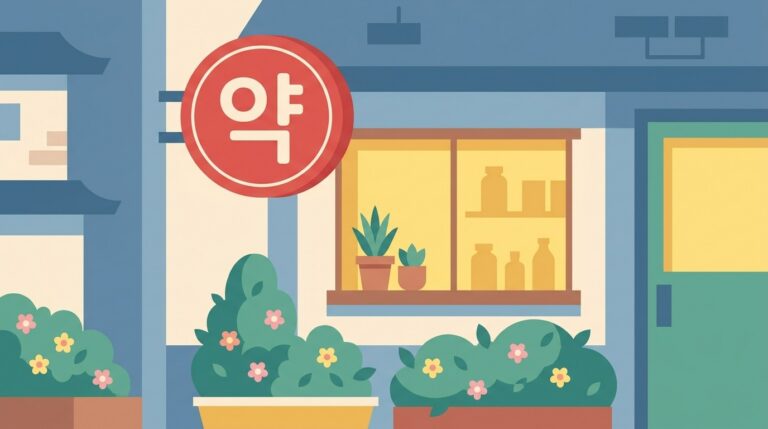
In Korea, pharmacies are marked by a big red or blue cross accompanied by a single, bold character: 약 (Yak). Unlike some Western countries where you must pick medicine off giant aisles yourself, Korean community pharmacies are pharmacist-curated. The pharmacist stands right behind the counter, listens, reaches behind them, and hands you the exact item you need in ten seconds.
If you love K-Travel trends like riverside tent camping (차박 – chabak) or picnic mats at Yeouido Hangang Park, you will find that bug defense is an art form here. Along with topical medicine, you can even ask for 모기 기피제 (mogi gipije – mosquito repellent spray) or 모기 패치 (mogi paechi – cute cartoon patches that stick to clothes) to prevent bites in the first place!
Phase 5: Real-Life Roleplay Scenario
- Location: A cozy neighborhood pharmacy near Mangwon Station, Seoul.
- Character: Pharmacist Kim (약사님 – Yaksanilm), wearing neat gold-rimmed glasses and a crisp white coat.
Pharmacist Kim: 어서 오세요! 어디 불편하세요?
(Eoseo oseyo! Eodi bulpyeonhaseyo?)
“Welcome! Where does it bother you?”
🎭 Smiles warmly behind the glass counter.
You: 안녕하세요! 모기 물렸어요.
(Annyeonghaseyo! Mogi mullyeosseoyo.)
“Hello! I got bitten by mosquitoes.”
🎭 Points to two red bumps on your forearm with a polite nod.
Pharmacist Kim: 아이고, 많이 부었네요. 많이 가려워요?
(Aigo, mani bueonneyo. Mani garyeowoyo?)
“Oh dear, it is quite swollen. Is it very itchy?”
🎭 Leans forward slightly to inspect the bump with a sympathetic frown.
You: 네, 너무 가려워요! 바르는 약 주세요.
(Ne, neomu garyeowoyo! Bareuneun yak juseyo.)
*”Yes, it is very itchy! Please give me medicine to apply.”
🎭 Nods and rubs arm gently to show the discomfort.
Pharmacist Kim: 롤 타입이 편하세요, 크림 타입이 편하세요?
(Rol taibi pyeonhaseyo, keurim taibi pyeonhaseyo?)
“Do you prefer a roll-on liquid or a cream type?”
🎭 Holds up two small boxes from the shelf behind him.
You: 롤 타입 주세요!
(Rol taip juseyo!)
“Roll-on type, please!”
🎭 Smiles gratefully.
Pharmacist Kim: 네, 버물리 드릴게요. 하루에 서너 번 톡톡 바르세요. 사천 원입니다.
(Ne, Beomulli deurilgeyo. Harue seoneo beon toktok bareuseyo. Sacheon-won-imnida.)
“Alright, here is Beomulli. Dab it gently 3 to 4 times a day. That will be 4,000 KRW.”
🎭 Mimics a light tapping gesture with the bottle cap.
You: 감사합니다!
(Gamsahamnida!)
“Thank you!”
🎭 Hands credit card over with two hands.
🔀 Interactive Choice Point
The pharmacist asks: “크림 타입이 편하세요, 롤 타입이 편하세요?” (Do you prefer cream or roll-on?)
- Choice A: “롤 타입 주세요!” (Rol taip juseyo! – Roll-on type, please!)
- Feedback (Best): Perfect! Roll-ons (like classic Beomulli) dry fast on bare arms and don’t make your hands sticky while traveling outdoors.
- Choice B: “아무거나 다 주세요!” (Amugeona da juseyo! – Give me literally everything!)
- Feedback (Risk): You might end up walking away with four different lotions, sprays, and hydrocolloid patches that cost you 25,000 KRW.
- Choice C: “약 싫어요.” (Yak sireoyo. – I hate medicine.)
- Feedback (Bad): Awkward silence! The pharmacist will wonder why you came into a pharmacy just to state your dislike of medication!
Phase 6: 10-Second Emotion Shadowing Drill
Practice these lines out loud with the pause slashes (/) and emotional cues:
[😫 Frustrated & Itchy]
저기요… / 모기 물렸어요. / 너무 가려워요!
(Jeogiyo… / mogi mullyeosseoyo. / neomu garyeowoyo!)-
[🙏 Polite & Pleading]
모기 물린 데 / 바르는 약 / 주세요.
(Mogi mullin de / bareuneun yak / juseyo.) -
[😊 Relieved & Grateful]
감사합니다! / 시원해요.
(Gamsahamnida! / siwonhaeyo. – Thank you! It feels cooling.)
Phase 7: K-Culture Mini Dictionary
- 약국 (Yakguk) | Pharmacy | Look for the bold red sign saying ‘약’. In Korea, almost all basic OTC remedies are purchased across the counter directly from certified pharmacists.
- 버물리 (Beomulli) | Bumeulli (Iconic anti-itch brand) | Korea’s most iconic insect bite brand, famous for its sponge-tip or round roll-on applicator that provides an instant icy sensation.
- 물파스 (Mulpaseu) | Liquid analgesic / menthol roll-on | Originally formulated for muscle aches, older generations in Korea famously dab this cooling liquid on mosquito bites too!
- 연고 (Yeongo) | Ointment / Salve | General term for topical therapeutic creams like antibiotic ointments (e.g., Fucidin or Madecassol) or soothing balms.
Phase 8: Traveler’s Survival Kit
Top 3 Survival Phrases
- 이거 얼마예요? (Igeo eolmayeyo?) – How much is this? (Pro Tip: Keep this ready when paying at the counter).
- 카드 돼요? (Kadeu dwaeyo?) – Do you take card? (Pro Tip: 99.9% of Korean pharmacies accept international credit cards without issue).
- 모기 패치 있어요? (Mogi paechi isseoyo?) – Do you have mosquito patches? (Pro Tip: Great for kids or preventing yourself from scratching while you sleep).
Editor’s Travel Note
Need a pharmacy fast? Open the 네이버 지도 앱 다운로드 (Naver Map app) and simply search the letter “약” or the word “약국”. You can check their real-time opening hours directly. If it is past 10 PM and neighborhood pharmacies are closed, visit any convenience store (CU, GS25, 7-Eleven). While they don’t carry Beomulli roll-ons due to regulations, they always stock emergency basic safety medicines (안전상비의약품) like fever reducers, basic band-aids, and pain patches!
Phase 9: “One Step Deeper” (Reflective Essay)
In many Western countries, going to a pharmacy is a self-serve retail experience where you wander down fluorescent aisles of hundreds of boxes. In Korea, however, a pharmacy visit remains an intimate community checkpoint. Pharmacists are viewed as neighborhood health counselors who take pride in diagnosing minor ailments on the spot without needing an appointment. When you say “모기 물렸어요,” you aren’t just buying a commercial good—you are initiating an age-old social exchange of care (정 – jeong).
💬 Your Turn: In your home country, do you usually buy bug bite relief off a supermarket shelf, or do you consult a pharmacist directly? Share your experience in the comments below!
Phase 10: FAQ & Common Mistakes
Q: Do I need a doctor’s prescription to get mosquito bite medicine in Korea?
A: No! Anti-itch ointments, roll-ons, and soothing patches are classified as General Over-The-Counter Drugs (일반의약품 – ilban uiyakpum). You can buy them immediately at the counter.
Q: Can I use Madecassol (마데카솔) on fresh mosquito bites?
A: Madecassol is primarily a wound-healing and skin-regenerating herbal ointment. While it won’t hurt, it lacks the menthol and antihistamine ingredients that stop acute itching. For itching, always ask for 바르는 모기약 (bareuneun mogiyak) or 버물리 (Beomulli).
Q: How much does mosquito bite medicine typically cost at a Korean pharmacy?
A: It is very budget-friendly! A standard bottle of Beomulli roll-on or anti-itch gel usually costs between 3,500 KRW and 5,000 KRW (approx. $2.50 to $4.00 USD).
🚨 Common Mistakes Alert!
- Mistake: Slapping your skin and saying “아파요!” (Apayo! – It hurts!).
Correct Action: Say “가려워요” (Garyeowoyo – It’s itchy). Pain and itchiness require completely different treatments! - Mistake: Handing cash or a credit card with one single hand casually.
Correct Action: Always hand your card or cash over using both hands or supporting your right forearm with your left hand to show proper Korean politeness. - Mistake: Looking for anti-itch liquid in grocery supermarket aisles.
Correct Action: Korean supermarkets do not carry medicated bug bite ointments. Head straight to a shop with the red 약 sign!
Phase 11: Action Missions
- 🥉 Bronze Mission (Solo Practice): Stand in front of your mirror, point to your arm, and say: “모기 물렸어요! 바르는 약 주세요!” with confident emotion three times.
- 🥈 Silver Mission (Social Connection): Drop a photo of your favorite travel pouch on your Instagram Stories and tag us with the Korean caption: #약국 #모기조심!
- 🥇 Gold Mission (Real Life): During your next trip to Korea, walk into a pharmacy, find the red ‘약’ sign, and purchase a roll-on completely in Korean without translating on your phone!
- 🎮 K-Culture Mission: Watch an episode of a Korean variety show set in the summer (like Three Meals a Day or Earth Arcade) and listen closely for the moment someone slaps their arm and yells “모기!”.
Phase 12: Interactive Quiz Challenge
1. [Scenario] You got bitten by three mosquitoes at the park and it itches like crazy. Which sentence should you say to the pharmacist?
a) 머리가 아파요. (Meoriga apayo.)
b) 모기 물린 데 바르는 약 주세요. (Mogi mullin de bareuneun yak juseyo.)
c) 밥 주세요. (Bap juseyo.)
2. [Fill in the Blank] 너무 __________! (It is so itchy!)
a) 가려워요 (garyeowoyo)
b) 맛있어요 (masisseoyo)
c) 비싸요 (bissayo)
3. [True / False] In Korea, you must visit a hospital and get an official doctor’s note before a pharmacist can sell you Beomulli ointment.
🔍 Click here to reveal the Answers & Explanations!
-
Answer: b) 모기 물린 데 바르는 약 주세요.
Explanation: Option (a) means “I have a headache” and (c) means “Please give me cooked rice/a meal”! Option (b) gets you the exact itch-relief cream you need. -
Answer: a) 가려워요 (garyeowoyo).
Explanation: 가려워요 expresses physical itching sensation. 맛있어요 means “it is delicious,” and 비싸요 means “it is expensive!” -
Answer: False!
Explanation: Bug bite ointments and roll-ons are over-the-counter products that can be bought right away without any prescription or doctor’s note.






