

Phase 1: Empathy (Storytelling Opening)
안녕하세요! 매일한글 에디터입니다.
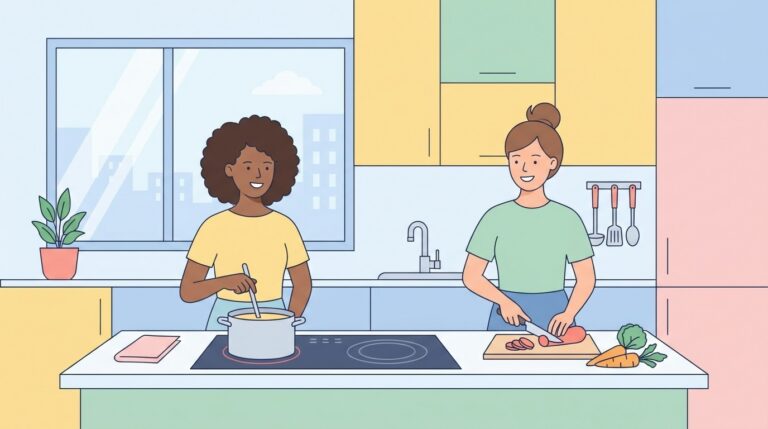
Picture this: It’s 10:30 PM on a chilly Tuesday in Seoul. You’ve just dragged yourself home from a grueling Korean language institute class or a long internship shift in Gangnam. You turn your key into the front door of your shared flat in Sinchon, braced for the quiet chill of an empty room—a familiar pang of homesickness creeping up on you. But the moment you slide off your shoes at the hyeon-gwan (entryway), the intoxicating aroma of simmering kimchi stew hits your senses. Sitting at the small kitchen table, your Korean housemate looks up with a grin and says, “밥 아직 안 먹었지? 같이 먹자! (You haven’t eaten yet, right? Let’s eat together!)”
In that single heartbeat, the suffocating loneliness of living abroad dissolves. Sharing living space with someone in a foreign country can be terrifying—nightmares of passive-aggressive sticky notes about unwashed dishes or awkward arguments over high winter heating bills are universal. But when you find a compatible housemate who matches your lifestyle rhythm, your Seoul rental ceases to be just four walls; it turns into a sanctuary.
Navigating shared living expenses (gongdong saenghwalbi) and expressing deep emotional appreciation without sounding overly dramatic or accidentally impolite requires subtle conversational finesse. Based on real feedback from international residents and students living across Korea, this practical B1-level guide will equip you with authentic, nuanced Korean phrases to turn potential friction into lifelong camaraderie.
Phase 2: Top 3 Core Expressions In-Depth
1. 마음이 잘 맞다 (Maeumi jal matda)
- Pronunciation: Mae-um-ee jal mat-da (Sounds like “my-oom-ee” + “jahl” + “maht-dah”)
- Meaning: Literal: “Our minds/hearts fit well” vs. Real Nuance: “To be on the same wavelength / To click effortlessly”
- K-Culture Moment: Seen frequently in slice-of-life K-dramas like Age of Youth (청춘시대), where diverse female roommates go from hesitant strangers to kindred spirits who can understand each other’s moods with just one glance across the breakfast table.
- Editor’s Insight: In Korean culture, relationships aren’t simply described by external traits like “she is friendly.” Instead, the harmony of inner feelings—maeum (mind/heart)—is central. When you say “마음이 잘 맞아요 (We click really well),” you indicate that your unspoken living habits, sensitivity to noise, and personal boundaries mesh naturally.
- Situation Spectrum:
- Casual: ✅ 마음이 잘 맞아 (Maeumi jal maja)
- Semi-formal: ✅ 마음이 잘 맞아요 (Maeumi jal majayo)
- Formal: ✅ 마음이 잘 맞습니다 (Maeumi jal matseumnida)
- 🤔 Think About It: In English, we often say “we get along well.” How does the Korean metaphor of two hearts physically “fitting” (맞다) like interlocking puzzle pieces reflect the collective intimacy valued in Korean co-living?
2. ~덕분에 든든해요 (~deokbune deundeunhaeyo)
- Pronunciation: Deok-boo-neh deun-deun-hae-yo (Think of the English word “duck” + “boo” + “neh”, followed by “dun-dun-hae-yo”)
- Meaning: Literal: “Thanks to [you], I feel sturdy/solid” vs. Real Nuance: “Having you around makes me feel safe, supported, and reassured”
- K-Culture Moment: That heartwarming scene in hospital or family dramas where an anxious character exhales in relief when their partner or best friend arrives with warm food, feeling that they no longer have to carry life’s heavy burdens alone.
- Editor’s Insight: 든든하다 (deundeunhada) is one of the most culturally rich adjectives in the Korean language. It originally described the pleasant physical sensation of feeling full and energized after a steaming bowl of gukbap (soup with rice). Metaphorically, it translates to an emotional fortress—knowing that if the boiler breaks or an unexpected package arrives, someone reliable has your back.
- Situation Spectrum:
- Casual: ✅ 네 덕분에 든든해 (Ne deokbune deundeunhae)
- Semi-formal: ✅ 룸메 덕분에 든든해요 (Rumme deokbune deundeunhaeyo)
- Formal: ✅ 하우스메이트 덕분에 든든합니다 (Hauseumeiteu deokbune deundeunhamnida)
- 🤔 Think About It: English speakers usually say “I’m so relieved” or “You’ve been a lifesaver.” How does tying emotional reassurance to physical groundedness and nourishment alter the emotional weight of your gratitude?
3. n분의 1로 나눠요 (En-bune il-ro nanwoyo)
- Pronunciation: En-boo-neh eel-ro nah-nwo-yo (Just say the English letter ‘N’ + Korean “boo-neh eel-ro nah-nwo-yo”)
- Meaning: Literal: “Let’s divide by 1/n” vs. Real Nuance: “Let’s split the bill evenly / Go Dutch per person”
- K-Culture Moment: The moment an apartment utility bill or bulk grocery purchase of dish soap and trash bags drops into the shared KakaoTalk room, accompanied by a casual KakaoPay transfer request.
- Editor’s Insight: While textbook Korean often teaches 더치페이 (Dutch pay), young locals overwhelmingly favor the mathematical term n분의 1 (n-bun-ui-il). It sounds lighthearted, neutral, and fair, stripping away any potential social awkwardness surrounding money discussions.
- Situation Spectrum:
- Casual: ✅ n분의 1 하자! (En-bune il haja!)
- Semi-formal: ✅ n분의 1로 나눠요. (En-bune il-ro nanwoyo.)
- Formal: ⚠️ 균등하게 분할 정산하겠습니다. (Gyundeunghage bunhal jeongsanhagesseumnida. – Better for business legal contexts)
- 🤔 Think About It: Why does adopting a mathematical idiom like “1/n” help alleviate personal discomfort during financial settlements in close-knit communities?
Phase 3: Textbook Korean vs. Real Korean
Situation 1: Expressing that your roommate is wonderful and easy to live with
- 📖 Textbook Korean: 룸메이트는 매우 친절하고 배려심이 많습니다. (Rummeyiteuneun maeu chinjeolhago baeryeosimi manseumnida. – My roommate is very kind and full of consideration.)
- 🗣️ Real Korean: 우리 룸메랑 티키타카가 진짜 잘 통해요! (Uri rumme-rang tiki-taka-ga jinjja jal tonghaeyo! – My roomie and I have incredible banter and great chemistry!)
- 💡 Why is it different?: Textbook Korean sounds like an official rental reference letter. Real Koreans love using the soccer loanword 티키타카 (tikitaka) to denote snappy, harmonious verbal and behavioral synergy between close friends.
Situation 2: Asking to divide the shared grocery or toilet paper bill
- 📖 Textbook Korean: 공동 생활비를 각자 지불합시다. (Gongdong saenghwalbireul gakja jibulhapsida. – Let us each pay the shared living expenses.)
- 🗣️ Real Korean: 이번에 장본 거 카톡 정산하기로 보낼게! (Ibeone jangbon geo katok jeongsanhagiro bonaelge! – I’ll send the split request for the groceries via KakaoPay!)
- 💡 Why is it different?: Nobody living under the same roof uses the formal business verb 지불하다 (jibulhada – to disburse/pay). Instead, modern Koreans reference fintech features like KakaoTalk’s “정산하기 (jeongsanhagi – bill split)” directly.
Phase 4: K-Culture Deep Dive & Non-Verbal Manners
4-1. 눈치 (Nunchi) & Unspoken Spatial Etiquette
In a Korean household, harmony is preserved not just through spoken words, but through perceptive awareness (nunchi). Living with a compatible housemate involves showing small, considerate micro-behaviors:
* Door Care: In studio flats (won-room) or villas, sound travels easily. Gently turning the door handle when closing bedroom or bathroom doors late at night shows supreme respect.
* Waste Sorting (Bunri-sugeo): Nothing causes housemate warfare in Korea faster than mixing food waste (eumsikmul sseuregi) with regular trash (ilban sseuregi). Proactively rinsing delivery containers before putting them into recycling reflects maturity and community spirit.
* The Two-Handed Hand-off: When passing a shared bill, grocery receipt, or a house key, handing it over using both hands (or supporting your right forearm with your left hand) softens the transaction with quiet warmth.
4-2. Culture Code: From “Roommate” to “식구 (Sikgu)”
In English, a roommate is simply someone who shares rent and a roof. But in Korean, when you bond with someone over shared food, you enter the realm of 식구 (Sikgu)—literally “eating mouths.” Historically, anyone who sits around the same low wooden table to share rice and side dishes (banchan) is family. When your housemate asks, “밥 먹었어? (Did you eat?)”, they are not prying; they are inviting you into the safety circle of jeong (deep relational affection).
Phase 5: Real-Life Roleplay Scenario
Setting: Sunday evening in the cozy communal kitchen of a shared house near Hongdae. Soft lo-fi music plays while rain taps against the window.
Characters:
* You (Yuna/유나): International student living in Seoul for six months.
* Minji (민지): Your Korean housemate who works at a design studio.
- 민지: 유나야, 주말 잘 보냈어? 오늘 날씨 진짜 쌀쌀하더라.
(Yunaya, jumal jal bonaesseo? Oneul nalssi jinjja ssalssalhadeora.)
“Yuna, did you have a good weekend? The weather was seriously chilly today.”
🎭 Takes off her wet jacket and sets down a large grocery bag on the kitchen counter. -
You: 응! 민지 너는? 비 와서 들어오기 힘들었지?
(Eung! Minji neoneun? Bi waseo deureo-ogi himdeureotji?)
“Yeah! What about you, Minji? It must have been tough coming back in the rain?”
🎭 Hands Minji a clean hand towel from the rack. -
민지: 고마워! 아, 오는 길에 마트 들러서 휴지랑 주방세제 사 왔거든.
(Gomawo! A, oneun gire mateu deulleoseo hyujirang jubangseje sa watgeodeun.)
“Thanks! Oh, on my way back I stopped by the mart and bought toilet paper and dish soap.”
🎭 Pulls out the receipt from the mart bag with a gentle smile. -
You: 와, 생필품 다 떨어졌었는데 먼저 챙겨줘서 진짜 고마워.
(Wa, saengpilpum da tteoreojyeosseonneunde meonjeo chaenggyeojwoseo jinjja gomawo.)
“Wow, we were totally out of daily supplies—thank you so much for taking care of it first.”
🎭 Carefully looks over the supplies with genuine relief. -
민지: 별말씀을! 총 이만사천 원 나왔는데, 어떻게 할까?
(Byeolmalsseumeul! Chong iman-sacheon won nawanneunde, eotteoke halkka?)
“Don’t mention it! It came out to 24,000 KRW in total—how should we handle it?”
🎭 Taps the total on the receipt. -
You: 당연히 n분의 1로 나눠야지! 지금 바로 만이천 원 보낼게.
(Dang-yeonhi en-bune il-ro nanwoyaji! Jigeum baro man-icheon won bonaelge.)
“Of course we should split it fifty-fifty! I’ll send you 12,000 KRW right now.”
🎭 Pulls out smartphone to open the banking app. -
민지: 확인했어, 빨라라! 유나랑 같이 사니까 생활비도 아끼고 진짜 편해.
(Hwaginhaesseo, ppallara! Yunarang gachi sanikka saenghwalbido akkigo jinjja pyeonhae.)
“Got it, that was fast! Living with you really saves living costs and feels so comfortable.”
🎭 Smiles warmly while putting the supplies in the cabinet. -
You: 나야말로! 타지 생활이라 외로울 줄 알았는데, 민지 덕분에 마음이 든든해.
(Nayamallo! Taji saenghwal-ira oeroul jul aranneunde, Minji deokbune maeumi deundeunhae.)
“Same here! I thought living far from home would be lonely, but thanks to you, I feel so supported and secure.”
🎭 Hands a warm mug of roasted barley tea (*boricha*) to Minji.
🔀 Interactive Decision Point
Suppose Minji bought communal groceries and mentions the cost. How do you respond?
- Option A: “영수증 찍어서 카톡으로 보내줘! 내가 바로 반 정산해서 보낼게.” (Yeongsujeung jjigeoseo katogeuro bonaejwo! Naega baro ban jeongsanhaeseo bonaelge. – “Snap a photo of the receipt and send it to KakaoTalk! I’ll split it in half and transfer it right away.”)
👉 Feedback (Best Choice): ⭐⭐⭐ Flawless! Fast, transparent, and eliminates any financial hesitation. This cements trust immediately. - Option B: “다음에 내가 장볼 때 살 테니까 이번엔 그냥 넘어가자!” (Daeume naega jangbol ttae sal tenikka ibeonen geunyang neomeogaja. – “I’ll buy next time when I go grocery shopping, so let’s skip splitting it this time!”)
👉 Feedback (Risk): ⚠️ Unless you have lived together for years, balancing unspecified future purchases easily creates resentment if spending amounts differ. - Option C: “그건 네가 주로 쓰는 거니까 네가 더 내야 하는 거 아니야?” (Geugeon nega juru sseuneun geonikka nega deo naeya haneun geo aniya? – “Since you use that more, shouldn’t you pay more?”)
👉 Feedback (Bad Choice): ❌ Overly confrontational for minor communal items like dish soap or paper towels. It creates an instant chill in the household.
Phase 6: 10-Second Emotion Shadowing Drill
Practice reading these out loud, pausing briefly at each slash (/), and channeling the exact emotion indicated in the bracket!
[😊 Genuinely relieved and joyful]
너랑 / 하우스메이트가 돼서 / 타지 생활이 / 하나도 안 외로워!
(Neorang / hauseumeiteuga dwaeseo / taji saenghwali / hanado an oerowo!)
“Becoming housemates with you / makes living abroad / not lonely at all!”-
[🤝 Cool, fair, and organized]
공동 생활비는 / 영수증 확인하고 / 깔끔하게 n분의 1로 / 정산하자.
(Gongdong saenghwalbineun / yeongsujeung hwaginhago / kkalkkeumhage en-bune il-ro / jeongsanhaja.)
“As for shared living expenses, / let’s check the receipt / and split it cleanly / fifty-fifty!” -
[🥺 Deeply touched and sincere]
혼자였으면 힘들었을 텐데, / 네 덕분에 / 마음이 진짜 든든해.
(Honjayeosseumyeon himdeureosseul tende, / ne deokbune / maeumi jinjja deundeunhae.)
“If I were alone it would’ve been so hard, / but thanks to you, / I feel so grounded and reassured.”
Phase 7: K-Culture Mini Dictionary
- 정산 (Jeongsan) | Financial Settlement / Bill Splitting
Usage: The go-to word whenever communal expenses (gas, electricity, toilet paper) are calculated and divided among group members. - 분리수거 (Bunniseugeo) | Separate Garbage Disposal / Recycling
Usage: A civic necessity in Korea. Mastering bunri-sugeo alongside your flatmate is the supreme sign of domestic harmony. - 식구 (Sikgu) | People Who Eat Together / Household Family
Usage: More affectionate than the cold word donggeoin (cohabitant); it honors roommates who regularly share dining moments. - 티키타카 (Tikitaka) | Rapid Banter / Instant Conversational Chemistry
Usage: Borrowed from Spanish football tactics, this buzzword describes housemates who effortlessly bounce jokes and thoughts back and forth without awkward pauses.
Phase 8: Survival Kit for Travelers & Expats
Top 3 Survival Phrases
- 생필품 같이 주문할까요?
(Saengpilpum gachi jumunhalkkayo?)
“Shall we order household essentials together?”
Pro Tip: Use Coupang Rocket Delivery together to hit free shipping thresholds and save cupboard space. - 이번 달 관리비 정산 링크 보내주세요!
(Ibeon dal gwallibi jeongsan ringkeu bonaejuseyo!)
“Please send the settlement link for this month’s maintenance bill!”
Pro Tip: Perfect for politely prompting your master-tenant or roommate without sounding impatient. - 오늘 저녁 같이 먹을래요? 제가 쏠게요!
(Oneul jeonyeok gachi meogeullaeyo? Jega ssolgeyo!)
“Would you like to have dinner together tonight? My treat!”
Pro Tip: Using 제가 쏠게요 (jega ssolgeyo – I’ll shoot/treat) is a guaranteed icebreaker after a stressful week.
Editor’s Travel & Expat Note
Living in Korea means embracing seamless digital infrastructure. When sharing living expenses, nobody exchanges physical paper bills. Make sure to complete your alien registration and set up a local bank account so you can install the official KakaoTalk app download on Google Play Store. With KakaoPay’s built-in “정산하기 (1/N Split)” feature, you can send direct payment links to your flatmates in one second flat without needing their 14-digit bank account numbers.
Phase 9: “One Step Deeper” (Cultural Reflection)
In many Western cultures, a roommate agreement begins with strict legalistic boundaries: “This shelf is mine, that milk is yours, and don’t touch my laundry detergent.” While personal space is increasingly respected in modern Korea, the traditional undercurrent leans toward 우리 (uri – “we/our”). When Koreans share an apartment, the boundary between “mine” and “yours” gently blurs into shared care. When your housemate boils soup, they naturally make enough for two. A housemate who feels 든든하다 is not just a co-signer on a lease; they are your anchor against the solitary nature of city life in Seoul.
💬 Your Turn: Have you ever experienced a moment with a friend or roommate where you realized you “click” (마음이 잘 맞다)? Share your favorite housemate story or roommate pet peeves in the comments below!
Phase 10: FAQ & Common Misconceptions
Q: Can I use “n분의 1” when talking to someone older than me or my landlord?
A: Be careful! “n분의 1 하자” is strictly informal and casual. If you are discussing bill division with someone significantly older, a landlord, or in a formal meeting, say: “반씩 나누어 정산하겠습니다 (We will settle it by dividing it in half)” or “각자 부담하겠습니다 (Each will cover their own share).”
Q: What is the exact difference between “고마워요 (Thank you)” and “든든해요 (I feel supported)”?
A: “고마워요” thanks someone for a specific action (e.g., “Thanks for washing the cup”). In contrast, “든든해요” praises the person’s presence and the peace of mind they provide you over time. Saying “네 덕분에 든든해” is a much deeper emotional compliment.
Q: What should I do if my housemate repeatedly forgets to send their share of the utility bill?
A: Avoid angry confrontations. Use gentle, indirect phrasing: “혹시 지난달 가스비 정산 확인하셨나요? 바쁘신 것 같아서 살짝 말씀드려요! (By any chance, did you check last month’s gas bill settlement? Just gently letting you know in case you’ve been busy!)”
🚨 Common Mistakes Alert
- Confusing ‘덕분에’ with ‘때문에’:
- Wrong: 룸메이트 때문에 든든해요 (Sounds accusatory; 때문에 is often paired with blame).
- Correct: 룸메이트 덕분에 든든해요 (덕분에 is exclusively reserved for positive outcomes and gratitude).
- Using “더치페이” in everyday peer conversations:
- While understood, saying “우리 더치페이 해요” can sound slightly outdated. Stick to “반반씩 나눠요” or “n분의 1 해요.”
- Saying “마음이 맞다” without “잘”:
- Always add 잘 (well). Saying “우리 마음이 잘 맞아요” flows far more naturally to native ears than simply “우리 마음이 맞아요.”
Phase 11: Action Missions
- 🥉 Bronze Mission (Solo Practice): Stand in front of your mirror and practice the emotion shadowing drill from Phase 6 three times with genuine facial expressions.
- 🥈 Silver Mission (Social Sharing): Post a photo of your cozy room, a warm home meal, or a favorite mug on Instagram/Threads and caption it: “좋은 하우스메이트 덕분에 마음이 든든해요! 🏠✨”
- 🥇 Gold Mission (Real-Life Application): The next time you split a bill for groceries, coffee, or snacks with a friend, casually suggest: “우리 이거 n분의 1로 나눠요!”
- 🎮 K-Culture Watch Mission: Watch an episode of a co-living reality show (like Heart Signal or Roommate) or K-drama Age of Youth. Listen carefully for when characters share food and spot how often they use words like 정산, 같이, and 덕분에!
Phase 12: Interactive Quiz Challenge
Q1. [Scenario Judgment]
Your Korean housemate stayed up late to help you translate an urgent lease document. You want to thank them and express how emotionally reassuring and safe they make you feel living in Seoul. What is the most natural B1-level expression?
* A) 룸메이트 씨는 문서를 잘 번역합니다.
* B) 덕분에 타지 생활이 외롭지 않고 정말 든든해요!
* C) 다음부터는 제가 직접 번역기를 돌리겠습니다.
👉 Click to Reveal Answer & Explanation
Correct Answer: B
Explanation: Option B (덕분에 타지 생활이 외롭지 않고 정말 든든해요!) perfectly conveys heartfelt gratitude, emotional security, and appreciation for their presence. Option A sounds like an aloof performance review, while Option C sounds cold and dismissive!
Q2. [Fill in the Blank]
Complete the sentence to mean: “Let’s check the grocery receipt and split it evenly (1/n).”
“장본 영수증 확인하고 깔끔하게 ( )로 나눠요.”
👉 Click to Reveal Answer & Explanation
Correct Answer: n분의 1 (or 엔분의 일)
Explanation: The full sentence is: “장본 영수증 확인하고 깔끔하게 n분의 1로 나눠요.” This is the definitive modern phrase for splitting communal living costs evenly.
Q3. [True or False Cultural Quiz]
In Korean shared living culture, calling your housemates 식구 (Sikgu) implies that you have signed a legally binding family registry document.
* True
* False
👉 Click to Reveal Answer & Explanation
Correct Answer: False
Explanation: 식구 literally translates to “eating mouths.” While it traditionally denotes family members who live together, young roommates affectionately use it metaphorically to describe the warmth of sharing regular meals together under one roof!







