

Phase 1: Empathy & Narrative Immersion
안녕하세요! 매일한글 에디터입니다. (Hello! It’s your Daily Hangul editor.)
Picture this: It is 11:30 PM on a brisk Friday in Seoul. You have retreated to your cozy studio apartment after a grueling week, eager to indulge in a midnight snack—a legendary staple of K-drama binge-watchers everywhere. You pull out a bag of frozen CJ Bibigo king dumplings (왕교자) or perhaps a pack of cheese-stuffed Korean corn dogs. You shove them into your air fryer, crank up the dial, wait fifteen minutes, and eagerly bite in… only to be met with a lukewarm, leather-tough exterior and a half-frozen filling. The culinary tragedy of a soggy, limp frozen snack (눅눅한 냉동식품) is a universal frustration, especially when Korean food culture treats crispiness as high art.
At a C2 level, you are no longer satisfied with merely asking “이거 어떻게 요리해요?” (How do I cook this?). You want to articulate the micro-textures of Korean gastronomy, master colloquial appliance vernacular, and command native discourse around modern culinary shortcuts. Drawing directly from real-life feedback from our advanced learners living in Korea, this guide delivers the nuanced expressions, non-verbal subtleties, and sociological contexts necessary to master the undisputed sovereign of modern Korean kitchens: the air fryer. Let’s ensure your frozen snacks achieve culinary nirvana every single time.
Phase 2: Core Expressions Deep Dive
1. 겉바속촉 (Geot-ba-sok-chok)
- Pronunciation: Geot-ba-sok-chok (Think of the quick staccato snapping of dry twigs: guht-bah-sohk-chohk)
- Meaning: Literal: Outside crispy, inside moist. / Actual Nuance: The golden standard of modern Korean culinary texture—revered as the pinnacle of fried or roasted food perfection.
- K-Culture Moment: Seen ubiquitously on mukbang YouTube channels and variety shows like Stars’ Top Recipe at Fun-Staurant (신상출시 편스토랑) when judges assess whether an air-fried dish retains succulent moisture without sacrificing audible crunch.
- Editor’s Insight: This portmanteau (겉은 바삭하고 속은 촉촉하다) transcended foodie slang to enter standard cultural lexicon. At the C2 tier, note that using this demonstrates you understand the sensory hierarchy of Korean dining.
- Situation Spectrum: Casual ✅ | Semi-formal ✅ | Formal ⚠️
- 🤔 Think About It: English often relies on separate descriptive sentences (“crisp exterior with a juicy center”), whereas Korean collapses multi-sensory experiences into punchy compound neologisms. What does this reveal about Korea’s trend-driven, hyper-efficient communicative culture?
2. 기름을 살짝 둘러야 풍미가 살아요 (Gireum-eul saljjak dulleoya pungmiga sarayo)
- Pronunciation: Gireum-eul saljjak dulleoya pungmiga sarayo (Glide through dulleoya like “doo-luh-yah”, where the tongue curls gently behind your upper teeth)
- Meaning: Literal: You must circle oil slightly for the flavor to live. / Actual Nuance: “A light drizzle or spray of oil is essential to bring out the authentic richness.”
- K-Culture Moment: Common in cooking vlogs where hosts caution that completely dry air-frying ruins frozen dough, advising a silicone brush or spray oil coat.
- Editor’s Insight: The verb 살다 (to live) paired with 풍미 (flavor profile) elevates the sentence from a simple recipe instruction to refined gastronomic commentary. It conveys that the flavor isn’t just present—it’s vibrant and active.
- Situation Spectrum: Casual ✅ | Semi-formal ✅ | Formal ✅
- 🤔 Think About It: Contrast the English passive “the flavor is enhanced” with the dynamic Korean active verb 살아나다 / 살다 (the flavor comes to life). How does this linguistic animacy reflect animistic roots in Korean sensory descriptions?
3. 덜 익었으니까 뒤집어서 5분만 더 돌려요 (Deol igeosseunikka dwijibeoseo obunman deo dollyeoyo)
- Pronunciation: Deol igeosseunikka dwijibeoseo obunman deo dollyeoyo (Pronounce dollyeoyo like “dol-lee-yuh-yo”, mimicking the whirring rotation of a mechanical dial)
- Meaning: Literal: Because it is undercooked, flip it and turn/spin it for five more minutes. / Actual Nuance: “It’s still raw in the center—flip it over and pop it back in the air fryer for another five minutes.”
- K-Culture Moment: Uttered casually among roommates or friends sharing a late-night feast during a weekend sleepover.
- Editor’s Insight: 돌리다 literally means “to rotate” or “spin”. While originally derived from the rotating glass plates in microwave ovens, Koreans seamlessly transferred 돌리다 to air fryers, washing machines, and even blenders. Using 작동시키다 (to operate) in this context sounds pedantic and robotic.
- Situation Spectrum: Casual ✅ | Semi-formal ✅ | Formal 🚫
- 🤔 Think About It: Reflect on how your native language adapts physical mechanical verbs to digital, stationary kitchen tech. Why does 돌리다 feel so intimately linked to convenience appliances in Korea?
Phase 3: Textbook Korean vs. Real Korean
Situation 1: Evaluating the Crispiness of Dumplings
- 📖 교과서 한국어 (Textbook):
만두가 바삭바삭하게 잘 튀겨졌습니다. (Manduga basakbasakhage jal twigyeojeotseumnida. / “The dumplings have been fried very crisply.”) - 🗣️ 진짜 한국어 (Real-World Native):
겉바속촉의 정석이네요! 육즙이 하나도 안 빠져나갔어요. (Geotbasokchogui jeongseogineyyo! Yukjeubi hanado an ppajyeonagasseoyo. / “This is the absolute textbook definition of crispy outside, juicy inside! The juices haven’t dried out at all.”) - 💡 왜 다를까? (Why the divergence?):
Textbook Korean relies on basic onomatopoeia (바삭바삭) and standard passive verbs (튀겨지다). Educated native speakers employ cultural archetypes like ~의 정석 (the golden standard / textbook example) to express discerning culinary taste.
Situation 2: Giving Appliance Instructions to a Friend
- 📖 교과서 한국어 (Textbook):
에어프라이어 작동 버튼을 눌러서 180도에서 가열하세요. (Eeopeuraiyeo jakdong beoteuneul nulleoseo baekpalsipdoeseo gayeolhaseyo. / “Press the air fryer operation button and heat at 180 degrees.”) - 🗣️ 진짜 한국어 (Real-World Native):
에프 180도에 맞춰놓고 딱 10분만 돌려봐. (Epeu baekpalsipdoe matchwonoko ttak sipbunman dollyeobwa. / “Set the air fryer to 180 and just run it for 10 minutes.”) - 💡 왜 다를까? (Why the divergence?):
Native speakers consistently abbreviate compound foreign loanwords (에어프라이어 becomes 에프). The phrase 돌려봐 embodies casual imperative intimacy combined with experimental suggestion (-아/어 보다).
Phase 4: K-Culture Deep Dive & Non-Verbal Nuances
4-1. Nunchi & Physical Gestures
When eating straight out of an air fryer with Korean peers, mind the rhythm of hospitality and communal sharing. Because air-fried items emerge blisteringly hot, never stab the item immediately and cram it into your mouth—it looks gluttonous. Instead, use your metal chopsticks to gently tap the surface twice (탁-탁). This subtle physical gesture serves two purposes: it creates an audible resonance proving the crunch factor (바삭함) to everyone around, and tests if the crust has hardened adequately.
When taking that first piping-hot bite, cup your free hand under your chin like an impromptu saucer (손받침), gently fanning your mouth while emitting an appreciative, breathless exhale (하- 후-). This is not considered rude; it signals to your host or companion that the food is freshly cooked, steaming, and exceptionally delicious.
4-2. The Cultural Code: The “Jachwisaeng” (자취생) Ecosystem
The stratospheric rise of the air fryer in South Korea is intrinsically tied to the explosion of single-person households (1인 가구 or 자취족). Compact Korean apartments rarely feature full-sized ovens; traditionally, Korean cuisine utilizes boiling, stewing, grilling, and fermenting rather than baking. The air fryer bridged this structural gap. Major food conglomerates like CJ CheilJedang, Pulmuone, and Ottogi redesigned their entire frozen portfolio specifically with “Air Fryer Optimized” (에어프라이어 전용) badges on packaging.
Moreover, the rise of modern 꿀조합 (honey combinations—creative viral food pairings) spawned an entire subculture where young Koreans compete on Instagram and YouTube to invent air-fryer lifehacks, such as roasting frozen homestyle tteok wrapped in pork belly or transforming convenience store frozen mandu into luxury gourmet dishes.
Phase 5: Real-World Roleplay Scenario
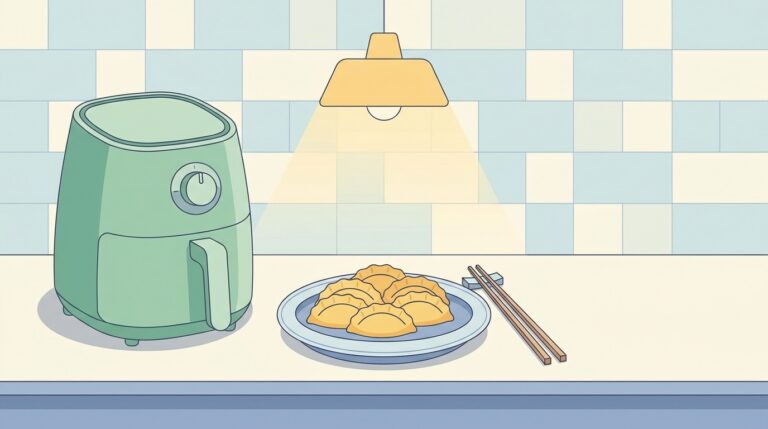
Setting: A stylish, dimly lit studio apartment (오피스텔) in Mapo-gu, Seoul. Rain patters against the double-glazed window. Min-woo (민우), a 28-year-old UX designer and self-proclaimed midnight gourmet, stands over his pastel olive-green air fryer alongside you.
1. 민우: 비도 오는데, 냉동고 털어서 야식이나 만들어 먹을까요? (Bi-do oneunde, naengdonggo teoreoseo yasigina mandeureo meogeulkkayo? / “Since it’s raining, shall we raid the freezer and whip up a late-night snack?”)
🎭 Looks expectantly into the freezer with a playful grin, holding up a frozen pack of pork katsu and thin-skin mandu.
2. You: 완전 찬성이에요! 에어프라이어로 바삭하게 살릴 수 있는 메뉴가 뭐 있죠? (Wanjeon chanseong-ieyo! Eeopeuraiyeoro basakhage sallil su inneun menyuga mwo itjyo? / “Totally down! What menu can we bring back to crispy life with the air fryer?”)
🎭 Nod enthusiastically while pulling out the air fryer basket.
3. 민우: 이 얇은피 만두랑 치즈 핫도그가 제격이에요. 근데 이거 그냥 넣으면 퍽퍽해지는 거 알죠? (I yalbeunpi mandurang chijeu hatdeoguga jegyeogieyo. Geunde igeo geunyang neo-eumyeon peokpeokhaejineun geo aljyo? / “These thin-skin dumplings and cheese hot dogs are spot-on. But you know that if we just chuck them in as is, they get bone-dry, right?”)
🎭 Taps the frozen dumpling package warningly with his index finger.
4. You: 그럼요. 오일 스프레이로 기름 살짝 둘러서 코팅해야 겉바속촉이 되잖아요. (Geureomyo. Oil seupeureiro gireum saljjak dulleoseo kotinghaeya geotbasokchogi doejanayo. / “Naturally. You’ve gotta mist them lightly with oil spray to coat them so they get crispy outside and juicy inside.”)
🎭 Mimics an oil-spraying wrist action with knowledgeable confidence.
5. 민우: 오, 제대로 아시네요! 그럼 180도에 10분 맞추고 먼저 돌릴게요. (O, jedaero asineyyo! Geureom baekpalsipdoe sipbun matchugo meonjeo dollyeolkeyo. / “Oh, you really know your stuff! Then I’ll set it to 180 and spin it for 10 minutes first.”)
🎭 Spins the temperature dial and clicks the timer into place with satisfaction.
6. You: 중간에 한 번 열어서 뒤집어줘야 골고루 익어요. (Junggan-e han beon yeoreoseo dwijibeojwoya golgoru igeoyo. / “We have to open it halfway through and flip them so they cook evenly.”)
🎭 Glances at the digital timer, setting down tongs on a clean dish.
7. 민우: 맞아요, 안 뒤집으면 아랫부분만 눅눅해지니까요. 땡 소리 나면 바로 확인해 봐요. (Majayo, an dwijibeomyeon araetbubunman nungnukhaejinikkayo. Ttaeng sori namyeon baro hwaginhae bwayo. / “Spot on. If we don’t flip them, only the bottoms turn soggy. Let’s check them the second it dings.”)
🎭 Rubs his hands together in delicious anticipation as the warm air fryer fan hums.
8. You: 냄새 벌써 대박이네요. 시원한 맥주 미리 꺼내둘게요! (Naemsae beolsseo daebagineyo. Siwonhan maekju miri kkeonaedulkeyo! / “The aroma is already unbelievable. I’ll get some cold beers out ahead of time!”)
🎭 Heads toward the fridge with a broad smile.
🔀 Interactive Choice Point
The air fryer dings (땡!). You slide the basket out. The top surface looks slightly pale, and the dumpling edges aren’t deeply browned yet. Min-woo reaches for a pair of tongs to plate them. How do you respond?
- Option A: “아직 색깔이 덜 났어요. 올리브유 살짝 덧바르고 200도로 올려서 3분만 바짝 더 돌리죠!” (Ajik saekkkari deol nasseoyo. Ollibeuyu saljjak deotbareugo ibaekdoro ollyeoseo sambunman bajjak deo dollijo! / “The color hasn’t fully developed yet. Let’s brush a touch more olive oil on, crank it to 200, and give it an intense 3 more minutes!”)
- Option B: “안 익은 것 같으니까 전자레인지에 넣고 2분 동안 강하게 돌려버려요.” (An igeun geot gateunikka jeonjareinjie neoko ibun dongan ganghage dollyeobeoryeoyo. / “It seems raw, so let’s throw it into the microwave and blast it for 2 minutes.”)
- Option C: “기다리기 현기증 나니까 그냥 이대로 먹어요. 속은 다 익었을 거예요.” (Gidarigi hyeongijeung nanikka geunyang idaero meogeoyo. Sogeun da igeosseul geoyeyo. / “I’m feeling dizzy waiting, let’s just eat it like this. The inside is probably cooked.”)
Strategic Feedback:
- Option A (Best): Pure gastronomic sophistication! You correctly diagnosed lack of Maillard browning (색깔이 덜 났다), used accurate culinary adverbs (바짝), and proposed raising the temperature for crisping. Min-woo will be profoundly impressed by your cooking instincts.
- Option B (Bad): Culinary sacrilege! Putting air-fried crust into a microwave introduces steam condensation, destroying the crunchy exterior and making the pastry hopelessly rubbery (질겨짐).
- Option C (Risk): Culturally impatient. While 빨리빨리 (hurry-hurry) is celebrated, cutting corners on the texture of fried food violates the cardinal pursuit of 겉바속촉. You risk cold dumpling center and mild indigestion.
Phase 6: 10-Second Emotional Shadowing Drill
Master the rhythm of Korean kitchen banter. Emphasize pauses at / and mirror the indicated emotive cadence.
[🤤 군침을 삼키며 감탄하듯이 - Drooling with sensory admiration]
와, / 냄새 장난 아니다… / 겉은 바삭하고 / 속은 진짜 촉촉해!
(Wa, / naemsae jangnan anida… / Geoteun basakhago / sogeun jinjja chokchokhae!)
“Whoa, / the smell is unreal… / The outside is so crispy / and the inside is seriously succulent!”-
[🧐 진지하고 단호하게 요리 훈수 두듯이 - Sternly giving pro-chef advice]
기름 안 바르고 그냥 돌리면 / 수분 다 날아가서 / 돌덩이처럼 딱딱해져요.
(Gireum an bareugo geunyang dollimyeon / subun da naragaseo / doldeong-icheoreom ttakttakhaejyeoyo.)
“If you run it without applying oil / all the moisture evaporates / and it turns rock-hard.” -
[💡 깨달음을 얻고 적극적으로 제안하며 - Eureka moment with bright enthusiasm]
아, / 종이호일을 깔면 / 설거지는 편한데 / 바삭함은 좀 떨어지거든요!
(A, / jongi-hoil-eul kkalmyeon / seolgeojineun pyeonhande / basakham-eun jom tteoreojigeodeunyo!)
“Ah, / if you line it with parchment paper / clean-up is easy, / but you lose some crispiness, you see!”
Phase 7: K-Culture Mini Dictionary
-
에프 (Ep-peu)
- Definition: High-frequency truncation of 에어프라이어 (Air Fryer).
- Usage: Essential for modern residential speech. Example: “이거 에프에 몇 분 돌려야 돼?” (“How many minutes do I spin this in the air fryer?”)
- 꿀조합 (Kkul-jo-hap)
- Definition: Literal “Honey Combination”—a magical pairing of food items that creates an elevated taste sensation.
- Usage: Widely used when pairing air-fried frozen foods with convenience store items (e.g., air-fried frozen dumplings paired with spicy Buldak noodles).
- 해동 (Hae-dong)
- Definition: Thawing or defrosting.
- Usage: Crucial culinary grammar: “자연 해동” (natural room-temp thawing) vs “전자레인지 해동” (microwave defrosting). In air frying, natives often advise: “해동하지 말고 냉동 상태 그대로 돌리세요” (“Don’t thaw it; run it frozen as is”).
- 종이호일 (Jong-i-ho-il)
- Definition: Parchment paper / baking paper silicone sheets specifically tailored for air fryers.
- Usage: A debate catalyst. Using it saves cleaning time but traps escaping oil underneath, compromising the coveted bottom-crust crispiness.
Phase 8: Traveler & Expat Survival Kit
Top 3 Grocery Survival Phrases
- 에어프라이어 전용 상품은 어디에 진열되어 있나요?
(Eeopeuraiyeo jeonyong sangpum-eun eodie jinyeoldoeeo innayo?)
Pro Tip: Use this at large marts like Emart or Homeplus to locate frozen goods specifically formulated with oil-infused crusts. -
이거 냉동 상태 그대로 조리해도 속까지 잘 익나요?
(Igeo naengdong sangtae geudaero jorihaedo sokkkaji jal ingnayo?)
Pro Tip: Perfect when asking food counter clerks whether thick meats or dumplings need pre-thawing before air frying. -
남은 거 포장해 주실 수 있나요? 집에서 에프로 데워 먹으려고요.
(Nameun geo pojanghae jusil su innayo? Jibeseo epeuro dewo meogeuryeogoyo.)
Pro Tip: At fried chicken (치킨) joints, this polite request signals that you know how to revive leftover fried food at home like a seasoned local.
Editor’s Expat Travel Note
When shopping for food in Korea, don’t rely on generic search engines. Install the Market Kurly Delivery App or Baemin B-Mart Grocery Service for lightning-fast late-night delivery of artisanal frozen items (밀키트). Look out for items marked 에프 조리 추천 (Air fryer cooking recommended). Also, pay attention to Korean trash sorting (분리수거): greasy parchment paper (종이호일) cannot be recycled as paper—it belongs strictly in the regular domestic burnable waste bag (종량제 봉투)!
Phase 9: “A Step Deeper” (한 발 더 깊이)
In classical Joseon Dynasty households, the hearth (아궁이) was the metaphysical heart of the home, carefully protected and shared by the collective family unit. Today, the compact, humming air fryer quietly represents the culinary autonomy of Korea’s hyper-individualized single-person generation (1인 가구). Transforming uninspiring frozen foods into warm, sensory delights within the confines of a modest officetel is not merely about nutrition—it is a deeply therapeutic ritual of modern self-care (소확행 – small but certain happiness). By reclaiming textures like 겉바속촉 in their private sanctuaries, young Koreans assert warmth and dignity amidst high-density urban isolation.
💬 Your Turn: 여러분의 나라에서는 에어프라이어로 어떤 냉동 식품을 가장 자주 요리하시나요? 한국의 ‘겉바속촉’처럼 여러분의 모국어에서 음식의 식감을 가장 생생하게 표현하는 단어가 있다면 댓글로 공유해 주세요! (In your home country, what frozen foods do you air-fry most often? Does your native language have a vivid word for texture like Korea’s 겉바속촉? Share in the comments below!)
Phase 10: FAQ & Common Pitfalls
Q: Why do native Koreans use ‘돌리다’ (to spin/turn) instead of ‘굽다’ (to bake/roast) when using an air fryer?
A: Linguistically, Korean speakers heavily associate modern electrical appliances featuring dials, timers, or interior motorized elements (like rotating fans or turntables) with the mechanical verb 돌리다. While the food itself is technically undergoing a roasting or baking process (구워지다), the human action directing the machine is framed as 기계를 돌리다 (running/spinning the machine). Thus, “180도에 15분 돌려” sounds effortlessly natural, whereas “180도에서 15분 구워” sounds like a formal recipe book.
Q: Is parchment paper (종이호일) considered a culinary sin among Korean home cooks?
A: Not a sin, but a polarizing trade-off! Cooks divide into two camps: the “Convenience Camp” (편의파), who line the basket with parchment paper to avoid washing greasy grates, and the “Crispy Purists” (바삭파), who insist that lining the bottom traps rendered pork lard and vegetable moisture, leaving the food soggy on the bottom (밑면이 눅눅해짐). The advanced native solution? Cook it on the bare grate for 80% of the time, then slide parchment paper in only if melting cheese is involved.
Q: What is the exact difference between ‘바삭하다’ and ‘파삭하다’?
A: At C2, sensory nuances are everything. 바삭하다 indicates a firm, audible, satisfying crunch—like biting into a well-fried panko pork katsu or golden dumpling. 파삭하다, on the other hand, describes an ultra-light, brittle, fragile crispness that dissolves instantly, reminiscent of paper-thin pastry flakes, dried seaweed sheets, or French mille-feuille.
🚨 Common Mistakes (외국인 학습자의 흔한 실수)
- Overusing “요리하다” for simple air frying:
- Incorrect: 오늘 밤에 에어프라이어로 만두를 요리할 거예요. (Sounds overly grandiose, like preparing an elaborate culinary banquet).
- Correct Action: 오늘 밤에 에프에 만두 좀 돌려먹으려고요. (Natural, relaxed, colloquial).
- Confusing “눅눅하다” and “축축하다”:
- Mistake: 만두 피가 축축해서 맛이 없어요. (축축하다 implies unpleasantly soaked/damp like rain-soaked socks).
- Correct Action: 만두 피가 눅눅해서 아쉬워요. (눅눅하다 accurately denotes loss of crispiness in food products).
- Neglecting Pre-heating (예열):
- Mistake: Skipping pre-heating and wondering why frozen food steams instead of crisps.
- Correct Action: Always say: “바삭하게 하려면 무조건 3분 예열부터 해야 돼.” (“To make it crispy, you unconditionally have to preheat for 3 minutes first.”)
Phase 11: Action Missions & Cultural Immersion
- 🥉 Bronze Mission (Solo Shadowing):
Record an audio note describing your favorite snack using the three essential descriptors: 겉바속촉, 기름을 두르다, and 돌리다. Focus on the staccato ending of 촉! - 🥈 Silver Mission (Community Engagement):
Go to Instagram or Threads, search the Korean hashtag#에어프라이어꿀조합(Air fryer honey combinations), find one recipe photo that looks appetizing, and leave a native comment: “와, 완전 겉바속촉 비주얼이네요! 저장해 두고 꼭 돌려먹어 볼게요.” - 🥇 Gold Mission (Real-World Execution):
The next time you visit a Korean supermarket or convenience store, purchase a frozen food product featuring the label 에어프라이어 전용. Cook it, and share a photo with a caption assessing whether it successfully achieved 겉바속촉의 정석. - 🎮 K-Culture Mission:
Watch an episode of MBC’s reality show I Live Alone (나 혼자 산다). Tally how many times cast members either use the appliance 에프 or utter the verb 돌리다 when fixing late-night snacks!
Phase 12: Interactive Mastery Quiz Challenge
Test your high-level cultural discernment! Choose your answers before unfolding the solutions.
1. Situational Judgment
Your Korean friend is about to dump bone-dry, store-bought frozen dumplings directly into a cold, un-preheated air fryer basket without any oil. What is the most natural and diplomatically sophisticated C2 phrase to guide them?
* (A) 그거 그렇게 요리하면 기계가 망가지니까 절대 하지 마세요.
* (B) 잠깐만! 그렇게 그냥 돌리면 수분 다 날아가서 퍽퍽해져. 오일 살짝 뿌리고 예열부터 하자.
* (C) 만두는 프라이팬에서만 튀겨야 전통적인 미각을 보존할 수 있어.
2. Fill-in-the-Blank
완벽한 식감을 만들려면 에어프라이어 바스켓에 만두가 서로 겹치지 않게 (________) 놓고 중간에 한 번 (________) 주어야 골고루 바삭해진다.
(To create the perfect texture, dumplings should be placed without overlapping in the air fryer basket in a [__________] manner, and [__________] once halfway through to crisp evenly.)
3. Cultural True or False
In colloquial Korean domestic conversation, saying “전자레인지나 에프 좀 작동시켜 주세요” is considered the most native and warm way to ask your close roommate to heat food.
* [True / False]
🔍 Click here to reveal the answers and explanations!
- Answer: (B)
- Explanation: Option (B) captures flawless natural register. It uses accurate food terminology (수분이 날아가다 – moisture evaporating; 퍽퍽해지다 – becoming dry/leathery) while pairing it with the authentic lifestyle verbs 돌리다 and 예열하다.
- Answer: 가지런히 (or 여유 있게) / 뒤집어
- Explanation: 가지런히 means neatly, orderly in a row without overlapping; 뒤집어 주다 means flipping the food over so heat distributes evenly.
- Answer: False
- Explanation: 작동시키다 is far too clinical, mechanical, and formal for an intimate domestic environment. A real native would say: “전자레인지나 에프에 좀 돌려줘” (Run it in the microwave or air fryer for me). Using overly formal vocabulary with close friends creates social distance (거리감).







