

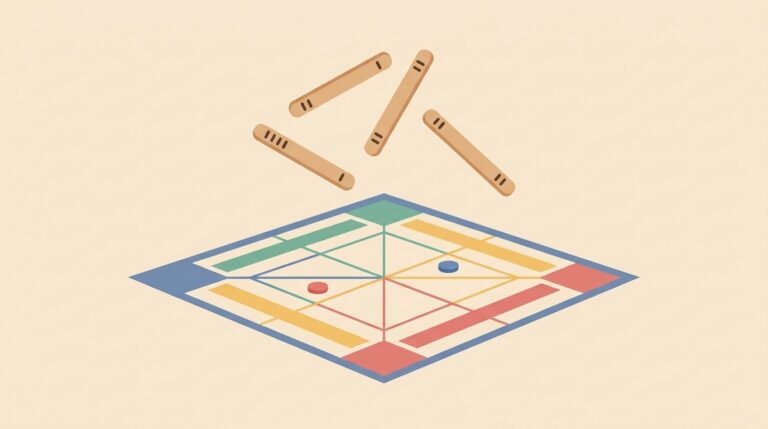
Master the Strategic Art of Korean Yut Nori: Rules, Board Tactics, and Authentic Banter
Phase 1: Empathy (Story-Driven Opening)
안녕하세요! This is your Daily Hangul editor.
Picture this: It is Lunar New Year (Seollal) afternoon in a cozy, sunlit Seoul apartment. The aroma of simmering tteokguk (rice cake soup) still lingers, but the serene family vibe has evaporated into raw, electrifying tension. You are gathered around a woven straw mat (meongseok) with your Korean host family or friends. Four smoothed wooden sticks clatter onto the fabric. Someone screams, “잡았다!” (Jabatda! / Got them!), another groans in comedic despair, and a grandmother calmly rearranges three cloth tokens (mal) onto a single junction, murmuring, “인생은 한 방이야” (Life is all or nothing).
You might have initially thought Yut Nori (윷놀이) was a simple children’s dice game. But as the sticks fly, you quickly realize it is a high-stakes psychological battlefield of probability, communal risk-taking, and ruthless spatial maneuvering on the malpan (말판, board). Many advanced Korean learners hit a wall here: while they know basic vocabulary, they struggle to keep up with the lightning-fast tactical banter, the intricate terminology of grouping tokens (eopgi), or knowing when a casual remark crosses into holiday family heresy.
This comprehensive guide is designed precisely for C1-level learners who want to move past simply rolling sticks and step into the mindset of a master tactician. Drawing from real cultural mentoring sessions and native holiday gaming rituals, this guide equips you with the exact phrases, cultural non-verbal cues, and linguistic nuances needed to command the board like a seasoned local.
Phase 2: Core Expressions Deep Dive
Here are the three foundational tactical phrases every player must master to orchestrate the board with native-level fluency.
1. 말을 업다 (Mareul eopda)
- Pronunciation: [Mah-reul eop-da] (Think of the English verb “up” combined with the Korean sound eop as in upset).
- Meaning: Literal: “To carry a piece on one’s back.” / Nuanced: To stack multiple tokens together on the same space so they move as a single unit, doubling both progress and risk.
- K-Culture Moment: Seen frequently in variety shows like Run BTS or 2 Days & 1 Night when a team desperately trails behind and gambles everything on stacking three tokens to rush toward the exit in a single turn.
- Editor’s Insight: The verb 업다 (to carry someone on your back, typically a child or an injured loved one) carries deep emotional intimacy in Korean society. Translating this to game pieces underscores how Korean culture personifies game markers as living entities embarking on a perilous shared journey.
- Situation Spectrum: Casual: ✅ | Semi-formal: ✅ | Formal: ⚠️
- 🤔 Think About It: In Western board games like Chess, stacking pieces to share vulnerability is rare; pieces defend or replace each other. Why do you think Korean gaming philosophy embraces the collective vulnerability of “carrying” allies together?
2. 말을 잡다 (Mareul japda)
- Pronunciation: [Mah-reul jap-da] (Rhymes roughly with “drop that”, with a short, tight p hold at the end of jap).
- Meaning: Literal: “To catch/capture a piece.” / Nuanced: To land squarely on an opponent’s token, removing it completely from the board and earning an immediate bonus roll.
- K-Culture Moment: The explosive climax of any holiday game. The thrower yells, “잡았다!” (Jabatda!), slaps their thigh, and immediately scoops up the wooden sticks for their bonus turn while the opposing team buries their faces in their hands.
- Editor’s Insight: Capturing an opponent is not merely a tactical advantage; it dictates game momentum. Using the verb 잡다 here denotes active subjugation and strategic dominance on the board.
- Situation Spectrum: Casual: ✅ | Semi-formal: ✅ | Formal: ⚠️
- 🤔 Think About It: 잡다 is used across Korean idioms for seize-the-moment situations: 기회를 잡다 (seize an opportunity), 멱살을 잡다 (grab by the collar). How does this visceral action verb reflect the dynamic pacing of Korean interpersonal play?
3. 빽도로 물리다 (Bbaek-do-ro mullida)
- Pronunciation: [Bbaek-do-ro mool-li-da] (The slang loanword “Back” with a hard Korean double bb, followed by do like “dough”).
- Meaning: Literal: “To be pushed back by a Back-Do.” / Nuanced: When a marked stick indicates moving one step backward instead of forward, often turning a winning move into tragic disaster—or an ingenious shortcut straight into the home stretch.
- K-Culture Moment: In K-Dramas featuring tense family holidays, an overconfident cousin gloats about being one step from victory, rolls the sticks, and reveals a Bbaek-do, sending their piece backward away from the goal.
- Editor’s Insight: 빽도 (Back-Do) was popularized in the 1980s and is now an official standard variant rule. It exemplifies the Korean linguistic phenomenon of Konglish adapting instantly into tactical traditional parlance. Notice the passive verb 물리다 (to be bitten, or to be forced backward/undone), expressing situational helplessness.
- Situation Spectrum: Casual: ✅ | Semi-formal: ✅ | Formal: 🚫
- 🤔 Think About It: How does your native language express accidental setbacks that secretly yield miraculous tactical advantages?
Phase 3: Textbook Korean vs. Real Korean
Situation 1: Suggesting a High-Risk Token Stack
- 📖 교과서 한국어 (Textbook):
“말을 합쳐서 이동하면 위험하지만 더 빠릅니다.”
(Mareul hapchyeoseo idonghamyeon危险hajiman deo ppareumnida. / “Moving the pieces combined is risky, but faster.”) - 🗣️ 진짜 한국어 (Real-World):
“인생 뭐 있어? 모 아니면 도지! 그냥 시원하게 업고 가자!”
(Insaeng mwo isseo? Mo animyeon doji! Geunyang siwonhage eopgo gaja! / “What is life anyway? All or nothing! Let’s just boldly stack them and go!”) - 💡 왜 다를까? (Why the Difference?): Textbook phrasing relies on bland, mechanical descriptions of board rules (합쳐서 이동하다). Native speakers immediately frame tactical choices as existential life philosophies, using the ubiquitous idiom 모 아니면 도 (All or nothing / 5 or 1).
Situation 2: Capturing an Opponent’s Critical Piece
- 📖 교과서 한국어 (Textbook):
“상대방의 말을 잡아서 한 번 더 던질 기회를 얻었습니다.”
(Sangdaebang-ui mareul jabaseo han beon deo deonjil gihoereul eodeotseumnida. / “I caught the opponent’s piece and gained another opportunity to throw.”) - 🗣️ 진짜 한국어 (Real-World):
“와, 저걸 끊네! 판 뒤집혔다, 윷 한 번 더 굴려!”
(Wa, jeogeol kkeunne! Pan dwijiphyeotda, yut han beon deo gullyeo! / “Whoa, you actually cut that piece off! The entire board has flipped, roll again!”) - 💡 왜 다를까? (Why the Difference?): Advanced natives rarely say 기회를 얻다 during casual gameplay. Instead, they use kinetic expressions like 판이 뒤집히다 (the tables have turned / the board is overturned) and 끊다 (to cut off an opponent’s advance).
Phase 4: K-Culture Deep Dive & Non-Verbal Manners
4-1. 눈치 (Nunchi) & Spatial Etiquette
Yut Nori is as much a test of environmental awareness (nunchi) as it is of mathematical calculation. Keep these unwritten rules in mind:
* The Boundary Rule (Nak, 낙): If even one of the four wooden sticks bounces completely off the designated straw mat (meongseok) or blanket, the entire roll is declared invalid (Nak), and your turn evaporates instantly. Cultivate a fluid, upward tossing arc rather than a wild throw. Controlling your throw symbolizes emotional self-regulation.
* Generational Deference: When throwing against elders, avoid excessively aggressive celebrations right in their faces. Celebrate collectively toward the center of the mat with expressions like “어르신, 이번 판 운이 좀 따르네요!” (Eoreusin, ibeon pan uni jom ttareuneyo! / “Elders, luck seems to be on our side this round!”). If playing with peers, unrestrained teasing and table-slapping are fully permissible.
4-2. Cultural Code Analysis: The Philosophy of the Malpan
The traditional circular malpan represents the ancient cosmological order: the central point symbolizes Polaris (the North Star), while the perimeter circles represent the 28 constellations of the oriental zodiac. When you maneuver tokens, you are metaphorically navigating seasonal cycles. This deep-seated collective worldview explains why Korean gameplay rewards synergy and mutual entanglement (업기 and 잡기) rather than detached, solitary progress.
Phase 5: Real-Life Roleplay Scenario
Setting: Lunar New Year (Seollal) living room gathering. The score is dead even. You are teamed up with your strategic friend, Ji-hoon (지훈), competing against his fiercely competitive cousin, Min-su (민수).
- Turn 1 (Min-su): 🎭 Shakes the yut sticks vigorously, shouting playfully.
“자, 이번에 ‘윷’이나 ‘모’ 안 나오면 우리 팀 끝장이다! 간다!”
(Ja, ibeone ‘yut’ina ‘mo’ an naomyeon uri tim kkeutjang-ida! Ganda! / “Alright, if we don’t get a ‘Yut’ or ‘Mo’ this turn, our team is done for! Here it comes!”) -
Turn 2 (Ji-hoon): 🎭 Leans back, smirking confidently.
“입만 살았네, 민수. 낙이나 나오지 마라.”
(Imman saranne, Minsu. Nag-ina naoji mara. / “All talk, Min-su. Just make sure you don’t throw a foul.”) -
Turn 3 (Min-su): 🎭 Tosses the sticks; three flat sides land face-up. A ‘Geol’ (걸 – 3 spaces).
“봤지? 완벽한 ‘걸’! 바로 너네 본진 앞까지 간다!”
(Bwatji? Wanbyeokan ‘geol’! Baro neone bonjin apkkaji ganda! / “Did you see that? A perfect ‘Geol’! We’re coming right up to your base!”) -
Turn 4 (Ji-hoon): 🎭 Turns to you, handing you the four wooden sticks with an intense gaze.
“야, 여기서 네 손에 판이 달렸다. 저 말 무조건 잡아야 돼.”
(Ya, yeogiseo ne sone pani dallyeotda. Jeo mal mujeogeon jabaya dwae. / “Hey, the whole game is in your hands right now. We must catch that piece no matter what.”) -
Turn 5 (You): 🎭 Focusing your breath, holding the sticks together.
“딱 두 칸이면 잡는 거지? ‘개’ 나오면 끝장낸다! 던진다!”
(Ttak du kan-imyeon jamneun geoji? ‘Gae’ naomyeon kkeutjangnaenda! Deonjinda! / “Just two spaces to catch them, right? If I roll a ‘Gae’, it’s game over! Throwing!”) -
Turn 6 (Min-su): 🎭 Watching your hand motion with wide eyes, holding his breath.
“어어? 멍석 밖으로 나간다? 낙이다, 낙!”
(Eoeo? Meongseok bakkeuro naganda? Nag-ida, nak! / “Uh oh? Is it flying outside the mat? That’s a foul, foul!”) -
Turn 7 (Ji-hoon): 🎭 Slaps the floor in ecstatic relief as the sticks land cleanly inside: two flat, two round.
“낙은 무슨! 정확하게 ‘개’ 나왔다! 싹 잡고 한 번 더!”
(Nageun museun! Jeonghwakhage ‘gae’ nawatda! Ssak japgo han beon deo! / “Foul, my foot! It’s an exact ‘Gae’! Wipe them out and roll again!”) -
Turn 8 (You): 🎭 Grinning broadly, readying the sticks for the earned bonus turn.
“판 제대로 엎었다! 다음 말까지 시원하게 업고 갑시다!”
(Pan jedaero eopeotda! Daeum malkkaji siwonhage eopgo gapsida! / “We flipped the board completely! Let’s stack our next piece boldly and ride it home!”)
🔀 Interactive Choice Point
You have captured Min-su’s lead token and now get a bonus throw. However, your second piece is lingering on an exposed crossroad. How do you respond to Ji-hoon asking: “다음 수 어떻게 둘래?” (“What do you want to do for the next move?”)
- Option A: “안전하게 뒤에 있는 말 따로 뺍시다. 욕심부리면 다 죽어요.”
(Anjeonhage dwie inneun mal ttaro ppaepsida. Yoksimburimyeon da jugeoyo. / “Let’s safely advance the rear piece separately. If we get greedy, we both die.”) - Option B: “모 아니면 도니까 뒤처진 말까지 싹 다 업고 전진하죠!”
(Mo animyeon donikka dwicheojin malkkaji ssak da eopgo jeonjinhajyo! / “All or nothing! Let’s stack all trailing tokens together and sprint forward!”) - Option C: “규칙을 잘 모르겠으니 지훈 씨가 알아서 해 주세요.”
(Gyucheigeul jal moreugesseuni Jihun ssiga araseo hae juseyo. / “I don’t know the rules well, so please decide for me, Ji-hoon.”)
Analysis:
* Option A (Strategic/Cautious): Valid strategic advice. Shows tactical balance, but might slightly lower the exhilarating holiday energy.
* Option B (Best C1 Cultural Native Move): Perfect alignment with the Korean high-risk, communal-thrill holiday spirit (흥). Demonstrates mastery of both the board lexicon and cultural mindset.
* Option C (Bad / Risk): Completely breaks the collaborative synergy (케미) of the game. Even if you are unsure, guessing with conviction is culturally preferred over passivity.
Phase 6: 10-Second Emotion Shadowing Drill
Practice matching the cadence, pauses (/), and emotional drive of native players.
- Sentence 1: [🔥 Unapologetic Competitive Fire]
“이번 판은 / 무조건 잡아야 / 뒤집힌다! / 제대로 굴려 봐!”
(Ibeon paneun / mujeogeon jabaya / dwijiphinda! / Jedaero gullyeo bwa! / “This round / we have to catch them / to turn this around! / Roll it right!”) -
Sentence 2: [😱 Comedic Shock & Agony]
“아, 거짓말! / 거기서 빽도가 나오면 / 어떡하자는 거야?”
(A, geojinmal! / Geogiseo bbaekdoga naomyeon / eotteokhajaneun geoya? / “Ah, no way! / If a Back-Do lands right there, / what on earth are we supposed to do?”) -
Sentence 3: [😎 Strategic Swagger]
“인생 뭐 있어? / 모 아니면 도지, / 시원하게 업고 가자!”
(Insaeng mwo isseo? / Mo animyeon doji, / siwonhage eopgo gaja! / “What is life anyway? / It’s all or nothing, / let’s stack them up and roll!”)
Phase 7: K-Culture Mini Dictionary
- 말판 (Malpan): The 29-station grid board traditionally plotted on paper or embroidered fabric. In modern business and everyday parlance, it is used metaphorically to mean a “strategic arena” or “playing field” (e.g., 글로벌 시장이라는 말판 – “the playing field of the global market”).
- 멍석 (Meongseok): The woven straw mat designated for rolling. This gives rise to the classic Korean idiom 멍석을 깔아주다 (literally, “to roll out the mat for someone”), meaning to actively set the stage so someone can freely showcase their talents or speak their mind.
- 낙 (Nak / 落): A foul throw where a stick tumbles beyond the mat perimeter. In casual youth slang, getting disqualified or failing an endeavor abruptly is often equated to suffering a 낙.
- 모 아니면 도 (Mo animyeon Do): The quintessential Korean idiom for an “all-or-nothing” gamble. Do is the lowest roll (1 step), and Mo is the highest regular score (5 steps). Used constantly in stock investing, career transitions, and decisive relationship choices.
Phase 8: Traveler’s Cultural Survival Kit
Top 3 Survival Lines for Traditional Gatherings
- “말판 어디로 쓰는 게 유리해요?”
(Malpan eodiro sseuneun ge yurihan-gayo? / “Which path on the board gives us the strategic advantage?”)- Pro Tip: Ask this when pointing to junction forks. It immediately highlights that you understand the geometry of shortcuts on the board.
- “낙 처리 기준이 어떻게 돼요?”
(Nak cheori gijuni eotteoke dwaeyo? / “What is your house rule for handling fouls?”)- Pro Tip: Every Korean family boasts quirky, idiosyncratic “house rules” regarding boundary lines. Clarifying this upfront earns immediate respect.
- “한 번만 물러주시면 안 될까요?”
(Han beonman mulleojusimyeon an doelkkayo? / “Could you let me take that move back just this once?”)- Pro Tip: Deliver this with humorous aegyo (charm) when making a catastrophic tactical mistake. Grandparents will usually concede with a hearty laugh.
Editor’s Travel Note
If you want to experience authentic Yut Nori outside family living rooms, head to the National Folk Museum of Korea in Seoul during major holidays like Seollal or Chuseok. They host open courtyards where visitors play on human-sized outdoor mats. To get there seamlessly, navigate using the Naver Map app download rather than standard Western GPS apps, which often lack precise indoor and courtyard footpaths in historical Seoul palaces.
Phase 9: 한 발 더 깊이 (One Step Deeper)
Unlike Western competitive board games centered on territorial conquest or individual annihilation, Yut Nori mirrors the solidarity and collective fate (공동체 의식) of agrarian Korean culture. The choice to 업다 (carry one another) demonstrates that progress is vastly accelerated when individuals pool their fates together—even though failure means collective ruin. The cyclical nature of the board reminds players that falling behind is never terminal; a single Bbaek-do or timely catch can reset the universe in seconds. It is a living, playable metaphor for perseverance (은근과 끈기).
💬 Your Turn: Have you ever played a game in your culture where carrying or joining your teammate’s pieces increases both risk and glory? Share your stories in the comments below!
Phase 10: FAQ & Common Pitfalls
Q: What is the exact difference between ‘윷’ (Yut) and ‘모’ (Mo)?
A: A ‘Yut’ occurs when all four flat sides face up, awarding 4 spaces. A ‘Mo’ occurs when all four rounded sides face up (all flat sides down), awarding 5 spaces. Both rolls grant an immediate additional throw (한 번 더).
Q: Does a token have to land exactly on the final exit space to finish?
A: No! Unlike games like backgammon or Ludo that sometimes require exact rolls, any roll that carries your token beyond the starting/exit station (참먹이) successfully retires that piece from the board.
Q: Can I intentionally throw a Back-Do (빽도) on the very first turn?
A: Yes! If your very first piece rolls a 빽도, house rules often allow you to move backward one space from the start point straight to the corner exit. If successful, you can escape the entire board on your subsequent turn. It is the ultimate high-risk shortcut!
🚨 Common Mistakes Warning Board
- Mistake: Throwing the yut sticks overhand like darts.
- Correct Action: Hold all four sticks horizontally across your palms and toss them underhand with a gentle upward spin so they tumble flat within the mat.
- Mistake: Forgetting to roll again after rolling Yut or Mo.
- Correct Action: Never touch the board immediately after rolling Yut or Mo! Always declare your extra throw, roll again, and accumulate your movements strategically before moving pieces.
- Mistake: Demanding strict adherence to textbook rules during a family dispute.
- Correct Action: Korean family Yut Nori thrives on theatrical debate and playful negotiation. Defer graciously to the oldest elder’s judgment on close line calls.
Phase 11: Action Missions
- 🥉 Bronze Level: Pronounce the five standard rolls smoothly five times in sequence: 도 (Do), 개 (Gae), 걸 (Geol), 윷 (Yut), 모 (Mo).
- 🥈 Silver Level: Teach the concept of 모 아니면 도 (All or nothing) to a language exchange partner using a personal dilemma.
- 🥇 Gold Level: During your next cultural meetup or holiday event, successfully suggest a team stack using: “시원하게 업고 갑시다!” (“Let’s stack them boldly and advance!”).
- 🎮 K-Culture Mission: Watch any Lunar New Year special episode of variety shows like Running Man or idol contents like Going Seventeen. Write down at least two instances where someone screams “낙이다!” or “말 업어!”.
Phase 12: Interactive Quiz Challenge
1. Contextual Judgment
You and your partner are in second place. An opponent’s stacked piece of two tokens is sitting 3 spaces ahead of you. You roll a Geol (3 spaces). What is your best verbal and tactical response?
* A) “포기하고 다른 길로 돌아갑시다.” (Let’s give up and take another detour.)
* B) “잡았다! 저 두 개 다 날리고 한 번 더 던집니다!” (Got them! Wipe both pieces out and roll again!)
* C) “규칙상 잡으면 안 되는 자리입니다.” (By the rules, you cannot capture on this spot.)
🔍 Click to view Answer & Explanation
Correct Answer: B
Landing squarely on an opponent’s space captures all tokens stacked there (말을 잡다), removes them back to the start, and grants you an immediate bonus roll. Announcing it emphatically matches native holiday enthusiasm!
2. Fill-in-the-Blank
Complete the iconic Korean proverb derived from traditional Yut Nori that signifies risking everything on a single venture:
“인생은 [ ] 아니면 [ ]다!”
🔍 Click to view Answer & Explanation
Correct Answer: 모, 도
Full Expression: “인생은 모 아니면 도다!” (Insaeng-eun mo animyeon do-da! / Life is all or nothing!)
3. True or False Cultural Nuance
Statement: If any part of a single yut stick touches the floor outside the woven mat during a throw, the roll is automatically considered valid as long as the other three remain on the mat.
🔍 Click to view Answer & Explanation
Correct Answer: False
This is known as 낙 (Nak / Foul). If even one stick tumbles completely off the designated perimeter, the entire roll is voided, and your turn ends immediately without moving any pieces.







