

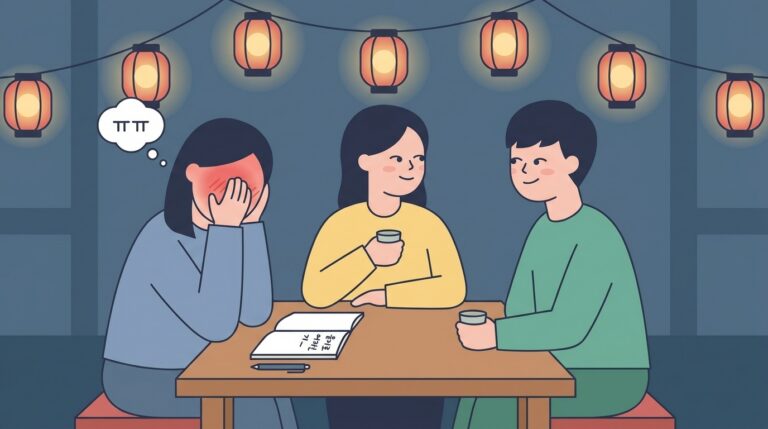
Mastering the Art of Korean Wit: How to Navigate and Neutralize ‘Gap-bun-ssa’ (갑분싸)
Phase 1: Empathy & Narrative Opening
안녕하세요! 매일한글 에디터입니다. (Hello! This is your Daily Hangul editor.)
Picture this: You are sitting with your Korean colleagues or university friends at a bustling pojangmacha (street tent bar) in Euljiro. The soju is flowing, the grilled pork belly is sizzling, and the banter is bouncing around the table with effortless rhythm—what Koreans call tiki-taka (티키타카). Feeling confident in your C2-level Korean, you decide to chime in with a snappy, satirical one-liner inspired by Western dry wit. You deliver the punchline with a self-assured smirk.
Suddenly, the laughter evaporates. Chopsticks freeze mid-air. The only sound left is the faint hum of the neon beer sign and someone awkwardly clearing their throat.
Congratulations, you have just birthed a textbook 갑분싸 (Gap-bun-ssa)—the dreaded sudden freeze of conversational atmosphere.
In high-context Korean culture, wit is an intricate dance of social hierarchy, emotional solidarity, and impeccable timing. A joke that kills in an English-speaking boardroom or comedy lounge can land like a lead balloon in Seoul, triggering immediate social discomfort. Over the past decade of coaching advanced expatriates, diplomats, and creators, I have witnessed even near-native speakers stumble into this linguistic minefield. Humor at the C2 level is no longer about vocabulary; it is about atmosphere architecture. In this masterclass, we will deconstruct the anatomy of misplaced wit, give you linguistic antidotes to salvage any social freeze, and elevate your cultural radar from merely fluent to undeniably charming.
Phase 2: Core Expressions in Depth
1. 갑분싸 (Gap-bun-ssa) / 갑자기 분위기가 싸해진다
- Pronunciation: [Gap-bun-ssa] (Think of gap as in “gap year”, bun sounding like the bread “bun”, and ssa pronounced with a crisp, hissing double-S sound like “psst” without the ‘t’).
- Meaning: Literal: “Suddenly the atmosphere turns cold.” Nuance: An abrupt, spine-chilling awkward silence caused by an inappropriate, ill-timed, or unfunny remark.
- K-Culture Moment: Frequently deployed on variety shows like Running Man or Knowing Bros with cold blizzard sound effects and animated icicles dropping onto the offending speaker’s face.
- Editor’s Insight: While originally born as an internet buzzword, gap-bun-ssa has cemented itself into the socio-lexical vernacular. It captures the psychological terror of breaking conversational cohesion (bunwigi). It is rarely hostile; rather, it names the exact moment communal warmth curdles into shared embarrassment.
- Situation Spectrum: Casual: ✅ | Semi-formal: ⚠️ (acceptable if addressing peer peers) | Formal: 🚫
- 🤔 Think About It: Why does Korean culture possess such a vibrant lexicon solely dedicated to collective atmosphere rather than individual conversational blunders?
2. 눈치 좀 챙겨 (Nunchi jom chaenggyeo)
- Pronunciation: [Nun-chi jom chaeng-gyeo] (Nun like “noon”, chi like “cheese”, jom like “chom-p”, chaeng-gyeo like “tcheng-gyuh”).
- Meaning: Literal: “Pack your nunchi.” Nuance: “Read the room,” or “Get your situational awareness together!”
- K-Culture Moment: Seen in office K-Dramas like Misaeng when a junior employee makes a flippant joke right after the team manager received a scathing audit from upper management.
- Editor’s Insight: This phrase moves beyond mild teasing—it is a social corrective. Telling someone to “pack their nunchi” is an alert that their humor lacks environmental calibration. Use it with a playful grin among close friends, but beware: delivered dryly, it cuts deep.
- Situation Spectrum: Casual: ✅ | Semi-formal: ⚠️ | Formal: 🚫
- 🤔 Think About It: How does the cultural demand to “read the unspoken” (nunchi) fundamentally alter the types of irony permissible in public dialogue?
3. 선 제대로 넘었네 (Seon jedaero neomeon-ne)
- Pronunciation: [Seon je-dae-ro neo-meon-ne] (Seon like “sun”, je-dae-ro like “jay-deh-raw”, neomeonne sounding like “naw-mun-neh”).
- Meaning: Literal: “You have completely crossed the line.” Nuance: “That joke went way too far and hit an uncomfortable nerve.”
- K-Culture Moment: YouTube content creators such as Jang Sung-kyu (Workman) built entire personas around dancing dangerously close to “crossing the line” (선 넘는 녀석들), turning boundary-pushing into comedic tension.
- Editor’s Insight: In Korean interpersonal relations (in-gan-gwan-gye), invisible perimeters delineate intimacy, seniority, and personal privacy. When humor violates these invisible borders, people do not laugh—they retreat. Acknowledging that someone (or you yourself) crossed the line is the fastest way to reset social equilibrium.
- Situation Spectrum: Casual: ✅ | Semi-formal: ⚠️ | Formal: 🚫
- 🤔 Think About It: In your native culture, is boundary-crossing celebrated as rebellious humor, or treated as a social boundary violation as in Korea?
Phase 3: Textbook Korean vs. Real Korean
Scenario 1: Apologizing after a joke flops and silences the dinner table
- 📖 교과서 한국어 (Textbook): 제 농담이 재미없었습니까? 분위기를 망쳐서 대단히 죄송합니다. (Je nongdami jaemieopseosseumnikka? Bunwigireul mangchyeoseo daedanhi joesonghamnida. – “Was my joke unfunny? I am terribly sorry for ruining the atmosphere.”)
- 🗣️ 진짜 한국어 (Real-Life): 아, 제가 무리수를 뒀네요. 못 들은 걸로 해주세요! (A, jega murisureul dwonne-yo. Mot deureun geollo haejuseyo! – “Ah, I totally forced that move. Please pretend you never heard that!”)
- 💡 왜 다를까? (Why the difference?): An excessively stiff, dramatic apology makes an already awkward situation (gap-bun-ssa) feel solemn and judicial. Using the Go-derived metaphor muri-su (무리수, an overstretched gambit) with light self-deprecation immediately disarms the tension and allows the group to laugh with you.
Scenario 2: Playfully warning a close colleague who is making a borderline-offensive quip
- 📖 교과서 한국어 (Textbook): 당신의 발언은 타인에게 불쾌감을 줄 수 있으니 조심하십시오. (Dangsin-ui bareoneun tainege bulkwaegameul jul su isseuni josimhasipsio. – “Please be careful as your statement may cause unpleasantness to others.”)
- 🗣️ 진짜 한국어 (Real-Life): 씁, 방금 발언 살짝 아슬아슬했다? 브레이크 밟자! (Sseup, banggeum bareon saljjak aseuraseulhaetta? Beure-i-keu balpja! – “Oof, that last comment was skirting on thin ice! Let’s hit the brakes!”)
- 💡 왜 다를까? (Why the difference?): Calling someone’s comment “offensive” in a casual Korean gathering is a nuclear conversational move. Using dynamic colloquialisms like “stepping on the brakes” or the cautionary linguistic click “Sseup” offers a soft social parachute without inducing public shame.
Phase 4: K-Culture Deep Dive & Non-Verbal Manners
4-1. 눈치(Nunchi) & The Physical Anatomy of an Awkward Silence
When a misplaced joke drops in Korea, the linguistic freeze is accompanied by rapid physical signifiers. Watch for the sudden dropping of eye contact—Koreans will instinctively look down at their banchan side dishes or check their smartphones. You may notice an involuntary neck scratch or a slight clearing of the throat (흠흠, heum-heum).
If you accidentally trigger this reaction:
* Do NOT: Laugh loudly alone to compensate or double down with an explanation of why the joke was clever. In Korean humor, an explained joke is an autopsy of social failure.
* DO: Lower your shoulder tension, bring your hands slightly inward, tilt your head slightly with a rueful smile, and offer an immediate verbal release valve.
4-2. Culture Code: The Fragility of “Tiki-Taka”
In variety entertainment, the highest comedic virtue is tiki-taka (rapid-fire, cooperative conversational ping-pong). Western wit frequently prizes the individualist “zinger” or dry sarcasm where the punchline comes at another’s expense. In Korean culture, however, humor is fundamentally collectivist.
A successful joke must elevate the group’s collective energy (heung, 흥) without compromising anyone’s public face (chemyeon, 체면). If a joke singles out a colleague’s perceived weakness in front of their peers—especially regarding age, marital status, or job performance—the group prioritizes the victim’s social comfort over your comedic brilliance. The freeze of gap-bun-ssa is the group’s collective defense mechanism shutting down a perceived relational threat.
Phase 5: Real-Life Roleplay Scenario
Setting: A dimly lit, bustling craft beer bar in Seongsu-dong. After finishing a grueling product launch, the marketing team is winding down over truffle fries and pale ales.
Characters:
* Min-woo (대리 / Senior Associate): Highly competent, usually witty, but fiercely protective of team cohesion.
* Alex (You – Advanced Professional): Seasoned Korean speaker eager to prove your colloquial sharpness.
- Min-woo: (맥주잔을 부딪치며 활짝 웃는다) 다들 이번 주 진짜 고생 많았어요. 이번 프로젝트는 알렉스 씨의 활약이 컸지!
(Maekjujaneul buditchimyeo hwaljjak unneunda) Dadeul ibeon ju jinjja gosaeng manasseoyo. Ibeon peurojekteuneun Alex-ssi-ui hwalyagi keotji!
(Clinks beer glasses with a wide smile) “Everyone worked insanely hard this week. Alex, your role in this launch was massive!” -
Alex: 🎭 (Smiles playfully) 에이, 민우 대리님이 야근으로 갈아 넣으신 영혼에 비하면 아무것도 아니죠!
Ei, Min-woo daerinimi yageuneuro gara neoeusin yeonghone bihamyeon amugeotdo anijyo!
“Oh come on, compared to the soul Deputy Min-woo ground into dust during overtime, mine was nothing!” -
Min-woo: 🎭 (Chortles, sipping beer) 하하, 맞아요. 저 이번 주에 3년은 늙은 것 같아요.
Haha, majayo. Jeo ibeon jue samnyeoneun neulgeun geot gatayo.
“Haha, you’re right. I feel like I aged three years this week alone.” -
Alex: 🎭 (Attempting a dry, dark Western-style joke about burnout) 그래서 그런지 아까 보니까 정수리에 흰머리가 셀 수 없이 늘었더라고요? 이제 염색 예약하셔야겠어요!
Geuraeseo geureonji akka bonikka jeongsurie huinmeoriga sel su eopsi neureotdeoragoyo? Ije yeomsaek yeyakhasyeoyagesseoyo!
“Maybe that’s why when I looked earlier, your crown was covered in countless gray hairs? Time to book a hair dye appointment!” -
Min-woo: 🎭 (Freezes mid-sip, eyes darting to the side table, laughter dying down) 아… 제 흰머리가… 그렇게 눈에 띌 정도인가요?
A… je huinmeoriga… geureoke nune ttwil jeongdo-ingayo?
“Ah… Are my gray hairs… really that noticeable?” -
Colleague nearby: 🎭 (Glares into their beer foam in complete silence) ……
-
Alex: 🎭 (Recognizing the sudden freeze in the room) ……
-
Min-woo: 🎭 (Clears throat uncomfortably) 흠, 제가 요즘 스트레스 관리를 좀 못 했나 봅니다.
Heum, jega yojeum seuteureseu gwanrireul jom mot haenna bomnida.
“Ahem, I guess I haven’t been managing my stress well lately.”
🔀 Interactive Choice Point: How do you save this moment?
- Option A: “농담이에요, 대리님! 서양에서는 이런 걸 장난으로 자주 말하는데, 왜 그렇게 진지하게 받아들이세요?” (It’s just a joke, Deputy! In the West we say this as banter, why take it so seriously?)
- Option B: “앗, 제가 너무 건방진 무리수를 뒀네요! 대리님 흰머리가 아니라 제 눈에 낀 먼지였습니다. 시원하게 원샷하고 반성하겠습니다!” (Ack, I made such an impudent overreach! Those weren’t gray hairs, just dust in my eyes. I’ll chug this beer and reflect on my sins!)
- Option C: (Stay completely silent, look at your phone, and let the conversation naturally pick up on a different topic five minutes later.)
Decision Feedback:
* Option A [Bad / Destructive]: Fatal error. By defending the joke and citing “Western culture,” you invalidate Min-woo’s feelings, expose him to further public humiliation, and appear culturally tone-deaf.
* Option B [Best / Masterful]: Perfect C2 execution! You acknowledge your comment as a murisu (overreach), deflect the insult with absurd humor (dust in your eyes), and use the classic Korean social ritual of taking a penalty shot (beolju, 벌주) to restore harmony without defensiveness.
* Option C [Risk / Awkward]: Leaves an emotional bruise unhealed. Min-woo will leave the bar wondering if his physical decline is glaringly obvious to junior staff, creating an invisible rift in future team interactions.
Phase 6: 10-Second Emotion Shadowing Drill
Practice these recovery cadences aloud. Pay sharp attention to pitch shifts and rhythmic breath drops at the slash (/) marks.
- [😅 Self-deprecating & Instant Relief]
아, / 제가 완전히 무리수를 뒀네요! / 방금 말은 / 공중에 흩어진 걸로 해주세요.
(A, / jega wanjeonhi murisureul dwonne-yo! / Banggeum mareun / gongjunge heuteojin geollo haejuseyo.)
“Ah, / I totally overplayed my hand! / Let’s pretend / those words just dissolved into thin air.” -
[🫣 Playful Panic & Diffusing Tension]
앗, / 갑분싸 제조기 등판인가요? / 분위기 살리기 전까지 / 마이크 내려놓겠습니다!
(At, / gap-bun-ssa jejogi deungpan-ingayo? / Bunwigi salligi jeonkkaji / maikeu naeryeonokeusseumnida!)
“Oops, / did the ‘Awkward Silence Machine’ just enter the room? / I’ll set down my mic / until I bring the mood back to life!” -
[🤝 Warm & Direct Boundary Calibration]
제가 선을 살짝 넘었죠? / 기분 상하셨다면 진심으로 죄송해요, / 제가 아직 눈치가 부족하네요.
(Jega seoneul saljjak neomeotjyo? / Gibun sanghasyeotdamyeon jinsimeuro joesonghaeyo, / jega ajik nunchiga bujokaneyo.)
“I crossed the line a bit, didn’t I? / If that stung, I sincerely apologize, / my nunchi still has some catching up to do.”
Phase 7: K-Culture Mini Dictionary
-
무리수 (Muri-su) | An overstretched gambit / A forced comedic try-hard move
Originally a bad tactical stone placement in Baduk (Go). Today, Koreans use it constantly when a joke falls flat because the speaker tried way too hard to be funny. -
아재개그 (Ajae-gae-geu) | Dad joke / Puns based on homophones
Wordplay typically deployed by middle-aged men (e.g., “Why did the king go to the bank? To get cash / 왕이 무너지면? 킹콩”). Can provoke endearing groans, but if deployed during high-stakes business meetings, will cause instant gap-bun-ssa. -
선 넘다 (Seon neom-da) | To cross boundaries of social decorum
Refers to transgressing the invisible boundary of hierarchical respect, intimacy, or personal trauma under the guise of casual banter. -
티키타카 (Tiki-taka) | Flawless, rhythmic comedic chemistry
Borrowed from Spanish soccer passing styles; describes when two or more people bounce banter back and forth with zero conversational friction and perfect mutual trust.
Phase 8: Traveler & Expat Survival Kit
Top 3 Atmospheric Reset Phrases
- “제가 방금 뇌를 안 거치고 말했네요.” (Jega banggeum noereul an geochigo malhaetneyo.)
Pro Tip: “I spoke straight without passing through my brain.” Self-aware, humble, and universally produces a chuckle of pardon. - “앗, 이번 개그는 실패! 다음 기회를 노리겠습니다.” (At, ibeon gaegeuneun silpae! Daeum gihwoereul norigesseumnida.)
Pro Tip: “Oops, that joke was a fail! I will aim better on the next opportunity.” Shows resilience and light-hearted confidence. - “분위기 수습용 노래 한 곡 뽑아야 하나요?” (Bunwigi suseubyong norae han gok ppobaya hanayo?)
Pro Tip: “Do I need to belt out a song to salvage this atmosphere?” Ideal at noraebang (karaoke) or post-dinner gatherings to reset the mood.
Editor’s Local Life Note
When moving through modern Seoul’s social scene, staying tapped into local trends is essential. Use the official Naver Map application on your smartphone to pinpoint trending natural wine bars or retro pubs in Euljiro where intimate group gatherings happen. And remember: at Korean tables, keeping everyone’s glass filled and monitoring their emotional comfort level will earn you far more social admiration than delivering an uninvited, razor-sharp sarcastic punchline.
Phase 9: “One Step Deeper” (Cultural Philosophy)
In many Western comedic paradigms, humor functions as an act of subversion—deconstructing authority, pointing out flaws, or leveraging irony to separate the astute observer from the naive crowd. In Korea, however, humor is historically tied to Madangguk (마당극, traditional village square theater), where wit was designed to resolve communal sorrow (han, 한) and invite collective joy (heung, 흥). To crack a joke that leaves an individual participant singled out and isolated is an ideological betrayal of this communal harmony. When you understand that Korean banter is not an audition for individual cleverness, but a collaborative effort to make the room feel cohesive, your timing changes completely.
💬 Your Turn: Have you ever experienced a sudden gap-bun-ssa in Korea or with Korean speakers? What was the context, and how did you navigate out of it? Share your story in the comments below!
Phase 10: FAQ & Common Pitfalls
Q: Can I use self-deprecating humor without causing an awkward silence in Korea?
A: Yes, but with strict parameters! Self-deprecation regarding your lack of coordination, linguistic slips, or inability to handle spicy food (mapjjiri, 맵찌리) is beloved. However, deeply depressive or existential self-deprecation regarding family trauma, severe financial stress, or personal failures will cause instant gap-bun-ssa because Koreans feel a moral obligation to console you rather than laugh.
Q: How do I tell someone else that their humor made me uncomfortable without ruining the night?
A: Avoid blunt confrontation. Use the semi-ironic question formula: “어라? 방금 공격력 좀 세셨는데요?” (Whoa, your attack power was a bit high just now?) or “저 방금 마음에 스크래치 살짝 났어요!” (My heart just got a tiny scratch!). This flags the boundary clearly using gaming/pop metaphors without breaking the social mood.
Q: Is sarcastic irony understood by younger Koreans?
A: Younger urban Koreans love irony (ban-eo-beop), but primarily in meme culture or between intimately bonded friends (jjin-chin, 찐친). If you have not established a foundation of emotional warmth (jeong, 정) with someone, dry sarcasm sounds indistinguishable from cold passive-aggression.
🚨 Common Mistakes Alert
- Mistake: Roasting someone’s age or status to appear casually intimate.
- Correct Action: Teasing across age lines is only permissible if you tease upward gently about someone buying the food, never downward about someone’s youth or age-related milestones.
- Mistake: Doubling down to explain the joke in English when Koreans don’t laugh.
- Correct Action: Pivot immediately with “아, 제가 무리수 뒀네요!” and change the topic.
- Mistake: Assuming that quiet nodding means your dark humor was appreciated.
- Correct Action: A quiet nod followed by a quick sip of water is polite Korean for “Please stop talking about this.” Change conversational lanes immediately.
Phase 11: Action Mission & Engagement
- 🥉 Bronze Level (Solo Practice): Stand in front of a mirror and recite the recovery phrase: “아, 제가 무리수를 뒀네요! 못 들은 걸로 해주세요!” five times, matching your facial expression from mock-horror to an infectious grin.
- 🥈 Silver Level (Social Sharing): Share an instance on your social feed or in our study group where you completely misjudged a joke in a foreign language using the hashtag
#MyGapbunssaMoment. - 🥇 Gold Level (Real-World Application): The next time a quiet pause hits your Korean group chat after an odd comment, chime in with the sticker or text: “분위기 무슨 일이죠…? 심폐소생술 들어갑니다!” (What happened to the atmosphere…? Starting CPR!).
- 🎮 K-Culture Mission: Watch an episode of Workman on YouTube. Identify three instances where the host says something risky, and transcribe how the editor uses cartoon sound effects and captions to prevent real gap-bun-ssa.
Phase 12: Interactive Quiz Challenge
1. Situational Judgment:
You are at a team lunch with your team lead (팀장님). The team lead makes an objectively awful dad joke (ajae-gae-gu) about squid. What is the most culturally savvy response?
A) “팀장님, 20년 전 개그 같습니다. 분위기 싸해졌어요.” (Team Lead, that joke feels 20 years old. The atmosphere turned cold.)
B) Laugh softly while shaking your head: “아, 팀장님… 이건 진짜 제가 웬만하면 웃어넘기려 했는데 쉽지 않네요!” (Ah, Team Lead… I really tried to laugh this off, but you made it tough!)
C) Ignore him and turn around to order more side dishes.
Click to view Answer & Explanation
Correct Answer: B
Explanation: Option B uses endearing, respectful cheekiness (neungcheong, 능청) that acknowledges the joke was cheesy while validating the leader’s attempt to entertain the table. Option A is an overly aggressive boundary violation, and Option C is blatant disrespect.
2. Fill-in-the-Blank:
Fill in the missing idiom to complete the recovery statement:
“제가 순간 욕심을 부려서 개그에 ( ______ )를 뒀네요. 죄송합니다!”
(I got greedy for a laugh and played an overextended gambit. I’m sorry!)
Click to view Answer & Explanation
Correct Answer: 무리수 (Muri-su)
Explanation: The complete phrase is ‘무리수를 두다’ (to play an overstretched/unreasonable move), the definitive colloquial idiom for an ill-advised comedic attempt.
3. True or False Culture Quiz:
In Korean culture, the awkward silence called gap-bun-ssa indicates that the group despises the speaker and wishes to permanently exclude them from the circle.
Click to view Answer & Explanation
Correct Answer: False
Explanation: Gap-bun-ssa is usually a momentary freeze of collective atmosphere (bunwigi), not permanent social condemnation. If handled swiftly with self-deprecating humility and quick emotional awareness, it often transforms into an opportunity for greater interpersonal bonding!






