

Phase 1: Empathy (Story-Driven Opening)
안녕하세요! 매일한글 에디터입니다.
Imagine this: You’ve just finished a dreamy evening exploring the glowing vintage alleys of Euljiro, feeling like the lead character in a romantic K-drama like Our Beloved Summer. The streetlights reflect off the pavement, the autumn breeze is crisp, and your phone battery suddenly drops to 3%. You need to take the green bus back to your hotel in Hongdae, but as you look across the bustling six-lane boulevard, confusion strikes.
There’s a small blue signpost on the sidewalk, a large covered shelter standing isolated in the exact middle of the highway, and hundreds of commuters walking with laser-focused determination. Where on earth do you actually stand to catch your bus? Google Maps is spinning in confused circles, and panic begins to creep in.
Take a deep breath! You are definitely not alone. Every single traveler and expat in Korea has stared blankly at Seoul’s multi-layered transit system at least once. Finding the right bus stop is actually an art form in Korea, but armed with just three golden phrases and an understanding of local transit flow, you will navigate like a born-and-raised Seoulite. This guide is crafted directly from real beginner feedback collected from our Daily Hangul community. By the time you finish reading, you’ll never feel lost at a Korean intersection again!
Phase 2: Top 3 Core Expressions In-Depth
1. 버스 정류장이 어디예요? (Beoseu jeongnyujangi eodiyeyo?)
- Pronunciation: [Beo-seu jeong-nyu-jang-i eo-di-ye-yo?] (Think: “Bus-uh jung-new-jahng-ee uh-dee-yeh-yo?”)
- Meaning: “Where is the bus stop?” (Literally: Bus stop + subject marker + where is it?)
- K-Culture Moment: You hear this line constantly in travel vlogs and slice-of-life dramas when a character moves to a new neighborhood in Seoul or visits Jeju Island for the first time.
- Editor’s Insight: This is your number one survival sentence. The word 정류장 (jeongnyujang) can feel like a tongue-twister. If your tongue gets tied, simply saying “버스 어디서 타요?” (Beoseu eodiseo tayo? / Where do I take the bus?) works just as well!
- Situation Spectrum:
- Casual (Friends): 🚫 (Too formal)
- Semi-formal (Polite to strangers): ✅ (Perfect balance!)
- Formal (Broadcast/Public speaking): ⚠️ (Usable, but -십니까 is preferred in official announcements)
- 🤔 Think About It: Notice how Korean doesn’t require “Excuse me, can you tell me…” before asking. Adding the polite ending -예요 (-yeyo) already carries built-in respect!
2. 저기예요? (Jeogiyeyo?)
- Pronunciation: [Jeo-gi-ye-yo?] (Think: “Juh-ghee-yeh-yo?”)
- Meaning: “Is it over there?” (Direct: That place over there + is it?)
- K-Culture Moment: When a kind local points across a crosswalk toward the middle of the street, you point gently with an open hand and ask: “저기예요?”
- Editor’s Insight: Koreans use three distance words: 여기 (yeogi – here, close to me), 거기 (geogi – there, close to you), and 저기 (jeogi – over there, far from both of us). When looking for a bus stop down the street, 저기 is your best friend.
- Situation Spectrum:
- Casual: ⚠️ (Use ‘저기야?’ with close friends)
- Semi-formal: ✅ (Standard polite question)
- Formal: ⚠️
- 🤔 Think About It: Why does Korean have two different words for “there” (거기 vs 저기)? It reflects how Korean culture constantly tracks spatial awareness and interpersonal distance.
3. 몇 번 타요? (Myeot beon tayo?)
- Pronunciation: [Myeot beon ta-yo?] (Think: “Myut-bun tah-yo?”)
- Meaning: “Which number (bus) do I take?” (Direct: How many/which + number + ride?)
- K-Culture Moment: In K-dramas when two characters are leaving work and realize they live in the same district, one casually asks the other which bus number they take home.
- Editor’s Insight: Short, sweet, and punchy. You don’t even need to say the word “bus” because the verb 타다 (tada – to ride) already makes your intention 100% clear.
- Situation Spectrum:
- Casual: 🚫 (Add ‘몇 번 타?’ for peers)
- Semi-formal: ✅ (Friendly, natural, and polite)
- Formal: ⚠️
- 🤔 Think About It: In English, we say “catch a bus” or “take a bus.” In Korean, the universal verb is 타다 (to ride). You ride buses, subways, bicycles, and even horses using the exact same verb!
Phase 3: Textbook Korean vs. Real Korean
Situation 1: Asking a passerby for the bus stop location
- 📖 교과서 한국어 (Textbook): 버스 정류장이 어디에 위치해 있습니까? (Beoseu jeongnyujangi eodie wichihae itsseumnikka? / Where is the bus stop located?)
- 🗣️ 진짜 한국어 (Real-Life): 저기요, 버스 정류장 어디예요? (Jeogiyo, beoseu jeongnyujang eodiyeyo? / Excuse me, where is the bus stop?)
- 💡 왜 다를까? (Why the difference?): The textbook version sounds like a formal written police report or automated GPS voice. Real Koreans drop the word “location” (위치) and use the smooth conversational ending -어디예요?.
Situation 2: Confirming if the stop across the street is the right spot
- 📖 교과서 한국어 (Textbook): 저곳이 버스를 승차하는 장소입니까? (Jeogosi beoseureul seungchahaneun jangsoimnikka? / Is that place the boarding location for the bus?)
- 🗣️ 진짜 한국어 (Real-Life): 저기서 타면 돼요? (Jeogiseo tamyeon dwaeyo? / Can I just take it over there?)
- 💡 왜 다를까? (Why the difference?): -면 돼요? (-myeon dwaeyo?) means “Is it okay to do X?” It’s the ultimate natural formula used by native speakers every single day for effortless confirmation.
Phase 4: K-Culture Deep Dive & Non-Verbal Manners
4-1. 눈치 (Nunchi) & Street Gestures
When approaching a stranger on the streets of Seoul to ask for directions, keep your body language mindful:
* The Soft Approach: Never tap someone abruptly on the shoulder or yell from behind. Approach from a 45-degree angle, make gentle eye contact, give a slight 15-degree bow, and say “저기요…” (Jeogiyo / Excuse me).
* The Two-Finger or Open Palm Point: If you want to ask “Is it over there?”, avoid pointing aggressively with a single index finger directly at a person or building. Instead, gesture toward the bus shelter with an open hand or a soft, angled gesture. It radiates warmth and politeness.
4-2. Cultural Code: The Mystery of the “Middle-of-the-Road” Shelter
If you visit Seoul, Busan, or Daegu, you will notice large, modern bus shelters built right in the middle of wide avenues. This is called 중앙차로 (Jung-ang-cha-ro – Median Bus Lane System).
* The Secret: In major districts, blue (trunk) and red (express) buses stop exclusively at the center islands, while green (neighborhood/feeder) buses often stop on the curb right next to the sidewalk storefronts!
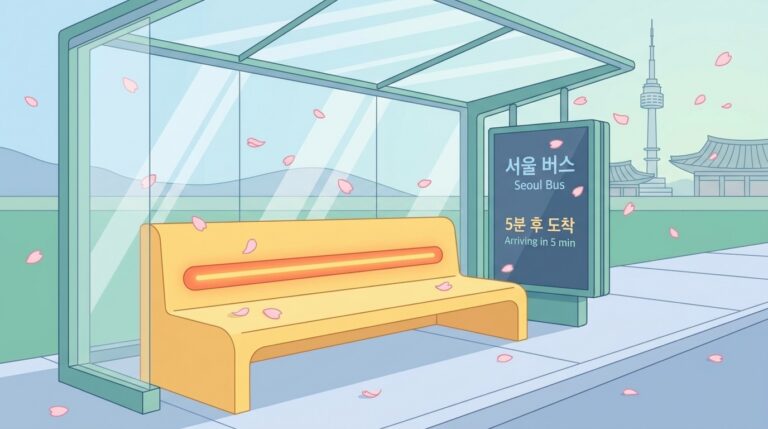
* Winter Magic: Korean bus stops in winter are pure luxury. Look closely at the bench—it’s likely an 온열의자 (Heated Smart Bench) kept at a toasty 38°C (100°F). Many stops also have clear vinyl 온기텐트 (Warmth Shelters) to shield commuters from icy Siberian winds, a quintessential cozy K-winter experience!
Phase 5: Real-Life Roleplay Scenario
Setting: Outside a cozy convenience store in Mangwon-dong on a cool autumn evening.
NPC: Mrs. Park (60s, warm-hearted store owner tidying the outdoor snack counter).
- Turn 1 (You): 🎭 (Approaching with a polite mini-bow) 저기요, 죄송한데요… (Jeogiyo, joesonghandeyo… / Excuse me, I’m sorry to bother you…)
- Turn 2 (Mrs. Park): 🎭 (Wiping hands on apron, smiling warmly) 네~ 학생, 왜 그래요? (Ne~ haksaeng, wae geuraeyo? / Yes, dear, what’s up?)
- Turn 3 (You): 버스 정류장이 어디예요? (Beoseu jeongnyujangi eodiyeyo? / Where is the bus stop?)
- Turn 4 (Mrs. Park): 🎭 (Pointing across the street toward the crosswalk) 아, 버스? 저기 신호등 건너면 바로 있어요! (A, beoseu? Jeogi sinhodeung geonneomyeon baro isseoyo! / Ah, the bus? Cross the traffic light over there and it’s right there!)
- Turn 5 (You): 🎭 (Squinting and checking the direction) 저기 편의점 앞이요? (Jeogi pyeon-uijeom apiyo? / In front of that convenience store over there?)
- Turn 6 (Mrs. Park): 맞아요! 거기 파란 표지판 보이죠? (Majayo! Geogi paran pyojipan boijyo? / That’s right! You see that blue signpost there, right?)
- Turn 7 (You): 🎭 (Relieved smile) 네, 보여요! 감사합니다! (Ne, boyeoyo! Gamsahamnida! / Yes, I see it! Thank you!)
- Turn 8 (Mrs. Park): 🎭 (Waving kindly) 차 조심해서 건너가요~ (Cha josimhaeseo geonneogayo~ / Be careful of cars when crossing~)
🔀 Interactive Decision Branch
Mrs. Park just pointed to the crosswalk, but you see two different shelters across the road! What do you say?
- Choice A: 저기 빨간 버스도 거기서 타요? (Jeogi bpalgan beoseudo geogiseo tayo? / Do red buses also stop there?)
- 👉 Feedback [Best]: Excellent! Red buses often use the center median lane while local buses use the sidewalk. Clarifying this prevents waiting at the wrong shelter.
- Choice B: 어디? (Eodi? / Where?)
- 👉 Feedback [Bad]: Too blunt! Dropping honorifics (Banmal) with elders sounds disrespectful. Always maintain -요 (-yo).
- Choice C: 네이버 지도가 이상해요! (Neibeo jidoga isanghaeyo! / Naver Map is acting weird!)
- 👉 Feedback [Risk]: While understandable, complaining about your app won’t get you to your bus stop faster! Stick to clear questions about the location.
Phase 6: 10-Second Emotion Shadowing Drill
Practice reading these out loud with rhythm and native feeling! ( / = slight pause)
[🥺 Polite & In Need]
저기요… / 버스 정류장이 / 어디예요?
(Jeogiyo… / beoseu jeongnyujangi / eodiyeyo?)-
[🤔 Curious & Confirming]
길 건너서… / 저기예요?
(Gil geonneoseo… / jeogiyeyo?) -
[😊 Relieved & Cheerful]
아! / 찾았어요! / 정말 감사합니다!
(A! / Chajasseoyo! / Jeongmal gamsahamnida!)
Phase 7: K-Culture Mini Dictionary
- 버스 정류장 (Beoseu Jeongnyujang)
- Translation: Bus Stop / Bus Station.
- Usage: Written on road signs, navigation apps, and public maps. In casual speech, people frequently shorten it to 정류장.
- 교통카드 (Gyotong Kadeu)
- Translation: Transit Card (T-Money, Cashbee, Climate Card).
- Usage: Essential for riding. Cash is completely phased out on most Seoul buses today!
- 환승 (Hwanseung)
- Translation: Transfer.
- Usage: Korea offers free or heavily discounted transfers between buses and subways within 30 minutes if you tap your card when getting off!
- 중앙차로 (Jung-ang-cha-ro)
- Translation: Median Dedicated Bus Lane.
- Usage: The dedicated bus road situated in the middle of major multi-lane avenues.
Phase 8: Survival Kit for Travelers
Top 3 Survival Expressions
- 여기 버스 서요? (Yeogi beoseu seoyo?)
- Pronunciation: Yeo-gi beo-seu seo-yo?
- Pro Tip: Use this when standing at a pole to confirm if buses actually stop there: “Does the bus stop here?”
- 홍대 가요? (Hongdae gayo?)
- Pronunciation: Hong-dae ga-yo?
- Pro Tip: When the bus doors open, quickly ask the driver: “[Destination] + 가요?” (Does this go to Hongdae?).
- 내릴게요! (Naerilgeyo!)
- Pronunciation: Nae-ril-ge-yo!
- Pro Tip: If the bus is crowded and you need to get off immediately: “I am getting off!”
Editor’s Travel Note
- Essential Navigation Apps: Google Maps is notoriously inaccurate for walking routes in South Korea due to local mapping regulations. Before your trip, download the official 네이버 지도 앱 다운로드 (Naver Map) or 카카오맵 앱 다운로드 (KakaoMap) for English-supported live bus arrival times.
- Tag On, Tag Off: Always tap your T-Money card on the reader when boarding at the front, and tap again before exiting at the back doors to unlock automatic transfer discounts!
Phase 9: One Step Deeper (Thinking Prompt)
Korean bus stops reflect the country’s profound emphasis on collective consideration and technological convenience. From digital screens displaying real-time arrival down to the exact second, to heated benches that warm cold commuters during harsh winters, the transit stop is a community micro-hub designed with public welfare in mind. When you ask a stranger for directions, you aren’t just getting navigational help; you are stepping into Korea’s culture of mutual neighborhood care (정, Jeong).
💬 Your Turn: Have you ever experienced getting lost on public transport in another country? How does the bus stop setup in your hometown compare to Seoul’s high-tech shelters? Share your stories in the comments below!
Phase 10: FAQ & Avoiding Misunderstandings
Q: Can I pay with cash if I can’t find a place to buy a transit card?
A: In Seoul, nearly all buses are now 현금 없는 버스 (Cashless Buses). You must use a transit card (T-Money, EZL) or foreign traveler cards with transit chips like WOWPASS. Always pick up and charge a card at any convenience store before heading to the stop.
Q: Why did the bus drive right past me without stopping?
A: In Korea, if no passengers are getting off and you are sitting deep inside the shelter looking down at your phone, the driver may assume you are waiting for a different bus. When your bus approaches, stand up, step near the curb, and make brief eye contact with the driver!
Q: How do I know if the stop is for the subway or the bus?
A: Subway station entrances have numbered staircase exits marked with a round colored line symbol (Line 1 to 9). Bus stops will display a yellow-and-black or blue pole with bus numbers printed on metallic plates or digital LED screens.
🚨 Common Mistakes Warning Board
- Mistake: Waving your arm aggressively up and down like hailing a New York taxi.
- 👉 Correct Action: Simply step toward the boarding line near the curb. A subtle nod or stepping forward is the universal signal that you intend to board.
- Mistake: Searching for the bus stop on the sidewalk when it’s located in the central median lane.
- 👉 Correct Action: Check if the road has red painted lanes in the center. If yes, look for the crosswalk leading to the central island shelter.
- Mistake: Forgetting to tap your card when getting off.
- 👉 Correct Action: Tap your card at the rear sensor before stepping off to avoid penalty surcharges on your next journey.
Phase 11: Action Mission & Engagement
- 🥉 Bronze Mission (Solo Practice): Stand in front of your mirror and repeat “버스 정류장이 어디예요?” five times until your tongue flows without pausing.
- 🥈 Silver Mission (Social Media): Take a screenshot of your favorite K-drama bus stop scene, tag us on Instagram, and caption it with “저기서 타요!” (I ride it over there!).
- 🥇 Gold Mission (Field Test): Next time you are in Korea, ask a real person on the street for directions to the nearest bus stop using only Korean—no translation apps!
🎮 K-Culture Mission: Watch an episode of Extraordinary Attorney Woo or My Liberation Notes. Notice how the characters wait at bus stops. Can you spot the digital real-time arrival screen in the background?
Phase 12: Interactive Quiz Challenge
Test your new skills before you hit the streets of Seoul!
1. Situation Judgment:
You are standing at an intersection and see a bus stop across the street. You want to ask a nearby shopkeeper politely if that is the bus stop. Which sentence is most natural?
* (A) 야, 버스 어디야? (Ya, beoseu eodiya?)
* (B) 저기 버스 정류장 어디에 위치해 계십니까? (Jeogi beoseu jeongnyujang eodie wichihae gyesimnikka?)
* (C) 저기 버스 정류장이에요? (Jeogi beoseu jeongnyujang-ieyo?)
2. Fill in the Blank:
“Excuse me, which number bus do I take?”
👉 “저기요, 몇 번 ________?” (Jeogiyo, myeot beon ________?)
3. True or False:
All buses in Seoul pick up passengers right beside the sidewalk curb. (True / False)
👉 Click here to reveal the answers and explanations!
- Answer: (C) 저기 버스 정류장이에요?
- Explanation: (A) is rude informal talk (Banmal) used only with close friends. (B) uses unnatural, overly complicated honorifics for an inanimate object. (C) is natural, polite, and clear.
- Answer: 타요 (tayo)
- Explanation: The verb 타다 (to ride) conjugates politely into 타요.
- Answer: False!
- Explanation: Major arterial roads feature 중앙차로 (Median Bus Lanes) located right in the center of the road!
- Explanation: Major arterial roads feature 중앙차로 (Median Bus Lanes) located right in the center of the road!







