

Phase 1: 공감 (Story-Immersive Opening)
안녕하세요! 매일한글 에디터입니다.
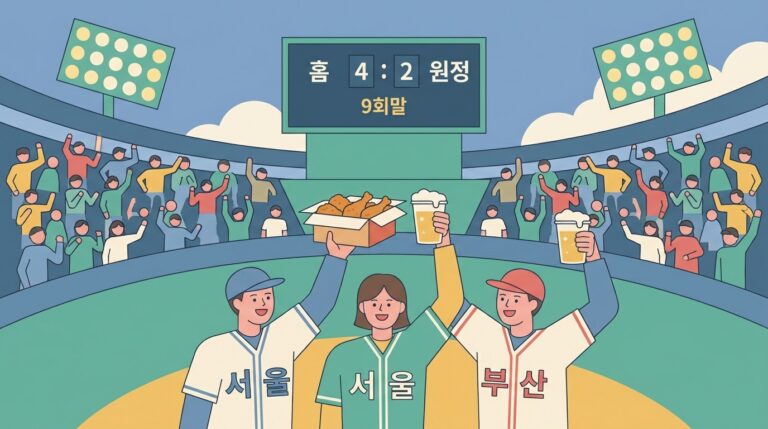
Imagine this: The late afternoon sun dips below the rim of Jamsil Baseball Stadium in Seoul. The crisp spring breeze carries the unmistakable aroma of freshly fried crispy garlic chicken. All around you, twenty thousand fans in matching baseball jerseys beat yellow thundersticks in synchronized harmony, singing an infectious melody so loud the concrete vibrates beneath your sneakers. You are holding an ice-cold draft beer in one hand, completely swept away by the rhythm—until your Korean friend turns to you with a beaming smile and shouts: “오늘 직관 오길 진짜 잘했지? 같이 응원가 부르자!”
Suddenly, your mind freezes. Jik-gwan? Eung-won-ga? You practiced classroom phrases like “야구를 봅니다”, but nobody taught you how to navigate the electric, chaotic, and heartwarming world of KBO (Korean Baseball Organization) live culture.
Don’t worry at all! Watching a baseball game in Korea is far more than just watching sports; it is a giant outdoor karaoke festival, a culinary adventure of chimaek (chicken and beer), and a masterclass in Korean communal bonding. This guide is built directly from real student experiences and local stadium hacks. By the end of this lesson, you will comfortably speak the essential A2 phrases to order stadium snacks, follow player chants, and blend seamlessly into the roaring crowd at Jamsil Stadium!
Phase 2: 핵심 표현 3선 심층 분석 (Top 3 Core Expressions)
1. 오늘 직관 왔어요! (Oneul jikgwan wasseoyo!)
- Pronunciation: [O-neul jik-gwan wa-sseo-yo] (Pronunciation tip: “Jik” sounds like “chic” with a softer j, and “gwan” rhymes with “swan”!)
- Meaning:
- Literal: Today in-person viewing came.
- Actual Nuance: “I came to watch the game live at the stadium today!”
- K-Culture Moment: Korean celebrities or vloggers uploading selfies in jerseys with the stadium background captioned: “드디어 올 시즌 첫 직관!” (Finally, my first live game of the season!).
- Editor’s Insight: The word 직관 (jikgwan) is a trendy compound of 직접 (jikjeop – directly/in person) and 관람 (gwanram – viewing). Watching via television is called 집관 (jipgwan – home viewing). Using 직관 immediately makes you sound like a true insider rather than a casual tourist.
- Situation Spectrum:
- Casual (Friends): 오늘 직관 왔어! (Oneul jikgwan wasseo!) ✅
- Semi-formal (Polite): 오늘 직관 왔어요! (Oneul jikgwan wasseoyo!) ✅
- Formal (Broadcast/Interviews): 오늘 직관을 오게 되었습니다. (Oneul jikgwaneul oge doe-eotseumnida.) ⚠️
- 🤔 Think About It: In English, we simply say “I’m at the game.” Why do you think Korean created a distinct shorthand word (직관) to separate live stadium viewing from screen viewing?
2. 치맥 먹으면서 응원해요! (Chimaek meogeumyeonseo eungwonhaeyo!)
- Pronunciation: [Chi-maek meo-geu-myeon-seo eung-won-hae-yo] (Pronunciation tip: “Myeon-seo” sounds like “myun-suh”, expressing two actions happening at once.)
- Meaning:
- Literal: Chicken-beer eating while cheering.
- Actual Nuance: “Let’s cheer while enjoying our chicken and beer!”
- K-Culture Moment: In K-Dramas like Weightlifting Fairy Kim Bok-joo, characters always grab boxes of crispy chicken and canned beers before climbing up the stadium bleachers.
- Editor’s Insight: The grammar pattern -(으)면서 connects two simultaneous actions. At a Korean game, cheering without eating is unthinkable, and eating without singing is impossible. This phrase captures the quintessential Korean stadium lifestyle.
- Situation Spectrum:
- Casual: 치맥 먹으면서 응원하자! (Chimaek meogeumyeonseo eungwonhaja!) ✅
- Semi-formal: 치맥 먹으면서 응원해요! (Chimaek meogeumyeonseo eungwonhaeyo!) ✅
- Formal: 치맥을 들면서 응원하시겠습니다. 🚫 (Too rigid for stadium fun!)
- 🤔 Think About It: Food and socializing are inseparable in Korean culture. How does sharing food during a public event foster closeness compared to sporting events in your country?
3. 홈런 한 번 날려 주세요! (Hom-reon han beon nallyeo juseyo!)
- Pronunciation: [Hom-reon han beon nal-lyeo ju-se-yo] (Pronunciation tip: “Nal-lyeo” rolls smoothly from “nal” to “lyeo”, sounding like “nahl-lyuh”.)
- Meaning:
- Literal: Home run one time fly please.
- Actual Nuance: “Please hit a home run for us!”
- K-Culture Moment: The batter steps up with bases loaded in the bottom of the 8th inning. The cheer captain blows his whistle, and thousands of fans chant this exact line pointing their clappers toward the outfield fence.
- Editor’s Insight: 날리다 (nallida) means “to send flying.” Rather than saying “치다” (to hit), fans say “날려 주세요” (send it soaring over the fence). Using 한 번 (han beon – just once / this once) softens requests and adds heartfelt urgency.
- Situation Spectrum:
- Casual: 홈런 한 번 날려 줘! (Hom-reon han beon nallyeo jwo!) ✅
- Semi-formal: 홈런 한 번 날려 주세요! (Hom-reon han beon nallyeo juseyo!) ✅
- Formal: 홈런을 쳐 주시기 바랍니다. 🚫 (Nobody cheers with stiff textbook grammar!)
- 🤔 Think About It: Notice the polite ending -주세요 directed at an athlete on the field. Why do Korean fans maintain polite request endings even when screaming at the top of their lungs?
Phase 3: 교과서 한국어 vs 진짜 한국어 (Textbook vs. Real Korean)
Situation 1: Cheering for your team to win
- 📖 교과서 한국어: 우리 야구팀이 승리하기를 진심으로 바랍니다. (Uri yagutimi seungrihagireul jinsimeuro baramnida.) — “I sincerely hope our baseball team achieves victory.”
- 🗣️ 진짜 한국어: 우리 팀 이겨라! 파이팅! (Uri tim igyeora! Paiting!) — “Win, our team! Let’s go!”
- 💡 왜 다를까? Textbook Korean frequently uses heavy Sino-Korean nouns (승리, 진심). At a roaring stadium, native speakers favor direct, energetic exclamations and the imperative cheer form -아라/어라 paired with the universal Korean cheer “파이팅!” (Fighting!).
Situation 2: Deciding to eat stadium snacks
- 📖 교과서 한국어: 닭튀김과 맥주를 함께 섭취합시다. (Daktwigimgwa maekjureul hamkke seopchwihapsida.) — “Let us ingest fried chicken and beer together.”
- 🗣️ 진짜 한국어: 시원하게 치맥 때리자! (Siwonhage chimaek ttaerija!) — “Let’s hit up some refreshing chimaek!”
- 💡 왜 다를까? Koreans rarely say “닭튀김” (fried chicken) in daily life; they say “치킨”. Furthermore, the slang verb 때리다 (ttaerida – literally to hit) is colloquially used among close peers to mean passionately partaking in food or drink (e.g., 커피 한잔 때리자 – let’s grab a coffee).
Phase 4: K-Culture 딥다이브 & 비언어적 매너 (Deep Dive & Non-Verbal Manners)
4-1. 눈치 (Nunchi) & Stadium Gestures
- The Beer-Passing Bucket Brigade: In crowded stadium rows, if someone orders drinks from an aisle cart, people pass cups and boxes along the row hand-to-hand. Always use two hands to receive and pass items, accompanied by a polite nod of gratitude (목례, mongnye).
- Standing vs. Sitting Zones: If your ticket is in the 응원석 (Cheering section), sitting down during home offense is frowned upon! Everyone stands, dances, and sings. However, if you are seated in the 테이블석 (Table section) or upper decks, avoid standing up abruptly during an active pitch, as it blocks the view of families behind you.
- The Thunderstick Rhythm: Avoid randomly banging your inflatable clappers (응원 막대). Watch the cheerleader on stage: arms raised means hold, double taps match the drum beat!
4-2. Cultural Code Analysis: The K-Cheering Phenomenon
Korean baseball isn’t just a sport; it is an interactive theatrical concert. Every single batter on the roster has their own personalized 응원가 (cheering song), usually remixed from iconic K-Pop melodies or famous pop songs with easy-to-sing customized lyrics. Even if you know nothing about baseball statistics, within three innings, you will find yourself doing the signature hand choreography and singing the player’s name along with twenty thousand newly minted friends!
Phase 5: 실전 롤플레이 시나리오 (Real-Life Roleplay)
Setting: Jamsil Baseball Stadium, Section 107 (1st base cheering zone). The home team LG Twins are playing, and the bases are loaded.
Characters:
* Alex: A2 Korean learner visiting Jamsil for the very first time.
* Minho: Alex’s energetic Korean university friend and hardcore baseball fan.
Minho: 알렉스야, 잠실 직관 오니까 기분 어때?
(Alex-ya, Jamsil jikgwan onikka gibun eottae?)
“Alex, how does it feel coming to Jamsil to watch live?”
🎭 Eyes wide with excitement, pointing at the singing crowd
Alex: 사람 진짜 많아요! 분위기 정말 최고예요!
(Saram jinjja manayo! Bunwigi jeongmal choegoyeyo!)
“There are so many people! The atmosphere is truly the best!”
🎭 Clapping yellow thundersticks with an amazed smile
Minho: 그렇지? 이제 3회 말이니까 치맥 주문하자. 뭐 먹을래?
(Geureochi? Ije 3-hoe marinikka chimaek jumunhaja. Mwo meogeullae?)
“Right? It’s the bottom of the 3rd inning now, let’s order chimaek. What do you want to eat?”
🎭 Pulling out his phone delivery app while nodding toward the concourse
Alex: 저는 양념치킨이랑 시원한 생맥주 마시고 싶어요!
(Jeoneun yangnyeom-chikinigirang siwonhan saengmaekju masigo sipeoyo!)
“I want seasoned fried chicken and refreshing draft beer!”
🎭 Thumbs up enthusiastically
Minho: 좋아! 저기 응원단장님 올라온다. 다음 타자 응원가 알지?
(Joa! Jeogi eungwondanjangnim ollaonda. Daeum taja eungwonga alji?)
“Great! Look, the cheer captain is stepping up. You know the next batter’s chant, right?”
🎭 Standing up quickly and waving his rally towel
Alex: 네, 유튜브로 예습했어요! 같이 불러요!
(Ne, yutyubeuro yeseuphaesseoyo! Gachi bulleoyo!)
“Yes, I practiced on YouTube beforehand! Let’s sing together!”
🎭 Confidently bouncing to the drum beat
Minho: 대박! 알렉스, 이번에 안타 치면 우리 다 같이 소리 지르는 거야!
(Daebak! Alex, ibeone anta chimyeon uri da gachi sori jireuneun geoya!)
“Awesome! Alex, if he hits a base hit this time, we all scream together!”
🎭 Hand cupped beside his mouth, ready to scream
Alex: 홈런 한 번 날려 주세요! 파이팅!
(Hom-reon han beon nallyeo juseyo! Paiting!)
“Please hit a home run for us! Let’s go!”
🎭 Jumping up and raising thundersticks high toward the sky
🔀 Interactive Choice Point
During the 7th inning stretch, the stadium speakers blast a famous team song and everyone links shoulders, swaying left and right. What will you do?
- Option A: Smile warmly, link shoulders with Minho and the neighboring Korean fan, and sway along to the melody.
- Option B: Stay frozen in your seat looking at your phone because you don’t know the exact Korean lyrics.
- Option C: Jump out into the aisle and start performing a solo breakdance to impress the crowd.
Feedback:
* Option A (Best): Perfect cultural adaptation! Linking shoulders (어깨동무, eokkaedongmu) during team anthems is the ultimate KBO bonding ritual. Even humming along earns you massive respect and snacks from neighbors!
* Option B (Bad): You miss out on the magic of Korean sports camaraderie. Nobody cares if your pitch or pronunciation is imperfect!
* Option C (Risk): Security staff will promptly ask you to return to your seat for safety reasons, and you might accidentally block the cameras or drinks.
Phase 6: 10초 감정 섀도잉 드릴 (10-Second Emotion Shadowing Drill)
Practice these lines out loud with the emotional cues and pauses (/) marked below!
[😊 Excitement & Wonder]
와, / 잠실 직관 분위기 / 진짜 대박이에요!
(Wa, / Jamsil jikgwan bunwigi / jinjja daebagieyo!)
“Wow, / the live game atmosphere at Jamsil / is truly unbelievable!”-
[🍗 Craving & Thirst]
우리 / 시원한 치맥 먹으면서 / 응원해요!
(Uri / siwonhan chimaek meogeumyeonseo / eungwonhaeyo!)
“Let’s / while having cold chimaek / cheer our hearts out!” -
[🔥 Passionate & Pleading]
제발! / 홈런 한 번 / 시원하게 날려 주세요!
(Jebal! / hom-reon han beon / siwonhage nallyeo juseyo!)
“Please! / Just one home run / send it soaring through the air!”
Phase 7: K-Culture 미니 사전 (Mini Dictionary)
-
직관 (Jikgwan)
Translation: In-person attendance / Live viewing.
Daily Usage: Used across baseball, soccer, esports (LoL Champions Korea), and K-Pop concerts. (e.g., “롤드컵 결승전 직관 티켓 구했어!” – I got live tickets to the LoL World Finals!). -
치맥 (Chimaek)
Translation: Chicken + Maekju (Beer) combo.
Daily Usage: The unrivaled national soul food combination, enjoyed along the Han River parks, at neighborhood pubs, and above all, in sports stadiums. -
응원가 (Eungwonga)
Translation: Cheering song / Fight chant.
Daily Usage: Catchy songs designated for specific players or the entire team. Fans memorize them to sing in unison during game rallies. -
육성응원 (Yukseong-eungwon)
Translation: Unamplified acoustic cheering from human voices.
Daily Usage: Moments in late innings when stadium music cuts out and thousands of fans chant the player’s name using only their raw voices. A goosebump-inducing experience!
Phase 8: 여행자를 위한 생존 키트 (Traveler’s Survival Kit)
Survival Expressions TOP 3
- 여기 치킨 배달 되나요? (Yeogi chikin baedal doenayo?)
Meaning: Can fried chicken be delivered to this gate/seat?
💡 Pro Tip: Outside Jamsil Station Exit 5 and 6, local vendors hold up numbered menus. Simply ask this and tell them your seat block number! - 응원 타월 어디서 사요? (Eungwon tawol eodiseo sayo?)
Meaning: Where can I buy a cheer towel?
💡 Pro Tip: Team merchandise shops (굿즈샵) outside the stadium get packed 1 hour before first pitch. Arrive 90 minutes early to grab cheering gear. - 맥주 한 캔 더 주세요! (Maekju han kaen deo juseyo!)
Meaning: Please give me one more can of beer!
💡 Pro Tip: Convenience stores inside the stadium pour cans into plastic cups before handing them to you for stadium safety guidelines.
Editor’s Travel Note
- Subway Access: Take Seoul Subway Line 2 or Line 9 to Sports Complex Station (종합운동장역). Use Exit 5 or 6, which leads directly onto the stadium concourse plaza.
- Essential App Setup: Download the official 네이버 지도 앱 (Naver Map app) to track stadium food kiosks, and use the 인터파크 티켓 예매 사이트 (Interpark Ticket booking portal) to secure seats in advance. Foreign cards work smoothly on the Global Interpark portal!
- Trash Manners: At the end of the game, take all your chicken boxes and beer cups to the large sorting stations labeled 분리수거 (Recycling) at stadium exits.
Phase 9: “한 발 더 깊이” (Cultural Insight)
In many Western stadiums, baseball is a laid-back experience—people chat quietly, check box scores, and enjoy a warm afternoon. In Korea, however, baseball is defined by the profound concept of 우리 (Uri – “We / Our”). When you enter Jamsil Stadium, social barriers dissolve. The CEO in his fifties, the high school student, and the foreign traveler become one family sharing chicken skewers, mourning every strikeout together, and hugging strangers after a walk-off hit. The stadium is not just an arena for athletes; it is an emotional sanctuary where Koreans collectively release work week stress through synchronized music and shared joy.
💬 Your Turn: What sporting event in your home country creates this kind of unified, electric community feeling? Or what Korean stadium food are you most excited to try? Drop a comment below!
Phase 10: FAQ & 흔한 실수 방지 (FAQ & Mistake Prevention)
Q: Can I bring my own outside food and drinks into Jamsil Baseball Stadium?
A: Yes, absolutely! Unlike many overseas venues that ban outside food, KBO stadiums welcome outside food. You can bring takeout chicken, gimbap, or dumplings. However, glass bottles and hard liquor are strictly prohibited. Beer cans are permitted up to 1 liter per person, but must be poured into plastic cups upon entry.
Q: I don’t support either team. Which seats should I choose?
A: If you want high-voltage energy, choose the 1루 응원석 (1st base cheer section) for the home team or 3루 응원석 (3rd base cheer section) for the visiting team. If you prefer a relaxed view with tables for your food, book 테이블석 (Table seats) behind home plate!
Q: How do I learn the player cheer songs if I don’t speak Korean fluently?
A: Don’t stress! Most cheering songs repeat simple hooks like “안타! (An-ta! / Base hit!)” or the player’s name followed by “날려라! (Nal-lyeo-ra!)”. Simply listen to the cheer leader’s cues once or twice, and you will naturally pick up the rhythm.
🚨 Common Mistakes Alert
- Sitting on the wrong side wearing the opposing team’s colors:
Mistake: Wearing a visitor’s jersey in the home cheering section (1st base side).
Correct Action: Respect the territory! 1st base is typically Home; 3rd base is Away. If wearing neutral clothes, you can sit anywhere comfortably. - Leaving trash on your seat after the game:
Mistake: Walking away leaving plastic cups and chicken bones behind.
Correct Action: Pack your garbage in the yellow plastic bag provided at the entrance and dispose of it at the concourse sorting bins. - Calling baseball “베이스볼 (Be-i-seu-bol)”:
Mistake: Asking locals “베이스볼 좋아해요?”
Correct Action: Always use the authentic Korean word 야구 (Yagu) (e.g., “야구 좋아하세요?”).
Phase 11: 액션 미션 & 참여 유도 (Action Missions)
- 🥉 Bronze Level: Stand in front of your mirror and repeat today’s shadowing phrase 3 times with rhythm: “오늘 직관 왔어요! 치맥 먹으면서 응원해요!”
- 🥈 Silver Level: Find a KBO cheering video on YouTube (search: “잠실야구장 응원가”). Comment on our blog with the name of the catchiest player song you discovered!
- 🥇 Gold Level: On your next trip to Korea, purchase a ticket to Jamsil Stadium, order real chimaek using Korean, and snap a selfie holding thundersticks!
- 🎮 K-Culture Mission: Watch an episode of a Korean variety show featuring baseball (like A Clean Sweep / 최강야구) and spot how many times the cast uses the word 직관 (Jikgwan)!
Phase 12: 인터랙티브 퀴즈 챌린지 (Interactive Quiz Challenge)
Q1. (Situational Judgment)
You are sitting in the lively 1st base cheer section, and the bases are loaded. Your team’s star slugger steps up to bat. What is the most natural Korean phrase to shout?
* A) 닭튀김을 더 주세요! (Daktwigimeul deo juseyo!)
* B) 홈런 한 번 날려 주세요! (Hom-reon han beon nallyeo juseyo!)
* C) 집관이 최고예요! (Jipgwani choegoyeyo!)
Q2. (Fill in the Blank)
Complete the sentence to mean: “Let’s cheer while eating chicken and beer!”
치맥 먹(____) 응원해요!
Q3. (True or False Cultural Fact)
At Korean baseball stadiums, fans are strictly prohibited from bringing outside snacks and must only buy from inside concession stands. (True / False)
👉 Click here to reveal the answers and explanations!
- Q1 Answer: B) 홈런 한 번 날려 주세요!
Explanation: When a batter steps up, fans passionately ask for a big hit or home run (날려 주세요). Choice A means asking for more fried chicken, and Choice C means watching the game from home is the best! - Q2 Answer: 으면서 (eumyeonseo)
Explanation: Because the verb stem 먹- ends in a consonant, attach -으면서 to express doing two actions simultaneously (먹으면서 = while eating). - Q3 Answer: False
Explanation: KBO stadiums warmly welcome outside food! Enjoying famous local takeout chicken and snacks in the stands is one of the most beloved aspects of Korean baseball culture.







