

How to Make Han River Convenience Store Ramen Like a Real Seoulite
Phase 1: Empathy (Story Immersion Opening)
안녕하세요! (Annyeonghaseyo!) This is your Daily Hangul editor, your personal Seoul culture navigator.
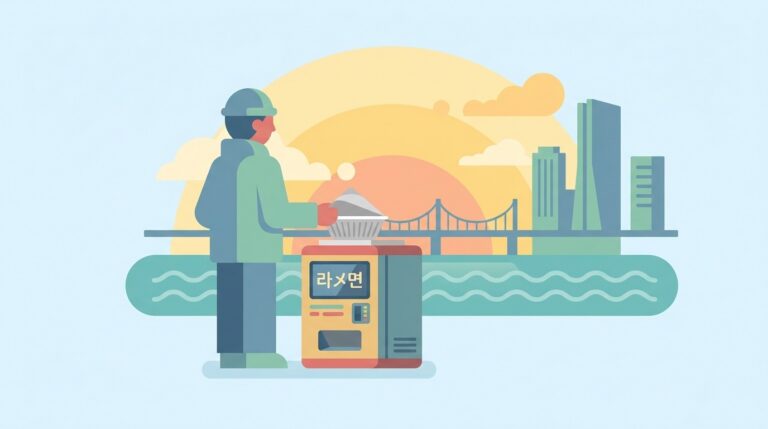
Picture this: the sun has just dipped below the horizon, casting a soft amber glow over the Han River. The cool evening breeze whispers through the trees, city lights twinkle along the Mapo Bridge, and all around you, couples and groups of friends are lounging on silver picnic mats, happily slurping piping-hot instant noodles out of shiny foil bowls.
You follow that irresistible aroma into a riverside GS25 convenience store, proudly grab a pack of spicy Shin Ramyun, and step up to the register. But the moment you walk outside to the cooking station, you freeze. There is a row of high-tech induction machines, digital timers blinking, steam hissing, and a queue of hungry locals behind you. Which button do you press first? Where does the hot water come from? Did you even grab chopsticks?
Take a deep breath! Many travelers freeze at this exact moment. Today, you’ll learn the essential A1 Korean phrases, machine button secrets, and unspoken etiquette you need to cook Han River ramen like a born-and-raised local. Let’s dive in!
Phase 2: Top 3 Core Expressions
1. 라면 하나 주세요 (Ramyeon hana juseyo)
- Pronunciation: [Ramyeon hana juseyo] (Sounds like: “Rah-myeon ha-nah joo-seh-yo” – say it smoothly with a friendly smile)
- Meaning: Literal: “One ramen, please.” / Real Nuance: “I’d like to buy this ramen and get the cooking container, please.”
- K-Culture Moment: You’ll see this phrase in practically every slice-of-life K-drama (like Hospital Playlist) whenever doctors or students sprint to convenience stores for late-night fuel.
- Editor’s Insight: At Han River stores, saying this confirms that you want the specialized cooking kit (foil bowl + disposable chopsticks), not just the dried noodle packet.
- Situation Spectrum: Casual ⚠️ | Semi-formal ✅ | Formal ✅
- 🤔 Think About It: In English, you might casually mumble “Just this one.” In Korean, the ending -주세요 (-juseyo) adds instant politeness and goodwill. Why do you think Korean builds respect directly into everyday verbs?
2. 이거 어떻게 써요? (Igeo eotteoke sseoyo?)
- Pronunciation: [Igeo eotteoke sseoyo?] (Sounds like: “Ee-gaw uh-tteo-kay suh-yo?” – ‘uh-tteo-kay’ expresses genuine curiosity)
- Meaning: Literal: “How do I use this?” / Real Nuance: “Could you show me how this machine works?”
- K-Culture Moment: Seen on variety shows like I Live Alone, whenever celebrities encounter new kitchen gadgets or camping gear.
- Editor’s Insight: Koreans are remarkably helpful when foreigners ask about ramen machines. Don’t panic in silence; point gently at the machine and ask this question!
- Situation Spectrum: Casual ⚠️ | Semi-formal ✅ | Formal ✅
- 🤔 Think About It: While asking strangers for help might feel awkward back home, asking a peer for quick operational help in Korea is viewed as friendly and natural.
3. 젓가락 챙겼어요? (Jeotgarak chaenggyeosseoyo?)
- Pronunciation: [Jeotgarak chaenggyeosseoyo?] (Sounds like: “Chut-gah-rahk cheng-gyuh-ssuh-yo?”)
- Meaning: Literal: “Did you pack/grab chopsticks?” / Real Nuance: “Make sure you didn’t leave the chopsticks behind!”
- K-Culture Moment: The iconic line whispered between friends right before walking from the store down to the picnic lawn.
- Editor’s Insight: The verb 챙기다 (chaenggida) is one of the warmest words in Korean—it means looking out for someone’s needs and keeping essentials organized.
- Situation Spectrum: Casual ✅ | Semi-formal ✅ | Formal ⚠️
- 🤔 Think About It: Sharing food and looking out for small table utensils shows the Korean value of Jeong (정)—deep interpersonal connection.
Phase 3: Textbook Korean vs. Real Korean
Situation 1: Locating the ramen cooking machine
- 📖 교과서 한국어 (Textbook): 온수기가 어디에 위치합니까? (Onsgiga eodie wichi-hamnikka? / “Where is the water heater situated?”)
- 🗣️ 진짜 한국어 (Real-life): 라면 기계 어디 있어요? (Ramyeon gigye eodi isseoyo? / “Where is the ramen machine?”)
- 💡 왜 다를까? Textbooks often teach formal, Sino-Korean nouns like 온수기 (water dispenser) and 위치합니까 (located). Real locals use natural everyday words like 라면 기계 (ramen machine) and 어디 있어요? (where is it?).
Situation 2: Asking where to dispose of leftover broth
- 📖 교과서 한국어 (Textbook): 잔여 음식물을 어디에 폐기합니까? (Janyeo eumsikmureul eodie pyegihamnikka? / “Where does one dispose of residual foodstuffs?”)
- 🗣️ 진짜 한국어 (Real-life): 국물 어디에 버려요? (Gungmul eodie beoryeoyo? / “Where do I dump the soup?”)
- 💡 왜 다를까? Official recycling bins use dense vocabulary. In conversation, simply asking where to throw away the 국물 (soup/broth) is effortless and 100% natural.
Phase 4: K-Culture Deep Dive & Non-Verbal Manners
4-1. Nunchi (눈치) & Gestures
- Two-Handed Exchange: When the clerk gives you your ramen container, receive it using both hands or rest your left fingertips beneath your right wrist. This non-verbal sign shows instant respect.
- The Queue Nunchi: While waiting for an induction burner, step back about two paces. Keep your bowl’s barcode ready so you can scan it the instant the previous person finishes.
4-2. Cultural Code: The Magic of Hangang Ramyeon (한강라면)
Why does instant ramen taste infinitely better on the banks of the Han River? To Koreans, it represents 소확행 (Sohwakhaeng)—”small but certain happiness.” Taking a break from busy city life to enjoy a modest 3,500 KRW bowl under the night breeze bridges generational gaps and creates shared memories.
Phase 5: Real Roleplay Scenario
- Setting: A bustling GS25 convenience store by Yeouido Han River Park on a Friday at 7:30 PM.
- Characters:
- Alex: A beginner Korean learner hungry for riverside ramen.
- Minho: A helpful university student working the store counter.
- Dialogue:
- Alex: 안녕하세요! 신라면 하나 주세요. (Annyeonghaseyo! Shin-ramyeon hana juseyo. / “Hello! One Shin Ramyun, please.”) 🎭 Placing the noodle packet gently on the checkout counter.
- Minho: 네, 3천5백 원입니다. 전용 용기 여기 있어요! (Ne, sam-cheon-o-baek won-imnida. Jeonyong yonggi yeogi isseoyo! / “Sure, that’s 3,500 won. Here is your cooking bowl!”) 🎭 Hands over the silver-rimmed paper bowl with a smile.
- Alex: 감사합니다. 저기… 라면 기계 어디 있어요? (Gamsahamnida. Jeogi… ramyeon gigye eodi isseoyo? / “Thank you. Um… where is the ramen machine?”) 🎭 Glancing around toward the store exit.
- Minho: 매장 오른쪽에 바로 있어요. (Maejang oreunjjoge baro isseoyo. / “It’s right outside on the right side of the store.”) 🎭 Points toward the riverside terrace.
- Alex: 죄송하지만, 이거 어떻게 써요? (Joesonghajiman, igeo eotteoke sseoyo? / “Excuse me, but how do I use this?”) 🎭 Holding the bowl in front of the cooking station with an inquisitive look.
- Minho: 용기 바코드를 기계에 찍고, ‘시작’ 버튼 누르시면 돼요! (Yonggi bakodeureul gigyee jjikgo, ‘sijak’ beoteun nureusimyeon dwaeyo! / “Scan the bowl’s barcode on the sensor, then just press the ‘Start’ button!”) 🎭 Mimics a scanning gesture with his hand.
- Alex: 아! 바코드 찍고 시작 버튼이요! 젓가락도 챙겼어요. (Ah! Bakodeu jjikgo sijak beoteun-iyo! Jeotgarakdo chaenggyeosseoyo. / “Ah! Scan barcode and press Start! I also grabbed chopsticks.”) 🎭 Nods happily, holding up a pair of wooden chopsticks.
- Minho: 맞아요! 뜨거우니까 조심하세요. 맛있게 드세요! (Majayo! Tteugeo-unikka josimhaseyo. Mas-itge deuseyo! / “That’s it! It’s very hot, so be careful. Enjoy your meal!”) 🎭 Bows lightly and offers two thumbs up.
- 🔀 Interactive Decision Point:
What should Alex say to conclude the conversation? - Option A: “네, 감사합니다! 좋은 하루 보내세요!” (Ne, gamsahamnida! Joeun haru bonaeseyo!)
- Feedback: [Best Choice] Polite, natural, and leaves the clerk feeling appreciated.
- Option B: “야, 고마워!” (Ya, gomawo!)
- Feedback: [Bad Choice] “Ya” is rude slang for “Hey you!” Never use informal speech (banmal) with strangers.
- Option C: “젓가락 더 줘.” (Jeotgarak deo jwo.)
- Feedback: [High Risk] While understood (“Give more chopsticks”), dropping polite endings makes it sound like an aggressive command. Always add -주세요 (-juseyo).
Phase 6: 10-Second Emotional Shadowing Drill
Read aloud, matching the pause markers (/) and feeling the emotional tags:
[😊 설레고 명랑하게 - Excited & Cheerful]
라면 하나 주세요! / 계란도 추가할게요!
(Ramyeon hana juseyo! / Gyerando chugahalgeyo!)
“One ramen, please! / I’ll add an egg too!”-
[🥺 조금 쑥스럽지만 정중하게 - Slightly Shy but Polite]
저기요, / 이거 어떻게 써요?
(Jeogiyo, / igeo eotteoke sseoyo?)
“Excuse me, / how do I use this?” -
[😋 기대감 가득 차서 - Full of Anticipation]
와, 냄새 진짜 좋다! / 젓가락 챙겼어?
(Wa, naemsae jinjja jota! / Jeotgarak chaenggyeosseo?)
“Wow, smells incredible! / Did you grab the chopsticks?”
Phase 7: K-Culture Mini Dictionary
- 한강라면 (Hangang Ramyeon) | Han River Ramen | The iconic Seoul tradition of cooking instant ramen outdoors using induction machines alongside the Han River.
- 용기 (Yonggi) | Cooking Bowl / Container | The barcode-activated, heat-safe bowl specifically engineered for induction boiling.
- 돗자리 (Dotjari) | Picnic Mat | The ubiquitous foil/plastic mat rented or purchased at convenience stores for riverside lounging.
- 국물 (Gungmul) | Broth / Soup | The seasoned soup; crucial when looking for the special liquid disposal station marked “국물 버리는 곳”.
Phase 8: Survival Kit for Travelers
-
Top 3 Survival Phrases:
- 젓가락 어디 있어요? (Jeotgarak eodi isseoyo?) – Where are the chopsticks? (Pro Tip: Chopsticks are usually self-serve right beside the microwaves or door, not placed inside your bag by clerks).
- 물 더 넣을 수 있어요? (Mul deo neoeul su isseoyo?) – Can I add more water? (Pro Tip: Look for the machine button labeled 물 추가 if you prefer a milder, less salty soup).
- 돗자리 있어요? (Dotjari isseoyo?) – Do you have picnic mats? (Pro Tip: You don’t need to carry one around; stores sell basic mats starting at 3,000 KRW).
- Editor’s Travel Note:
Before taking the subway to Yeouinaru Station, download the Naver Map app for Seoul navigation, as Google Maps does not provide real-time walking pathways in South Korea. Convenience stores at Han River parks accept credit cards and T-Money transit cards, but carrying 5,000 KRW in cash is wise for small seasonal tent vendors!
Phase 9: One Step Deeper (Cultural Reflection)
In South Korea, sitting side by side on a shared picnic mat to slurp hot noodles is an everyday expression of communal equality. No matter someone’s corporate title or social standing, everyone stands in the same line, stirs their own noodles with wooden chopsticks, and savors the river breeze together. Food in Korea is rarely just fuel; it is a shared emotional space.
- 💬 Your Turn: Have you ever cooked instant noodles outdoors? How does public park culture in your home city compare to Seoul’s lively riverside picnic scene? Share your thoughts below!
Phase 10: FAQ & Common Mistakes
Q: Can I bring packet ramen from home and use the Han River machine?
A: No. The induction dispensers will only activate when you scan the barcode printed specifically on the store-purchased disposable bowl.
Q: When should I add the ramen soup powder and the noodles into the bowl?
A: Put both the dry noodles and soup powder into the bowl before scanning and pressing start. The machine senses the weight before dispensing water.
Q: What if I bought an egg? When do I crack it in?
A: Wait until the timer shows less than 1 minute remaining and the water is vigorously boiling. If you put the egg in at the start, it will stick to the bottom and scorch the container!
🚨 Common Mistakes Warning Board
- Mistake: Throwing remaining soup into standard trash cans. -> Correct Action: Pour liquid waste into the designated red bucket labeled 국물 버리는 곳, then recycle the bowl.
- Mistake: Pressing buttons before scanning the container. -> Correct Action: Hold the container barcode flat against the red laser scanner until it beeps, then hit 시작 (Start).
- Mistake: Forgetting napkins and wet wipes. -> Correct Action: Han River picnic tables can get sticky; grab a small pack of wet tissues (물티슈 – multisyu) at the checkout counter.
Phase 11: Action Missions
- 🥉 Bronze Level: Practice saying “라면 하나 주세요” (Ramyeon hana juseyo) aloud 3 times in front of your mirror with a warm smile.
- 🥈 Silver Level: Next time you cook instant noodles at home, post a story on Instagram with the caption: “한강에서 라면 먹고 싶어요! (I want to eat ramen at Han River!)” and tag
@DailyHangul. - 🥇 Gold Level: Visit a Korean grocery mart or travel to Seoul, order your ramen entirely in Korean, and complete the cooking cycle solo!
- 🎮 K-Culture Mission: Watch any episode of a travel or food K-variety show (like Hangout with Yoo). Notice how cast members cheer when the timer hits zero—can you spot what side dishes they eat with their ramen?
Phase 12: Interactive Quiz Challenge
Test your new skills before packing your picnic basket!
1. Situational Challenge: You just paid for your noodles and want to ask the clerk where the cooking machines are located. What do you say?
a) 국물 어디에 버려요? (Gungmul eodie beoryeoyo?)
b) 라면 기계 어디 있어요? (Ramyeon gigye eodi isseoyo?)
c) 젓가락 챙겼어요? (Jeotgarak chaenggyeosseoyo?)
2. Fill-in-the-Blank: You want to ask for one ramen politely at the counter:
“라면 하나 ________” (Hint: 3 syllables, starts with ‘ju’)
3. True or False: You should drop a fresh egg into the dry bowl before pressing the start button.
👉 Click here to reveal the answers and explanations!
Answers:
1. b) 라면 기계 어디 있어요? (Great job! ‘기계’ means machine, and ‘어디 있어요?’ means ‘where is it?’).
2. 주세요 (juseyo) – The phrase becomes “라면 하나 주세요” (One ramen, please).
3. False! If you put the raw egg in before the water boils, it sinks to the bottom and burns the paper container. Always add it in the final 60 seconds!







