

Phase 1: 공감 (Story Opening)
안녕하세요! 매일한글 에디터입니다.
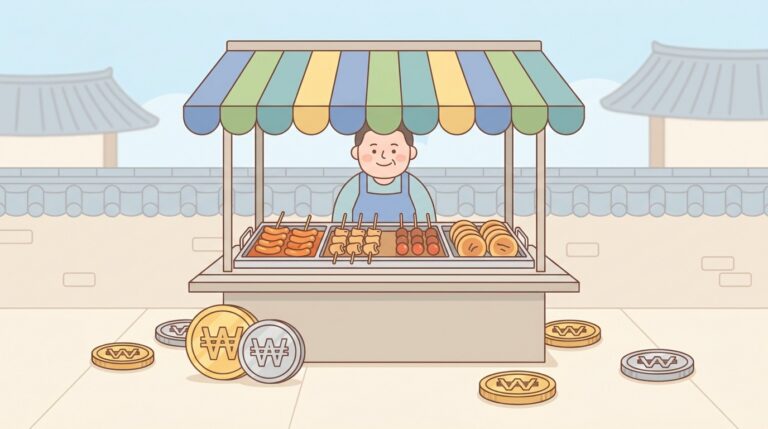
Picture this: You are standing in the middle of a bustling night market in Hongdae, Seoul. The mouthwatering aroma of freshly grilled tteokbokki and sizzling chicken skewers fills the crisp evening air. You point to a giant plate of street food, and the vendor cheerfully smiles and says, “3,000원이에요!” (Sam-cheon-won-i-e-yo!). You panic for a split second. Three thousand? Your mind scrambles with all those zeros on the paper notes. But then you quickly calculate the exchange rate in your head—wait, that is only about two US dollars! A huge wave of relief washes over you, and you want to exclaim: “Wow, that is way cheaper than I thought!”
Many of our beginner students tell us that Korean currency feels overwhelming at first because of the large numbers. Seeing 10,000 or 50,000 on a single bill can feel intimidating when you are used to smaller numbers like 10 or 20. But once you master the basic number units and one simple phrase, shopping in Korea turns from a stressful math test into pure joy. Today, let’s learn how to read Korean prices with confidence and deliver the perfect reaction that will make local shopkeepers smile!
Phase 2: 핵심 표현 3선 심층 분석 (Top 3 Core Expressions)
1. 생각보다 싸네요! (Saeng-gak-boda ssa-ne-yo!)
- Pronunciation: [Saeng-gak-bo-da ssa-ne-yo] (Sounds like: “Seng-gahk-boh-dah sah-neh-yoh” — make the double ‘ss’ crisp and tense!)
- Meaning: “It is cheaper than I thought!”
- K-Culture Moment: In popular Korean travel and reality shows like Omniscient Interfering View, celebrities often visit traditional markets. When an elderly shopkeeper hands them an enormous portion of homemade noodles for just 4,000 won, the guest covers their mouth and exclaims, “생각보다 싸네요!” (Saeng-gak-boda ssa-ne-yo!).
- Editor’s Insight: 생각 (saeng-gak) means ‘thought’, ~보다 (-boda) means ‘compared to’, and 싸네요 (ssa-ne-yo) means ‘is cheap (with gentle surprise)’. The ending -네요 expresses a genuine emotional discovery.
- Situation Spectrum: Casual (⚠️ only with friends: 생각보다 싸네!), Semi-formal (✅ 생각보다 싸네요!), Formal (✅ 생각보다 쌉니다!)
- 🤔 Think About It: In English, we might casually say “What a steal!”. But in Korean, expressing your personal expectation (생각보다) creates a polite connection showing you appreciate the vendor’s honest pricing.
2. 얼마예요? (Eol-ma-ye-yo?)
- Pronunciation: [Eol-ma-ye-yo] (Sounds like: “Uhl-mah-yeh-yoh”)
- Meaning: “How much is it?”
- K-Culture Moment: Every K-drama shopping montage features this exact line! When the protagonist picks up a cute winter scarf or plushie in Myeongdong, this is always the first magic question.
- Editor’s Insight: This is the absolute golden key of Korean commerce. It is polite, concise, and works everywhere from luxury department stores to sidewalk cart stalls.
- Situation Spectrum: Casual (⚠️ 얼마야?), Semi-formal (✅ 얼마예요?), Formal (✅ 얼마입니까?)
- 🤔 Think About It: Why does Korean combine the question particle with politeness so effortlessly? It allows you to be inquisitive without ever sounding blunt or demanding.
3. 만 원이에요 (Man-won-i-e-yo)
- Pronunciation: [Man-won-i-e-yo] (Sounds like: “Mahn-won-ee-eh-yoh”)
- Meaning: “It is 10,000 won.”
- K-Culture Moment: In convenience store dramas, 10,000 won is the iconic price of the “4 cans of craft beer” deal that weary office workers purchase after a long day.
- Editor’s Insight: English counts in thousands (1,000 -> 10,000 -> 100,000), but Korean counts in 만 (man = ten-thousand). Mastering the concept of 만 (10,000) is your first major breakthrough in Korean counting!
- Situation Spectrum: Casual (⚠️ 만 원이야), Semi-formal (✅ 만 원이에요), Formal (✅ 만 원입니다)
- 🤔 Think About It: While Western currencies reset commas every three zeros, East Asian currencies conceptually group numbers by four zeros (1,0000 = 1만). Embracing this shift opens up how Koreans visualize amounts.
Phase 3: 교과서 한국어 vs 진짜 한국어 (Textbook vs. Real-Life Korean)
Situation 1: Asking for the price of an item
- 📖 교과서 한국어 (Textbook): 이것의 가격은 얼마입니까? (I-geot-ui ga-gyeok-eun eol-ma-im-ni-kka?) — “What is the price of this object?”
- 🗣️ 진짜 한국어 (Real Life): 이거 얼마예요? (I-geo eol-ma-ye-yo?) — “How much is this?”
- 💡 왜 다를까? (Why the difference?): Standard textbooks often teach rigid, formal grammatical forms. In real life, native speakers naturally shorten 이것은 (i-geot-eun) into the effortless 이거 (i-geo) to keep casual shopping friendly and fast.
Situation 2: Reacting to an unbelievable bargain
- 📖 교과서 한국어 (Textbook): 가격이 매우 저렴합니다. (Ga-gyeok-i mae-u jeo-ryeom-ham-ni-da.) — “The price is exceedingly inexpensive.”
- 🗣️ 진짜 한국어 (Real Life): 우와, 진짜 싸네요! (U-wa, jin-jja ssa-ne-yo!) — “Wow, this is really cheap!”
- 💡 왜 다를까? (Why the difference?): 저렴하다 (jeo-ryeom-ha-da) is a formal Sino-Korean term used in written reports or news broadcasts. On the streets, everyday Koreans always use the expressive native word 싸다 (ssa-da) with genuine excitement.
Phase 4: K-Culture 딥다이브 & 비언어적 매너 (Deep Dive & Body Language)
4-1. 눈치 (Nunchi) & Body Language
When you are shopping in Korea, how you pay is just as important as what you say.
* The Two-Handed Hand-off: When handing your credit card or cash to the shopkeeper, always hold it with both hands, or support your right wrist/forearm with your left hand. This subtle gesture shows deep respect and polite manners.
* The Expressive Nod: When you say 생각보다 싸네요!, pair it with wide, delighted eyes and a light nod. It signals to the vendor that you value their generosity, creating instant warmth.
4-2. Cultural Insight: The 10,000 Won Metric
In Korea, the green 10,000 won bill (featuring King Sejong the Great) is the psychological baseline for everyday spending. Street meals, cozy cafe combos, and souvenir socks are frequently priced around or just under 만 원 (man-won, roughly $7.50 USD). Traditional markets like Gwangjang Market or Dongdaemun thrive on this accessible pricing, making them paradise for budget travelers!
Phase 5: 실전 롤플레이 시나리오 (Real-Life Roleplay Scenario)
- Location: Mangwon Traditional Market, Seoul (망원시장)
- Characters:
- You: A traveler craving crispy Korean fried chicken skewers.
- 이모님 (Imo-nim): The cheerful stall owner wearing a colorful floral apron.
- You: 🎭 (Approaching the sizzling stall with curiosity) 안녕하세요! 이거 얼마예요? (An-nyeong-ha-se-yo! I-geo eol-ma-ye-yo? / Hello! How much is this?)
- 이모님: 🎭 (Waving you closer with a warm grin) 닭꼬치? 한 개에 삼천 원이에요! (Dak-kko-chi? Han gae-e sam-cheon-won-i-e-yo! / Chicken skewer? It’s 3,000 won for one!)
- You: 🎭 (Surprised by the generous portion) 삼천 원이요? 우와, 생각보다 싸네요! (Sam-cheon-won-i-yo? U-wa, saeng-gak-boda ssa-ne-yo! / 3,000 won? Wow, it is cheaper than I thought!)
- 이모님: 🎭 (Beaming with pride) 우리 집이 양도 많고 제일 맛있어! (U-ri jib-i yang-do man-ko je-il mas-iss-eo! / Our place gives big portions and is the tastiest!)
- You: 🎭 (Nodding eagerly) 그럼 두 개 주세요! (Geu-reom du gae ju-se-yo! / Then please give me two!)
- 이모님: 🎭 (Packing two skewers into a paper cup) 네, 육천 원입니다! (Ne, yuk-cheon-won-im-ni-da! / Okay, that’s 6,000 won!)
- You: 🎭 (Handing over your card with both hands) 여기 카드 있어요. (Yeo-gi ka-deu iss-eo-yo. / Here is my card.)
- 이모님: 🎭 (Handing the piping hot skewers back) 맛있게 먹어요, 또 와요! (Mas-iss-ge meog-eo-yo, tto wa-yo! / Enjoy your food, come again!)
🔀 인터랙티브 분기점 (Interactive Decision Point)
Imagine the vendor says: “두 개에 오천 원에 줄게요!” (I will give you two for 5,000 won instead of 6,000!). How do you respond?
- Option A: “싫어요, 비싸요.” (Sil-eo-yo, bi-ssa-yo.)
- Feedback (Bad): This means “I don’t like it, it’s expensive!” You just rejected a discount rudely. The vendor will feel embarrassed.
- Option B: “진짜요? 감사합니다! 생각보다 싸네요!” (Jin-jja-yo? Gam-sa-ham-ni-da! Saeng-gak-boda ssa-ne-yo!)
- Feedback (Best!): You acknowledged the discount with enthusiasm and gratitude. You will probably get extra napkins or a free drink!
- Option C: “만 원 깎아주세요.” (Man-won kkak-a-ju-se-yo.)
- Feedback (Risk): Asking for a 10,000 won discount on a 5,000 won snack makes no mathematical sense and sounds unreasonable.
Phase 6: 10초 감정 섀도잉 드릴 (10-Second Emotion Shadowing Drill)
Read aloud and follow the pauses marked by / while channeling the matching emotion:
[😲 Genuine pleasant shock]- 우와! / 생각보다 / 진짜 싸네요!
- (U-wa! / Saeng-gak-bo-da / jin-jja ssa-ne-yo!)
[😊 Polite & curious]- 저기요, / 이거 / 얼마예요?
- (Jeo-gi-yo, / i-geo / eol-ma-ye-yo?)
[🥰 Delighted customer]- 맛있는데 / 생각보다 / 너무 싸요!
- (Mas-iss-neun-de / saeng-gak-bo-da / neo-mu ssa-yo!)
Phase 7: K-Culture 미니 사전 (Mini Dictionary)
- 원 (Won): The official currency unit of South Korea (symbol: ₩). Always placed right after the number (e.g., 천 원 = 1,000 won).
- 만 원 (Man-won): Ten thousand won (10,000₩). The most common paper bill in everyday street life, worth roughly $7 to $8 USD.
- 깎아주세요 (Kkak-a-ju-se-yo): Literally “Please cut it down (give me a discount).” Best used playfully with an endearing smile in traditional flea markets.
- 가성비 (Ga-seong-bi): An acronym for ‘Price-to-Performance Ratio’. Koreans love places with great 가성비 (high value for low cost)!
Phase 8: 여행자를 위한 생존 키트 (Traveler Survival Kit)
Top 3 Survival Phrases
- 이거 주세요. (I-geo ju-se-yo.) — “Please give me this one.” (Pro tip: Point your finger at the menu while saying this!)
- 카드 돼요? (Ka-deu dwae-yo?) — “Do you take credit cards?” (Pro tip: Korea is almost cashless, but tiny outdoor carts may prefer cash or bank transfers.)
- 영수증 버려주세요. (Yeong-su-jeung beo-ryeo-ju-se-yo.) — “Please throw away the receipt.” (Very common when buying quick snacks).
Editor’s Travel Note
Before stepping foot onto the streets of Seoul, make sure to check out our [official guide to Naver Map app download] for seamless subway navigation, and pick up a rechargeable card via the [Korea T-money transit card user guide]. While credit cards work almost anywhere, having 20,000 won in crisp cash in your pocket ensures you will never miss out on magical sidewalk street food stalls.
Phase 9: “한 발 더 깊이” (One Step Deeper)
In many Western cultures, asking about price or commenting on cost can sometimes feel overly transaction-focused. In Korea, however, marveling at how affordable a local meal is—saying 생각보다 싸네요!—is one of the highest compliments you can pay to a hard-working shop owner. It validates their spirit of Jeong (정)—the uniquely Korean bond of warmth, generosity, and community care through hearty, affordable food.
💬 Your Turn: Have you ever visited a country where the prices surprised you pleasantly? What was the first street food you tried?
Frequently Asked Questions (FAQ)
Q: What does "생각보다 싸네요! (Saeng-gak-boda ssa-ne-yo!)" mean in Korean and how do you pronounce it?
A: In Korean, "생각보다 싸네요! (Saeng-gak-boda ssa-ne-yo!)" is pronounced [Saeng-gak-bo-da ssa-ne-yo] and means: "It is cheaper than I thought!"
Q: What does "얼마예요? (Eol-ma-ye-yo?)" mean in Korean and how do you pronounce it?
A: In Korean, "얼마예요? (Eol-ma-ye-yo?)" is pronounced [Eol-ma-ye-yo] and means: "How much is it?"
Q: What does "만 원이에요 (Man-won-i-e-yo)" mean in Korean and how do you pronounce it?
A: In Korean, "만 원이에요 (Man-won-i-e-yo)" is pronounced [Man-won-i-e-yo] and means: "It is 10,000 won."







