

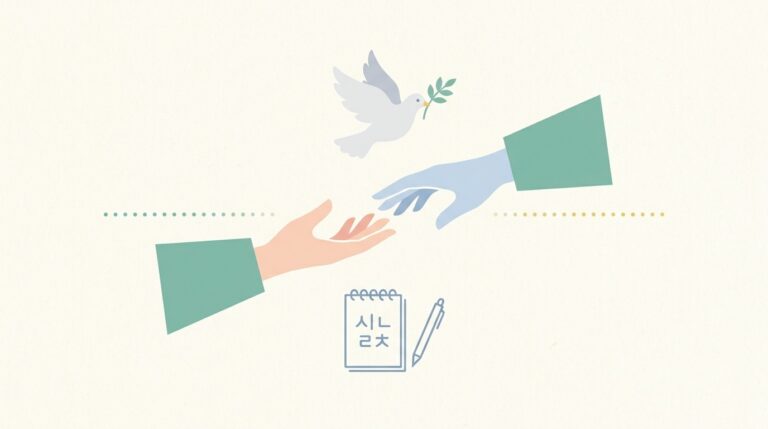
Beyond the Barbed Wire: Unlocking the Deep Emotions of Modern Korean History
Phase 1: Empathy & Storytelling Opening
안녕하세요! 매일한글 에디터입니다. (Hello! It’s your Daily Hangul editor.)
Have you ever stood in front of the Imjingak fence, watching hundreds of colorful ribbons flutter against rusted barbed wire overlooking the North? Or perhaps you were watching the movie Ode to My Father (국제시장) or the iconic border scene in Crash Landing on You, and felt a sudden knot in your chest as separated families cried out names into a television camera.
As advanced learners at the C1 level, you’ve likely mastered ordering food, debating social issues, and deciphering complex K-drama plots. But many learners tell me: “Editor, when conversations drift toward 6.25 (the Korean War) and the division of the peninsula with elder Koreans, my Korean suddenly feels paper-thin. I only know sterile historical facts, not the emotional vocabulary.”
It makes total sense. Discussing the Korean War (6.25 전쟁) and the tragedy of division (분단의 아픔) is not merely a history lesson—it is navigating the collective soul of modern Korea. This guide is crafted directly from field interviews with older Koreans and tested dialogues with advanced learners. By mastering these linguistic subtleties, you will move beyond textbook grammar into the profound realm of empathy, cultural resonance, and mature discourse. Let’s take this meaningful step together.
Phase 2: Key C1 Expressions
1. 이산가족의 한 (Isan-gajok-ui han)
- Pronunciation: [Isan-gajogui han] (Think: ee-sahn gah-johk-wee hahn; rhyme ‘han’ with German ‘Bahn’)
- Meaning: Literal: “The Han (unresolvable sorrow/regret) of separated families.” | Real Nuance: A lifelong, quiet ache caused by geopolitical separation from parents, siblings, or children without knowing whether they are alive or dead.
- K-Culture Moment: Seen in historical broadcasts reenacted in films like Ode to My Father, where elderly people hold up cardboard signs with handwritten names from decades ago.
- Editor’s Insight: Han (한) cannot be translated simply as “sadness.” It is sorrow aged over decades that turns into enduring, melancholic resilience. Pairing it with 이산가족 represents Korea’s ultimate historical wound.
- Situation Spectrum: Casual ⚠️ | Semi-formal ✅ | Formal ✅
- 🤔 Think About It: Does your native culture have an emotion that encompasses historical injustice and enduring personal grief in a single syllable?
2. 피는 물보다 진하다 (Pi-neun mul-boda jinhada)
- Pronunciation: [Pineun mulboda jinhada] (Think: pee-neun mool-boh-dah jeen-hah-dah)
- Meaning: Literal: “Blood is thicker than water.” | Real Nuance: Beyond familial loyalty, this proverb is repeatedly invoked in national reconciliation contexts to express that North and South Koreans share the same ancestral roots despite ideological walls.
- K-Culture Moment: Uttered frequently during joint Korean sports entries at the Olympics under the Unification Flag, or when cross-border reunions temporarily open.
- Editor’s Insight: While Western speakers use this mainly for immediate family drama, Koreans evoke it during diplomatic and humanitarian discussions regarding North-South unity.
- Situation Spectrum: Casual ✅ | Semi-formal ✅ | Formal ✅
- 🤔 Think About It: When geopolitical ideology conflicts with ethnic brotherhood, which narrative dominates in your home country?
3. 하루아침에 갈라지다 (Haru-achime gallajida)
- Pronunciation: [Haru-achime gallajida] (Think: hah-roo-ah-cheem-eh gahl-lah-jee-dah)
- Meaning: Literal: “To be split overnight.” | Real Nuance: Expresses an unexpected, devastating rupture that fundamentally broke ordinary lives without warning or closure.
- K-Culture Moment: Elderly survivors often begin their oral testimonies with: “우리 고향이 하루아침에 삼팔선으로 갈라졌어요” (Our hometown was split overnight by the 38th parallel).
- Editor’s Insight: Notice 하루아침에 (in a single morning). It emphasizes absolute helplessness in the face of macro-historical turbulence.
- Situation Spectrum: Casual ✅ | Semi-formal ✅ | Formal ✅
- 🤔 Think About It: How does your language express historical catastrophe that suddenly overturned civilian daily life?
Phase 3: Textbook Korean vs. Real Korean
Situation 1: Describing the sorrow of separated families
- 📖 교과서 한국어: 가족과 헤어져서 매우 슬픕니다. (Gajok-gwa heeojyeoseo maeu seulpeumnida.) – “I am very sad because I was separated from my family.”
- 🗣️ 진짜 한국어: 생사조차 모른 채 평생 가슴에 묻고 살았어요. (Saengsajocha moreun chae pyeongsaeng gaseume mutgo sarasseoyo.) – “Without even knowing if they were alive or dead, I buried it deep in my heart for a lifetime.”
- 💡 왜 다를까? Koreans rarely use generic adjectives like 슬프다 (sad) for generational trauma. Real speakers employ metaphorical physical expressions such as 가슴에 묻다 (to bury inside one’s heart).
Situation 2: Expressing hopes for peace on the Korean Peninsula
- 📖 교과서 한국어: 남북통일이 되면 좋겠습니다. (Nambuk-tongiri doemyeon jokessseumnida.) – “It would be nice if North and South Korea reunited.”
- 🗣️ 진짜 한국어: 더 늦기 전에 분단의 벽이 허물어졌으면 해요. (Deo neutgi jeone bundan-ui byeogi heomureojyeosseumyeon haeyo.) – “Before it’s too late, I wish the wall of division would crumble.”
- 💡 왜 다를까? 남북통일 can sound like an official slogan. Educated native speakers talk about urgency (더 늦기 전에, referencing the aging generation) and dismantling barriers (벽이 허물어지다).
Phase 4: K-Culture Deep Dive & Non-Verbal Manners
4-1. 눈치 (Nunchi) & Somber Posture
When modern Korean history—specifically the Korean War (6.25 전쟁) or post-war poverty—is brought up by Korean elders (어르신):
* Vocal Modulation: Lower your pitch slightly and slow down your cadence. Avoid enthusiastic, bubbly high tones.
* Physical Demeanor: Interlock your fingers gently on your lap, tilt your head slightly in empathetic listening (경청), and nod deliberately.
* Taboo Reaction: Never treat the DMZ or wartime division as merely an exciting tourist novelty or an action-movie backdrop. To older generations, it represents the death of siblings and unhealed generational grief.
4-2. Cultural Code: The Shift in Korean Cinema
Notice the cinematic transition in Korean entertainment. Mid-century films depicted the war purely through black-and-white ideological anti-communism (반공). However, modern masterpieces—from Joint Security Area (JSA, 공동경비구역 JSA) and Taegukgi: The Brotherhood of War (태극기 휘날리며) to Crash Landing on You (사랑의 불시착)—shift the lens entirely toward human tragedy, fraternal love, and the artificial absurdity of borders.
Phase 5: Real-Life Roleplay Scenario
Setting: Imjingak Peace Park, Paju. You are accompanying Mr. Park (박 선생님, 76), whose parents originally fled south from Hwanghae Province during the 1.4 Retreat (1.4 후퇴).
- 박 선생님: (철조망에 걸린 빛바랜 리본들을 조용히 매만지며) 여기가 올 때마다 가슴이 저려요. 제 부모님 고향이 저기 손 뻗으면 닿을 곳인데 말이죠.
(Yeogiga ol ttaemada gaseumi jeoryeoyo. Je bumonim gohyangi jeogi son ppeodeumyeon daeul gosin-de marijyo.)
🎭 Looking out toward the northern ridge, eyes glassy.
“Every time I come here, my heart aches. My parents’ hometown is right there within arm’s reach.” -
학습자 (You): 선생님, 손에 닿을 듯 가까운데 갈 수 없다는 게 참 안타깝습니다.
(Seonsaengnim, sone daeul deut gakkaun-de gal su eopdaneun ge cham antakkapseumnida.)
🎭 Standing slightly beside him, looking toward the same horizon with a low, respectful voice.
“Sir, it is truly heartbreaking that it is so close you could almost touch it, yet unreachable.” -
박 선생님: 그래요. 우리 어머니는 평생 고향에 두고 온 누이 생사라도 알고 싶어 하셨어요. 그게 평생의 한이셨지.
(Geuraeyo. Uri eomeonineun pyeongsaeng gohyange dugo on nui saengsarado algo sipeo hasyeosseoyo. Geuge pyeongsaeng-ui hanisyeotji.)
🎭 Sighing softly, shaking his head.
“Indeed. My mother lived her entire life just wishing to know if the sister she left behind was still alive. That was her lifelong Han.” -
학습자 (You): 분단의 아픔이 한 개인과 가족에게 얼마나 깊은 상처인지 조금이나마 느껴집니다.
(Bundan-ui apeumi han gaein-gwa gajogege eolmana gipeun sangcheoinji jogeuminama neukkyeojimnida.)
🎭 Nodding slowly, validating his family narrative.
“I can feel, even if just a little, how deep of a wound this national division has inflicted upon individual families.” -
박 선생님: 젊은 외국인 친구가 우리 역사의 아픔을 그렇게 헤아려주니 참 고맙구려.
(Jeolmeun oegukin chin-guga uri yeoksa-ui apeumeul geureoke hearyeojuni cham gomapguryo.)
🎭 Turning to pat your arm gently with a faint, warm smile.
“Hearing a young foreign friend understand and acknowledge the pain of our history means a great deal to me.” -
학습자 (You): 늦기 전에 그 상처들이 아물 수 있는 날이 꼭 오길 바랍니다.
(Neutgi jeone geu sangcheodeuri amul su inneun nari kkok ogil baramnida.)
🎭 Speaking with sincere composure.
“I truly hope the day comes when those wounds can heal before it is too late.” -
박 선생님: 네, 피는 물보다 진하니까요. 언젠가는 이 철조망도 걷히겠지요.
(Ne, pineun mulboda jinhannikkayo. Eonjen-ganeun i cheoljomangdo geochigetchiyo.)
🎭 Looking forward once more with renewed composure.
“Yes. Blood is thicker than water, after all. Someday, even these barbed wires will come down.” -
학습자 (You): 네, 선생님. 저도 그 평화의 날을 함께 기억하고 응원하겠습니다.
(Ne, seonsaengnim. Jeodo geu pyeonghwa-ui nareul hamkke gieokhago eung-wonhagesseumnida.)
🎭 Bowing head slightly in quiet solidarity.
“Yes, sir. I will continue to remember and root for that peaceful day alongside you.”
🔀 Interactive Decision Point
When Mr. Park reveals his mother’s lifelong Han, how should you respond?
- Choice A: “북한에 아직도 못 가요? 요즘 비행기 타면 어디든 가는데 신기하네요!” (Bukhane ajikdo mot gayo? Yojeum bihaenggi tamyeon eodideun ganeunde sin-gihaneyo!)
- Choice B: “분단의 아픔이 한 개인과 가족에게 얼마나 깊은 상처인지 조금이나마 느껴집니다.” (Bundan-ui apeumi han gaein-gwa gajogege eolmana gipeun sangcheoinji jogeuminama neukkyeojimnida.)
- Choice C: “전쟁은 북한이 먼저 일으켰으니까 어쩔 수 없는 대가 아닌가요?” (Jeonjaeng-eun bukhani meonjeo ireukyeosseunikka eojjeol su eomneun daega anin-gayo?)
[Feedback]
* Choice A (Risk): Sounds naive and dismissive of geopolitical reality. Calling national partition '신기하다' (curious/novel) offends victims.
* Choice B (Best): Demonstrates C1 empathy, historical depth, and elevated vocabulary (헤아리다, 깊은 상처).
* Choice C (Bad): Overly confrontational and political. Disregards individual civilian sorrow in favor of ideological finger-pointing.
Phase 6: 10-Second Emotion Shadowing Drill
Read aloud, matching the pause markers (/) and internalizing the emotional cues:
[🕊️ 숙연하고 진중하게]
손에 닿을 듯 가까운데 / 갈 수 없다는 게 / 참 안타깝습니다.
(Sone daeul deut gakkaun-de / gal su eopdaneun ge / cham antakkapseumnida.)-
[🥺 깊은 한숨과 탄식]
생사조차 모른 채 / 평생 가슴에 묻고 / 살아오셨군요.
(Saengsajocha moreun chae / pyeongsaeng gaseume mutgo / saraosyeotgun-yo.) -
[🌱 조용한 희망을 담아]
더 늦기 전에 / 분단의 벽이 허물어지고 / 평화가 찾아오길 바랍니다.
(Deo neutgi jeone / bundan-ui byeogi heomureojigo / pyeonghwaga chaja-ogil baramnida.)
Phase 7: K-Culture Mini Dictionary
-
실향민 (Sil-hyang-min)
Translation: Displaced persons who lost access to their native home due to war or division.
Usage: Used respectfully when discussing elderly people who originated from provinces now in North Korea (e.g., “실향민 어르신들의 망향가”). -
이산가족 (I-san-ga-jok)
Translation: Separated/dispersed families divided across the North-South border.
Usage: Critical vocabulary for civic diplomacy, historical news, and humanitarian affairs. -
분단국가 (Bun-dan-guk-ga)
Translation: A divided nation / divided state.
Usage: Academic and analytical context. Korea is often described as 세계 유일의 분단국가 (the world’s only remaining divided nation). -
망향 (Mang-hyang)
Translation: Yearning for one’s lost homeland.
Usage: Found in monument names like 망배단 (Mangbaedan alter at Imjingak where displaced people bow toward northern ancestors during Chuseok).
Phase 8: Traveler’s Survival Kit
Survival Expressions Top 3
-
여기서 사진 촬영이 가능한가요?
(Yeogiseo sajin chwaryeong-i ganeunghangayo?)
“Is photography permitted here?”
Pro Tip: Border areas near the Civilian Control Line (민통선) enforce strict military photography bans. -
신분증을 미리 제시해야 하나요?
(Sinbunjeung-eul miri jesihayeoya hanayo?)
“Do I need to present my ID/passport in advance?”
Pro Tip: Crucial for DMZ tours and the Dora Observatory. Always carry your physical passport. -
엄숙한 분위기를 유지해 주세요.
(Eomsukhan bun-wigireul yujihae juseyo.)
“Please maintain a solemn atmosphere.”
Pro Tip: A frequent sign inside memorial halls. Mind loud laughter or energetic vlogging.
Editor’s Travel Note
- Planning a visit to the border area? Book DMZ shuttle tours in advance via the [Korail official reservation page] or trusted cultural services. Local buses around Imjingak run infrequently, so check arrival intervals via Naver Map before departing.
Phase 9: A Step Deeper (Reflection)
In Korean culture, grief is rarely isolated to the individual. The division of the Korean peninsula highlights how macro-history infiltrates personal identity. While modern youth in Seoul view the Korean War as past history, the emotional architecture of 한 (Han) and 정 (Jeong) keeps the longing for human connection alive across generations. To understand modern Korea’s obsession with peace, community, and security, one must acknowledge that this wound is not yet a closed historical chapter, but an ongoing reality.
💬 Your Turn: Have you ever encountered a historical division or wall in your home country that still impacts personal family lives today? Share your thoughts in the comments below!
Phase 10: FAQ & Common Mistakes
Q: Can I openly ask elderly Koreans about their war memories?
A: It is best not to probe aggressively. If an elder opens up about their hometown or postwar hardship, listen attentively (경청). Asking intrusive questions like “Did you see combat?” can trigger real trauma.
Q: What is the politically neutral way to refer to North Korea in South Korea?
A: In standard South Korean discourse, use 북한 (Buk-han). In formal/diplomatic contexts, 남북관계 (Inter-Korean relations) is preferred. Avoid derogatory slang or overly casual reductions.
Q: Is reunification (통일) viewed unanimously across generations?
A: No. While older generations often view 통일 as an urgent emotional duty to reunite families, younger generations often view it through economic, demographic, and sociological realities.
🚨 Common Mistakes Alert
- Mistake: Calling the DMZ “amusing” or “cool” (재미있다 / 신기하다).
- Correct Action: Describe it as 인상 깊다 (deeply memorable) or 숙연해지다 (solemn/humbling).
- Mistake: Confusing 6.25 전쟁 (Korean War, 1950) with 8.15 광복절 (Liberation from Japanese colonial rule, 1945).
- Correct Action: Ensure clear distinction between liberation (광복) and the outbreak of the war (발발).
- Mistake: Assuming all separated families are in elderly care centers.
- Correct Action: Many second- and third-generation South Koreans carry the ancestral identity of 실향민 가문 (families of displaced roots).
Phase 11: Action Missions
- 🥉 Bronze Mission (Solo): Read the Phase 6 Shadowing Drill aloud three times using accurate pauses and somber vocal inflection.
- 🥈 Silver Mission (SNS): Share your favorite scene from Ode to My Father or Crash Landing on You on social media with the sentence: “분단의 아픔을 돌아보게 되었습니다.” (Bundan-ui apeumeul doraboge doeotseumnida.)
- 🥇 Gold Mission (Real Life): Visit the War Memorial of Korea in Yongsan or Imjingak, and read at least one civilian testimony plaque in Korean.
- 🎮 K-Culture Mission: Watch the opening 15 minutes of Taegukgi: The Brotherhood of War and note down the transition from peaceful 1950 Seoul streets to sudden military draft.
Phase 12: Interactive Quiz Challenge
Q1. Which expression best captures the lifelong, sorrowful longing of separated families?
a) 가벼운 슬픔
b) 이산가족의 한
c) 단순한 후회
Click for the Answer & Explanation
Correct Answer: b) 이산가족의 한
Explanation: ‘한 (Han)’ represents the distinct Korean cultural emotion of deep-seated, enduring sorrow born of unresolved historical wounds.
Q2. Fill in the blank:
우리는 한 핏줄이고 민족이기에, “피는 _____ 진하다”고 말합니다.
Click for the Answer & Explanation
Correct Answer: 물보다
Explanation: The full proverb is ‘피는 물보다 진하다’ (Blood is thicker than water), frequently invoked to emphasize ethnic and familial unity.
Q3. True or False:
Visiting the DMZ and describing the experience as “유쾌하고 신기한 관광지” (a delightful and amusing tourist spot) to Korean seniors is considered culturally considerate.
Click for the Answer & Explanation
Correct Answer: False
Explanation: Treating war division memorial sites as merely amusing or trivial disregards the deep trauma experienced by war survivors and displaced families.







