

How to Make Friends with Korean Dogs and Their Owners on Your Daily Walk
Phase 1: Empathy & Story Opening
안녕하세요! 매일한글 에디터입니다. (Hello! I’m your Daily Hangul editor.)
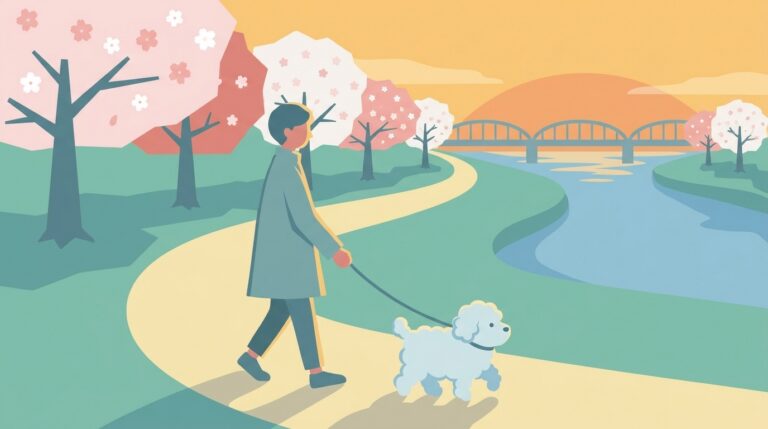
Picture this: It’s a crisp autumn afternoon in Seoul. You are strolling along the Gyeongui Line Forest Park—affectionately known as Yeontral Park—with an iced Americano in hand. Suddenly, you spot the most impossibly fluffy white cloud on four legs trotting toward you. It’s a Bichon Frise wearing a tiny neon fleece vest and tiny yellow booties. Your heart instantly melts. You desperately want to say hello, pet its little head, and strike up a chat with the friendly owner smiling nearby.
Then, panic freezes your tongue. What do you say? “Can I touch your dog?” sounds awkward when translated literally. Will asking “Does it bite?” sound rude? What if you accidentally breach Korean etiquette and make the owner uncomfortable?
If you’ve ever felt that awkward hesitation while passing adorable pups at the Han River or in neighborhood alleys, you are definitely not alone. Many intermediate Korean learners struggle because textbooks rarely cover the warm, highly contextual language of modern pet culture. Based on real feedback from our Daily Hangul learners living in and traveling around Korea, this guide is crafted to turn those tongue-tied park encounters into delightful, natural conversations. By the end of this guide, you will know exactly how to compliment a puppy, ask for permission politely, and navigate Korea’s vibrant dog culture with confidence!
Phase 2: Core Expressions Deep Dive
Here are three must-have expressions for walking dogs and greeting pets in Korea.
1. 만져봐도 돼요? (Manjyeobwado dwaeyo?)
- Pronunciation: Mahn-jyeo-bwah-doh dway-yoh? (Think of “man” like the English word, “jyeo” like “geo” in geography, and “dway-yo” rhyming with “sway-yo”.)
- Meaning: Literally “May I try touching [it]?” | Real Nuance: “May I pet your dog? / Is it okay if I say hi to them?”
- K-Culture Moment: Seen in almost every lifestyle K-drama (like Weightlifting Fairy Kim Bok-joo or My Roommate is a Gumiho) whenever leads take a romantic walk through a park and pause at an energetic puppy.
- Editor’s Insight: Korean uses the combination of the verb 만지다 (to touch) + -아/어 보다 (to try doing something) + -도 되다 (to be permitted). Saying just 만져도 돼요? sounds abrupt, but inserting -봐도 softens the request considerably, signaling gentle respect.
- Situation Spectrum: Casual (Friends): ⚠️ (Use 만져봐도 돼?) | Semi-formal (Strangers in park): ✅ | Formal: ⚠️ (만져봐도 되겠습니까? is grammatically correct but overly stiff for a casual park).
- 🤔 Think About It: In English, we say “pet” or “stroke”, whereas Korean uses “try touching” (만져보다). Why do you think Korean expresses permission through “trying out” an action rather than a direct verb?
2. 안 물어요? (An mureoyo?)
- Pronunciation: Ahn moo-ruh-yoh? (Sounds like “Ahn” + “moo” as in a cow + “ruh” + “yoh”.)
- Meaning: Literally “Does it not bite?” | Real Nuance: “Does he/she bite? / Is he/she gentle?”
- K-Culture Moment: Frequently heard on popular Korean pet entertainment shows like Dogs Are Incredible (개는 훌륭하다) when trainer Kang Hyung-wook approaches an anxious client’s pup.
- Editor’s Insight: Notice that Koreans ask in the negative form (안 물어요?) instead of 물어요? (Does it bite?). Asking 물어요? can sound accusatory, as if you assume the dog is aggressive. Asking in the negative subtly assumes the dog is good: “He doesn’t bite, right?”
- Situation Spectrum: Casual: ✅ | Semi-formal: ✅ | Formal: ⚠️
- 🤔 Think About It: How does phrasing a sensitive question negatively soften social friction in Korean interpersonal relationships?
3. 몇 살이에요? (Myeot sarieyo?) / 몇 개월이에요? (Myeot gaeworieyo?)
- Pronunciation: Myut sah-ree-ey-yo? / Myut gay-wuh-ree-ey-yo?
- Meaning: “How old is he/she?” / “How many months old is he/she?”
- K-Culture Moment: A staple small-talk starter among pet owners at neighborhood dog cafes (애견 카페) across Hongdae and Seongsu-dong.
- Editor’s Insight: In Korea, age is the universal anchor for relationship building—and that extends to pets! For puppies that look small, Koreans almost always ask for the age in months using 개월 (gaewol). It shows you notice how youthful and tiny they are.
- Situation Spectrum: Casual: ⚠️ (몇 살이야?) | Semi-formal: ✅ | Formal: ⚠️ (몇 살이십니까? is only used for human elders!).
- 🤔 Think About It: Why do you think Korean society applies human age-inquiry patterns to domestic pets?
Phase 3: Textbook Korean vs. Real Korean
Let’s upgrade your textbook phrases to everyday conversational Korean.
Situation 1: Asking if the dog is well-behaved
- 📖 교과서 한국어 (Textbook): 개가 얌전합니까? (Gae-ga yamjeonhamnikka? – Is the dog well-behaved?)
- 🗣️ 진짜 한국어 (Real-life): 강아지가 참 순하네요! (Gang-a-ji-ga cham sun-ha-ne-yo! – The puppy is so gentle and sweet!)
- 💡 왜 다를까? (Why the difference?): Koreans rarely refer to someone’s companion as 개 (gae – plain dog), as it can sound slightly harsh. Instead, locals use 강아지 (gang-a-ji – puppy/dog) regardless of the dog’s size, and the word 순하다 (sun-ha-da – mild, tame, docile) is the gold-standard compliment.
Situation 2: The owner reassuring you
- 📖 교과서 한국어 (Textbook): 제 개는 사람을 물지 않습니다. (Je gae-neun sarameul mulji anseumnida. – My dog does not bite humans.)
- 🗣️ 진짜 한국어 (Real-life): 우리 애 순해요, 사람 좋아해요~ (Uri ae sun-hae-yo, saram jo-a-hae-yo~ – Our baby is very sweet, he loves people!)
- 💡 왜 다를까? (Why the difference?): Modern Korean pet owners view their dogs as family members, often calling them 우리 애 (uri ae – our child/kid) rather than “my dog.” This creates an immediate warm and cozy connection.
Phase 4: K-Culture Deep Dive & Non-Verbal Manners
4-1. 눈치 (Nunchi) & Gestures
When interacting with dogs in Korea, your non-verbal cues matter as much as your spoken grammar:
1. The Back-of-the-Hand Greeting (손등 인사): Never plunge your hand straight over a dog’s head. Squat down slightly to reduce your silhouette, curl your fingers inward, and extend the back of your hand (손등) below their nose so they can catch your scent.
2. Eye Contact Nunchi: Do not stare directly into the dog’s eyes with wide eyes, which can be interpreted as a challenge. Maintain a soft, oblique gaze while smiling at the owner.
3. Leash Etiquette (리드줄 매너): Korea strictly enforces leash laws (리드줄 착용 의무). If you are walking your own pet, keep the leash comfortably short (under 2 meters by law) when passing other pedestrians.
4-2. Cultural Code: The Rise of “Pet-fam” (펫팸족) & 개모차 (Pet Strollers)
Korea is experiencing an unprecedented pet boom. The blend of Pet and Family created the buzzword 펫팸족 (Pet-fam Tribe). Wander through Starfield Mall or along the Han River on any weekend, and you will see dogs wearing tailored trench coats, sunglasses, and riding in sleek 개모차 (dog strollers)—which famously out-sold baby strollers in South Korea in recent retail metrics! This shift reflects deep changes in demographics and urban lifestyle, turning pets into cherished companions deserving of the highest urban courtesy.
Phase 5: Real-Life Roleplay Scenario
Setting: A golden sunset over the Han River Park in Ttukseom. You spot Minji walking her snow-white Pomeranian.
Characters:
* 민지 (Minji): Friendly Seoul resident in her late 20s walking her energetic dog.
* 나 (You): An observant international walker practicing natural Korean.
- Turn 1 (나): 앗, 안녕하세요! 강아지가 진짜 귀여워요. (Ah, annyeonghaseyo! Gang-a-ji-ga jinjja gwi-yeo-wo-yo.) [🎭 Smiling warmly, stopping at a polite 2-meter distance]
- “Oh, hello! Your puppy is really cute.”
- Turn 2 (민지): 감사합니다! 산책 나온 걸 너무 좋아해요. (Gamsahamnida! Sanchaek naon geol neomu jo-a-hae-yo.) [🎭 Smiling and gently gathering the leash]
- “Thank you! He loves coming out for walks.”
- Turn 3 (나): 혹시… 잠깐 만져봐도 돼요? (Hoksi… jamkkan manjyeobwado dwaeyo?) [🎭 Crouching slightly down to eye level]
- “By any chance… may I pet him for a moment?”
- Turn 4 (민지): 네, 만져보세요! 우리 애 엄청 순해요. (Ne, manjyeoboseyo! Uri ae eomcheong sun-hae-yo.) [🎭 Loosening the leash slightly]
- “Yes, go ahead and pet him! Our baby is super gentle.”
- Turn 5 (나): 손등 먼저 냄새 맡게 해줄게요. 안 물죠? (Sondeung meonjeo naemsae matge hae-julgeyo. An muljyo?) [🎭 Extending closed fist, letting the dog sniff]
- “I will let him sniff the back of my hand first. He doesn’t bite, right?”
- Turn 6 (민지): 네, 전혀 안 물어요. 사람을 워낙 좋아해서요. (Ne, jeonhyeo an mureoyo. Sarameul wonak jo-a-hae-seoyo.) [🎭 Watching happily as the dog wags its tail]
- “Yes, he doesn’t bite at all. He just loves people so much.”
- Turn 7 (나): 털이 진짜 부드럽네요! 몇 살이에요? (Teori jinjja budeureomne-yo! Myeot sarieyo?) [🎭 Gently stroking the dog’s chest]
- “His fur is so soft! How old is he?”
- Turn 8 (민지): 이제 두 살 됐어요! 좋은 하루 보내세요! (Ije du sal dwaesseoyo! Joeun haru bonaeseyo!) [🎭 Waving gently as they move on]
- “He just turned two years old! Have a wonderful day!”
🔀 Interactive Branching Moment
The dog suddenly gets excited and jumps lightly toward your knee. What do you do?
- Choice A: Squeal loudly, grab the dog’s ears, and pick it up instantly.
- Outcome (Bad): High risk! Screaming or sudden grabbing can frighten even the friendliest dog, provoking defensive nipping, and will alarm the owner.
- Choice B: Step backward abruptly with hands in the air and yell “안 돼요!” (An dwaeyo!).
- Outcome (Risk): While understandable if you are startled, sudden jerks confuse the dog and can cause the leash to trip passing runners or cyclists.
- Choice C: Stand calmly, let the owner adjust the leash, and softly say “반가워~ 착하다!” (Bangawo~ chak-ha-da!).
- Outcome (Best): Perfect display of pet etiquette! It keeps the dog calm, reassures the owner, and shows seasoned park manners.
Phase 6: 10-Second Emotional Shadowing Drill
Practice reading these out loud to master authentic rhythm and natural intonation:
[😊 Cheerful and polite]
강아지가 / 너무 귀여운데, / 잠깐 만져봐도 돼요?
(Gang-a-ji-ga / neomu gwi-yeo-wun-de, / jamkkan manjyeobwado dwaeyo?)-
[🥺 Reassuring and soft]
손등 먼저 냄새 맡게 / 해줄게요~ / 안 물죠?
(Sondeung meonjeo naemsae matge / hae-julge-yo~ / an muljyo?) -
[😍 Full of admiration]
어머, / 털이 진짜 부드럽네요! / 몇 개월이에요?
(Eomeo, / teori jinjja budeureomne-yo! / myeot gaeworieyo?)
Phase 7: K-Culture Mini Dictionary
-
댕댕이 (Daeng-daeng-i)
- Meaning: A darling slang term for dog/puppy.
- Usage: Born on Korean internet forums due to visual typography (the Hangul letters of ‘멍멍이’ look like ‘댕댕이’). Widely used on social media captions, pet YouTube titles, and street fashion for pets.
- 펫티켓 (Pettiket)
- Meaning: Pet + Etiquette.
- Usage: Commonly seen on public park banners. Refers to carrying waste bags (배변 봉투), keeping dogs leashed (리드줄 착용), and respecting non-dog owners.
- 개모차 (Gae-mo-cha)
- Meaning: Pet stroller (개 + 유모차).
- Usage: Essential vocabulary when entering pet-friendly department stores, cafes, or public transit spots in Seoul where pets must be wheeled or crated.
- 순둥이 (Sun-dung-i)
- Meaning: A sweetheart; an exceptionally gentle creature.
- Usage: Used to praise a calm, docile dog who doesn’t bark or snap. E.g., “우리 강아지는 완전 순둥이에요!” (Our dog is a complete sweetheart!).
Phase 8: Traveler’s Survival Kit
Survival Expressions TOP 3
- 배변 봉투 있어요? (Baebyeon bongtu isseoyo?)
- Pronunciation: Bae-byeon bong-too ees-suh-yoh?
- Pro Tip: If you run out of poop bags during a walk, asking a fellow dog walker this will save you from heavy municipal littering fines!
- 간식 줘도 괜찮아요? (Gansik jwodo gwaenchannayo?)
- Pronunciation: Gan-sik jwoh-doh gwaen-chan-nah-yoh?
- Pro Tip: Never offer treats without asking; many Korean pets have severe allergies or specialized diets.
- 줄 조금만 당겨주세요. (Jul jogeumman dang-gyeo-juseyo.)
- Pronunciation: Jool joh-geum-mahn dahng-gyuh-joo-seh-yoh.
- Pro Tip: Politeness tool when an unfamiliar dog approaches you too closely in tight spaces like elevators.
Editor’s Travel Note
- Navigation: Download the [Naver Map app for pet-friendly cafes] to easily filter places marked as 반려동물 동반 (pets allowed).
- Transit Rules: In the Seoul subway and city buses, pets are permitted only inside enclosed carriers or specialized pet bags. Heads and paws must remain inside unless aboard specific pet taxis.
Phase 9: “One Step Deeper” (Reflective Prompt)
In recent years, Korean legal and colloquial terms shifted from 애완견 (Aewangyeon)—meaning an animal kept for amusement—to 반려견 (Ballyeogyeon), meaning a lifelong animal companion accompanying you through your journey. In high-density apartment environments where millions share close quarters, walking a dog is not merely a chore; it is an active civic agreement rooted in collective mindfulness and consideration for neighbors.
💬 Your Turn: In your home country, what is the very first question dog lovers ask each other in the park? How does it compare to asking about age or gentleness in Korea? Share your story in the comments below!
Phase 10: FAQ & Avoiding Misunderstandings
Q: Can I approach any dog I see tied outside a convenience store in Korea?
A: It is best not to. Dogs waiting outside convenience stores are often on high alert awaiting their guardians. Approaching them without their owner present can cause sudden stress and defensive barking.
Q: What should I say if an owner tells me their dog is shy or sensitive?
A: Simply reply: “아, 그렇군요! 알겠습니다~” (Ah, geureokunyo! Algetseumnida~ – Ah, I see! Understood~) and take a step back with a polite smile.
Q: Are all Han River park lawns open to dogs?
A: Yes, but dogs must remain on leashes at all times, and owners must clean up immediately. Dogs are strictly prohibited inside designated children’s sandboxes and water play areas.
🚨 Common Mistakes Warning Board
- Mistake 1: Calling someone’s dog “저 개” (jeo gae – that dog).
- Correct Action: Use “저 강아지” (jeo gang-a-ji) or “아가” (a-ga – baby/little one) to maintain polite warmth.
- Mistake 2: Patting the dog on top of its head immediately upon meeting.
- Correct Action: Present the back of your hand (손등) below chin level first to allow sniffing.
- Mistake 3: Handing out snacks to a dog without consulting the owner.
- Correct Action: Always ask 간식 줘도 돼요? first.
Phase 11: Action Mission & Engagement
- 🥉 Bronze Mission (Solo): Stand in front of a mirror and recite “만져봐도 돼요? 안 물어요?” three times with a bright, welcoming smile.
- 🥈 Silver Mission (Social): Next time you watch a K-drama with a pet scene or follow a Korean pet Instagram account, write a comment: “강아지가 너무 순하고 귀여워요!”
- 🥇 Gold Mission (Real Life): When visiting a pet-friendly cafe in Seoul or walking along the Han River, initiate a short exchange with an owner using the phrase “강아지 참 순하네요! 몇 살이에요?”
- 🎮 K-Culture Mission: Search for the keyword 댕댕이 브이로그 (Dog V-log) on YouTube to observe the gentle tones native speakers use when talking to their pets!
Phase 12: Interactive Quiz Challenge
Test your knowledge with these three practical questions!
- Situational Judgment: You meet a stranger walking a fluffy Pomeranian. What is the most natural, polite way to ask to pet the dog?
- A) 개를 만져도 됩니까?
- B) 만져봐도 돼요?
- C) 이 개는 사람을 뭅니까?
- Fill-in-the-Blank: Complete the compliment:
- “강아지가 참 _______! 전혀 안 짖네요.” (Hint: Word meaning mild/gentle)
- True / False: In Korea, it is considered polite to feed a small piece of bread or meat from your meal to someone else’s dog in an outdoor cafe without asking.
- [ ] True
- [ ] False
👉 Click to reveal answers & explanations!
- Answer: B (만져봐도 돼요?)
- Explanation: Choice A is overly formal textbook language, and Choice C sounds abrupt and accusatory. B strikes the perfect balance of warmth and politeness.
- Answer: 순하네요 (or 순해요)
- Explanation: 순하다 is the go-to expression used to describe gentle, well-behaved animals.
- Answer: False
- Explanation: Never feed human food or treats to someone’s pet without explicit permission (간식 줘도 돼요?).
- Explanation: Never feed human food or treats to someone’s pet without explicit permission (간식 줘도 돼요?).







