

Decoding Gangnam Station Billboards: Your Insider Guide to Korea’s Plastic Surgery Talk
Phase 1: Empathy (Stepping into Gangnam Station)
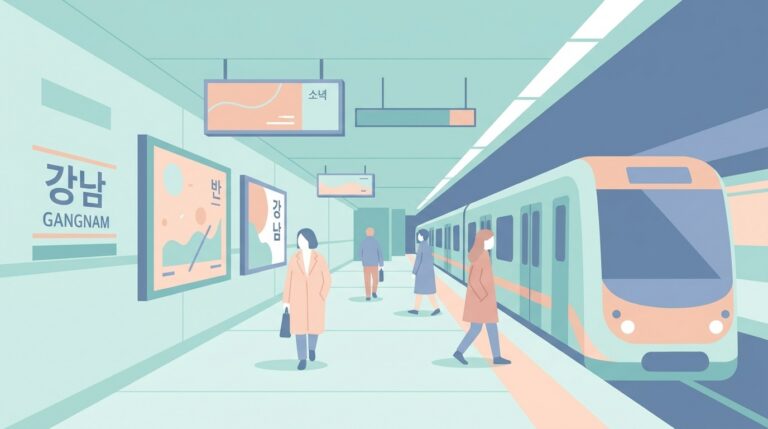
안녕하세요! (Hello!) I am your editor at Daily Hangul. If you have ever transferred trains at Gangnam Station (강남역) on Seoul Subway Line 2, you know the feeling. The moment the train doors open, you are greeted by an ocean of pristine lighting, minimalist pastel aesthetics, and massive digital clinic billboards stretching as far as the eye can see.
For many international visitors and learners, this creates an immediate cultural pause. You might ask yourself: “Is it polite to look? Why are there so many clinics right here? How do locals actually discuss this without feeling awkward?” Many of our intermediate learners share that they want to understand these advertisements and cultural discussions—not necessarily because they want surgery, but because Korean beauty standards, media, and self-care vocabulary show up constantly in K-Dramas, webtoons, and everyday coffee shop chats.
Navigating this topic requires nuanced language and cultural tact (눈치, nunchi). Today, drawing from years of real classroom discussions and local life in Seoul, I will walk you through the essential B1-level expressions, social etiquette, and cultural mindsets so you can understand what those Gangnam billboards are really saying.
Phase 2: 3 Core Expressions Deep Dive
1. 자연스럽게 해주세요 (Jayeonseureopge haejuseyo)
- Pronunciation: Jayeonseureopge haejuseyo (Sounds like: jah-yuhn-seu-ruhp-geh hae-joo-seh-yo)
- Meaning:
- Literal: Please do it naturally.
- Real Nuance: “Keep it subtle so it enhances my features without looking artificially altered.”
- K-Culture Moment: You will hear this phrase frequently in Korean beauty consultation vlogs on YouTube or lifestyle reality shows where guests visit salons, skin clinics, or aesthetic consults.
- Editor’s Insight: The word 자연스럽다 (natural) is the gold standard of modern Korean aesthetic procedures. Ten or fifteen years ago, dramatic changes were trendy. Today, the ultimate compliment in Korea is looking like you were simply born with great genes.
- Situation Spectrum: Casual ⚠️ | Semi-formal ✅ | Formal ✅
- 🤔 Think About It: In your culture, does “beauty” prioritize bold, distinct features or effortless, undetectable subtlety? How does language reflect that preference?
2. 인상이 달라 보이다 (Insang-i dalla boida)
- Pronunciation: Insang-i dalla boida (Sounds like: in-sang-ee dahl-lah boh-ee-dah)
- Meaning:
- Literal: One’s facial impression looks different.
- Real Nuance: “Your overall aura or vibe looks softer/brighter/changed!”
- K-Culture Moment: In K-Dramas, when a character returns after a makeover or a major life decision, their colleagues will politely comment on their 인상 (impression/facial aura) rather than bluntly pointing out a specific surgical procedure.
- Editor’s Insight: 인상 (impression) is an indispensable B1 concept. Instead of bluntly asking “Did you get your nose done?”, Koreans soften observations by speaking about someone’s overall 인상 becoming “brighter” (인상이 환해졌어요) or “softer” (인상이 부드러워졌어요).
- Situation Spectrum: Casual ✅ | Semi-formal ✅ | Formal ⚠️
- 🤔 Think About It: Why do you think Korean uses terms related to holistic “impressions” rather than pointing out specific physical anatomy during social interactions?
3. 손을 대다 (Son-eul daeda)
- Pronunciation: Son-eul daeda (Sounds like: sohn-eul dae-dah)
- Meaning:
- Literal: To lay hands on something; to touch.
- Real Nuance: To have minor cosmetic adjustments or cosmetic work done.
- K-Culture Moment: Celebrities on Korean variety talk shows (Radio Star, etc.) often joke about their past appearances by saying, “I barely touched anything!” (코만 살짝 손댔어요 – I only lightly touched up my nose).
- Editor’s Insight: While 성형수술 (plastic surgery) feels heavy and clinical, 손을 대다 or 손보다 (to touch up) treats aesthetic procedures casually, almost like tailoring a suit.
- Situation Spectrum: Casual ✅ | Semi-formal ⚠️ | Formal 🚫
- 🤔 Think About It: How does your native language casually refer to minor cosmetic enhancements without using clinical terms?
Phase 3: Textbook Korean vs. Real Korean
Situation 1: Talking about someone looking refreshed and noticeably different
- 📖 교과서 한국어 (Textbook): 성형수술을 하셨습니까? (Seonghyeongsusul-eul hasyeotseumnikka? / Did you undergo plastic surgery?)
- 🗣️ 진짜 한국어 (Real-life): 분위기가 확 달라졌네요! 훨씬 밝아 보여요. (Bunwigiga hwak dallajyeonneyo! Hwolssin balga boyeoyo. / Your whole vibe has totally transformed! You look so much brighter.)
- 💡 왜 다를까? (Why the difference?): Directly asking someone about medical operations can make them defensive. Koreans focus on the positive outcome—the ambiance (분위기) and energy level.
Situation 2: Expressing a desire for a subtle tweak
- 📖 교과서 한국어 (Textbook): 저는 코 수술을 원합니다. (Jeoneun ko susul-eul wonhamnida. / I desire nose surgery.)
- 🗣️ 진짜 한국어 (Real-life): 코 라인을 살짝 다듬고 싶어요. (Ko rain-eul saljjak dadeumgo sipeoyo. / I’d love to lightly refine my nose line.)
- 💡 왜 다를까? (Why the difference?): Using softening words like 살짝 (slightly/lightly) and 다듬다 (to trim/refine) frames procedures as minor self-care rather than radical transformation.
Phase 4: K-Culture Deep Dive & Non-verbal Manners
4-1. Nunchi & Public Gestures near Gangnam Station
When walking through Gangnam Station Exit 8, 9, or 10, you will inevitably pass people wearing bucket hats, surgical masks, and dark sunglasses—often accompanied by compression tape or swelling.
* The Golden Rule of Nunchi: Practice 모르는 척하기 (pretending not to notice). Do not stare, whisper, or point at clinic ads while looking at passersby.
* Eye Contact: Keep your gaze natural and forward. Respecting their personal recovery space without judgment is considered standard urban courtesy in Seoul.
4-2. Cultural Code: Plastic Surgery as “Self-Management” (자기관리)
In many Western cultures, cosmetic work has historically carried either a taboo or a stigma of vanity. In modern South Korea, however, aesthetic procedures are frequently conceptualized under the umbrella of 자기관리 (Jagi-gwanri – Self-management)—akin to going to the gym, getting your teeth straightened with braces, or visiting a dermatologist.
* This cultural phenomenon is famously explored in popular media like the webtoon and drama My ID is Gangnam Beauty (내 ID는 강남미인). The storyline highlights both the intense social pressure to conform to strict visual ideals and the emotional journey of seeking genuine self-esteem.
Phase 5: Real-Life Roleplay Scenario
Setting: Gangnam Station, underground shopping passage near Exit 10. You are meeting your Korean friend Minji for iced Americanos.
- Turn 1 (Minji): 여기 강남역은 올 때마다 광고판이 진짜 화려하죠? (Yeogi Gangnam-yeog-eun ol ttaemada gwang-gopani jinjja hwaryeohajyo? / 🎭 Pointing with her iced coffee cup toward a glowing digital clinic ad / Gangnam Station’s billboards are always so dazzling whenever we come here, aren’t they?)
- Turn 2 (You): 네, 맞아요. 광고에 ‘자연스러운 변화’라는 말이 정말 많네요. (Ne, majayo. Gwang-go-e ‘jayeonseureoun byeonhwa’raneun mari jeongmal manneyeo. / 🎭 Reading one of the digital posters / Yeah, that’s true. There are so many slogans mentioning ‘natural transformation’.)
- Turn 3 (Minji): 요즘은 티 나는 것보다 한 듯 안 한 듯한 스타일이 대세거든요. (Yojeum-eun ti naneun geotboda han deut an han deutan seutairi daese-geodeunyo. / 🎭 Nodding knowingly / These days, looking subtle like you almost didn’t do anything is much trendier than looking obvious.)
- Turn 4 (You): 아, ‘한 듯 안 한 듯’! 한국 친구들이 화장할 때도 자주 쓰는 말이죠? (A, ‘han deut an han deut’! Hanguk chingudeuri hwajanghal ttaedo jaju sseuneun marijyo? / 🎭 Smiling with sudden realization / Ah, ‘as if you did it, but didn’t’! That’s something Korean friends often say about makeup too, right?)
- Turn 5 (Minji): 정확해요! 사실 제 사촌 언니도 지난달에 눈 살짝 손봤거든요. (Jeonghwakhaeyo! Sasil je sachon eonnido jinandare nun saljjak sonbwatgeodeunyo. / 🎭 Lowering her voice slightly in friendly confidence / Exactly! To be honest, my older cousin slightly touched up her eyes last month.)
- Turn 6 (You): 그래요? 인상이 많이 달라졌어요? (Geuraeyo? Insang-i mani dalla-jyeosseoyo? / 🎭 Listening attentively without looking shocked / Really? Did her impression change a lot?)
- Turn 7 (Minji): 훨씬 또렷하고 생기 있어 보여서 만족한대요. (Hwolssin ttoryeothago saenggi isseo boyeoseo manjokhandaeyeo. / 🎭 Smiling comfortably / She says she’s really satisfied because her eyes look much clearer and full of energy.)
- Turn 8 (You): 잘됐네요! 자신감이 생기는 게 제일 중요한 것 같아요. (Jaldwaenneyo! Jasingam-i saenggineun ge jeil jung-yohan geot gatayo. / 🎭 Nodding warmly / That’s great! Gaining personal confidence seems to be the most important thing.)
🔀 Interactive Branching Choice
Imagine Minji asks you: “한국에서는 성형외과 광고가 지하철에 너무 많아서 처음엔 다들 놀란다던데, 어때요?” (People say foreigners are surprised because there are so many plastic surgery ads in Korean subways. What do you think?)
- Option A: “너무 이상해요! 왜 외모에만 이렇게 집착해요?” (Neomu isanghaeyo! Wae oemoe-man ireoke jipchakhaeyo? – It’s so weird! Why are people so obsessed with looks?)
- Feedback [Bad 🚫]: Too blunt and dismissive. It generalizes a complex societal issue and may make your conversational partner uncomfortable.
- Option B: “처음에는 신기했는데, 한국의 자기관리 문화나 트렌드를 볼 수 있어서 흥미로워요.” (Cheo-eumeneun sin-gihaenneunde, hangug-ui jagi-gwanri munhwana teurendeureul bol su isseoseo heungmirowoyo. – It was surprising at first, but it’s interesting because it reveals Korea’s self-management culture and trends.)
- Feedback [Best ✅]: Shows empathy, cultural curiosity, and respectful B1-level expression without endorsing or condemning.
- Option C: “광고 보니까 저도 코를 당장 고쳐야 할 것 같아요.” (Gwang-go bonikka jeodo koreul dangjang gochyeoya hal geot gatayo. – Looking at these ads, I feel like I need to fix my nose right away.)
- Feedback [Risk ⚠️]: Self-deprecating humor can work, but it might lead Minji to worry that you are genuinely feeling self-conscious.
Phase 6: 10-Second Emotion Shadowing Drill
Practice matching the cadence, pauses (/), and emotional intent of native speakers:
[😊 차분하고 공감하며 / Calm & Empathetic]- 분위기가 / 훨씬 밝고 / 부드러워 보여요.
- Bunwigiga / hwolssin balgo / budeureowo boyeoyo.
- (Your vibe / looks much brighter / and softer.)
[🤔 호기심 가득하게 / Curious & Inquiring]- 혹시 / 요즘 한국에서는 / 어떤 스타일이 대세예요?
- Hoksi / yojeum hangug-eseoneun / eotteon seutairi daeseyeyo?
- (By the way, / these days in Korea, / what style is the leading trend?)
[😌 편안하고 담백하게 / Casual & Reassuring]- 티 안 나고 / 자연스럽게 잘 된 것 같아요.
- Ti an nago / jayeonseureopge jal doen geot gatayo.
- (It doesn’t look obvious / and seems to have turned out very natural.)
Phase 7: K-Culture Mini Dictionary
- 쁘띠성형 (Ppetti-seonghyeong)
- Translation: Petite procedure / Non-invasive cosmetic procedures (Botox, fillers, skin boosters).
- Context: Widely used in clinics near Gangnam and Sinsa to denote quick treatments requiring minimal downtime.
- 붓기 (Butgi)
- Translation: Swelling / Puffiness.
- Context: Common in daily wellness talk. You will see cafes in Gangnam selling pumpkin juice (호박즙) specifically marketed for soothing 붓기.
- 성지 (Seongji)
- Translation: Mecca / Holy ground.
- Context: Colloquially used for hubs. Gangnam Station is often referred to as “성형의 성지” (the mecca of aesthetic clinics).
- 쌩얼 / 민낯 (Ssaeng-eol / Min-nat)
- Translation: Bare face / Makeup-free skin.
- Context: Frequently used when discussing skincare treatments that aim to make one look radiant even without cosmetics.
Phase 8: Traveler’s Survival Kit
Survival Expressions TOP 3
- 한국어: 상담 예약하고 왔는데요.
- Romanization: Sangdam yeyakhago wanneundeyo.
- Pro Tip: Perfect when checking into any skincare or aesthetic clinic for an appointment.
- 한국어: 회복 기간이 얼마나 걸려요?
- Romanization: Hoebok gigani eolmana geollyeoyo?
- Pro Tip: Essential for asking about downtime before planning flights or weekend trips.
- 한국어: 사진 촬영 금지인가요?
- Romanization: Sajin chwaryeong geumji-in-gayo?
- Pro Tip: Underground subway station zones and clinics often have strict privacy policies regarding photos.
Editor’s Travel Note
- If you want to check local clinic reviews or understand typical Korean beauty consulting platforms, locals download dedicated lifestyle apps. You can research platforms by checking the official Babitalk beauty information service on Google Play or visiting medical tourism information centers located right inside Gangnam Station Exit 8.
- Transit Tip: Gangnam Station gets extremely crowded between 5:30 PM and 7:00 PM. If you are meeting someone for a consultation or dinner, arrange your meeting at a specific underground landmark rather than just “Exit 10.”
Phase 9: One Step Deeper (Reflective Thought)
In Korean society, physical presentation is often treated not merely as a matter of personal vanity, but as a component of social etiquette and interpersonal consideration (예의). While international observers often critique the visual uniformity of advertisements in Gangnam, locals often view self-improvement through the lens of collective diligence and agency over one’s life. However, younger Koreans are increasingly opening discussions about body positivity and questioning rigid aesthetic standards.
💬 Your Turn: How does your home culture view aesthetic procedures compared to routine fitness or skincare? Share your thoughts in the comments below!
Phase 10: FAQ & Misconception Prevention
Q: Are all the advertisements in Gangnam Station promoting full plastic surgery?
A: Not at all! In fact, due to tightening city regulations on graphic “before-and-after” photos, the vast majority of current advertisements focus on dermatology, dental alignment, laser vision correction (LASIK/LASEK), or non-invasive skin treatments rather than invasive surgical procedures.
Q: Is it considered offensive to ask a Korean friend if they have had surgery?
A: Generally, yes, unless you are very close friends and they bring it up first. In Korean etiquette, personal medical details are private. It is always safer to compliment their overall healthy appearance or style rather than speculating on procedures.
Q: Why do so many clinics cluster specifically around Gangnam Station?
A: Gangnam became the hub of private healthcare and aesthetic medicine in the late 1990s and 2000s due to rapid urban development, high transit accessibility, and top medical specialists establishing private practices in Apgujeong and Sinsa nearby.
🚨 Common Mistakes Alert
- Mistake: Pointing at someone wearing a recovery bandage in public.
- Correct Action: Mind your own path. In Seoul, ignoring recovery wear is standard politeness.
- Mistake: Using the formal word 성형수술 in casual compliment conversations.
- Correct Action: Compliment the vibe (인상이 좋아 보여요 / You look great) rather than bringing up clinical surgery terms.
- Mistake: Assuming every Korean person endorses these beauty standards.
- Correct Action: Keep an open, balanced perspective. Korean society features a wide spectrum of views on this subject.
Phase 11: Action Missions & Engagement
- 🥉 Bronze Mission (Solo Practice): Stand in front of a mirror and practice saying: “자연스럽게 해주세요!” with a confident, polite smile 3 times.
- 🥈 Silver Mission (Social Media): Watch a clip from the drama My ID is Gangnam Beauty or a beauty vlog, spot the word 자연스럽다, and write it down in your Korean study journal.
- 🥇 Gold Mission (Real Life): When visiting a Korean hair salon or clinic, try describing your desired style using the phrase: “너무 튀지 않고, 자연스럽게 부탁드려요.” (Please make it natural and not too flashy).
🎮 K-Culture Mission: On your next subway ride or while watching a Seoul travel video, count how many times you spot the word 자연스러운 (natural) on street signage or beauty product displays!
Phase 12: Interactive Quiz Challenge
1. Situational Judgment:
Your Korean friend comes to brunch looking rested with a fresh, slightly different look, and mentions they feel refreshed. What is the most polite and natural response?
* (A) “어디 수술했어요? 코 맞죠?” (Where did you get surgery? It’s your nose, right?)
* (B) “분위기가 확 달라졌네요! 인상이 정말 부드러워 보여요.” (Your vibe changed completely! Your impression looks really soft and nice.)
* (C) “성형 광고에서 본 스타일 같아요.” (You look like a style I saw in a plastic surgery ad.)
2. Fill-in-the-Blank:
“과하지 않고 ___________ 해주세요.” (Please do it naturally, without overdoing it.)
* (Hint: Adverbial form of 자연스럽다)
3. True or False:
In modern Korea, the word 인상 (impression/facial aura) is preferred over directly pinpointing specific surgical procedures in social conversations.
* (True / False)
👉 Click to reveal answers & explanations!
- Answer: (B)
- Explanation: Complimenting their impression (인상) and overall atmosphere (분위기) is culturally sensitive, polite, and flattering.
- Answer: 자연스럽게 (Jayeonseureopge)
- Explanation: The suffix -게 turns the adjective 자연스럽다 into an adverb meaning “naturally.”
- Answer: True
- Explanation: Focusing on the general harmonious impression (인상) protects everyone’s social comfort and avoids invasive questioning.
- Explanation: Focusing on the general harmonious impression (인상) protects everyone’s social comfort and avoids invasive questioning.







