

Beyond the Traditional Roof: Exploring Modern Hanok Villages Like a Local
Phase 1: Empathy & Immersion Opening
안녕하세요! (Annyeonghaseyo!) It’s your editor from Daily Hangul, your cultural navigator in Korea.
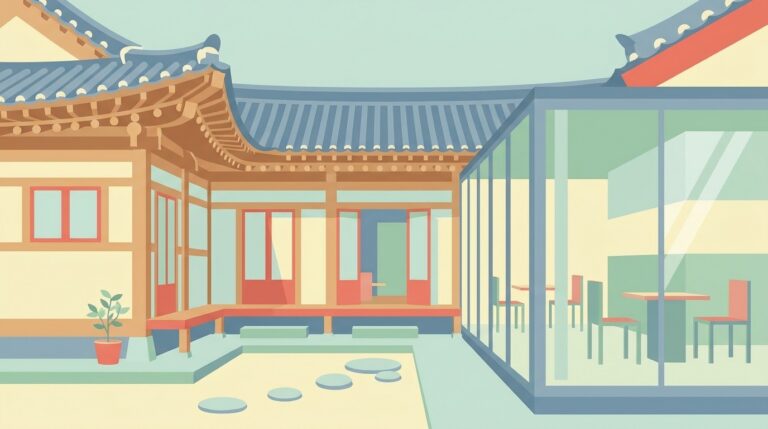
Picture this: You are strolling through the winding stone alleys of Bukchon or Ikseon-dong on a crisp autumn afternoon. Up above, the graceful curve of charcoal-black tiled roofs (giwa) traces the sky. But when you step toward what looks like a 100-year-old wooden residence, a whisper-quiet automatic glass door slides open, unveiling a sleek espresso bar illuminated by minimalist warm LEDs nestled directly beneath century-old pine timber beams.
You are mesmerized. You want to strike up a conversation with the barista or the resident architect sitting next to you. You want to express how breathtaking this blend of historical preservation and contemporary design truly is. Yet, your mind freezes. Textbook Korean taught you rigid sentences like “이것은 기와집입니다” (This is a tile-roof house) or “한국 전통 건축입니다” (It is traditional Korean architecture). Those sentences feel flat, distant, and completely out of touch with the living, breathing reality of Korea’s urban landscape.
Learning how to discuss architectural preservation (보존) and modernization (현대화) at a B2 (Intermediate) level is a game-changer. It unlocks deep, engaging cultural conversations with educated locals, design lovers, and shop owners who take pride in these reinvented spaces. Tested and refined alongside intermediate learners during our Seoul Architectural Walking Seminars, this guide is crafted to transform you from a passive tourist snapping selfies into an articulate cultural insider.
Phase 2: Core 3 Expressions Deep Dive
Let’s upgrade your architectural vocabulary with three expressive, culturally rich phrases.
1. 고즈넉하다 (Gojeuneokhada)
- Pronunciation: [Go-jeu-neok-ha-da] (Imagine saying ‘go’ + the French ‘je’ with a ‘u’ sound + a crisp ‘knock’ + ‘ha-da’)
- Meaning: Peacefully quiet, tranquil, and antique-serene (Literal: Quiet / Nuance: A profound, poetic stillness reserved specifically for traditional, timeless environments).
- K-Culture Moment: You will hear this word constantly in travel documentaries, vlogs exploring Jeonju Hanok Village, or quiet scenes in historical K-dramas like Mr. Sunshine when characters walk through temple grounds at dusk.
- Editor’s Insight: Please don’t use 고즈넉하다 to describe an empty subway car or a quiet library! That is just 조용하다 (joyonghada). 고즈넉하다 demands an atmospheric, historic aura—wooden eaves, fallen leaves, and gentle sunlight.
- Situation Spectrum: Casual ⚠️ | Semi-formal ✅ | Formal ✅
- 🤔 Think About It: Does your native language have a specific word that describes not just silence, but a silence steeped in history?
2. 옛것과 현대의 조화 (Yetgeotgwa hyeondae-ui johwa)
- Pronunciation: [Yet-geot-gwa hyeon-dae-ui jo-hwa] (Rhymes loosely with: ‘Yet-got-gwa hyun-day-we jo-hwa’)
- Meaning: The harmonious balance between the past and the contemporary (Literal: Harmony of old things and modernity).
- K-Culture Moment: Often featured in lifestyle magazines, K-drama interior design reveals (Where is My Home / 구해줘! 홈즈), and architecture features on Seoul’s urban regeneration.
- Editor’s Insight: Korean urbanites love this phrase because it justifies why an old building wasn’t simply demolished. When a Hanok incorporates steel frames or glass skylights without destroying its wooden soul, locals praise this exact “조화” (harmony).
- Situation Spectrum: Casual ⚠️ | Semi-formal ✅ | Formal ✅
- 🤔 Think About It: Western architectural preservation often demands exact restoration to an original state. Why do you think Korea leans toward dynamic adaptation and coexistence?
3. 살려두다 (Sallyeoduda)
- Pronunciation: [Sal-lyeo-du-da] (Notice the double ‘L’ liquid sound: Sal-lyuh-doo-dah)
- Meaning: To keep intact / to intentionally preserve an original element during renovation (Literal: To let live / to keep alive).
- K-Culture Moment: Used by interior designers and hip cafe owners when explaining how they retained original wooden rafters or cracked stone foundation blocks.
- Editor’s Insight: Notice the verb 살리다 (to revive or keep alive). Koreans unconsciously view timber, stone, and soil in traditional homes as living elements. Using “살려두다” shows you respect the building’s organic history.
- Situation Spectrum: Casual ✅ | Semi-formal ✅ | Formal ✅
- 🤔 Think About It: Notice the deep linguistic habit of treating inanimate architecture as an organism with a heartbeat.
Phase 3: Textbook Korean vs. Real-World Korean
Level up from academic stiffness to nuanced native delivery.
Situation 1: Praising a converted Hanok cafe’s design
- 📖 교과서 한국어: 이 한옥은 상업 시설로 개조되어 매우 아름답습니다.
(I hanogeun sang-eop siseollo gaejodoeeo maeu areumdapseumnida. / This Hanok has been remodeled into a commercial facility and is very beautiful.) - 🗣️ 진짜 한국어: 원래 있던 서까래를 그대로 살려서 인테리어가 진짜 감각적이에요!
(Wonrae itdeon seokkkaraereul geudaero sallyeoseo interieoga jinjja gamgakjeog-ieoyo! / Keeping the original rafters intact makes the interior feel so tasteful and stylish!) - 💡 왜 다를까? Educated Koreans rarely use sterile bureaucratic terms like “상업 시설 개조” (commercial conversion). Instead, they highlight specific architectural features like 서까래 (rafters) paired with modern aesthetic adjectives like 감각적이다 (aesthetically intuitive/stylish).
Situation 2: Checking whether a neighborhood is residential or commercial
- 📖 교과서 한국어: 이곳은 주민들의 거주 지역입니까?
(Igos-eun jumindeur-ui geoju jiyeog-imnikka? / Is this location a residential zone of the inhabitants?) - 🗣️ 진짜 한국어: 여기 실제로 주민분들이 사시는 생활 공간이죠? 조용히 둘러볼게요.
(Yeogi siljéro juminbundeuri sasineun saenghwal gonggan-ijyo? Joyonghi dulleobolgeyo. / Residents actually live in this neighborhood, right? I’ll be mindful and keep quiet while looking around.) - 💡 왜 다를까? Hanok villages like Bukchon suffer from severe over-tourism. Acknowledging that it is a living space (생활 공간) with resident honorifics (주민분들) immediately proves your maturity, cultural sensitivity, and fluency.
Phase 4: K-Culture Deep Dive & Non-Verbal Manners
4-1. 눈치 (Nunchi) & Gestures in Hanok Spaces
- The Threshold Step: Traditional Hanok architecture features raised thresholds (문턱 – munteok). In Korean culture, never step directly onto the wooden door sill! It was historically believed to bring bad luck, and structurally, it damages the delicate sliding door tracks. Always step cleanly over it.
- Shoes On or Off? Read the Floor: If you see exposed wooden flooring called 대청마루 (daecheongmaru) or traditional paper flooring, observe the entrance (현관). If there is a step-down with a stone slab (디딤돌 – didimdol), shoes come off instantly. If it’s polished modern concrete, you may keep them on. When in doubt, glance at the staff’s footwear.
- Lower the Decibels (정숙 관광 – Silent Tourism): In Bukchon or Seochon residential areas, you will spot signs with cartoon figures whispering. Walking in pairs without shouting or laughing loudly is considered basic civic decorum.
4-2. Cultural Code: The Art of 차경 (Chagyeong – Borrowed Scenery)
In Western architecture, windows often act as protective barriers keeping nature outside. Traditional Korean Hanok operates on the philosophy of 차경 (借景)—literally “borrowing landscape.”
Windows and doors are designed not just for sunlight, but as dynamic frames that borrow the mountain ridges, seasonal pine trees, or courtyard gardens. In modernized Hanoks, architects replace paper screens (창호지) with ultra-clear double insulation glass specifically to preserve this borrowed scenery while providing 21st-century thermal comfort.
Phase 5: Real-World Roleplay Scenario
Setting: You are visiting Suh-woo Jae (서우재), a boutique design gallery and tea salon nestled in Seochon, Seoul.
Character: Min-woo (민우), a 40-something resident architect who spent two years renovating this 1930s urban Hanok.
Frequently Asked Questions (FAQ)
Q: What does "고즈넉하다 (Gojeuneokhada)" mean in Korean and how do you pronounce it?
A: In Korean, "고즈넉하다 (Gojeuneokhada)" is pronounced [Go-jeu-neok-ha-da] and means: Peacefully quiet, tranquil, and antique-serene (Literal: Quiet / Nuance: A profound, poetic stillness reserved specifically for traditional, timeless environments).
Q: What does "옛것과 현대의 조화 (Yetgeotgwa hyeondae-ui johwa)" mean in Korean and how do you pronounce it?
A: In Korean, "옛것과 현대의 조화 (Yetgeotgwa hyeondae-ui johwa)" is pronounced [Yet-geot-gwa hyeon-dae-ui jo-hwa] and means: The harmonious balance between the past and the contemporary (Literal: Harmony of old things and modernity).
Q: What does "살려두다 (Sallyeoduda)" mean in Korean and how do you pronounce it?
A: In Korean, "살려두다 (Sallyeoduda)" is pronounced [Sal-lyeo-du-da] and means: To keep intact / to intentionally preserve an original element during renovation (Literal: To let live / to keep alive).







