

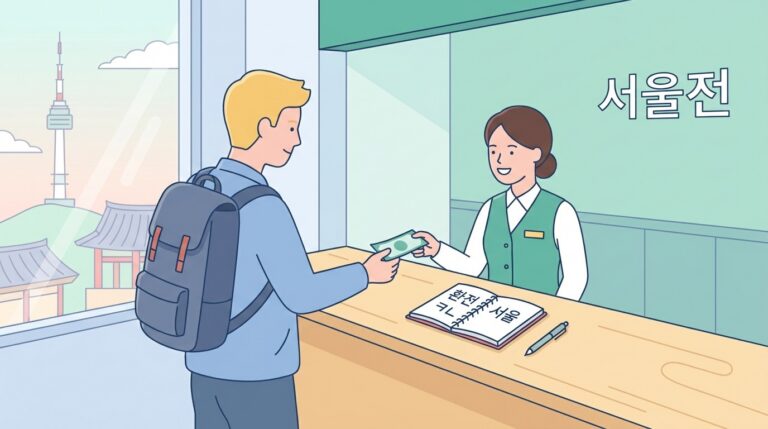
안녕하세요! 매일한글 에디터입니다.
Imagine this: You have just touched down in Seoul, buzzing with excitement. You stroll through the vibrant alleys of Myeongdong, where mouth-watering aromas of hotteok, crispy fried chicken, and spicy tteokbokki fill the crisp evening air. You pull out your international credit card to buy a skewer of street snacks, but the stall owner smiles warmly and points to a small handwritten sign: “현금만 가능 (Cash Only).”
You check your wallet, only to find crisp US dollars and zero Korean Won. Right down the boulevard stands a gleaming glass branch of Hana Bank. You push through the revolving doors into an ultra-clean, quiet lobby. Suddenly, your palms sweat. High-tech ticketing kiosks, uniformed security guards, and busy tellers make your mind go blank. What if they don’t speak English? What if you sound awkward? Over the past ten years at Daily Hangul, hundreds of beginner travelers have shared this exact heart-thumping moment with me. But here is the secret: exchanging money at a Korean bank follows an ultra-predictable, friendly script. By mastering just one effortless starter sentence, you will glide through the teller counter with complete poise, getting your Korean Won smoothly and walking right back out to savor Seoul’s street food paradise. Let’s dive in together!
Phase 2: Core 3 Expressions Deep Dive
1. 환전하러 왔어요 (Hwanjeonhareo wasseoyo)
- Pronunciation: [Hwan-jeon-ha-reo wa-sseo-yo] (Sounds like: Hwan-jun-ha-raw wah-so-yo)
- Meaning: Literal: “I came to do currency exchange.” / Real Nuance: “Hello, I’d like to exchange some money, please.”
- K-Culture Moment: Just like a traveler or exchange student arriving in Seoul in a modern K-Drama, walking confidently right up to the bank counter.
- Editor’s Insight: The grammar pattern
-(으)러 왔어요is your Swiss Army knife in Korea! It literally translates to “I came in order to [verb].” Stating your purpose upfront saves time and instantly puts the clerk at ease. - Situation Spectrum: Casual: 🚫 | Semi-formal: ✅ | Formal: ✅
- 🤔 Think About It: In English, we often start transactions with warm small talk (“Hi, how are you doing today?”). Why do you think Korean service interactions prioritize stating your concrete goal immediately?
2. 달러를 원화로 바꿔 주세요 (Dalloreul wonhwaro bakkwo juseyo)
- Pronunciation: [Dal-leo-reul won-hwa-ro ba-kkwo ju-se-yo] (Sounds like: Dahl-luh-reul wun-hwa-ro bah-kwo joo-say-yo)
- Meaning: Literal: “Please change dollars into Won.” / Real Nuance: “Could you please convert my dollars into Korean Won?”
- K-Culture Moment: The polite exchange when you slide your bills into the small counter tray while the teller inspects each note.
- Editor’s Insight: In Korean, the object particle
~를/을marks what currency you are giving, while~로/으로marks the target currency you wish to receive. Adding주세요(juseyo – please give/do) makes any sentence instantly polite. - Situation Spectrum: Casual: 🚫 | Semi-formal: ✅ | Formal: ✅
- 🤔 Think About It: How does the universal request form
~주세요reflect Korea’s cultural value of mutual politeness during public services?
3. 영수증 주세요 (Yeongsujeung juseyo)
- Pronunciation: [Yeong-su-jeung ju-se-yo] (Sounds like: Young-soo-jeung joo-say-yo)
- Meaning: Literal: “Please give receipt.” / Real Nuance: “May I have a receipt, please?”
- K-Culture Moment: The banker handing over a neatly folded transaction printout showing the day’s exchange rate and your exact converted sum.
- Editor’s Insight: While Korean convenience stores often ask “영수증 버려 드릴까요?” (Shall I discard your receipt?), at a bank you should always keep your paper receipt to confirm exchange fee deductions and for tax-refund verification at the airport.
- Situation Spectrum: Casual: 🚫 | Semi-formal: ✅ | Formal: ✅
- 🤔 Think About It: In an almost 100% digitized country, why do financial institutions still treat printed documentation with such high formality?
Phase 3: Textbook Korean vs. Real Korean
Scenario 1: Stating your visit reason
- 📖 교과서 한국어 (Textbook): 미국 달러를 대한민국 원으로 환전하고 싶습니다. (Miguk dalloreul daehanminguk woneuro hwanjeonhago sipsumnida. / “I wish to exchange United States dollars for Republic of Korea Won.”)
- 🗣️ 진짜 한국어 (Real Korean): 달러 환전하러 왔어요. (Dalloe hwanjeonhareo wasseoyo. / “I’m here to exchange dollars.”)
- 💡 왜 다를까? (Why the difference?): Real Koreans drop lengthy country designations like “대한민국” in conversation. Natural polite endings (
~요) sound friendly and warm, whereas stiff formal endings (~습니다) sound like a military announcement.
Scenario 2: Asking for today’s rate
- 📖 교과서 한국어 (Textbook): 현재 환율이 어떻게 됩니까? (Hyeonjae hwanyuri eotteoke doemnikka? / “How does the current exchange rate become?”)
- 🗣️ 진짜 한국어 (Real Korean): 오늘 환율 얼마예요? (Oneul hwanyul eolmayeyo? / “What is today’s rate?”)
- 💡 왜 다를까? (Why the difference?): Using
얼마예요?(How much is it?) is direct, natural, and widely used across all daily situations without losing politeness.
Phase 4: K-Culture Deep-Dive & Non-Verbal Etiquette
4-1. 눈치 (Nunchi) & Gestures
- The Kiosk First Rule: When you enter a Korean bank, never stroll directly to an open desk. Observe your surroundings with quick nunchi (situational awareness) and look for the ticket stand (번호표 – beonhopyo). If you cannot read the screen, simply say to the smiling security guard near the door: “환전이요” (Hwanjeon-iyo). They will cheerfully press the Foreign Exchange button for you!
- The Two-Hand Delivery: When handing your passport and foreign bills across the counter, never fling them with one hand. Always present items using both hands, or support your right forearm gently with your left hand. This subtle gesture instantly demonstrates respect and will earn you warm customer service.
4-2. Culture Code: The Cash Paradox of K-Travel
South Korea is renowned as one of the world’s most cashless economies—even small taxis accept tap-to-pay. However, traditional night markets, subway station T-money reload terminals, and viral photo booth studios (인생네컷) often operate exclusively on physical Korean Won cash! Exchanging an emergency stash of 50,000 to 100,000 Won ensures you will never miss out on iconic local street delicacies.
Phase 5: Real-World Roleplay Scenario
- Setting: A bright, quiet afternoon at a Hana Bank branch near Hongdae Station.
- Characters: You (Alex, an excited traveler) & Minji (A courteous bank teller behind counter 3).
-
Turn 1 (Minji): 어서 오세요! 고객님, 무엇을 도와드릴까요? (Eoseo oseyo! Gogaeknim, mueoseul dowadeurilkkayo? / “Welcome! Customer, how may I help you?”) 🎭 Smiling politely with her hands folded over the counter.
- Turn 2 (You): 안녕하세요! 환전하러 왔어요. (Annyeonghaseyo! Hwanjeonhareo wasseoyo. / “Hello! I came to exchange money.”) 🎭 Bowing slightly at a 15-degree angle.
- Turn 3 (Minji): 네, 어떤 돈으로 바꿔 드릴까요? (Ne, eotteon doneuro bakkwo deurilkkayo? / “Sure, what currency would you like to exchange?”) 🎭 Clicking her mouse to open the exchange screen.
- Turn 4 (You): 달러를 원화로 바꿔 주세요. (Dalloreul wonhwaro bakkwo juseyo. / “Please change dollars into Won.”) 🎭 Placing your crisp US dollar bills into the small acrylic counter dish.
- Turn 5 (Minji): 네, 여권 보여주시겠어요? (Ne, yeogwon boyeojusigesseoyo? / “Certainly, could you show me your passport?”) 🎭 Extending both hands across the counter slot.
- Turn 6 (You): 네, 여기 있어요. (Ne, yeogi isseoyo. / “Yes, here it is.”) 🎭 Handing over your passport using both hands.
- Turn 7 (Minji): 잠시만 기다려 주세요… 네, 50만 원 나왔습니다. (Jamsiman gidaryeo juseyo… Ne, osimman won nawatsseumnida. / “Please wait a moment… Here is 500,000 Won.”) 🎭 Counting the clean banknotes through the automatic counter machine and laying them out neatly.
- Turn 8 (You): 감사합니다! 영수증 주세요. (Gamsahamnida! Yeongsujeung juseyo. / “Thank you! Please give me the receipt.”) 🎭 Receiving the money and slip with a relieved smile.
🔀 Interactive Decision Point
Before handing you the cash, Minji asks: “어떻게 드릴까요?” (Eotteoke deurilkkayo? – “How would you like your bills distributed?”)
- Option A: “전부 만 원짜리로 주세요.” (Jeonbu man wonjjariro juseyo. / “Please give it all in 10,000 Won bills.”)
- 🏆 Feedback [Best]: Excellent choice! 10,000 Won bills (green bills featuring King Sejong) are universally accepted by all street vendors and subway reload machines.
- Option B: “돈 많이 줘.” (Don mani jwo. / “Give me lots of money.”)
- ❌ Feedback [Bad]: Danger! This uses blunt informal language (반말) and sounds like a bank robber in a comedic crime drama. Always maintain polite endings (
~주세요).
- ❌ Feedback [Bad]: Danger! This uses blunt informal language (반말) and sounds like a bank robber in a comedic crime drama. Always maintain polite endings (
- Option C: “오만 원짜리 네 장이랑 만 원짜리로 섞어 주세요.” (Oman wonjjari ne jang-irang man wonjjariro seokkeo juseyo. / “Please mix four 50,000 Won bills with 10,000 Won bills.”)
- ⚠️ Feedback [Risk]: Natural and practical, but requires confident Korean number counters (
장– jang for flat sheets). Attempt this once you are comfortable with Korean number systems!
- ⚠️ Feedback [Risk]: Natural and practical, but requires confident Korean number counters (
Phase 6: 10-Second Emotion Shadowing Drill
Practice matching the cadence and emotional intonation by pausing at the / marks:
[😊 Bright and welcoming]안녕하세요! / 환전하러 / 왔어요. (Annyeonghaseyo! / Hwanjeonhareo / wasseoyo.)[🤝 Clear and polite]달러를 / 원화로 / 바꿔 주세요. (Dalloreul / wonhwaro / bakkwo juseyo.)[🤲 Respectful and appreciative]여기 여권 있어요, / 감사합니다! (Yeogi yeogwon isseoyo, / gamsahamnida!)
Phase 7: K-Culture Mini Dictionary
- 환전 (Hwanjeon – Currency Exchange): The foundational term you will spot on signage at airports, bank storefronts, and private exchange booths.
- 환율 (Hwanyul – Exchange Rate): Look for this word on the large digital LED boards displaying foreign currency valuations.
- 여권 (Yeogwon – Passport): Your international identification. Under Korean banking law, tellers cannot execute currency conversion without inspecting your physical passport.
- 번호표 (Beonhopyo – Number Ticket): The small slip printed from the entrance ticketing machine. When your number dings above a teller counter, it is your turn!
Phase 8: Survival Kit for Travelers
Top 3 Survival Phrases
- 환전 돼요? (Hwanjeon dwaeyo?)
- Meaning: “Can I exchange money here?”
- Pro Tip: Perfect when checking private exchange booths in tourist districts before stepping inside.
- 여권 여기 있어요. (Yeogwon yeogi isseoyo.)
- Meaning: “Here is my passport.”
- Pro Tip: Hand it over smoothly with two hands right after requesting your currency swap.
- 수수료 얼마예요? (Susuryo eolmayeyo?)
- Meaning: “How much is the transaction fee?”
- Pro Tip: Helpful for comparing airport kiosk rates against city bank branches.
Editor’s Travel Note
- Navigation Guide: Instead of roaming blindly, locate nearby local banks like Hana, KB, or Shinhan using the official Naver Map navigation service.
- Exchange Strategy: Airport exchange counters charge noticeably higher processing margins. Exchange just $30-$50 at Incheon Airport for initial transportation, then use downtown exchange kiosks near Myeongdong Chinese Embassy Street or a local bank branch for the bulk of your funds.
Phase 9: “One Step Deeper” (Cultural Reflection)
Korean customer service embodies a fascinating harmony between modern Ppal-li Ppal-li (빨리빨리 – fast, efficient) culture and traditional Jeong (정 – interpersonal warmth and respect). In Korean society, conducting a transaction is never treated as purely cold commerce. By bowing slightly and using respectful grammar (존댓말), both customer and service worker build brief, dignified social harmony.
💬 Your Turn: What has been your most memorable or nervous money exchange experience while traveling? Share your story in the comments below, and let’s craft your custom Korean response together!
Phase 10: FAQ & Common Mistakes
Q: Can I use a digital photo of my passport on my smartphone to exchange currency?
A: No. Korean financial surveillance laws strictly require your physical, original passport. Smartphone photos, digital scans, or foreign driver’s licenses will be declined.
Q: What operating hours do banks keep in South Korea?
A: Most commercial Korean banks operate on weekdays from 09:00 to 16:00, remaining closed on weekends and public holidays. For weekend exchanges, look for certified private exchange counters in tourist hubs like Hongdae or Myeongdong.
Q: What should I do if the ticket kiosk doesn’t offer English?
A: Do not worry! Look for the bank’s security officer (청원경찰) standing near the doorway. Simply show your foreign cash, smile, and say: “환전이요” (Hwanjeon-iyo). They will gladly tap the correct screen button for you.
🚨 Common Mistakes Board
- Mistake 1: Tossing cash or passport onto the desk with one hand.
- Correct Action: Hand items over holding both edges, or touch your left hand to your right inner elbow as you extend your arm.
- Mistake 2: Using textbook formal language like “환전하고 싶습니다”.
- Correct Action: Use conversational honorifics: “환전하러 왔어요.” It sounds natural, friendly, and approachable.
- Mistake 3: Forgetting to retain your exchange slip.
- Correct Action: Keep the paper receipt (
영수증) inside your passport pocket for duty-free verification and tax refund processing.
- Correct Action: Keep the paper receipt (
Phase 11: Action Missions
- 🥉 Bronze Mission (Solo Shadowing): Stand in front of your mirror and practice saying “환전하러 왔어요” out loud 5 times with a bright, welcoming posture.
- 🥈 Silver Mission (Community Sharing): Leave a comment below or post on social media using the sentence “달러를 원화로 바꿔 주세요!” to lock in the pattern.
- 🥇 Gold Mission (Real-World Mastery): During your next trip to Seoul, step into a local bank or exchange kiosk and complete your currency transaction entirely in Korean without switching to English!
- 🎮 K-Culture Mission: Watch any scene from a travel show or slice-of-life K-drama and identify when characters say “현금” (cash), “영수증” (receipt), or “환전” (exchange).
Phase 12: Interactive Quiz Challenge
Test your knowledge with these three practical questions!
1. Situational Judgment: You step into a bank in Seoul to exchange currency. What is your very first action?
* A) Walk immediately to an open teller window and place your money down.
* B) Take a queue number ticket (번호표) at the entrance machine.
* C) Ask the security guard for free coffee.
2. Fill-in-the-Blank: Complete the polite sentence to exchange your currency:
* “달러를 원화____ 바꿔 주세요.”
* A) 로 (ro)
* B) 은 (eun)
* C) 에 (e)
3. True or False: Showing a clear photo of your passport on your phone is sufficient for exchanging currency at standard Korean banks.
* A) True
* B) False
👉 Click here to reveal answers & explanations!
- Question 1 Answer: B
- Explanation: Always pull a queue ticket (번호표) first and wait until your chime sounds before heading to the counter.
- Question 2 Answer: A (로)
- Explanation: The particle
~로/으로marks the target currency into which your money is transformed (“달러를 원화로 바꿔 주세요”).
- Explanation: The particle
- Question 3 Answer: B (False)
- Explanation: Korean banking regulations legally require your physical passport for anti-fraud and currency compliance.
- Explanation: Korean banking regulations legally require your physical passport for anti-fraud and currency compliance.







