

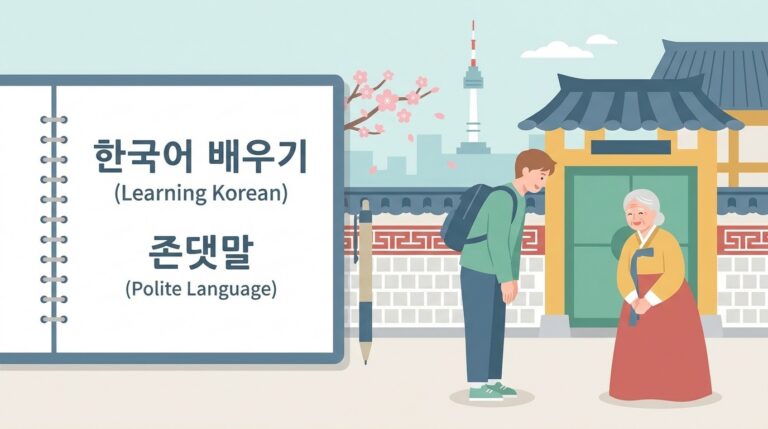
Phase 1: Empathy (Story-Immersive Opening)
안녕하세요! 매일한글 에디터입니다. (Hello! This is your Daily Hangul editor.)
Picture this: You are having a sweet chat over warm barley tea with the lovely elderly grandmother running your favorite neighborhood Gimbap spot in Seoul. Feeling confident in your Korean, you proudly ask: “Halmeoni, jib-i eodieyo?” (Grandma, where is your house?). Suddenly, the warm atmosphere freezes for a microsecond. She smiles gently and answers, but in your gut, you sense something was slightly off. Did you offend her? Did you use the wrong word?
Don’t panic—every single Korean learner has been there! In Korean culture, language is not just about exchanging data; it is an intricate dance of respect, hierarchy, and warmth. While jib (집) means “home,” using it directly toward an elder or someone senior can sound a bit too blunt—like asking your boss, “Hey, where’s your crib?” Instead, native speakers pull out a magical honorific noun: 댁 (Daek).
Mastering how to ask “Daek-i eodi-seyeo?” (Where do you reside?) will instantly elevate your Korean from “tourist phrasebook” to “culturally fluent neighbor.” Based on hundreds of real feedback sessions from our learners at Daily Hangul, we have distilled this exact survival guide so you can show flawless respect without breaking a sweat. Let’s dive right in!
Phase 2: Top 3 Core Expressions Deep Dive
1. 댁이 어디세요? (Daek-i eodi-seyeo?)
- Pronunciation: [Daek-i eo-di-se-yo?] (Think of ‘daek’ like a crisp playing ‘deck’ with a soft ‘t/d’ touch, followed by ‘eo-di-se-yo’)
- Meaning: Literal: “Where is your honorable residence?” | Real Nuance: “Where do you live, sir/ma’am?” (Deeply respectful and polished)
- K-Culture Moment: You will hear this in classic K-Dramas whenever a polite main character meets their partner’s grandparents or an esteemed elderly mentor for the first time.
- Editor’s Insight: Daek (댁) is the honorific counterpart of jib (집). When you pair daek with the honorific verb ending -useyo, you create an impenetrable shield of Korean politeness.
- Situation Spectrum: Casual 🚫 | Semi-formal ⚠️ | Formal & Respectful ✅
- 🤔 Think About It: In English, we simply say “your house” regardless of whether we talk to a 7-year-old or a CEO. Why do you think Korean developed separate vocabulary words just to honor someone else’s physical living space?
2. 어디 사세요? (Eodi saseyo?)
- Pronunciation: [Eo-di sa-se-yo?] (Sounds like ‘uh-dee’ + ‘sah-say-yo’)
- Meaning: Literal: “Where do you live?” | Real Nuance: “What neighborhood do you live in?”
- K-Culture Moment: The standard go-to line in blind dates (Sogeting) or casual networking events among adults in their 20s and 30s in Hongdae or Gangnam.
- Editor’s Insight: This uses the honorific verb form of salda (to live -> sada -> saseyo). It is polite, neutral, and safe for colleagues, acquaintances, and people roughly around your age or slightly older.
- Situation Spectrum: Casual ⚠️ | Semi-formal ✅ | Formal ✅
- 🤔 Think About It: Notice that Koreans rarely ask for an exact street address right away. How does asking “where do you live” serve as a safe icebreaker in your own culture?
3. 집이 어디야? (Jib-i eodi-ya?)
- Pronunciation: [Jib-i eo-di-ya?] (Soft ‘jip’ like ‘jeep’ + ‘ee-uh-dee-yah’)
- Meaning: Literal: “Where is your house?” | Real Nuance: “Where do you stay? / Which area are you at?” (Completely informal Banmal)
- K-Culture Moment: Campus life scenes in K-Dramas where university classmates pack up their backpacks after class and ask each other before heading out to eat Tteokbokki.
- Editor’s Insight: Only use this with close friends of the same age, younger friends, or children. Never use this with taxi drivers, elders, or store owners!
- Situation Spectrum: Casual ✅ | Semi-formal 🚫 | Formal 🚫
- 🤔 Think About It: Moving from honorifics to Banmal (informal speech) marks an emotional milestone in Korean relationships. Have you felt that shift with your Korean friends yet?
Phase 3: Textbook Korean vs. Real Korean
Situation 1: Inquiring about an elderly neighbor’s home
- 📖 교과서 한국어 (Textbook): 당신의 집은 어디입니까? (Dangsin-ui jib-eun eodi-imnikka? – Where is your house?)
- 🗣️ 진짜 한국어 (Real-World): 어르신, 실례지만 댁이 어디세요? (Eoreusin, sillyejiman daek-i eodi-seyeo? – Elder, excuse me, but where do you reside?)
- 💡 왜 다를까? (Why the difference?): Using dangsin (you) can sound confrontational or like an unnatural translation, while jib lacks respect for an elder. Real Koreans address the person with a respectful title like Eoreusin (respected elder) and use daek.
Situation 2: Asking a new colleague/peer what area they commute from
- 📖 교과서 한국어 (Textbook): 당신의 거주지는 어디에 있습니까? (Dangsin-ui geojuji-neun eodie itseumnikka? – Where is your residence located?)
- 🗣️ 진짜 한국어 (Real-World): OO씨는 어느 동네 사세요? (OO-ssi-neun eoneu dongne saseyo? – OO, which neighborhood do you live in?)
- 💡 왜 다를까? (Why the difference?): Koreans naturally refer to neighborhoods (dongne) rather than legal residential boundaries. It sounds friendly, natural, and conversational.
Phase 4: K-Culture Deep Dive & Non-Verbal Manners
4-1. 눈치 (Nunchi) & Non-Verbal Gestures
When asking an elder or someone senior where they live in Korea, body language does 50% of the talking:
* The Two-Hand Posture: Keep your hands loosely clasped in front of your navel (Gongsu posture) or place both hands softly on your lap.
* Gentle Head Tilt: Soften your gaze and nod slightly when they answer. Never stare directly into an elder’s eyes without blinking; a soft, respectful gaze toward their chin or chest area displays proper manners.
* The Privacy Line: When asking “Daek-i eodi-seyeo?”, Koreans expect a neighborhood or city name (e.g., “Mapo-gu” or “Suwon”), never an apartment room number! Pressing for exact building details violates personal boundaries.
4-2. Cultural Code: The Meaning of “Daek” in K-Media
In Korean history, daek (댁) originally referred to prominent noble households (e.g., Pyeongyang-daek, Andong-daek). Over centuries, it evolved into an honorific substitute for “home.” In popular family dramas (Makjang or weekend K-dramas), when an in-law asks the new bride or groom about their parents’ daek, it denotes reverence toward the entire family lineage. Showing that you know the difference between jib and daek signals to Koreans that you truly understand the essence of Jeong (정) and filial respect.
Phase 5: Real-Life Roleplay Scenario
Setting: You are volunteering at a traditional cultural center in Insadong, Seoul. Mr. Kim, a gentle 72-year-old calligrapher, is packing up his brushes after a workshop.
- Turn 1 (You): 어르신, 오늘 수업 정말 감사했습니다! (Eoreusin, oneul sueop jeongmal gamsahaesseumnida! – [🎭 Bowing 30 degrees with two hands held together] Elder, thank you so much for today’s lesson!)
- Turn 2 (Mr. Kim): 아이고, 별말씀을요. 잘 따라와 줘서 내가 고마워요. (Aigo, byeolmalsseum-eulyo. Jal ttarawa jwoseo naega gomawoyo. – [🎭 Smiling warmly while rolling his scroll] Oh, don’t mention it. I’m thankful you followed along so well.)
- Turn 3 (You): 짐이 무거우신데, 조심히 가셔야겠어요. (Jim-i mugeo-usineunde, josimhi gasyeoyagesseoyo. – [🎭 Glancing worriedly at his heavy bag] Your luggage looks heavy, you must travel carefully.)
- Turn 4 (Mr. Kim): 괜찮아요, 익숙한데요 뭐. (Gwaenchannayo, iksukhandeyo mwo. – It’s quite alright, I’m used to it.)
- Turn 5 (You): 저, 실례지만 어르신 댁이 어디세요? (Jeo, sillyejiman eoreusin daek-i eodi-seyeo? – [🎭 Leaning in politely with a gentle, attentive tone] Um, excuse me, but where do you reside, sir?)
- Turn 6 (Mr. Kim): 종로3가 쪽이에요. 걸어서 금방 갑니다. (Jongno-sam-ga jjok-ieyo. Georeoseo geumbang gamnida. – [🎭 Patting your shoulder happily] It’s over by Jongno 3-ga. Just a short walk away.)
- Turn 7 (You): 아, 가까우셔서 정말 다행입니다! (A, gakkausyeoseo jeongmal dahaeng-imnida! – [🎭 Nodding in relief] Ah, what a relief that it is close!)
- Turn 8 (Mr. Kim): 조심해서 들어가요, 다음 주에 봐요! (Josimhaeseo deureogayo, daeum jue bwayo! – Get home safely, see you next week!)
🔀 Interactive Branching Point
If Mr. Kim asked you how you are getting home, how would you respond?
* Option A: 집이 멀어서 지하철 타고 가요! (Jib-i meoreoseo jihacheol tago gayo!) -> [Best Outcome] Perfect! You refer to your own home as jib (never refer to your own home as daek), showing humble and natural speech.
* Option B: 댁이 멀어서 택시 타요. (Daek-i meoreoseo taeksi tayo.) -> [Bad Outcome] Critical error! Calling your own home daek elevates yourself over the elder, breaking Korean honorific rules.
* Option C: 종로 가요. (Jongno gayo.) -> [Risk Outcome] Too curt! While not rude grammar, short answers without honorific nuance can feel cold and detached.
Phase 6: 10-Second Emotion Shadowing Drill
Practice these lines out loud with the emotional markers and rhythm breaks (/):
[😊 Warm, humble, and polite]
실례지만 / 어르신 댁이 / 어디세요?
(Sillyejiman / eoreusin daek-i / eodi-seyeo?)-
[🙋 Friendly, curious peer tone]
민우 씨는 / 어느 동네 / 사세요?
(Minwoo-ssineun / eoneu dongne / saseyo?) -
[😌 Modest and gentle response]
제 집은 / 신촌 근처예요.
(Je jib-eun / Sinchon geuncheo-yeyo.)
Phase 7: K-Culture Mini Dictionary
- 댁 (Daek): [Honorific Noun] An elevated term for another person’s home or family. Used exclusively to honor someone of higher social standing, age, or an esteemed stranger. Never used for oneself.
- 집 (Jib): [Noun] The general, everyday word for “house” or “home.” Use this when referring to your own place (uri jib) or when speaking casually with close friends.
- 본가 (Bonga): [Noun] The primary parental home. Young adults living independently in Seoul frequently say, “Ju-mal-e bonga-e gayo” (I’m going to my parents’ home this weekend).
- 자취 (Jachwi): [Noun] Living alone away from family, typically as a university student or young worker (e.g., “Jachwi-bang” = studio apartment/bachelor pad).
Phase 8: Traveler’s Survival Kit
Top 3 Survival Expressions for Getting Around
- 여기서 댁까지 멀어요? (Yeogiseo daek-kkaji meoreoyo?)
Romanization: Yeo-gi-seo daek-kka-ji meo-reo-yo?
Pro Tip: Great when talking to an elder at a bus stop to ask if their home is far from here. - 어디로 모실까요? (Eodiro mosilkkayo?)
Romanization: Eo-di-ro mo-sil-kka-yo?
Pro Tip: This is what courteous Seoul taxi drivers will ask you. It means “Where may I take you, honorable guest?” - OO역 근처에 내려주세요. (OO-yeok geuncheoe naeryeojuseyo.)
Romanization: OO-yeok geun-cheo-e nae-ryeo-ju-se-yo.
Pro Tip: Essential taxi phrase: “Please drop me off near OO Station.”
Editor’s Travel Note
When navigating Korean neighborhoods, Google Maps often lags due to local data protection laws. For flawless real-time navigation and pinpoint taxi hailing, we highly recommend utilizing the official Naver Map Application. If you ever get lost in an unfamiliar alleyway (golmok), look for a 24-hour convenience store (Pyeon-ui-jeom); store clerks are always ready to guide you if you ask with a polite “Sillyehamnida!”
Phase 9: A Step Deeper (Reflective Insight)
In Western languages, physical space is objective: a house is simply a house, whether owned by the president or a toddler. In contrast, the Korean concept of honorifics mirrors interpersonal boundaries and communal hierarchy. Elevating someone’s living space with the word 댁 (Daek) while referring to one’s own space simply as 집 (Jib) is an act of voluntary humility (Geomyang). Language becomes an active tool to build social harmony and show appreciation for the life experience of elders.
💬 Your Turn: In your home language or culture, do you have unique ways of showing respect when visiting someone elderly or important? Share your story in the comments below!
Phase 10: FAQ & Misconception Prevention
Q: Can I refer to my own home as ‘댁 (Daek)’ if I want to sound extra fancy?
A: Absolutely not! In Korean honorific grammar, you never apply elevating honorifics to yourself or your own possessions. Doing so sounds boastful and linguistically awkward. Always call your own home 집 (Jib) or 저희 집 (Jeohui jib).
Q: When is it okay to ask someone ‘어디 사세요?’ instead of using ‘댁’?
A: “Eodi saseyo?” is the ultimate safe phrase for adults talking to other adults of similar status or age (colleagues, friends of friends, shop acquaintances). Save “Daek-i eodi-seyeo?” for senior citizens, clients, professors, and your partner’s parents.
Q: Is it rude to ask a taxi driver ‘댁이 어디세요?’
A: It is slightly unnatural. While polite, taxi drivers expect questions relevant to the trip or general small talk. If you want to ask where they reside during a friendly chat, “Gisanim-eun eoneu dongne saseyo?” (Driver, which neighborhood do you live in?) is much more natural and warm.
🚨 Common Mistakes Alert
- Mistake: Saying “Dangsin-ui jib-i eodi-imnikka?”
Why it’s bad: Using Dangsin can sound aggressive or translated directly from Google.
Correct Action: Drop the pronoun entirely: “Sil-lye-ji-man, daek-i eodi-se-yo?” - Mistake: Asking for someone’s exact street address or apartment unit on the first meeting.
Why it’s bad: Violates personal privacy in Korean social norms.
Correct Action: Expect and be satisfied with the general district or neighborhood (e.g., “Gangnam”, “Bundang”). - Mistake: Mixing honorific suffixes with casual nouns like “Halmeoni jib-i eodi-seyeo?”
Why it’s bad: Half-polite and half-casual.
Correct Action: Pair the honorific verb ending with the honorific noun: “Halmeoni, daek-i eodi-seyeo?”
Phase 11: Action Mission & Engagement
- 🥉 Bronze Mission (Solo Practice): Stand in front of your mirror. Practice the 30-degree bow and whisper: “어르신, 실례지만 댁이 어디세요?” three times with a gentle smile.
- 🥈 Silver Mission (Social Share): Leave a comment below introducing your home city in Korean using the humble form: “제 집은 [City] 근처예요!”
- 🥇 Gold Mission (Real-World Execution): Next time you watch a K-Drama or visit a Korean market, listen closely to see if you catch the word Daek (댁) used in context!
🎮 K-Culture Mission: Watch an episode of a slice-of-life K-Drama (like Reply 1988 or Our Blues). Notice how neighbors address each other’s homes (e.g., “Dong-ryong-i-ne daek”). Spotting it in the wild locks the memory in forever!
Phase 12: Interactive Quiz Challenge
1. Situational Judgment:
You are visiting your Korean significant other’s grandparents for Lunar New Year (Seollal). Which sentence is the most culturally appropriate way to ask where their home is located?
– A) 할머니, 집이 어디야?
– B) 할머니, 댁이 어디세요?
– C) 할머니, 거주지가 어디입니까?
👉 Click to reveal Answer & Explanation
Correct Answer: B) 할머니, 댁이 어디세요?
Explanation: Option A is informal (Banmal), which is disrespectful to grandparents. Option C sounds like an immigration officer filling out legal documents. Option B pairs the respectful noun daek with the honorific ending -useyo perfectly!
2. Fill-in-the-Blank:
Complete the respectful question to an elder:
“실례지만 어르신 ______이(가) 어디세요?” (Excuse me elder, where is your honorable home?)
– A) 집 (Jib)
– B) 방 (Bang)
– C) 댁 (Daek)
👉 Click to reveal Answer & Explanation
Correct Answer: C) 댁 (Daek)
Explanation: Daek is the honorific vocabulary word for an elder’s home.
3. True or False:
“It is polite to say ‘제 댁은 서울이에요 (My honorable home is Seoul)’ when introducing your own apartment to someone older.”
– [ ] True
– [ ] False
👉 Click to reveal Answer & Explanation
Correct Answer: False!
Explanation: You must never use daek for your own home. Always lower yourself politely by saying “제 집은 서울이에요” (Je jib-eun Seoul-ieyo).







