

Conquer the Korean Ramyeon Aisle: A Beginner Guide to Picking Your Perfect Noodles
Phase 1: Empathy (Story Opening)
안녕하세요! 매일한글 에디터입니다. (Hello! This is your Daily Hangul editor.)
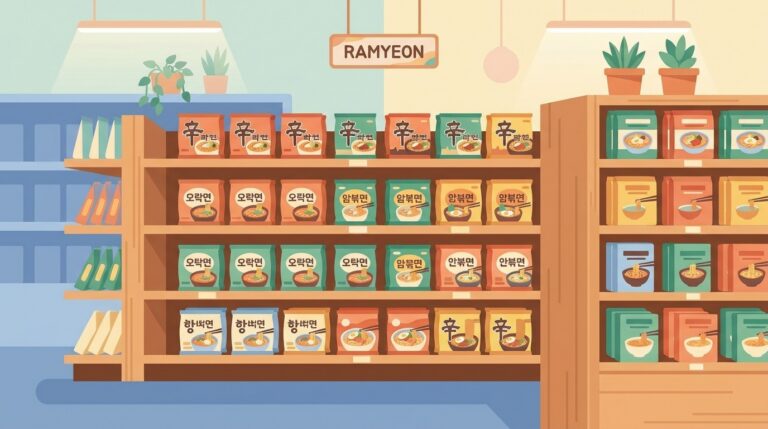
Picture this: You just touched down in Seoul. It’s late evening, the air is crisp, and your stomach is rumbling after unpacking at your Airbnb. You walk into a brightly lit supermarket like E-Mart or a neighborhood GS25, expecting a quick snack run. But as you turn the corner into the noodle aisle, you freeze. Towering before you is a literal “Wall of Ramyeon”—hundreds of colorful packages shouting in bold Korean script. Red packages, black packages, mysterious illustrations of cartoon fire chickens, seafood broths, and dry stir-fries stare back at you.
Every single traveler and beginner student I have coached over the past ten years confesses the exact same panic: “I just wanted a tasty, comforting midnight snack, but I ended up picking something so blisteringly hot that I cried through two liters of milk!” Or worse: *”I bought dry stir-fry noodles thinking it was soup, drained all the water, and ruined the broth powder!”
Choosing the right ramyeon shouldn’t feel like playing Russian roulette with your tastebuds. In this lesson, designed specifically for A2 elementary learners, we are going to unlock the exact, natural phrases you need to navigate any Korean noodle shelf with total confidence. Based on real-world feedback from hundreds of Daily Hangul students, this guide will transform your grocery anxiety into an exciting culinary adventure. Let’s dive in together!
Phase 2: 3 Core Expressions In-Depth
1. 안 매운 라면 있어요? (An maeun ramyeon isseoyo?)
- Pronunciation: [An mae-un ramyeon isseo-yo?] (Sounds like: “Ahn meh-oon rah-myeon ee-ssuh-yo?” Imagine saying “on” with a soft ‘a’, followed by “meh” and “spoon” without the ‘sp’)
- Meaning: Literal: “Is there non-spicy ramyeon?” | Actual Nuance: “Could you tell me if you have any mild, non-spicy ramyeon options?”
- K-Culture Moment: In variety shows like Jinny’s Kitchen or Three Meals a Day, whenever guests or foreigners arrive, Korean hosts immediately ask about spice tolerance before grabbing the pot, offering mild alternatives like snack noodles or bone-broth ramyeon.
- Editor’s Insight: In Korean grammar, placing “안 (an)” before a descriptive verb is the easiest way to make a negative sentence at the A2 level. While native speakers could say “순한맛 있어요?” (Do you have the mild flavor?), asking “안 매운 라면 있어요?” is universally understood, grammatically bulletproof, and guarantees you won’t accidentally buy a five-alarm chili surprise.
- Situation Spectrum:
- Casual (Friends): 안 매운 라면 있어? (An maeun ramyeon isseo?) ✅
- Semi-formal (Store clerks): 안 매운 라면 있어요? (An maeun ramyeon isseoyo?) ✅ [Best Choice]
- Formal (Official presentation): 안 매운 라면이 있습니까? (An maeun ramyeoni itsseumnikka?) ⚠️ (Grammatically correct, but sounds overly stiff for grocery shopping!)
- 🤔 Think About It: In English, we usually ask “Do you have anything mild?” but Koreans directly specify “not spicy” (안 매운). What does this reveal about Korean cuisine where spiciness is considered the default baseline?
2. 국물 있는 걸로 추천해 주세요. (Gungmul inneun geollo chucheonhae juseyo.)
- Pronunciation: [Gung-mul in-neun geol-lo chu-cheon-hae ju-se-yo?] (Notice the consonant assimilation: 국물 sounds like “gung-mool”, not “kook-mool”!)
- Meaning: Literal: “Please recommend by means of one that has broth.” | Actual Nuance: “Could you recommend one with soup broth, please?”
- K-Culture Moment: Think of classic K-drama scenes where characters are nursing a cold or feeling down on a rainy evening (like in Crash Landing on You or Hospital Playlist). They always crave hot “국물” (soup broth) to warm their soul rather than dry stir-fried noodles.
- Editor’s Insight: Korean instant noodles are sharply divided into two kingdoms: “국물 라면” (soup noodles) and “볶음면” (stir-fried / dry noodles like Buldak or Jjapagetti). The phrase “~있는 걸로 추천해 주세요” (~inneun geollo chucheonhae juseyo) is a golden A2 pattern meaning “Please recommend something that has [X].” You can swap “국물” (broth) with anything you like!
- Situation Spectrum:
- Casual (Friends): 국물 있는 걸로 추천해 줘. (Gungmul inneun geollo chucheonhae jwo.) ✅
- Semi-formal (Store clerks): 국물 있는 걸로 추천해 주세요. (Gungmul inneun geollo chucheonhae juseyo.) ✅ [Best Choice]
- Formal (High respect): 국물 있는 것으로 추천해 주시겠습니까? (Gungmul inneun geoseuro chucheonhae jusigetseumnikka?) ⚠️ (A bit too dramatic for a grocery aisle!)
- 🤔 Think About It: Notice how Koreans use the word “것” (thing), contracted naturally to “걸” (geol) in daily conversation. Why do you think conversational Korean prefers contractions over rigid textbook grammar?
3. 이게 제일 잘 나가요? (Ige jeil jal nagayo?)
- Pronunciation: [I-ge je-il jal na-ga-yo?] (Sounds like: “Ee-geh jeh-eel jahl nah-gah-yo?”)
- Meaning: Literal: “Does this go out the best?” | Actual Nuance: “Is this your top seller? / Is this the most popular one?”
- K-Culture Moment: Whenever K-pop idols do convenience store mukbangs on YouTube, they immediately gravitate toward the shelf asking the manager what’s trending right now to discover new viral foods.
- Editor’s Insight: Instead of asking “이게 제일 인기 있어요?” (Is this the most popular?), real Koreans say “잘 나가요” (literally: it goes out well / sells fast). It reflects inventory flying off the shelves! If you want to know what locals actually eat right now, this single sentence is pure magic.
- Situation Spectrum:
- Casual (Peer shopping buddy): 이게 제일 잘 나가? (Ige jeil jal naga?) ✅
- Semi-formal (Supermarket staff): 이게 제일 잘 나가요? (Ige jeil jal nagayo?) ✅ [Best Choice]
- Formal (Business context): 이것이 가장 인기가 많습니까? (Igeosi gajang ingiga manseumnikka?) 🚫 (Sounds like a market research survey, not a shopper!)
- 🤔 Think About It: In your native culture, do you usually rely on staff recommendations, customer reviews, or brand popularity when trying a new packaged food?
Phase 3: Textbook Korean vs Real Korean
Situation 1: Asking which ramyeon tastes best
- 📖 교과서 한국어 (Textbook Korean): 어느 라면이 맛있습니까? (Eoneu ramyeoni masitseumnikka? – “Which ramyeon is delicious?”)
- 🗣️ 진짜 한국어 (Real Korean): 어떤 게 제일 잘 나가요? (Eotteon ge jeil jal nagayo? – “Which one is the best seller?”)
- 💡 왜 다를까? (Why the difference?): Textbook phrasing sounds like an interrogation exam. In real Korean supermarkets, taste is subjective, so shoppers ask what sells the most (잘 나가요) or what people buy often.
Situation 2: Inquiring about the spice level
- 📖 교과서 한국어 (Textbook Korean): 이 라면은 대단히 맵습니까? (I ramyeoneun daedanhi maepseumnikka? – “Is this ramyeon exceedingly spicy?”)
- 🗣️ 진짜 한국어 (Real Korean): 이거 신라면보다 매워요? (Igeo Sin-ramyeon-boda maewoyo? – “Is this spicier than Shin Ramyun?”)
- 💡 왜 다를까? (Why the difference?): “대단히” (exceedingly) is an archaic book word. Real Koreans evaluate spiciness using a national benchmark: Shin Ramyun (신라면)! Asking if something is spicier than Shin Ramyun instantly gives everyone an exact sensory measurement.
Phase 4: K-Culture Deep Dive & Non-verbal Manners
4-1. 눈치 (Nunchi) & Polite Gestures in the Aisle
When shopping in a Korean mart, grocery clerks are often busy restocking heavy boxes. Practicing good 눈치 (Nunchi – social situational awareness) is key:
1. The Respectful Approach: Never shout across the aisle. Approach politely, wait until they pause their box-cutting or stacking, and make brief eye contact with a light head nod.
2. The Open-Hand Pointing: When asking about a specific package on a high shelf, do not point aggressively with a single index finger right near someone’s face. Instead, point gently toward the item using your open palm facing slightly upward, or indicate the row with a two-finger soft gesture.
3. Handling the Packaging: In Korean supermarkets, packages often come in “multi-packs” (usually 4 or 5 individual packets bundled in outer plastic). Do not tear open the outer plastic of a multi-pack to buy a single one unless it is in a dedicated single-item bin! Convenience stores sell singles; big supermarkets usually sell bundles.
4-2. Cultural Code: The Ramyeon Ecosystem
In Korea, ramyeon is not just broke-student food; it is a national comfort institution.
* The Shin Ramyun Metric: As mentioned, Shin Ramyun is the universal zero-point on the Korean Scoville scale. If a Korean says, “신라면 정도예요” (It’s about Shin Ramyun level), it means “pleasantly spicy with a kick.” If they say, “신라면보다 덜 매워요” (It’s less spicy than Shin Ramyun), it is safe for beginners. If they warn, “불닭 레벨이에요” (It’s Buldak level), prepare your will!
* Hangover Science (해장 – Haejang): Notice how many ramyeon packages feature words like “해장” (hangover relief), “얼큰한” (spicy & refreshing), or “시원한” (cool/clarifying broth). Koreans believe hot, peppery soup purges toxins through sweat after a night out.
Phase 5: Real-Life Roleplay Scenario
Setting: A bustling local supermarket in Mapo-gu, Seoul. You are standing in the noodle aisle holding two different packages looking puzzled.
Characters:
* Alex (You): An eager foreign traveler looking for delicious, non-deadly dinner.
* Imo-nim (이모님): A warm, energetic middle-aged mart employee wearing an apron.
- Alex: 저기요, 이모님! 질문 하나만 해도 돼요? (Jeogiyo, imo-nim! Jilmun hanaman haedo dwaeyo?)
🎭 Smiling politely with hands clasped in front- “Excuse me, ma’am! May I ask just one quick question?”
- Imo-nim: 네~ 골라봐요! 어떤 거 찾아요? (Ne~ gollabwayo! Eotteon geo chajayo?)
🎭 Pausing her box stacking and looking at Alex warmly- “Yes, dear! Take a look! What kind are you looking for?”
- Alex: 제가 매운 걸 잘 못 먹어요. 안 매운 라면 있어요? (Jega maeun geol jal mot meogeoyo. An maeun ramyeon isseoyo?)
🎭 Gesturing shyly with a modest smile- “I can’t eat spicy food very well. Do you have any non-spicy ramyeon?”
- Imo-nim: 아, 매운 거 못 먹어? 그러면 진라면 순한맛이나 사리곰탕 어때요? (A, maeun geo mot meogeo? Geureomyeon Jin-ramyeon sun-han-mat-ina Sari-gomtang eottaeyo?)
🎭 Pointing with an open palm to a blue package and a white package- “Ah, you can’t handle spicy? Then how about Jin Ramyeon Mild (Blue) or Sari Gomtang?”
- Alex: 국물 있는 걸로 추천해 주세요. (Gungmul inneun geollo chucheonhae juseyo.)
🎭 Pretending to hold a warm soup bowl with both hands- “Please recommend one with soup broth.”
- Imo-nim: 둘 다 국물 끝내줘요! 사리곰탕은 하얗고 구수해요. (Dul da gungmul kkeutnae-jwoyo! Sari-gomtangeun hayako gusu-haeyo.)
🎭 Giving a firm thumbs-up with pride- “Both have amazing broth! Sari Gomtang is white, savory, and rich beef bone soup.”
- Alex: 오, 좋아요! 혹시 여기서 이게 제일 잘 나가요? (O, joayo! Hoksi yeogiseo ige jeil jal nagayo?)
🎭 Picking up the Sari Gomtang bundle gently- “Oh, nice! By the way, is this one the top seller here?”
- Imo-nim: 외국인 손님들한테 인기 최고예요! 후회 안 해~ (Oegukin sonnimdeul-hante ingi choego-yeyo! Huhoe an hae~)
- “It’s super popular with foreign guests! You won’t regret it!”
🔀 Interactive Choice Point
You are about to take the pack to the checkout, but you notice another red package with a cartoon devil on sale nearby. What do you say?
- Choice A: “이모님, 저것도 안 매워요?” (Imo-nim, jeogeotdo an maewoyo? – “Ma’am, is that one over there also not spicy?”)
- Choice B: “이거 신라면보다 매워요?” (Igeo Sin-ramyeon-boda maewoyo? – “Is this spicier than Shin Ramyun?”)
- Choice C: “이거 그냥 주세요. 저 매운 거 아주 잘 먹어요!” (Igeo geunyang juseyo. Je maeun geo aju jal meogeoyo! – “Just give me this. I eat spicy food very well!”)
💡 Choice Feedback
- Option A (Risk ⚠️): Not bad grammatically, but asking if a package featuring flames and a devil is “not spicy” might make the clerk giggle at your innocence!
- Option B (Best Choice ✅): Perfect! You are using the universal Korean spice baseline (Shin Ramyun comparison). The clerk will immediately give you an accurate gauge like: “어유, 걔는 신라면보다 세 배는 매워요!” (Oh gosh, that’s three times hotter than Shin Ramyun!).
- Option C (Bad Choice 🚫): Major danger! Overestimating your spice tolerance with cartoon-fire noodles usually leads to an emergency trip to the ice cream freezer at 2 AM.
Phase 6: 10-Second Emotion Shadowing Drill
Master the rhythm, melodic pitch, and authentic emotion of Korean speech. Practice saying these aloud with the designated feeling and pauses (/)!
[🥺 조금 수줍고 걱정스럽게 - A bit shy and worried]- “저기요… / 제가 매운 걸 잘 못 먹어서요. / 안 매운 라면 있어요?”
- (Jeogiyo… / jega maeun geol jal mot meogeoseoyo. / An maeun ramyeon isseoyo?)
- “Excuse me… / I can’t really handle spicy food. / Is there non-spicy ramyeon?”
[😋 따뜻한 국물을 기대하며 - Craving a comforting warm soup]- “오늘 날씨가 추워서요, / 국물 있는 걸로 / 추천해 주세요!”
- (Oneul nalssiga chuweoseoyo, / gungmul inneun geollo / chucheonhae juseyo!)
- “The weather is chilly today, / so with soup broth / please recommend one!”
[🤩 호기심 가득 찬 목소리로 - Eyes sparkling with curiosity]- “우와! / 요즘 편의점에서 / 이게 제일 잘 나가요?”
- (Uwa! / Yojeum pyeon-ui-jeom-eseo / ige jeil jal nagayo?)
- “Whoa! / These days at convenience stores / is this the best seller?”
Phase 7: K-Culture Mini Dictionary
- 맵찔이 (Maep-jjil-i) | Noun (Slang)
- Meaning: Someone with zero spice tolerance (“spice wimp”). A blend of “맵다” (spicy) and “찌질이” (wimp). Self-deprecating and cute! You can say: “저 완전 맵찔이에요!” (I am totally a spice wimp!) to make Koreans laugh and instantly protect your stomach.
- 봉지라면 (Bong-ji-ram-yeon) | Noun
- Meaning: Bagged / packaged instant noodles intended to be cooked on a stovetop pot. “봉지” means plastic pouch/bag. It is cheaper and gives chewier noodles than cup varieties.
- 컵라면 (Keop-ram-yeon) | Noun
- Meaning: Cup or bowl noodles. Comes in “소컵” (small cup) and “큰사발” (big bowl). Essential for eating inside convenience stores or by the Han River.
- 해장 (Hae-jang) | Noun
- Meaning: The cultural act of relieving a hangover by consuming warm soup, spicy food, or fluids. Phrases like “해장 라면” (hangover ramyeon) refer to extra-savory, peppery noodles loaded with bean sprouts or scallions.
Phase 8: Traveler’s Survival Kit
Top 3 Survival Phrases
- 순한맛으로 주세요. (Sun-han-maseuro juseyo.)
- Pronunciation: [Soon-hahn-ma-seu-ro joo-seh-yo.]
- Pro Tip: Many brands (like Jin Ramyeon) come in two colors: Red (매운맛 – Spicy) and Blue (순한맛 – Mild). If you see blue, that is your safe harbor!
- 젓가락 챙겨주세요. (Jeotgarak chaenggyeo-juseyo.)
- Pronunciation: [Jeot-gah-rahk chaeng-gyuh-joo-seh-yo.]
- Pro Tip: When buying cup ramyeon at a convenience store, chopsticks are usually kept near the counter or hot water dispenser. Say this if the clerk forgets to put them in your bag.
- 뜨거운 물 어디에 있어요? (Tteugeoun mul eodie isseoyo?)
- Pronunciation: [Tteu-guh-oon mool uh-dee-eh ee-ssuh-yo?]
- Pro Tip: Use this at convenience stores to find the instant boiling-water dispenser machine.
Editor’s Travel Note
- Navigation Guide: Never use generic search engines to find local hypermarkets because store hours and holiday closures (Korean supermarkets are legally required to close on the 2nd and 4th Sunday of every month!) vary. Check your route in advance through the official Naver Map app download.
- Eco-Bags & Garbage Bags: Korea does not give free plastic bags. When buying at marts, bring your own tote, or ask the cashier for a 종량제 봉투 (Jongnyangje bongtu)—a certified municipal trash bag that doubles as your shopping bag and can later be used to throw away household trash at your accommodation!
Phase 9: “한 발 더 깊이” (One Step Deeper)
In Western dining, instant noodles are often viewed merely as cheap sustenance for rushed moments. But in Korea, ramyeon carries deep sentimental weight. During the post-war reconstruction in the 1960s, Samyang introduced Korea’s first instant ramyeon as an affordable weapon against national hunger. Over six decades, it evolved into an emotional ritual. Asking someone “라면 먹고 갈래?” (Do you want to eat ramyeon before you go?) famously became the Korean cultural equivalent of “Netflix and chill.” Sharing a pot of bubbling ramyeon with extra scallions and an egg cracked into the center is an expression of genuine warmth and intimacy. It is not just processed wheat; it is modern Korean comfort food history in a bowl.
💬 Your Turn: What is the ultimate comfort noodle soup in your home country? Have you ever had a hilarious spice-overload experience abroad? Drop your story in the comments below!
Phase 10: FAQ & Avoiding Misunderstandings
Q: Can I cook packet ramyeon (봉지라면) directly at a convenience store?
A: Yes, but only if the store has an automatic silver induction cooker (often called “한강 라면 조리기” / Han River Ramyeon Cooker)! You must purchase a special disposable foil/paper bowl at the counter for about 1,000 KRW along with your bagged noodles.
Q: If a package says “해물” (Seafood), does that mean it isn’t spicy?
A: Not at all! In Korea, seafood ramyeon (like Jjamppong or Neoguri) is frequently seasoned with abundant red pepper flakes (고춧가루) to cut through fishy notes. Always check for red broth pictures or ask: “이거 맑은 국물이에요?” (Is this clear broth?).
Q: What does “2+1” or “1+1” on the shelf tag mean?
A: These are beloved Korean convenience store promotions! “1+1” (One plus One) means buy one, get one free. “2+1” means if you bring three identical (or eligible promo) items to the counter, the third is free. You must bring all items to the register yourself; the clerk will not fetch them for you!
🚨 Common Mistakes (흔한 실수)
- Mistake: Tearing open the seasoning packet of cold bibim-myeon (비빔면) into the boiling water.
- Correct Action: Cold noodles must be cooked in plain water first, rinsed thoroughly under cold ice water, and then tossed with the liquid sauce packet!
- Mistake: Expecting mild broth when a package says “청양고추” (Cheongyang Chili).
- Correct Action: Even if the broth looks clear or white (like Kkokkomyeon or Nagasaki Jjamppong), “Cheongyang” peppers pack a fiery punch. Watch out for that keyword!
- Mistake: Throwing ramen soup remnants down the standard sink in a convenience store.
- Correct Action: Always pour leftover soup into the designated “국물 버리는 곳” (liquid waste bin) and throw the paper cup into the separate paper bin.
Phase 11: Action Missions & Engagement
- 🥉 Bronze Mission (Solo Practice): Stand in front of your kitchen mirror or pantry, hold any snack, and repeat three times with vivid intonation: “이게 제일 잘 나가요? 국물 있는 걸로 추천해 주세요!”
- 🥈 Silver Mission (Community Share): Snap a photo of a Korean ramyeon pack at your local Asian grocery or online mart, post it to your Instagram story, and caption it: “안 매운 라면 있어요? Practicing with @DailyHangul!”
- 🥇 Gold Mission (Real-World Test): Walk into an actual Korean mart or restaurant, ask the staff for a recommendation using “국물 있는 걸로 추천해 주세요”, and purchase the suggested bowl!
- 🎮 K-Culture Mission: Watch one episode of any contemporary K-drama (like Business Proposal or Weightlifting Fairy Kim Bok-joo) and spot the exact moment a character eats ramyeon. Are they eating it from the pot lid? (That’s called “냄비 뚜껑 앞접시”!).
Phase 12: Interactive Quiz Challenge
Test your noodle smarts before heading to the market!
1. Situational Judgment
You are standing in a Korean convenience store. You cannot eat spicy food at all, and you want to ask the clerk for help. Which sentence should you say?
* A) 이거 제일 맵게 해 주세요. (Igeo jeil maepge hae juseyo.)
* B) 안 매운 라면 있어요? (An maeun ramyeon isseoyo?)
* C) 국물 버려 주세요. (Gungmul beoryeo juseyo.)
2. Fill-in-the-Blank
Complete the natural Korean phrase asking if an item is a top-seller:
* “이게 제일 _____ _____?” (Ige jeil _____ _____?)
3. Cultural True or False
- Statement: All white-broth instant ramyeon (하얀 국물 라면) in Korea is guaranteed to be 100% mild and free of chili heat.
- (True / False)
👉 Click to reveal answers & explanations!
- Answer: B
- Explanation: “안 매운 라면 있어요?” means “Do you have non-spicy ramyeon?” Choice A asks to make it as spicy as possible! Choice C asks the clerk to throw away your soup.
- Answer: 잘 나가요 (jal nagayo)
- Explanation: The full sentence is “이게 제일 잘 나가요?” (Does this sell the best / Is this the most popular?).
- Answer: False
- Explanation: White-broth ramyeon like Kkokkomyeon or white jjamppong often contains spicy Korean Cheongyang green chili peppers, giving it a sharp, sneaky burn despite its innocent white color!







