

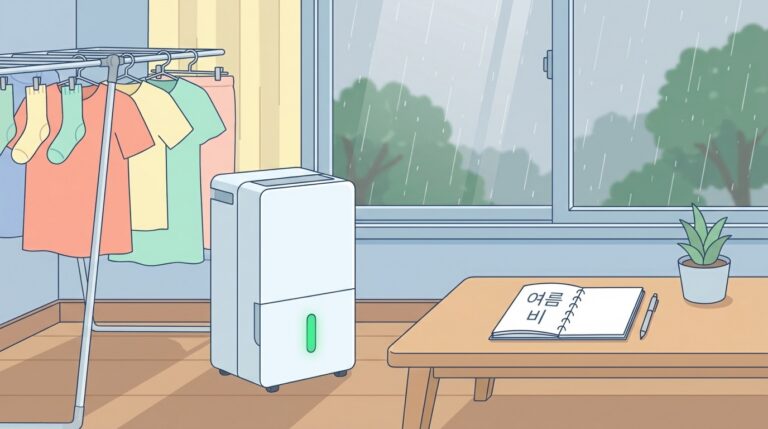
Surviving Korea’s Monsoon Season: The Dehumidifier Playbook
Phase 1: Empathy (Story-Driven Opening)
안녕하세요! This is your Daily Hangul editor. Picture this: It is early July in Seoul. You step into your studio apartment after dodging sudden downpours in Hongdae. You kick off your soaked sneakers, look forward to sinking into your cozy bed, but the moment you touch your bedsheet—it feels oddly damp, cold, and heavy. Your laundry rack in the corner hasn’t dried for three days, smelling faintly of sour mushrooms.
Welcome to 장마 (Jangma – Korea’s monsoon season). In modern Korean culture, surviving summer is not about finding sunshine; it is an indoor battle against sticky humidity. When I first mentored international students in Sinchon, almost every single learner panicked over one appliance: 제습기 (Jeseupgi – Dehumidifier). How do you ask your roommate to run it without sounding bossy? How do you describe that intolerable stickiness in authentic Korean rather than dictionary-stiff terms? This guide is tailored from real classroom feedback so you can speak like a local, save your laundry, and stay completely 뽀송뽀송 (crisp and dry) all summer long.
Phase 2: Core Expressions Deep Dive
1. 제습기 좀 틀어 줄래? (Jeseupgi jom teureo jullae?)
- Pronunciation: [Je-seup-gi jom teu-reo jul-lae?] (Sounds like: “Jae-seup-ghee jom teu-ruh jool-leh”)
- Meaning: Literal: “Could you turn on the dehumidifier a little?” | Nuance: “Hey, could you switch on the dehumidifier?”
- K-Culture Moment: You will hear this in roommate web dramas (like Hello, My Twenties!) when housemates negotiate utility bills or argue over swampy living room air.
- Editor’s Insight: The tiny word 좀 (jom – a little/please) is the golden key to polite Korean requests. Leaving out 좀 makes the sentence feel like a direct command from a manager. Adding 좀 softens your voice instantly.
- Situation Spectrum: Casual ✅ | Semi-formal ⚠️ (Say 제습기 좀 틀어 주실래요? – Jeseupgi jom teureo jusillaeyo?) | Formal 🚫
- 🤔 Think About It: In English, we often ask “Are you cold/warm?” before touching appliances. Why do Koreans prefer inserting softener words like 좀 instead of asking lengthy indirect questions?
2. 빨래가 전혀 안 말라요 (Ppallaega jeonhyeo an mallayo)
- Pronunciation: [Ppal-lae-ga jeon-hyeo an mal-la-yo] (Sounds like: “Ppal-leh-gah jun-hyuh ahn mahl-lah-yo”)
- Meaning: Literal: “The laundry is not drying at all.” | Nuance: “My clothes won’t dry due to this terrible humidity.”
- K-Culture Moment: Seen frequently in slice-of-life YouTube vlogs when vloggers hang laundry indoors with a fan blowing directly against clothes.
- Editor’s Insight: 전혀 (jeonhyeo) means “not at all” and naturally pairs with negative verbs. Pair it with an exasperated sigh, and any Korean listener will nod in deep commiseration.
- Situation Spectrum: Casual ⚠️ | Semi-formal ✅ | Formal ✅
- 🤔 Think About It: How does sharing everyday minor complaints (like damp clothes) function as social bonding in your native culture?
3. 방이 너무 꿉꿉해요 (Bangi neomu kkupkkuphaeyo)
- Pronunciation: [Bang-i neo-mu kkup-kkup-hae-yo] (Think of a heavy, blunt ‘k’ sound: “Bahng-ee nuh-moo kkoop-kkoop-heh-yo”)
- Meaning: Literal: “The room is very humid/sticky.” | Nuance: “The room feels gross, swampy, and clammy.”
- K-Culture Moment: Mentioned in variety shows like I Live Alone (나 혼자 산다) whenever a celebrity enters their basement or turns off the AC during July.
- Editor’s Insight: Standard textbooks teach 습해요 (seuphaeyo – it is humid). But 꿉꿉하다 (kkupkkuphada) carries physical discomfort—the feeling of damp skin sticking to vinyl chairs. It’s the ultimate sensory verb for Korean summers.
- Situation Spectrum: Casual ✅ | Semi-formal ✅ | Formal ⚠️
- 🤔 Think About It: Notice the double consonant ㄲ (kk). Korean onomatopoeia and sensory words use tense consonants to express physical, visceral discomfort. Does your native language have sound symbolism for humidity?
Phase 3: Textbook Korean vs. Real Korean
Situation 1: Asking to empty the full water reservoir of the dehumidifier
- 📖 교과서 한국어 (Textbook Korean): 수조에 물이 가득 찼으니 비워 주세요. (Sujoe muri gadeuk chasseuni biwo juseyo. – The water container is full, so please empty it.)
- 🗣️ 진짜 한국어 (Real Korean): 제습기 물통 다 찼어요. 비워야겠어요! (Jeseupgi multong da chasseoyo. Biwoyagesseoyo! – The dehumidifier bucket is completely full. We gotta empty it!)
- 💡 왜 다를까? (Why is it different?): Native speakers rarely use technical Sino-Korean terms like 수조 (water reservoir) in homes; instead, everyone calls it a 물통 (water tank/bucket).
Situation 2: Expressing relief once the room feels dry
- 📖 교과서 한국어 (Textbook Korean): 습도가 낮아져서 쾌적합니다. (Seupdoga najajyeoseo kwaejeokhumnida. – The humidity has dropped, so it is pleasant.)
- 🗣️ 진짜 한국어 (Real Korean): 와, 이제 공기가 완전 뽀송뽀송해요! (Wa, ije gong-giga wanjeon pposongpposonghaeyo! – Wow, the air feels totally dry and crisp now!)
- 💡 왜 다를까? (Why is it different?): 쾌적하다 sounds like an official weather broadcast. Everyday Koreans rely on the lovely tactile mimetic word 뽀송뽀송하다 (crisp, soft, and dry).
Phase 4: K-Culture Deep Dive & Non-verbal Manners
4-1. 눈치 (Nunchi) & Gestures: Appliance Etiquette in Shared Spaces
In a Korean officetel or shared flat, using electricity during the high-demand summer triggers subtle 눈치 (nunchi – social sensing) because of progressive residential electricity billing (누진세).
* The Clothing Touch Gesture: Before asking your roommate or host to turn on the dehumidifier, Koreans gently pinch their sleeve or sheet between thumb and index finger, giving it a slight flap while saying “아, 꿉꿉해” (Ah, kkupkkup-hae). This non-verbal cue visually validates your request without confronting the other person.
* The Water Tank Courtesy: Never leave a full water tank sitting inside the machine. When the dehumidifier beeps to notify it is full, immediately slide out the tank, dump the water down the bathroom drain, and slot it back in. Leaving the tank full implies you expect others to clean up after you.
4-2. Cultural Code Analysis: The Jangma Season Rituals
Jangma isn’t merely bad weather; it’s an entire seasonal subculture. When the rain pours relentlessly, Koreans head straight to traditional taverns for 파전 (Pajeon – green onion pancake) and 막걸리 (Makgeolli – rice wine) because the sizzling sound of frying batter mimics heavy rainfall. Meanwhile, inside apartments, single-person households run dehumidifiers side-by-side with small fans aimed at laundry racks—a survival setup affectionately nicknamed “빨래 건조 작전” (Operation Laundry Drying).
Phase 5: Real Roleplay Scenario
- Setting: A compact shared two-room flat in Mapo-gu, Seoul. Rain is rattling violently against the window. The humidity gauge on the wall reads 88%.
- Characters:
- 민우 (Minwoo): Your frugal Korean flatmate who is sensitive to the electricity bill.
- You (Learner): Desperately trying to dry your favorite clothes before an interview tomorrow.
Dialogue:
1. You: 민우 씨, 오늘 비가 진짜 쏟아지네요. (Minwoo ssi, oneul biga jinjja ssodajineyo.) — 🎭 Shaking wet umbrella gently by the door. “Minwoo, the rain is really pouring down today.”
2. 민우: 맞아요. 창문 닫았는데도 방이 너무 꿉꿉하네요. (Majayo. Changmun dadanneundedo bangi neomu kkupkkuphaneyo.) — 🎭 Wiping his forehead with the back of his hand. “I know. Even with windows shut, the room feels so clammy.”
3. You: 제 옷이 내일까지 말라야 하는데, 빨래가 전혀 안 말라요. (Je osi naeilkkaji mallaya haneunde, ppallaega jeonhyeo an mallayo.) — 🎭 Pointing worryingly at the damp shirt on the rack. “My clothes need to dry by tomorrow, but the laundry isn’t drying at all.”
4. 민우: 아, 진짜요? 선풍기 틀어 놨는데도 그래요? (Ah, jinjjayo? Seonpung-gi teureo nwanneundedo geuraeyo?) — 🎭 Looking at the slow-spinning desk fan. “Oh, really? Even with the electric fan running?”
5. You: 네, 제습기 모드로 좀 돌려도 될까요? (Ne, jeseupgi modeuro jom dollyeodo doelkkayo?) — 🎭 Pointing politely toward the portable dehumidifier unit. “Yes, would it be okay if we run the dehumidifier mode for a bit?”
6. 민우: 그럼요! 제습기 물통 비우고 바로 틀어요. (Geureomyo! Jeseupgi multong bi-u-go baro teureoyo.) — 🎭 Nodding enthusiastically. “Of course! Let’s empty the dehumidifier water tank and switch it on right away.”
7. You: 제가 얼른 물 비우고 켜 놓을게요! (Jega eolleun mul bi-u-go kyeo noheulgeyo!) — 🎭 Detaching the plastic reservoir carefully. “I’ll quickly dump the water and turn it on!”
8. 민우: 고마워요. 한 두 시간만 틀어도 금방 뽀송뽀송해질 거예요. (Gomawoyo. Han du siganman teureodo geumbang pposongpposonghaejil geoyeyo.) — 🎭 Smiling in relief. “Thanks. Running it for just a couple of hours will make everything crisp and dry.”
🔀 Interactive Decision Branch
What do you say after Minwoo agrees to let you run the dehumidifier?
- Option A: “전기세 많이 나오면 제가 이번 달에 더 낼게요!” (Jeongise mani naomyeon jega ibeon dare deo naelgeyo! – If the power bill comes out high, I’ll pay more this month!)
- Feedback [Best]: Demonstrates considerate understanding of shared utility anxieties in Korea. Minwoo will appreciate your maturity.
- Option B: “왜 진작 제습기 안 켰어요?” (Wae jinjak jeseupgi an kyeosseoyo? – Why didn’t you turn the dehumidifier on earlier?)
- Feedback [Bad]: Accusatory tone. It shatters the shared harmony and makes your flatmate defensive.
- Option C: “밤새도록 계속 켜 둘게요.” (Bamsaedorok gyesok kyeo dulgeyo. – I’ll keep it on all night long.)
- Feedback [Risk]: Running dehumidifiers all night in closed bedrooms can dry out nasal passages and hike up utility bills drastically. Might trigger friction.
Phase 6: 10-Second Emotion Shadowing Drill
Read aloud focusing on natural cadence, pausing cleanly at each slash /.
[😫 꿉꿉하고 지친 목소리로 - Exhausted & Clammy]- 아, 방이 / 너무 꿉꿉해서 / 잠을 못 자겠어.
- (Ah, bang-i / neomu kkupkkuphaeseo / jameul mot jagesseo.)
- “Ugh, the room is so clammy / I can’t even fall asleep.”
[🙏 조심스럽고 공손하게 - Gentle & Courteous]- 혹시 / 제습기 좀 / 1시간만 틀어도 될까요?
- (Hoksi / jeseupgi jom / han-siganman teureodo doelkkayo?)
- “By any chance / could we run the dehumidifier / for just an hour?”
[✨ 기분 좋고 상쾌하게 - Refreshed & Relieved]- 와! / 제습기 돌리니까 / 빨래가 완전 뽀송뽀송해졌네!
- (Wa! / jeseupgi dollinikka / ppallaega wanjeon pposongpposonghaejyeonne!)
- “Wow! / Since we ran the dehumidifier / the laundry became totally dry and crisp!”
Phase 7: K-Culture Mini Dictionary
- 장마 (Jangma) | Monsoon season | Refers specifically to the persistent East Asian rainy season in Korea from late June to mid-July. Everything from umbrella sales to delivery app surcharges revolves around this word.
- 물먹는 하마 (Mul-meongneun Hama) | “Water-Eating Hippo” (Moisture Absorber) | Korea’s most iconic commercial closet desiccant brand. People place these blue plastic tubs inside wardrobes and shoe racks to prevent green mold during humid weeks.
- 꿉꿉하다 (Kkupkkuphada) | Clammy / Swampy / Humid | An everyday descriptive verb capturing that tactile unpleasantness when humidity exceeds 70% and fabric clings to your skin.
- 뽀송뽀송 (Pposong-pposong) | Crisp / Softly dry / Powder-fresh | The ultimate state of comfort in Korean summers. Used for clean hotel sheets, line-dried clothes, and oil-free matte skin.
Phase 8: Traveler’s Survival Kit
Top 3 Survival Expressions
- 에어컨 제습 모드로 켜 주세요. (Eeokeon jeseup modeuro kyeo juseyo.)
- Pronunciation: [Ee-eo-keon je-seup mo-deu-ro kyeo ju-se-yo]
- Pro Tip: If your Airbnb doesn’t have a standalone dehumidifier, almost every Korean air conditioner has a dry-drop symbol representing dehumidification mode (제습).
- 물통 어디에 비워요? (Multong eodie biwoyo?)
- Pronunciation: [Mul-tong eo-di-e bi-wo-yo]
- Pro Tip: Ask this to your guesthouse host before emptying appliance water into an unfamiliar sink or drain.
- 우산 꽂이 어디 있어요? (Usan kkoji eodi isseoyo?)
- Pronunciation: [U-san kko-ji eo-di it-sseo-yo]
- Pro Tip: Korean cafes and shops will never allow wet, dripping umbrellas inside without umbrella stands or plastic wrappers (우산 비닐).
Editor’s Travel Note
- Install the Naver Map app official download link to track real-time indoor subway transfer pathways to avoid walking outside during monsoon downpours.
- Download the Korea Meteorological Administration weather warning page to receive emergency alert updates on localized heavy rain (호우경보).
Phase 9: One Step Deeper
In Korean society, complaining about the weather is rarely seen as negative venting; rather, it is an essential icebreaker called 생활 공감 (saenghwal gonggam – shared daily empathy). When someone walks into an elevator and mutters, “날씨가 너무 꿉꿉하죠?” (The weather is so sticky, isn’t it?), they are extending an invitation to mutual solidarity against a shared seasonal adversary. Validating another person’s sensory discomfort builds quick, warm social connections in Korea’s densely populated urban landscapes.
💬 Your Turn: How do you handle sticky rainy seasons in your home country? Have you ever negotiated appliance use with roommates? Share your story in the comments below!
Phase 10: FAQ & Common Mistakes
Q: Can I run the dehumidifier with the windows cracked open?
A: Never! Running a dehumidifier with open windows in Korea draws endless humid exterior air inside, overworking the machine and causing electricity bills to skyrocket. Always close windows and doors tightly when operating.
Q: What is the difference between 에어컨 제습 (AC Dry Mode) and an actual 제습기 (Dehumidifier)?
A: AC dehumidifier mode chills the room while extracting moisture, which is great for hot afternoons. A standalone dehumidifier emits slight warm exhaust air, making it superior for quickly drying laundry in closed utility areas without over-freezing the apartment.
Q: Why does my Korean host insist on keeping closet doors open during Jangma?
A: Built-in closets in Korean apartments often border exterior walls where moisture condenses. Opening closet doors while running the room dehumidifier prevents mildew from ruining winter coats.
🚨 Common Mistakes Alert
- Mistake: Using 축축하다 (chukchuk-hada) instead of 꿉꿉하다 (kkupkkup-hada).
- Correction: 축축하다 means thoroughly wet (like a drenched towel). Use 꿉꿉하다 for atmospheric dampness.
- Mistake: Forgetting the softener 좀 (jom) when requesting appliance changes.
- Correction: Say “제습기 좀 켜 주세요” instead of blunt “제습기 켜 주세요”.
- Mistake: Dumping the dehumidifier reservoir into regular trash bins.
- Correction: Always pour the condensed water down the toilet or shower drain.
Phase 11: Action Missions
- 🥉 Bronze Mission (Solo Shadowing): Stand in front of your mirror and practice saying: “방이 너무 꿉꿉해서 제습기 좀 틀었어요!” three times with authentic facial expressions.
- 🥈 Silver Mission (Social Share): Snap a photo of a rainy window or your laundry setup and post an Instagram story with the caption: “오늘 날씨 완전 꿉꿉함… 뽀송뽀송해지고 싶다 ☔”.
- 🥇 Gold Mission (Real Life Execution): Next time you are in a Korean Airbnb, guesthouse, or cafe that feels muggy, locate the AC remote and locate the 제습 (Dehumidify) button or politely ask your host about the dehumidifier.
- 🎮 K-Culture Mission: Watch an episode of a Korean variety show (such as I Live Alone or Omniscient Interfering View) filmed during summer, and spot how many times the word 꿉꿉하다 or a dehumidifier water tank appears on screen!
Phase 12: Interactive Quiz Challenge
Question 1: Situational Judgment
Your flatmate just walked in from heavy rain and groans about damp air. Which response is the most natural and considerate Korean phrase?
* A) 비가 오니까 창문을 다 열어 놓으세요. (Biga onikka changmuneul da yeoreo noheuseyo.)
* B) 방이 좀 꿉꿉하죠? 제습기 틀어 드릴까요? (Bangi jom kkupkkuphajyo? Jeseupgi teureo deurilkkayo?)
* C) 에어컨을 왜 안 샀어요? (Eeokeoneul wae an sasseoyo?)
Question 2: Fill in the Blank
제습기를 돌렸더니 빨래가 아주 ________해졌어요. (Because we ran the dehumidifier, the laundry became wonderfully soft and dry.)
* Hint: Think of the 4-syllable tactile mimetic word for crisp, dry freshness.
Question 3: True or False (Culture Check)
True or False: In Korean homes, it is considered polite to leave the dehumidifier water tank completely full so the next user knows how much moisture was collected.
👉 Click to view Answers & Explanations
- Answer 1: B — Acknowledging the clamminess (꿉꿉하죠?) and offering to run the dehumidifier (제습기 틀어 드릴까요?) demonstrates high social empathy (눈치).
- Answer 2: 뽀송뽀송 (pposong-pposong) — The classic phrase for clean, dried laundry free of clamminess.
- Answer 3: False — Leaving the water reservoir full is bad communal manners. Always empty the tank promptly so the appliance can resume operating without shutoff beeps.







