

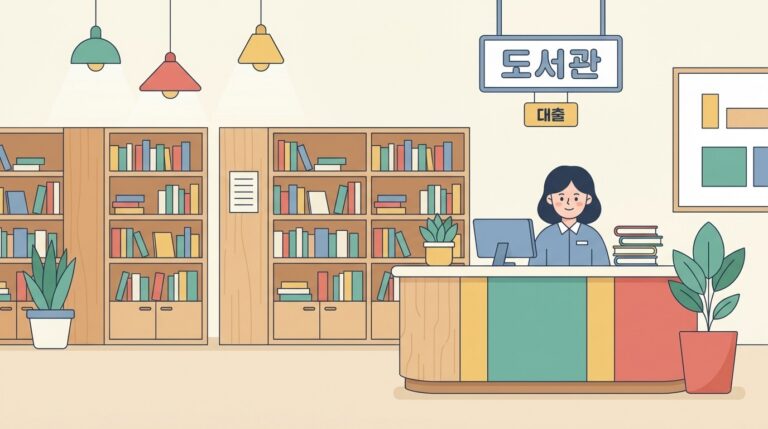
Phase 1: Empathy (Real-Life Library Jitters)
안녕하세요! 매일한글 에디터입니다. Have you ever stepped inside a breathtaking public library in Korea—perhaps the soaring, sunlit shelves of a local district library in Mapo or a quiet campus reading room—spotted a Korean book you desperately want to read, and then suddenly frozen in your tracks? You pick up the book, walk toward the circulation counter, and your heart starts racing. You want to ask, ‘Can I borrow this? And when do I have to bring it back?’ But your mind goes blank. You wonder: Do I say ‘빌리다’ (billida)? Is there a formal word for borrowing books? What if the librarian rattles off return rules in rapid-fire Korean?
Many of our B1 learners share that official spaces like libraries feel intimidating because you need speech that is polite, natural, and institutional without sounding like an antique textbook. But here is the good news: Korean library exchanges actually follow a very predictable, smooth rhythm! Today, we are breaking down the exact natural phrases native speakers use to check out books, confirm due dates, and ask for extensions. Let’s make your next Korean library visit smooth, stress-free, and memorable!
Phase 2: Top 3 Core Expressions
1. 이 책 대출할 수 있나요? (I chaek daechulhal su innayo?)
- Pronunciation: [I chaek dae-chul-hal su in-na-yo?] (Think: “ee check deh-chool-hahl soo een-nah-yo?”)
- Meaning: “Can I check out this book?” (대출하다 = to borrow/loan from an institution).
- K-Culture Moment: You will hear this in comforting slice-of-life dramas like When the Weather Is Fine or Run On when characters browse neighborhood book collections.
- Editor’s Insight: In casual Korean, “to borrow” is
빌리다(billida). While saying이 책 빌릴 수 있어요?is understandable, using대출(daechul) immediately demonstrates intermediate polish and respect for institutional etiquette. - Situation Spectrum: Casual ⚠️ | Semi-formal ✅ | Formal ✅
- 🤔 Think About It: English uses the phrase “check out” for libraries, hotels, and groceries. Korean clearly separates institutional loans (
대출), commercial purchases (결제), and peer borrowing (빌리기). How does this compartmentalization shape social boundaries?
2. 반납 기한이 언제까지예요? (Bannap gihani eonjekkajiye-yo?)
- Pronunciation: [Ban-nap gi-han-i eon-je-kka-ji-ye-yo?] (Think: “bahn-nahp gee-hahn-ee un-jeh-kkah-jee-yeh-yo?”)
- Meaning: “When is the return due date?” (반납 = return; 기한 = time limit/deadline; 언제까지 = until when).
- K-Culture Moment: The relatable campus trope where university students frantically check library notifications on their KakaoTalk before midterms!
- Editor’s Insight: You can also ask
반납일이 언제예요?(When is the return date?), but adding기한(deadline) emphasizes your intention to observe the schedule responsibly. - Situation Spectrum: Casual ⚠️ | Semi-formal ✅ | Formal ✅
- 🤔 Think About It: The postposition
~까지marks the ultimate boundary of an action. Notice how Korean pairs Sino-Korean nouns (반납 기한) with native grammatical endings to balance clarity and politeness.
3. 대출 연장 가능한가요? (Daechul yeonjang ganeunghangayo?)
- Pronunciation: [Dae-chul yeon-jang ga-neung-han-ga-yo?] (Think: “deh-chool yuhn-jahng gah-neung-hahn-gah-yo?”)
- Meaning: “Is it possible to extend the loan?” (연장 = extension; 가능하다 = to be possible).
- K-Culture Moment: That classic drama scene where a character cannot finish a 600-page mystery novel in two weeks and negotiates for extra reading days.
- Editor’s Insight: Ending a question with
~ㄴ/은/인가요?softens your request significantly compared to a direct연장돼요?. It signals modest deference to desk staff. - Situation Spectrum: Casual 🚫 | Semi-formal ✅ | Formal ✅
- 🤔 Think About It: By phrasing the request around possibility (
가능한가요) rather than personal demand (연장해 주세요), you allow the librarian room to decline gracefully without social awkwardness.
Phase 3: Textbook Korean vs. Real Korean
Situation 1: Checking out at the counter
- 📖 교과서 한국어: “이 책을 빌려 가겠습니다.” (I chaek-eul billyeo gagesseumnida. – “I shall borrow and take this book.”)
- 🗣️ 진짜 한국어: “이거 대출해 주세요.” (Igeo daechulhae juseyo. – “Please check this out for me.”) or “이거 대출할게요.” (Igeo daechulhalgeyo. – “I’ll check this out.”)
- 💡 왜 다를까? Textbook Korean frequently overuses heavy declarative endings (
-겠습니다). Real native speakers keep transactional counter dialogue warm, brisk, and active with-해 주세요or-할게요.
Situation 2: Inquiring about due dates
- 📖 교과서 한국어: “책을 돌려주는 날짜가 며칠입니까?” (Chaek-eul dollyeojuneun naljjaga myeochirimnikka? – “What date is the day of returning the book?”)
- 🗣️ 진짜 한국어: “반납 언제까지 하면 돼요?” (Bannap eonjekkaji hamyeon dwaeyo? – “By when should I return this?”)
- 💡 왜 다를까? Native speakers favor efficient Sino-Korean terms (
반납) combined with the practical grammatical pattern-면 돼요?(“Is it okay if I…?”). It sounds much more natural and conversational.
Phase 4: K-Culture Deep Dive & Non-Verbal Manners
4-1. 눈치 (Nunchi) & Library Body Language
- The Two-Handed Pass: When presenting your library card (
도서대출증) or smartphone membership barcode, hold it with both hands or rest your left fingers gently beneath your right forearm. Handing cards over single-handedly with a flick looks indifferent. - Barcode Orientation: Place your books on the counter with the back cover barcode facing upward toward the librarian scanner. This small consideration saves them time and shows great situational awareness (
눈치, nunchi). - The Stage-Whisper Register: Korean libraries are exceptionally quiet. Even at the checkout desk, drop your volume to a gentle, lowered whisper register.
4-2. Cultural Code: The Korean Public Library Phenomenon
Korean public libraries (구립도서관 / 시립도서관) are not just quiet book repositories; they are sophisticated community cultural spaces. Most neighborhood branches feature state-of-the-art self-checkout kiosks (무인 대출반납기), quiet laptop zones, and dedicated study reading rooms called 열람실 (yeollamsil). Best of all, if you cannot make it during desk hours, many Korean libraries offer 24-hour smart drop boxes (무인 반납함) at building gates and even inside subway stations!
Phase 5: Real-Life Roleplay Scenario
Setting: Mapo District Public Library on a sunny Tuesday afternoon. Soft keyboard typing echoes in the background.
Character: Librarian Min-ji (kind, efficient, wearing glasses and a library apron).
- Librarian Min-ji: 🎭 [Looks up with a warm, subtle smile] “안녕하세요. 대출 도와드릴까요?” (Annyeonghaseyo. Daechul dowadeurilkkayo? / “Hello. May I help you check out?”)
- Learner (You): 🎭 [Places two books on the counter barcode up] “네, 이 책 두 권 대출해 주세요.” (Ne, i chaek du gwon daechulhae juseyo. / “Yes, please check out these two books.”)
- Librarian Min-ji: 🎭 [Scans the items] “회원증이나 모바일 바코드 보여주시겠어요?” (Hoewonjeung-ina mobail bakodeu boyeojusigesseoyo? / “Could you show me your membership card or mobile barcode?”)
- Learner (You): 🎭 [Hands phone with both hands] “여기 모바일 카드 있어요.” (Yeogi mobail kadeu isseoyo. / “Here is my mobile card.”)
- Librarian Min-ji: 🎭 [Beeps barcode, prints a small slip] “네, 처리되었습니다. 반납일은 다음 주 화요일, 15일까지예요.” (Ne, cheoridoeeotseumnida. Bannap-ireun da-eum ju hwayoil, sibo-ilkkajiye-yo. / “All set. The return date is next Tuesday, the 15th.”)
- Learner (You): 🎭 [Nods gently] “혹시 대출 연장 가능한가요?” (Hoksi daechul yeonjang ganeunghangayo? / “By any chance, is a loan extension possible?”)
- Librarian Min-ji: 🎭 [Points softly toward the receipt slip] “네, 예약자가 없으면 홈페이지나 앱에서 1회 7일 연장할 수 있어요.” (Ne, yeyakjaga eopseumyeon hompeijina aeb-eseo il-hoe chiril yeonjanghal su isseoyo. / “Yes, if there are no reservations, you can extend it once for 7 days via the website or app.”)
- Learner (You): 🎭 [Takes receipt and books with a slight bow] “아, 알겠습니다. 감사합니다!” (A, algesseumnida. Gamsahamnida! / “Ah, understood. Thank you!”)
🔀 Interactive Decision Branch
What would you say if you want to know what happens if you bring the book back late?
- Option A: “늦게 내도 괜찮죠?” (Neutge naedo gwaenchantjyo? / “It’s fine if I turn it in late, right?”)
- Feedback [Bad]: Overly casual and presumes rules can be disregarded. Never use this with library staff!
- Option B: “하루 늦으면 벌금 얼마 내야 돼요?” (Haru neujeumyeon beolgeum eolma naeya dwaeyo? / “How much fine do I pay if I’m a day late?”)
- Feedback [Risk]: Grammatically fine, but most Korean public libraries do not charge monetary fines; they enforce loan suspension periods instead.
- Option C: “연체되면 어떻게 돼요?” (Yeonchedoemyeon eotteoke dwaeyo? / “What happens if it becomes overdue?”)
- Feedback [Best]: Polite, natural, and uses the accurate term
연체(yeonche, overdue). The librarian can easily clarify their branch’s policy.
- Feedback [Best]: Polite, natural, and uses the accurate term
Phase 6: 10-Second Emotion Shadowing Drill
Practice these lines aloud using the emotion cues and breathing pauses (/):
[😊 Crisp and Polite]“이 책 두 권 / 대출해 주세요.” (I chaek du gwon / daechulhae juseyo.)[🤔 Inquiring and Thoughtful]“반납 기한이 / 언제까지예요?” (Bannap gihani / eonjekkajiye-yo?)[💡 Soft and Considerate]“혹시 / 대출 연장 가능한가요?” (Hoksi / daechul yeonjang ganeunghangayo?)
Phase 7: K-Culture Mini Dictionary
- 대출 (Daechul) | Loan / Checkout | Used in institutional contexts (libraries, banks). In libraries,
대출 권수refers to your checkout limit (e.g., 5 books). - 반납 (Bannap) | Return | Specifically returning borrowed items or equipment. Distinct from
환불(hwanbul, store monetary refund). - 연체 (Yeonche) | Overdue / Arrears | When you exceed your borrowing deadline. If you have an overdue book, your card enters
연체 상태(overdue status). - 열람실 (Yeollamsil) | Study Hall / Reading Room | The silent, desk-filled rooms in Korean libraries where students and test-takers prepare for exams.
Phase 8: Traveler’s Survival Kit
Survival Expressions TOP 3
- “반납함 어디에 있어요?” (Bannap-ham eodie isseoyo? – “Where is the return drop box?”)
- Pro Tip: Use this when searching for the automated drop box after closing hours.
- “이거 대출 가능한 책인가요?” (Igeo daechul ganeunghan chaekingayo? – “Is this book available for checkout?”)
- Pro Tip: Reference materials and rare collections often have a label saying
관내열람(in-library reading only).
- Pro Tip: Reference materials and rare collections often have a label saying
- “모바일 회원증 바코드 찍으면 돼요?” (Mobail hoewonjeung bakodeu jjigeumyeon dwaeyo? – “Can I just scan my mobile membership barcode?”)
- Pro Tip: Great to use at self-service automated checkout machines (
무인 대출기).
- Pro Tip: Great to use at self-service automated checkout machines (
Editor’s Travel Note
Looking for the closest neighborhood library? Search for “구립도서관” on the Naver Map app download. If you are staying in Korea on an Alien Registration Card (ARC), you can register for free at almost any municipal library and access thousands of books, webtoons, and study spaces!
Phase 9: One Step Deeper (Reflective Insight)
In many Western library systems, returning a book late incurs a small cash fine (e.g., $0.25 per day). In Korea, however, public libraries generally operate on a principle of civic responsibility rather than economic penalty. If you return a book 4 days late, your checkout privileges are typically frozen for exactly 4 days (연체일수만큼 대출 정지). This policy reflects the deep cultural value placed on equitable community sharing: you deprived another community member of time with the book, so you make restitution through time rather than money.
💬 Your Turn: How do libraries in your home country handle overdue books? Do you prefer cash fines or temporary checkout suspensions? Tell us in the comments!
Phase 10: FAQ & Common Mistakes
Q: Can short-term foreign tourists borrow books from Korean public libraries?
A: Generally, short-term visa holders without an Alien Registration Card (ARC) can enter and read books freely inside the building (관내 열람), but borrowing books outside (관외 대출) requires local residency registration.
Q: What should I do if the library is closed on my return date?
A: You don’t have to panic! Use the exterior drop box (무인 반납함). Books dropped in before midnight or early the next morning are credited to the previous calendar day without penalty.
Q: Can I extend a book loan if another patron has reserved it?
A: No. If another user has placed a reservation (예약), the system will lock extensions, and you must return the book by the original due date.
🚨 Common Mistakes Warning Board
- Mistake: Asking “이 책 환불해 주세요” at the library counter.
- Correct Action:
환불(refund) is for retail money. Always say반납할게요(I will return this).
- Correct Action:
- Mistake: Handing your phone barcode with one hand while looking away.
- Correct Action: Hold your phone with two hands and make brief, respectful eye contact.
- Mistake: Assuming you can borrow books with a normal tourist passport alone.
- Correct Action: Enjoy the book comfortably in the open reading areas or digital lounges!
Phase 11: Action Mission & Engagement
- 🥉 Bronze Mission: Shadow the 3 audio rhythm drill sentences out loud 3 times until your pronunciation flows naturally.
- 🥈 Silver Mission: Write a mock text message to an imaginary librarian asking to extend your book loan using
대출 연장 가능한가요?in your Korean study journal. - 🥇 Gold Mission: Walk into a Korean bookstore or library, locate an information counter, and politely ask: “이 책 여기서 볼 수 있나요?” (Can I read this book here?).
- 🎮 K-Culture Mission: Watch an episode of a campus or romance K-drama (like Romance Is a Bonus Book or Twenty-Five Twenty-One) and spot any scene set in a library or bookstore. Listen closely for
대출or반납!
Phase 12: Interactive Quiz Challenge
1. Situation Decision: You need two more weeks to finish reading a non-fiction book that has no other holds. What is the most polite question to ask the staff?
* A) 연체료 낼 테니 더 봐도 돼요?
* B) 대출 연장 가능한가요?
* C) 이 책 그냥 제가 가질게요.
2. Fill in the Blank:
“반납 ________ 언제까지예요?” (When is the return deadline?)
* A) 기한
* B) 가격
* C) 번호
3. True or False: In Korea, if a library book is overdue by 5 days, public libraries usually make you pay a 50,000 KRW cash fine.
* A) True
* B) False
Click here for Answers & Explanations
- Answer: B (
대출 연장 가능한가요?). This is polite, natural, and standard library Korean. (A is rude; C means “I’ll just keep the book”). - Answer: A (
기한, gihan).반납 기한translates to “return deadline” or “due date.” - Answer: B (
False). Korean public libraries generally freeze your borrowing rights for the number of overdue days (연체일수만큼 대출 정지) rather than demanding cash fines!







