

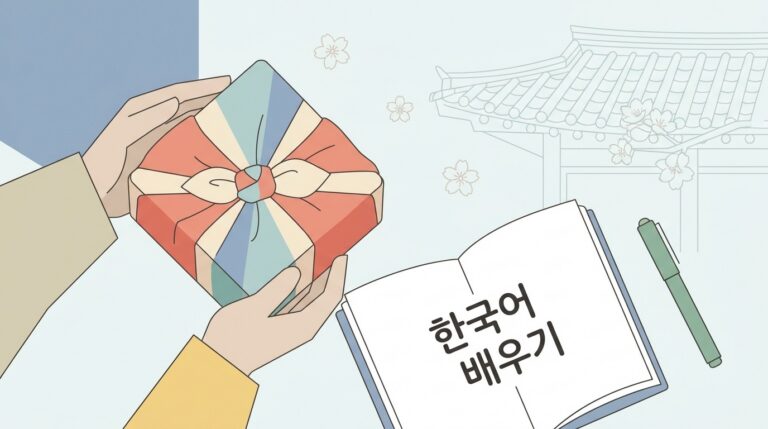
Beyond Thank You: The High-Context Masterclass on Korean Gift-Giving Protocols
Phase 1: Empathy & Storytelling Opening
안녕하세요! 매일한글 에디터입니다. Have you ever stood in the polished foyer of a respected Korean colleague’s home or a senior executive’s office, holding a thoughtfully wrapped package, only to be met with a vigorous wave of both hands and a startled exclamation: “아이구, 이런 거 왜 사 오셨어요! (Aigu, ireon geo wae sa osyeosseoyo! / Oh my, why on earth did you buy something like this!)”?
If your initial Western instinct was to apologize, pull the package back, and say, “Oh, I’m sorry, I can take it back,” you have collided head-on with Korea’s most intricate social labyrinth: the choreography of gift-giving. At a C2 mastery level, language is never merely about grammar or vocabulary; it is high-stakes relational diplomacy. In Korean society, exchanging gifts is not a straightforward commercial swap or an innocent holiday nicety. It is a finely calibrated dance of mutual face-saving, calculated rhetorical modesty (gyeomyang), and the mitigation of psychological indebtedness (budam).
Drawing from over a decade of intercultural executive consulting and countless real-world anecdotes from advanced learners living in Seoul, this guide will elevate your Korean from textbook-correct to culturally unimpeachable. Let’s master the art of giving, receiving, and declining with the poise of a true insider.
Phase 2: Core Expressions Deep Dive
1. 약소하지만 성의로 준비했습니다 (Yaksohajiman seong-uiro junbihaesseumnida)
- Pronunciation: [Yak-sso-ha-ji-man seong-ui-ro jun-bi-hae-sseum-ni-da] (Pronounce yakso with a crisp, suppressed ‘k’ like the end of ‘lock’, followed by a sharp ‘so’; pronounce seong-ui smoothly like ‘sung-wee’).
- Meaning: Literal: “Though it is meager, I prepared it with sincerity.” | Nuance: “No material item could adequately reflect my immense gratitude and respect for you, but please accept this humble token of my goodwill.”
- K-Culture Moment: Seen frequently in sophisticated legal and corporate dramas like Stranger (비밀의 숲) or Reborn Rich (재벌집 막내아들), when an elite professional presents high-grade red ginseng or a rare vintage to an influential mentor.
- Editor’s Insight: This is the gold standard of high-register humility (gyeomyang). Even if the gift is top-tier Hanwoo beef that cost half your monthly paycheck, referring to it as 약소하다 (meager/modest) gracefully lowers your own stance and relieves the recipient from feeling overwhelmed by its ostentatious market value.
- Situation Spectrum: Casual: 🚫 | Semi-formal: ⚠️ | Formal: ✅
- 🤔 Think About It: In many Western individualistic societies, telling someone your gift is “meager” might sound self-deprecating or even insulting to the recipient’s taste. Why does Korean society consider rhetorical self-diminishment to be the highest mark of honor toward the other party?
2. 이런 거 안 사 오셔도 되는데, 매번 염치없게 받기만 하네요 (Ireon geo an sa osyeodo doeneunde, maebeon yeomchieopge batgiman haneyo)
- Pronunciation: [I-reon geo an sa o-syeo-do doe-neun-de, mae-beon yeom-chi-eop-ge bat-gi-man ha-ne-yo] (Let yeomchi glide with a light ‘ch’ sound, almost like ‘yum-chee’).
- Meaning: Literal: “You really did not need to buy this, yet shamelessly I only keep receiving every time.” | Nuance: “I am deeply moved by your unceasing generosity, and while I feel bashful about not having reciprocated enough, I am profoundly thankful for your warm care.”
- K-Culture Moment: A staple in prestige slice-of-life dramas like Hospital Playlist (슬기로운 의사생활) or Reply 1988 (응답하라 1988), where a cherished elder accepts a heartfelt gift from a younger counterpart while playfully feigning embarrassment.
- Editor’s Insight: Pay close attention to the word 염치 (yeomchi – a sense of shame or tact). Confessing that you are 염치없다 (shameless) does not mean you lack morality; paradoxically, verbalizing your apparent lack of shame proves that you possess the highest standard of moral awareness (nunchi).
- Situation Spectrum: Casual: ⚠️ | Semi-formal: ✅ | Formal: ✅
- 🤔 Think About It: How does acknowledging relational asymmetry (“I only keep receiving”) strengthen rather than weaken long-term interpersonal trust in high-context cultures?
3. 부담 갖지 마시고 편하게 받아주셨으면 합니다 (Budam gatji masigo pyeonhage badajusyeosseumyeon hamnida)
- Pronunciation: [Bu-dam gat-ji ma-si-go pyeo-na-ge ba-da-ju-syeo-sseu-myeon ham-ni-da] (Pronounce budam with a soft, round ‘b’, rhyming with ‘who-calm’).
- Meaning: Literal: “Please do not bear a burden and comfortably receive it.” | Nuance: “Please accept this purely from my heart without feeling the slightest psychological pressure to return an equal favor.”
- K-Culture Moment: An experienced department head handing a fountain pen or mentorship book to a newly hired junior colleague, preemptively neutralizing the junior’s immediate panic about reciprocating.
- Editor’s Insight: The operative concept here is 부담 (budam – psychological/social debt). A true master of Korean etiquette always defuses budam before it can sprout. It signals: This is an act of pure affection or duty, not a transactional contract.
- Situation Spectrum: Casual: ⚠️ | Semi-formal: ✅ | Formal: ✅
- 🤔 Think About It: Why is granting someone emotional freedom from reciprocity considered a much more gracious gesture than the monetary value of the gift itself?
Phase 3: Textbook Korean vs. Real Korean
Situation 1: Presenting a gift to a senior supervisor or professor
- 📖 교과서 한국어 (Textbook Korean):
“선생님, 이 선물을 받으세요.”
(Seonsaengnim, i seonmureul badeuseyo. / Teacher, please receive this gift.) - 🗣️ 진짜 한국어 (Real-World High-Register Korean):
“약소하지만 평소 베풀어주신 은혜에 보답하고자 작은 정성을 담았습니다.”
(Yaksohajiman pyeongso bepuleojusin eunhyee bodabhagoja jageun jeongseongeul damasseumnida. / Though it is meager, I have put together a small token of my heart to repay the constant grace you have bestowed upon me.) - 💡 왜 다를까? (Why the divergence?):
The textbook imperative “받으세요” sounds uncomfortably blunt and demanding to native ears. Natural high-register Korean utilizes subordinate clauses reflecting historical gratitude (베풀어주신 은혜) and reframes the object not as a “gift” (선물), but as embodied sincerity (정성).
Situation 2: Receiving a thoughtful gift from a business counterpart
- 📖 교과서 한국어 (Textbook Korean):
“감사합니다. 잘 쓰겠습니다.”
(Gamsahamnida. Jal sseugesseumnida. / Thank you. I will use it well.) - 🗣️ 진짜 한국어 (Real-World High-Register Korean):
“어머, 늘 이렇게 세심하게 마음 써 주시니 정말 몸 둘 바를 모르겠습니다.”
(Eomeo, neul ireoke sesimhage maeum sseo jusini jeongmal mom dul bareul moreugesseumnida. / Oh my, with you always caring for me with such meticulous thought, I truly do not know where to place myself.) - 💡 왜 다를까? (Why the divergence?):
“잘 쓰겠습니다” is perfectly fine for peers, but when receiving something significant from an equal or senior, focusing instantly on utility (“I will use it”) feels slightly materialistic. The refined native response centers on emotional impact, employing the classical idiom 몸 둘 바를 모르겠다 (I am so overwhelmed with gratitude that I do not know where to position my body).
Phase 4: K-Culture Deep Dive & Non-Verbal Manners
4-1. 눈치 (Nunchi) & The Physical Choreography
Gift-giving in Korea is a theatrical performance where physical poise conveys 70% of the message. Keep these three somatic rules etched in your mind:
1. The Dual-Support Grip: Never hand or receive a gift with a single hand. Use both hands to hold the package. If the object is light, hold it with your right hand while lightly resting your left fingers under your right forearm or wrist. This physical posture originates from traditional hanbok sleeves, signaling that you harbor no concealed intentions or weapons.
2. The 15-Degree Gaze Deflection: Maintain a gentle bow (around 15 to 30 degrees). Avoid piercing eye contact during the handover; instead, direct your gaze downward toward the gift, emphasizing modesty.
3. The Ritual of Gentle Hesitation (양보 / Yangbo): When offered a prestigious gift, never grab it eagerly on the first pass. Native etiquette dictates a subtle pause and mild verbal resistance: “아닙니다, 제가 이런 걸 받을 자격이…” (No, I really do not deserve such a thing…). Once the giver insists a second or third time, accept it with both hands and deep gratitude.
4. The Golden Rule of Unwrapping: Unless the giver explicitly commands you (“지금 한번 뜯어보세요! / Open it right now!”), never unwrap a gift in front of the presenter. In Korea, opening a gift on the spot risks putting the giver’s financial capacity or aesthetic taste on public display, potentially causing loss of face (che-myeon).
4-2. Cultural Code Analysis: The Bojagi Philosophy & The Anti-Graft Reality
- Bojagi (보자기) Packaging: In Korean tradition, wrapping something in a silk or hemp cloth is not mere aesthetic wrapping; the verb 싸다 (to wrap) is historically synonymous with 복을 싸다 (wrapping and preserving good fortune). Presenting a gift wrapped in an intricately knotted norigae-accented bojagi signals that you respect the recipient’s spiritual well-being, not just their material utility.
- The Kim Young-ran Act (김영란법): In contemporary Korea, legal consciousness shapes gift-giving. The Improper Solicitation and Graft Act strictly limits the value of gifts given to public officials, educators, journalists, and state-affiliated hospital personnel (typically capped at 50,000 KRW for general gifts, or 100,000–150,000 KRW for domestic agricultural/fishery products during traditional holidays). Presenting an excessively lavish gift in a professional or academic context will trigger extreme anxiety rather than joy.
Phase 5: Real-World Roleplay Scenario
Setting: The private office of Managing Director Han (한 상무), an influential senior leader who recently endorsed your cross-border project. You are visiting before Chuseok with a premium gift box.
- You: 한 상무님, 바쁘신 와중에 잠시 시간 내주셔서 감사드립니다.
(Han sangmunim, bappeusin wajunge jamsi sigan naejusyeoseo gamsadeurimnida.)
“Director Han, thank you for sparing a moment out of your demanding schedule.”
🎭 두 손을 단정히 모으고 30도 각도로 정중하게 인사한다.(Holding hands neatly together, bowing respectfully at 30 degrees.) -
Managing Director Han: 어서 와요! 이번 분기 프로젝트 성과가 아주 훌륭했던데, 고생 많았어요.
(Eoseo wayo! Ibeon bungi peurojekteu seonggwaga aju hollyunghaetteonde, gosaeng manasseoyo.)
“Welcome! The project outcomes this quarter were stellar; you really went through a lot of hard work.” -
You: 상무님께서 세심하게 이끌어주신 덕분입니다. 다름이 아니라, 명절을 맞아 작은 감사의 뜻을 전하고자 찾아뵈었습니다.
(Sangmunimkkeseo sesimhage ikkeureojusin deokbunimnida. Dareumi anira, myeongjeoreul maja jageun gamsaui tteuseul jeonhagoja chajabwoesseumnida.)
“It was entirely thanks to your meticulous guidance. I came to visit to express a small token of gratitude ahead of the holidays.”
🎭 준비해 온 고급 전통차 세트를 두 손으로 받쳐 들며 내민다.(Holding the premium traditional tea set with both hands and presenting it.) -
Managing Director Han: 아이구, 이런 거 안 챙겨와도 되는데! 내가 해준 것도 별로 없는데 뭘 이런 걸 다 사 왔어요?
(Aigu, ireon geo an chaenggyeowado doeneunde! Naega haejun geotdo byeollo eomneunde mwol ireon geol da sa wasseoyo?)
“Oh my, you really didn’t need to bring such a thing! I hardly did anything for you, why did you buy all this?”
🎭 손사래를 치며 살짝 뒤로 물러서는 시늉을 한다.(Waving his hand dismissively and lightly leaning back.) -
You: 평소 베풀어주신 은혜에 비하면 정말 약소합니다. 부담 갖지 마시고 편하게 받아주셨으면 좋겠습니다.
(Pyeongso bepuleojusin eunhyee bihamyeon jeongmal yaksohamnida. Budam gatji masigo pyeonhage badajusyeosseumyeon jokgesseumnida.)
“Compared to the mentorship you have blessed me with, this is truly modest. I would be honored if you could accept it without feeling any burden.” -
Managing Director Han: 허허, 매번 이렇게 마음을 써주니 내가 참 염치가 없네. 고마워요, 아주 잘 마실게요.
(Heoheo, maebeon ireoke maeumeul sseojuni naega cham yeomchiga eomne. Gomawoyo, aju jal masilgeyo.)
“Haha, with you caring for me like this every time, I truly feel sheepish. Thank you so much, I will savor every cup.”
🎭 두 손으로 선물을 받아 테이블 위에 소중히 올려놓는다.(Receiving the gift with both hands and placing it carefully on the desk.) -
You: 귀한 시간 내주셔서 다시 한번 감사드립니다. 풍성한 한가위 보내시길 바랍니다.
(Gwihan sigan naejusyeoseo dasi hanbeon gamsadeurimnida. Pungseonghan hangawi bonaesigil baramnida.)
“Thank you once again for your precious time. Wishing you an abundant and prosperous Chuseok.”
🎭 상체를 숙여 마무리 인사를 건넨다.(Bowing politely to conclude the exchange.) -
Managing Director Han: 그래요, 가족들과 따뜻한 연휴 보내요!
(Geuraeyo, gajokdeulgwa ttatteukhan yeonhyu bonaeyo!)
“Indeed, spend a warm holiday with your family!”
🔀 Interactive Decision Point
When Director Han initially waved his hands saying, “내가 해준 것도 별로 없는데 뭘 이런 걸 다 사 왔어요?”, how should you respond?
- Choice A: “상무님, 이거 백화점에서 제일 비싼 명품 차 세트예요. 그냥 받으세요!” (Director Han, this is the most expensive luxury tea set from the department store. Just take it!)
- Outcome (Bad): Extreme loss of face. Boasting about price and commanding acceptance (그냥 받으세요) turns a respectful gift into an aggressive, arrogant transaction that borders on ethical anxiety.
- Choice B: “아, 싫으시면 제가 다시 가져가겠습니다.” (Oh, if you dislike it, I will take it back.)
- Outcome (Risk): Taking ritual hesitation literally. The senior executive will perceive you as completely devoid of nunchi and socially inept.
- Choice C (Best): “평소 베풀어주신 가르침에 비하면 너무나 보잘것없습니다. 편히 즐겨주시면 제게 큰 기쁨이겠습니다.” (Compared to the wisdom you have imparted, this is completely trivial. It would bring me immense joy if you enjoyed it comfortably.)
- Outcome (Ideal): Impeccable C2 poise. Lowers the gift’s material posture, highlights gratitude for guidance, and reframes acceptance as a favor to you.
Phase 6: 10-Second Emotional Shadowing Drill
Practice the subtle rhythm and melodic intonation of these three high-stakes sentences. Slanted slashes indicate deliberate pause markers.
[😊 겸손하고 극진하게 / Humble & Reverent]
“약소하지만 / 평소 베풀어주신 은혜에 감사드리는 마음으로 / 정성껏 준비했습니다.”
(Yaksohajiman / pyeongso bepuleojusin eunhyee gamsadeurineun maeumeuro / jeongseongkkeot junbihaesseumnida.)-
[🥺 황송하면서도 감격스러운 톤 / Overwhelmed with Gratitude]
“어머, / 매번 이렇게 분에 넘치는 배려를 해주시니 / 정말 몸 둘 바를 모르겠습니다.”
(Eomeo, / maebeon ireoke bune neomchineun baeryeoreul haejusini / jeongmal mom dul bareul moreugesseumnida.) -
[😌 상대방을 안심시키는 부드러운 톤 / Warm & Reassuring]
“정말 작은 성의일 뿐이니, / 부디 부담 갖지 마시고 / 편안하게 받아주셨으면 합니다.”
(Jeongmal jageun seong-uil ppunini, / budi budam gatji masigo / pyeon-anhage badajusyeosseumyeon hamnida.)
Phase 7: K-Culture Mini Dictionary
- 정 (Jeong / Interpersonal Emotional Glue): A uniquely Korean emotional infrastructure characterized by unspoken attachment, collective warmth, and persistent empathy built over repeated, selfless interactions.
- 품앗이 (Pum-asi / Communal Reciprocity Principle): Originally an agrarian tradition of trading mutual labor during harvest, pum-asi remains the modern psychological blueprint for gift exchanges—every gift received is a sacred social promise to return kindness in the future.
- 보은 (Bo-eun / Repaying Benevolence): The philosophical mandate to actively repay moral or professional grace (eun-hye) received from teachers, seniors, or parents, elevating gift-giving from simple courtesy to filial/relational duty.
- 염치 (Yeomchi / Moral Tact and Social Decency): The innate psychological regulator that prevents a person from taking advantage of others’ goodwill. Possessing yeomchi means being acutely sensitive to imposing burdens on others.
Phase 8: Traveler’s Survival Kit
Survival Expressions TOP 3
- “선물 포장 가능한가요?” (Seonmul pojang ganeunghangayo?)
Pro Tip: High-end Korean department stores have dedicated packaging desks (포장 코너) where you can request traditional wrapping styles. - “이거 기프티콘으로 보내드릴게요!” (Igeo gipeutikoneuro bonaedeurilgeyo!)
Pro Tip: Modern Koreans frequently exchange everyday gifts (coffees, cakes, wellness tonics) via KakaoTalk Gift. Use this phrase when sending digital vouchers. - “빈손으로 오지 말라니까 참…” (Binsoneuro oji mallanikka cham…)
Pro Tip: A warm, informal phrase uttered by close Korean friends when you bring something to their housewarming: “I told you not to bring anything, goodness!”
Editor’s Travel Note
- Navigate Gift Culture via Apps: If you want to experience Korea’s modern gift ecosystem firsthand, install the KakaoTalk messaging application and explore the “Kakao Gift” tab (카카오톡 선물하기). It allows you to select items from luxury beauty to artisanal Korean beef and send them instantly without needing the recipient’s home address.
- Where to Buy Proper Cultural Gifts: Avoid cheap souvenir stalls in tourist alleys. For high-level corporate or familial gifts, visit the basement grocery halls of Shinsegae Department Store or Lotte Department Store in Myeongdong, or the National Museum of Korea Gift Shop for bespoke artisan craftwork.
Phase 9: “One Step Deeper” (Philosophical Reflection)
In contemporary Western capitalism, the ultimate transaction is often defined by exact mathematical equality: you split the bill down to the cent, or you give a gift card matching the exact monetary value of the one you received last year. To a Korean mindset shaped by Confucian dynamics and jeong, exact immediate repayment is not considered polite—in fact, it can feel chillingly cold.
True intimacy in Korea thrives on intentional relational imbalance. When you accept a gift, you purposefully take on a temporary debt of kindness (eun-hye), cementing an invisible social thread that ensures future meetings, continued concern, and enduring connection. Gift-giving is not about zeroing out the balance sheet; it is the deliberate art of weaving lives together through perpetual mutual indebtedness.
💬 Your Turn: Have you ever experienced a situation in your own culture where an immediate return of a favor felt transactional rather than affectionate? How does your culture balance generosity and social burden? Let’s dissect the nuances in the comments below!
Phase 10: FAQ & Mistake Prevention
Q: Why do Koreans get so stressed when receiving an expensive gift?
A: Because of 부담 (budam). In Korea, receiving an expensive gift inherently obligates the recipient to reciprocate with equal or greater value in the future. If a gift exceeds their socio-economic capability, you haven’t given them a blessing—you have handed them an unavoidable social tax.
Q: Is it ever acceptable to open a gift immediately after receiving it?
A: Only if the presenter specifically urges you to do so (e.g., “마음에 드는지 지금 열어보세요! / Open it right now to see if you like it!”). Even then, open it gently without aggressively ripping the paper, and offer immediate enthusiastic compliments on the presenter’s taste.
Q: What gifts are culturally considered taboo in Korea?
A: Avoid gifting sharp objects like knives or scissors (it symbolically suggests “cutting” the relationship) and shoes to romantic partners (an old superstition says they will “run away from you”). Also, never write greeting cards or names using red ink, which historically signifies deceased names.
🚨 Common Mistakes Alert
- Mistake 1: Handing over a gift using only one hand while holding a smartphone with the other.
Correct Action: Put your phone away entirely. Use both hands to present the item, bowing your head respectfully. - Mistake 2: Accepting a gift immediately on the first offer without hesitation.
Correct Action: Enact the subtle yangbo dance. Hesitate lightly, express modest bashfulness, and accept gracefully upon the second confirmation. - Mistake 3: Giving an identical, generic corporate gift box to everyone in an office.
Correct Action: Korean corporate hierarchy requires subtle differentiation. Ensure the director’s gift has a distinct, higher tier of packaging or grade compared to general team members.
Phase 11: Action Missions
- 🥉 Bronze Mission (Solo Shadowing): Stand in front of a mirror with a household item in both hands. Deliver the phrase “약소하지만 성의로 준비했습니다” three times with a steady 20-degree bow, monitoring your gaze and facial warmth.
- 🥈 Silver Mission (Community Sharing): Share an anecdote on your language social channels about a time you gave or received a gift in a foreign country. Use the hashtag
#DailyHangulEtiquetteand explain whether the interaction felt transactional or relational. - 🥇 Gold Mission (Real-World Execution): Next time you meet a Korean mentor, client, or language partner, present a small beverage or seasonal treat using the phrase: “부담 갖지 마시고 편하게 드셨으면 좋겠습니다.”
- 🎮 K-Culture Quest: Watch an episode of a high-end Korean drama (such as SKY Castle or The King’s Affection). Spot the exact moment a gift or offering is made. Count how many times the recipient hesitates before accepting!
Phase 12: Interactive Quiz Challenge
Test your instincts on advanced Korean gift diplomacy!
1. Situational Judgment:
You visit your Korean fiancé’s parents for the first time. The mother offers you a beautiful set of handmade traditional plates. Which response represents the highest level of sociolinguistic mastery?
* A) “와, 공짜 그릇이 생겼네요! 감사합니다!”
* B) “어머님, 이런 귀한 선물을 주시니 정말 몸 둘 바를 모르겠습니다. 소중히 간직하며 쓰겠습니다.”
* C) “저 이런 거 집에 많으니까 다른 사람 주세요.”
2. Fill-in-the-Blank:
Complete the humble presentation sentence:
“[ ________ ] 성의로 준비했으니 부담 없이 받아주세요.”
(Hint: The 4-syllable word meaning ‘though meager/modest’.)
3. True or False:
In high-context Korean business protocol, writing a heartfelt holiday note to a partner in vivid red ink is viewed as an auspicious sign of passion and success. (True / False)
👉 Click to reveal answers & explanations
Answers & Strategic Analysis:
-
Correct Answer: B
Explanation: Option B incorporates proper familial honorifics (어머님), recognizes the exceptional nature of the gift (귀한 선물), utilizes the sophisticated idiom of humility (몸 둘 바를 모르겠습니다), and promises sentimental stewardship (소중히 간직하며 쓰겠습니다). Option A sounds like a crude bargain hunter, and Option C is devastatingly offensive. -
Correct Answer: 약소하지만 (Yaksohajiman)
Explanation: 약소하다 (to be meager/scanty) combined with the contrasting connective -지만 creates the quintessential diplomatic preface for high-level gift giving. -
Correct Answer: False
Explanation: Writing names or personalized holiday greetings in red ink (빨간 펜) is an extreme cultural taboo in Korea, traditionally associated with death or cutting ties. Always use black or dark blue ink for gift cards!







