

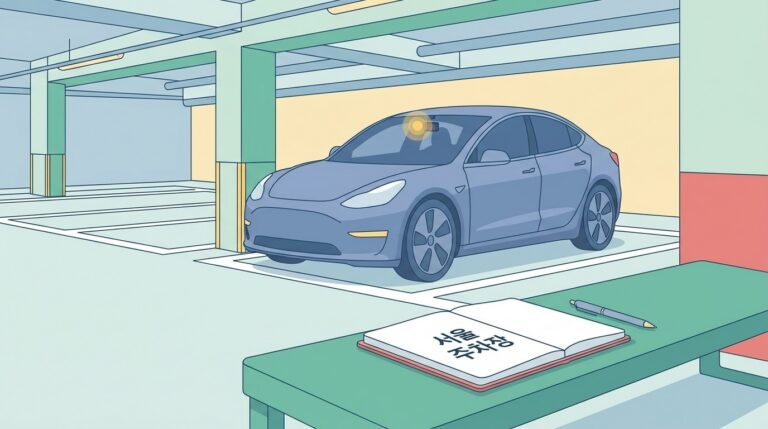
Master Korean Legal Basics: Surviving a Parked Car Hit-and-Run (물피도주) Like a Pro
Phase 1: Empathy (Story-Immersive Opening)
안녕하세요! 매일한글 에디터입니다.
Picture this: You have just finished a serene afternoon sipping single-origin pour-over at a sleek cafe in Seongsu-dong, or perhaps you’ve wrapped up an intense day at your Gangnam office. You stroll back to your car, feeling completely at peace—until you spot it. A jagged scratch gouged into your rear bumper, white paint transfer stark against your dark chassis, and the offending vehicle nowhere in sight. No business card tucked under the wiper, no polite apologetic note on your windshield. In many countries, you might throw your hands up in despair and assume your insurance deductible is doomed. But welcome to South Korea, the undisputed “Dashcam Republic” (블랙박스 공화국), where virtually every vehicle functions as an active surveillance sentinel.
Navigating this ordeal, however, requires more than just raw indignation; it demands precise socio-legal fluency. At the C2 level, you must articulate statutory nuances, distinguish between criminal negligence and administrative fines, and master the art of obtaining surveillance evidence without violating South Korea’s notoriously stringent Personal Information Protection Act. Based on real-world experiences from seasoned expatriates and Korean legal consultations, this guide equips you with the native-tier vernacular, institutional procedures, and diplomatic tact needed to resolve a parking hit-and-run without breaking a sweat.
Phase 2: Core Expressions Deep Dive
1. 물피도주 (Mulpidoju)
- Pronunciation: [Mul-pi-do-ju] (Sounds like: mool-pee-doh-joo)
- Meaning: Literally “property damage flight”; refers legally to causing property damage to an unattended vehicle and fleeing without leaving contact details.
- K-Culture Moment: In legal dramas like Extraordinary Attorney Woo or YouTube sensation Han Moon-chul TV, whenever an outraged driver discovers a mangled quarter-panel, they immediately yell: “이건 명백한 물피도주입니다!” (Igeon myeongbaekhan mulpidoju-imnida! / “This is unequivocally a hit-and-run on an unattended vehicle!”).
- Editor’s Insight: Do not confuse this with classic 뺑소니 (Ppaengsoni), which legally applies only to hit-and-run resulting in bodily injury or death (도주치사상). Using 뺑소니 for property-only damage sounds amateurish to insurance adjusters; using 물피도주 demonstrates authoritative mastery of Article 54, Paragraph 1 of the Road Traffic Act.
- Situation Spectrum: Casual ⚠️ | Semi-formal ✅ | Formal ✅
- 🤔 Think About It: Why does Korean law linguistically bifurcate human injury hit-and-runs (인명피해 도주) from unattended property flight (물피도주)? Reflect on how civil versus criminal jurisprudence treats the sanctity of physical personhood over mechanical property.
2. 블랙박스 상시 녹화 (Beullaekbakseu Sangsi Nokhwa)
- Pronunciation: [Beul-laek-bak-seu Sang-si Nok-hwa] (Sounds like: black-bahk-soo sang-shee nok-hwah)
- Meaning: Continuous 24/7 Dashcam Recording (Parking Surveillance Mode).
- K-Culture Moment: A dramatic suspense trope where an alibi hinges on whether a car’s black box was set to “상시 녹화” (continuous) or died due to “배터리 방전 방지” (battery discharge prevention mode).
- Editor’s Insight: In Korea, a dashcam is universally called a 블랙박스 (black box). Koreans rarely say “대시캠” (dashcam). “상시 녹화” means the sensor triggers both parking impact recording (충격 녹화) and motion detection (모션 감지).
- Situation Spectrum: Casual ✅ | Semi-formal ✅ | Formal ✅
- 🤔 Think About It: Contrast Korea’s cultural normalization of continuous vehicular surveillance with Western jurisdictions (such as Germany), where continuous recording faces severe legal restrictions due to public privacy expectations.
3. 인적사항 미제공 (Injeoksahang Mije-gong)
- Pronunciation: [In-jeok-sa-hang Mi-je-gong] (Sounds like: in-juck-sah-hahng mee-jeh-gong)
- Meaning: Failure to provide personal identifying information (name, phone number, address) after causing an accident.
- K-Culture Moment: Police officers sternly explaining the administrative fine code to an unapologetic culprit who argues, “I had an emergency meeting!”: “선생님, 인적사항 미제공으로 범칙금 처분 대상이십니다.” (Seonsaengnim, injeoksahang mije-gong-euro beomchikgeum cheobun daesang-isipnida. / “Sir, you are subject to a regulatory fine for failure to provide identification.”)
- Editor’s Insight: Under the amended Road Traffic Act, leaving the scene without leaving your contact information carries an administrative fine of up to 200,000 KRW and 15 demerit points (벌점 15점), regardless of whether the physical collision was accidental.
- Situation Spectrum: Casual 🚫 | Semi-formal ⚠️ | Formal ✅
- 🤔 Think About It: What does the institutional severity of a fine for simply “failing to leave a phone number” say about the Korean civic premium placed on accountability in high-density urban spaces?
Phase 3: Textbook Korean vs. Real Korean
Situation 1: Confronting the perpetrator over the phone after finding their contact via police/dashcam footage
- 📖 교과서 한국어: 제 자동차를 손상시키고 왜 연락처를 남기지 않으셨습니까? 법적 배상을 청구하겠습니다. (Je jadongchareul sonsangsikigo wae yeollakcheoreul namgiji aneusyeosseumnikka? Beopjeok baesangeul cheongguhagessumnida.) – “Why did you damage my vehicle and fail to leave contact information? I will demand legal compensation.”
- 🗣️ 진짜 한국어: 주차장에서 범퍼 긁고 그냥 가신 거 블박에 다 찍혔거든요. 대물 접수번호 지금 바로 보내주세요. (Juchajang-eseo beompeo geulgo geunyang gasin geo beulbak-e da jjikhyeotgeodeunyo. Daemul jeopsubeonho jigeum baro bonaejuseyo.) – “My dashcam captured you scraping my bumper and driving off. Please send me your insurance property claim number right now.”
- 💡 왜 다를까?: Native speakers bypass theoretical debates about fault. The mention of “블박에 다 찍혔다” (It’s all recorded on the black box) immediately establishes insurmountable leverage, prompting the immediate issuance of an insurance claim number (대물 접수번호).
Situation 2: Requesting CCTV footage from an apartment or commercial building security office
- 📖 교과서 한국어: 공공의 이익을 위하여 주차장 영상 기록 장치를 열람하고 싶습니다. (Gonggong-ui ieog-eul wihayeo juchajang yeongsang girok jangchireul yeollamhago sipsumnida.) – “I wish to inspect the parking garage video recording system for the public interest.”
- 🗣️ 진짜 한국어: 물피도주 건으로 지구대에 신고 접수했고요, 경찰관 동석하에 관리실 CCTV 열람하려고 합니다. 협조 부탁드립니다. (Mulpidoju geon-euro jigudae-e singo jeopsuhaetgoyo, gyeongchalgwan dongseokhae-e gwallisil CCTV yeollamharyeogo hamnida. Hyeopjo butakdeurimnida.) – “I filed a parked-car hit-and-run report with the local police precinct, and I’d like to review the security CCTV in the presence of an officer. Thank you for your cooperation.”
- 💡 왜 다를까?: Due to the Personal Information Protection Act (개인정보보호법), guards are legally prohibited from showing you third-party license plates unless a police officer is physically present or a formal legal warrant/procedure is established.
Phase 4: K-Culture Deep Dive & Non-Verbal Manners
4-1. Nunchi (눈치) & Gestural Etiquette: The Scene of Incident
When assessing vehicle damage in a public Korean lot, never erupt into aggressive, operatic rage. South Korean social spaces operate under high peer surveillance; loud shouting will paint you as an uncouth instigator (갑질/난동). Instead, deploy a calibrated blend of serene analytical gravity and quiet resolve:
1. The Tactical Macro Scan: Crouch, angle your smartphone camera parallel to the scrape, and turn on the flashlight to capture clear paint-depth grooves. Photograph the license plate, surrounding parking gridlines, and adjacent cars.
2. Engaging the Security Personnel (경비원/관리인): Approach with a gentle 30-degree bow, offering a warm “수고 많으십니다, 반장님” (You are working hard, supervisor). Security officers possess the keys to the CCTV control room; treating them as valued allies rather than bureaucratic obstacles yields immediate, enthusiastic cooperation.
3. Tone Modulation: Maintain an assertive low pitch. Express sorrow rather than raw anger: “마음이 참 쓰리네요” (My heart really aches over this), which activates empathetic social reciprocity.
4-2. Cultural Phenomenon: The “Han Moon-chul TV” Legacy
South Korea’s collective traffic psyche is profoundly shaped by the renowned traffic attorney Han Moon-chul (한문철 변호사). His YouTube channel, boasting millions of subscribers, dissects everyday dashcam submissions with forensic precision. Korean drivers are hyper-aware of “과실비율” (fault ratio percentages: 100:0, 90:10, 80:20). When dealing with hit-and-runs on correctly parked cars within designated spaces, the cultural consensus is uncompromisingly 100:0 (일백 대 영). Invoking this framework demonstrates that you are culturally native to Korean driving etiquette.
Phase 5: Real-Life Roleplay Scenario
Setting: The underground basement parking lot (지하 2층) of an officetel in Mapo-gu. Julian (User) discovers his driver-side fender dented. He enters the building management office to speak with Mr. Choi (Choi Ban-jang), the senior security director.
- Turn 1 (Julian): 🎭 [Politely bowing, with a worried yet composed facial expression]
반장님, 안녕하세요. 바쁘신 와중에 죄송한데 긴히 확인해야 할 일이 생겼습니다.
(Banjangnim, annyeonghaseyo. Bappeusin wajung-e joesonghande ginhi hwaginhaeya hal ir-i saenggyeotsumnida.)
“Hello, Director. I’m sorry to interrupt your busy day, but an urgent matter has arisen that requires verification.” -
Turn 2 (Mr. Choi): 🎭 [Looking up from his monitor, pushing his reading glasses down]
네, 입주민님. 무슨 일이시죠? 차에 문제라도 생기셨습니까?
(Ne, ipjumin-nim. Museun ir-isijyo? Cha-e munjerado saenggisyeotsumnikka?)
“Yes, resident. What seems to be the problem? Did something happen to your vehicle?” -
Turn 3 (Julian): 🎭 [Showing high-resolution photographs taken on the smartphone]
네, 지하 2층 B-04 구역에 주차해 뒀는데, 누군가 휀더를 치고 연락 없이 그냥 간 것 같습니다.
(Ne, jiha icheung B-04 guyeok-e juchahae dweotneunde, nugunga hwendeoreul chigo yeollak eopsi geunyang gan geot gatseumnida.)
“Yes, I parked in zone B-04 on B2, and it appears someone scraped my fender and left without leaving their contact info.” -
Turn 4 (Mr. Choi): 🎭 [Sighing empathetically, shaking head]
아이고, 참 괘씸하네요. 요즘도 전화번호 하나 안 남기고 도망가는 사람이 있습니까?
(Aigo, cham gwaessimhaneyo. Yojeumdo jeonhwabeonho hana an namgigo domangganeun saram-i itsumnikka?)
“Oh goodness, how utterly insolent. Are there still people nowadays who run off without leaving a single phone number?” -
Turn 5 (Julian): 🎭 [Maintaining a calm, legally knowledgeable tone]
제 차량 상시 녹화 영상과 주차장 CCTV 사각지대를 대조해보고 싶은데요.
(Je charyang sangsi nokhwa yeongsanggwa juchajang CCTV sagakjidaereul daejohaebogo sipeundeyo.)
“I would like to cross-reference my car’s continuous dashcam footage with the parking lot’s CCTV blind spots.” -
Turn 6 (Mr. Choi): 🎭 [Hesitating slightly, tapping the desk]
원칙적으로 개인정보보호법 때문에 타 차량 번호판이 찍힌 화면을 바로 보여드리기는 곤란한데요.
(Wonchikjeog-euro gaeinjeongbbohobeop ttaemune ta charyang beonhopan-i jjikhin hwamyeon-eul baro boyeodeurigineun gonranhandeyo.)
“Strictly speaking, due to the Personal Information Protection Act, it is difficult for me to directly show you screens displaying other vehicles’ license plates.” -
Turn 7 (Julian): 🎭 [Nodding respectfully with an understanding smile]
충분히 이해합니다. 그럼 제가 지금 112에 신고해서 경찰관 입회하에 함께 영상을 확인할 수 있도록 조치하겠습니다.
(Chungbunhi ihaehamnida. Geureom jega jigeum 112-e singohaeseo gyeongchalgwan iphoehae-e hamkke yeongsang-eul hwaginhalsu itdorok jochihagessumnida.)
“I completely understand. In that case, I will report it to 112 now so that we can review the footage together in the presence of an officer.” -
Turn 8 (Mr. Choi): 🎭 [Relieved, picking up the desk phone to assist]
네, 그렇게 하시는 게 가장 깔끔합니다. 경찰관 오시면 관리실로 오시라고 안내해 두겠습니다.
(Ne, geureoke hasineun ge gajang kkalkkeumhamnida. Gyeongchalgwan osimyeon gwallisillo osirago annaehae dugetseumnida.)
“Yes, that is the most seamless way. I will instruct security to guide the officers straight to the control room once they arrive.”
🔀 Interactive Decision Fork
Imagine the police arrive, inspect the CCTV, identify the vehicle, and provide you the driver’s phone number. When you call the driver, they aggressively retort: “It was dark! I didn’t even feel the bump! Why call the police over a tiny scratch?” How do you respond?
- Option A: “선생님, 핑계 대지 마시고요. 형사 처벌받고 빨간 줄 긋고 싶으세요?”
(Sir, stop making excuses. Do you want a criminal record?)- Feedback (Risk): Escalatory and legally inaccurate. Unattended property damage (물피도주) without bodily injury leads to administrative fines, not immediate criminal imprisonment. Threatening someone with a criminal record can backfire into an allegation of verbal intimidation (협박죄).
- Option B: “경찰관 입회하에 CCTV와 충격 영상 모두 확보된 상태입니다. 원만히 처리하고 싶으니, 보험사에 대물 접수하시고 접수번호 전달 부탁드립니다.”
(Both the CCTV and impact dashcam footage have been secured with police presence. I prefer to settle this amicably, so please file a property damage claim with your insurer and provide me the claim number.)- Feedback (Best): Flawless native professionalism. It leaves no room for debate, highlights concrete evidence, provides a seamless exit path through insurance, and avoids needless emotional mudslinging.
- Option C: “그냥 십만 원 현금으로 주시면 경찰 신고 취하해 드릴게요.”
(Just give me 100,000 KRW in cash, and I’ll drop the police report.)- Feedback (Bad): Highly hazardous. Cash settlements without signed formal agreements leave you exposed to accusations of extortion, and if structural internal bumper damage emerges later, you will forfeit proper insurance restitution.
Phase 6: 10-Second Emotional Shadowing Drill
Train your muscle memory with these pitch-perfect phonetic inflection drills. Slash marks (/) indicate natural pause points.
[😠 Firm, analytical, and unwavering]
“제 차 블박 충격 감지 영상에 / 가해 차량 번호판이 / 아주 선명하게 찍혔습니다.”
(Je cha beulbak chung-gyeok gamji yeongsang-e / gahae charyang beonhopan-i / aju seonmyeonghage jjikhyeotsumnida.)
“On my dashcam’s impact detection clip, / the offending vehicle’s license plate / is captured crystal clear.”-
[🙏 Respectful, diplomatic, yet procedurally assertive]
“관리사무소 규정은 존중하지만, / 정식 사건 접수를 위해 / 경찰 입회하에 CCTV 확인이 필요합니다.”
(Gwallisamuso gyujeong-eun jonjunghajiman, / jeongsik sageon jeopsureul wihae / gyeongchal iphoehae-e CCTV hwagin-i piryohamnida.)
“I respect the management office’s policy, / but for formal case processing, / I need to verify the CCTV under police supervision.” -
[😌 Calm, authoritative resolution]
“감정적인 다툼은 원치 않으니, / 대물 접수번호만 넘겨주시면 / 보험사 통해서 원상복구 진행하겠습니다.”
(Gamjeongjeogin datum-eun wonchi aneuni, / daemul jeopsubeonhoman neomgyeojusimyeon / boheomsa tonghaeseo wonsangbokgu jinhaenghagessumnida.)
“I don’t wish for an emotional dispute, / so if you simply provide the claim number, / I will proceed with restoring the car through the insurer.”
Phase 7: K-Culture Mini Dictionary
-
물피도주 (Mulpidoju)
Translation: Fleeing after causing property damage to an unattended parked vehicle.
Real-World Usage: Used in official police accident intake, insurance dispute applications, and formal settlement demands. -
한문철 TV (Han Moon-chul TV)
Translation: Han Moon-chul TV (The definitive YouTube channel on Korean traffic law).
Real-World Usage: A cultural benchmark for determining liability ratios. Saying “이거 한문철 TV 나가면 백 대 영이에요” means “If this were featured on Han Moon-chul TV, it would unquestionably be judged 100% your fault.” -
과실비율 (Gwasilbiyul)
Translation: Negligence / Fault ratio percentage between drivers.
Real-World Usage: Negotiated between insurance claims adjusters (e.g., 100:0, 80:20). In proper parking lot hit-and-runs, your goal is always an absolute 100:0 outcome. -
대물접수 (Daemuljeopsu)
Translation: Filing an insurance claim for third-party property damage.
Real-World Usage: Contrasts with “대인접수” (bodily injury claim). When settling a parked car bump, asking for the 대물 접수번호 (property claim number) is the single most important actionable transaction.
Phase 8: Survival Kit for Travelers & Expats
Top 3 Survival Expressions
- “블랙박스 상시 녹화 중입니다.” (Beullaekbakseu sangsi nokhwa jung-imnida.)
Pro Tip: Often printed on holographic bumper stickers. It deters potential parking culprits by alerting them that parking mode recording is active. - “경찰관 동석하에 영상 확인하겠습니다.” (Gyeongchalgwan dongseokhae-e yeongsang hwaginhagessumnida.)
Pro Tip: The magic phrase that circumvents privacy disputes with building security guards instantly. - “공업사 입고하고 렌트카 배차 부탁드립니다.” (Gongeopsa ipgohago renteuka baecha butakdeurimnida.)
Pro Tip: Tell this to the perpetrator’s insurance adjuster once claim numbers are exchanged: “I will admit the car to an authorized auto repair shop and request a replacement rental car.”
Editor’s Travel Note
- Essential Reporting App: Download the official 안전신문고 앱 다운로드 (Safety e-Report App) or visit your nearest local police substation (지구대 / 파출소). You can upload your dashcam footage directly to report traffic infractions without endless paperwork.
- Rental Cars in Jeju & Seoul: When renting from Lotte Rent-a-Car or SK Rent-a-Car, inspect the black box memory card beforehand. Ensure the dashcam’s LED blinking light (시큐리티 LED) activates when the engine turns off.
Phase 9: “한 발 더 깊이” (Reflective Cultural Essay)
South Korea represents a unique socio-spatial paradox. With over 25 million registered vehicles crammed into mountainous topography and dense high-rise clusters, parking is an intense daily negotiation. Double-parking (이중주차) in neutral gear (N단 주차) is a common, culturally accepted compromise. In such tight quarters, minor scrapes are almost statistically inevitable.
Yet, this spatial density is balanced by ubiquitous digital transparency. The dashcam is not perceived as an intrusive surveillance device, but as an indispensable shield of civic accountability. In Korean society, fleeing a scrape isn’t just viewed as property negligence; it is regarded as a violation of sinroe (신뢰, mutual civic trust). The collective expectation is that decent citizens acknowledge their mistakes, leave a contact number, and let insurance smoothly rectify the damage.
💬 Your Turn: In your home country, how do drivers customarily handle unattended parking collisions? Is dashcam footage legally binding in private parking lots, or is it treated as circumstantial? Share your cultural perspective in the comments below!
Phase 10: FAQ & Avoiding Misconceptions
Q: Can the driver who hit my parked car go to prison for hit-and-run?
A: Generally, no. Under Article 54 and Article 156 of the Korean Road Traffic Act, if an unattended vehicle is damaged without bodily injury, the offense is categorized as property damage flight (물피도주), resulting in an administrative fine (범칙금 up to 200,000 KRW) and demerit points. Criminal imprisonment (특가법상 도주치사상) is reserved strictly for hit-and-runs involving injured persons.
Q: The apartment security guard refuses to let me watch the parking lot CCTV. Are they breaking the law?
A: No, the security guard is actually complying with the Personal Information Protection Act (개인정보보호법). Building management cannot arbitrarily disclose video footage revealing other people’s faces or license plates to private citizens. You must call 112; the guard can legally show the screen once police officers are physically present to inspect the incident.
Q: What if my car was parked outside of a designated white parking line?
A: If you parked in a restricted zone (e.g., an alleyway corner, fire hydrant zone, or non-designated bay), comparative negligence (과실상계) may apply. Even though the other driver is liable for fleeing, insurance adjusters might assign you a 10% to 20% negligence liability ratio for improper parking.
🚨 Common Mistakes Board (흔한 실수 TOP 3)
- Mistake: Accusing the perpetrator of criminal “뺑소니” during initial phone calls.
Correct Action: Use the precise legal terminology: 물피도주 (Mulpidoju) and request their insurance claim number (대물 접수번호). - Mistake: Overwriting dashcam memory by driving around all week after the incident.
Correct Action: Immediately eject the micro-SD card from your black box. Driving overwrites older parking impact logs in looped storage systems. - Mistake: Accepting an informal cash payment without an official written waiver or mechanic estimate.
Correct Action: Insist on standard insurance registration (보험 접수) to cover latent structural and paint curing warranties.
Phase 11: Action Mission & Participation
- 🥉 Bronze Level: Check your vehicle’s dashcam today. Eject the memory card, view the files on your PC or phone, and verify whether the parking continuous recording (상시 녹화) and impact sensitivity settings (충격 감도) are active.
- 🥈 Silver Level: Bookmark the phrase “대물 접수번호 보내주세요” in your phone notes. Share this guide on your social media with fellow expats residing in South Korea.
- 🥇 Gold Level: If you ever spot an unattended car scratch, assist the victim or leave a polite note if you were a witness, modeling high-standard Korean civic responsibility.
🎮 K-Culture Mission: Search for “한문철 물피도주” on YouTube. Watch one short clip and see if you can identify the terms 과실비율 (fault ratio) and 블랙박스 영상 (dashcam footage) in the commentary!
Phase 12: Interactive Quiz Challenge
Test your legal mastery and cultural intuition with these 3 questions:
1. Situational Judgment:
You return to your car in an underground retail garage and discover a scrape on your door. What is your very first procedural step?
(A) Shout across the parking lot to locate witnesses.
(B) Take photos of the damage, inspect your dashcam impact log, and request CCTV inspection via 112 police presence.
(C) Follow the suspect vehicle down the highway immediately.
2. Fill-in-the-Blank:
주차된 차량을 파손하고 연락처를 남기지 않은 채 현장을 이탈하는 행위를 법률적으로 [ ](이)라고 부릅니다.
(The legal act of damaging a parked vehicle and departing without leaving identifying contact information is termed [ ].)
3. True or False:
Under the Personal Information Protection Act, any resident can demand to export and post apartment CCTV footage on social media to identify a parking culprit. (True / False)
Click here to reveal answers & explanations
-
Correct Answer: (B)
Explanation: Securing physical site photos and black box memory cards, combined with official police attendance for CCTV review, preserves legal integrity without breaching privacy laws. -
Correct Answer: 물피도주 (or 물피도주죄 / 인적사항 미제공)
Explanation: While commonly nicknamed 물피도주, the formal statutory violation under the Road Traffic Act is “인적사항 미제공” (failure to provide personal identification details). -
Correct Answer: False
Explanation: Publicly disseminating unblurred CCTV footage featuring private citizens and license plates is a severe criminal offense under Korea’s Personal Information Protection Act. Footages must only be reviewed with law enforcement or authorized personnel.







