

Phase 1: Empathy (Story Immersion Opening)
안녕하세요! 매일한글 에디터입니다. (Hello! It’s your Daily Hangul editor.)
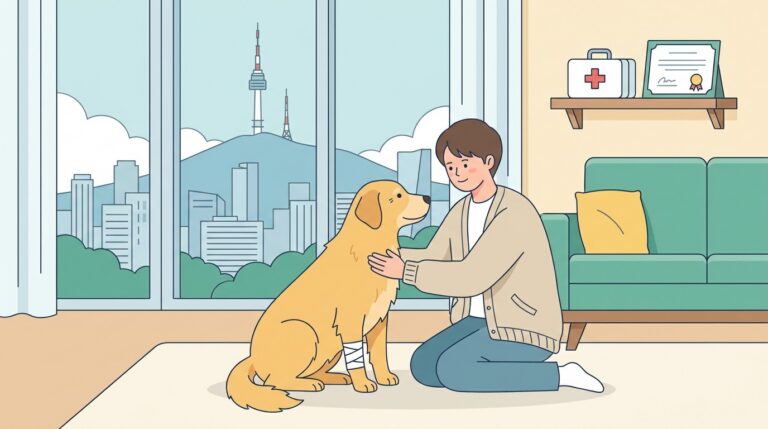
If you have ever spent a late evening watching your once-sprightly canine companion wander aimlessly toward the living room corner, freeze, and softly press their forehead against the wallpaper, your heart has undoubtedly skipped a terrifying beat. In Korea’s bustling metropolitan hubs like Seoul, veterinary culture has evolved into an exceptionally sophisticated domain. Pet owners no longer view dogs merely as companion animals; they are family members—cherished dongsaengs (younger siblings) or beloved firstborn children. Perhaps you’ve watched emotional segments on popular shows like SBS Animal Farm (TV 동물농장) or EBS There Are No Bad Dogs in the World (세상에 나쁜 개는 없다), where veteran trainer Kang Hyung-wook consoles tearful guardians dealing with an aging pet’s sudden behavioral decline.
Navigating the delicate realities of canine cognitive dysfunction syndrome (CDS)—colloquially known as 치매 (chimae, dementia)—in a foreign country is uniquely daunting. At a C2 mastery level, basic conversational Korean falls drastically short. You aren’t just ordering kibble; you need to articulate nuanced neurological symptoms, discuss circadian disruptions, and negotiate veterinary supplement regimens alongside pharmaceuticals with clinical accuracy and cultural tact. Based on consultations with Seoul-based veterinary specialists and real international guardians navigating K-veterinary care, this guide provides the exact high-register lexicon and empathetic fluency you need to advocate flawlessly for your senior dog.
Phase 2: Core Expressions Deep Dive
1. 밤낮이 완전히 뒤바뀌어서 밤마다 서성거려요
- Pronunciation: [Bam-na-si wan-jeon-hi dwi-ba-kwi-eo-seo bam-ma-da seo-seong-geo-ryeo-yo] (Sound analogy: Imagine “bahm-nah-shee” gliding smoothly into “dwee-bah-kwee-eo-seo”, where the ‘seo’ sounds like a gentle sigh of exhaustion)
- Meaning: Literal: “Day and night are completely swapped, so they pace every night.” | Clinical Nuance: Expressing classic canine sundowning and circadian rhythm disruption without sounding overly technical.
- K-Culture Moment: Seen frequently on pet rehabilitation reality shows when guardians consult behavioral veterinarians about dogs experiencing chronic nocturnal pacing.
- Editor’s Insight: The verb ‘서성거리다’ (seoseonggeorida) captures repetitive, restless, aimless walking—a textbook indicator of canine cognitive dysfunction. Using this specific descriptive verb instead of simply saying ‘걸어요’ (georeoyo, walks) immediately signals to a Korean veterinarian that the movement is pathological rather than energetic.
- Situation Spectrum: Casual ⚠️ | Semi-formal ✅ | Formal ✅
- 🤔 Think About It: Notice how Korean uses descriptive onomatopoeic/mimetic verb stems like ‘서성거리다’ to embed psychological state into physical movement. How does your native language distinguish purposeless pacing from ordinary walking?
2. 멍하니 벽에 머리를 대고 서 있는 빈도가 잦아졌어요
- Pronunciation: [Meong-ha-ni byeok-e meo-ri-reul dae-go seo in-neun bin-do-ga ja-ja-jyeo-sseo-yo] (Sound analogy: ‘Meong-ha-ni’ begins with a hollow, echoing tone like spacing out, followed by crisp dental stops in ‘ja-ja-jyeo-sseo-yo’)
- Meaning: Literal: “The frequency of standing blankly with the head against the wall has become frequent.” | Clinical Nuance: Accurately reporting feline/canine ‘head-pressing’ behavior alongside cognitive detachment (blank staring).
- K-Culture Moment: A consultation scene in a Korean documentary where an owner notices early neurological deterioration in an elderly rescue Jindo mix.
- Editor’s Insight: ‘멍하니’ (meonghani) signifies being dazed or zoning out (the root of the modern K-slang meong-ttearida). Pairing it with ‘빈도가 잦아지다’ (the frequency has escalated) elevates your speech instantly to a clinical, observational C2 register that commands immediate veterinary attention.
- Situation Spectrum: Casual ⚠️ | Semi-formal ✅ | Formal ✅
- 🤔 Think About It: In Korean medical discourse, guardians often report objective sensory observations rather than self-diagnosing. How does this posture of cautious precision reflect social etiquette during professional consultations?
3. 인지기능 개선제나 항산화 영양제를 병행해서 급여해도 될까요?
- Pronunciation: [In-ji-gi-neung gae-seon-je-na hang-san-hwa yeong-yang-je-reul byeong-haeng-hae-seo geub-yeo-hae-do doel-kka-yo?]
- Meaning: Literal: “May I concurrently feed cognitive function enhancers or antioxidant supplements?” | Nuance: Inquiring about polypharmacy safety and integrative nutraceutical protocols.
- K-Culture Moment: Experienced senior pet owners consulting with holistic and tertiary veterinary clinics in Cheongdam-dong regarding multi-supplement management.
- Editor’s Insight: While colloquial Korean uses ‘먹이다’ (meogida, to feed), veterinary professionals and experienced guardians consistently use ‘급여하다’ (geub-yeohada, to administer nutritional intake). Employing ‘병행하다’ (byeonghaenghada, to execute concurrently) ensures clarity regarding drug-supplement interactions.
- Situation Spectrum: Casual 🚫 | Semi-formal ✅ | Formal ✅
- 🤔 Think About It: Why does Korean maintain distinct Sino-Korean terms for clinical administration (‘급여’) versus everyday eating (‘먹이다’) when discussing pet care?
Phase 3: Textbook Korean vs. Real Korean
Situation 1: Explaining aimless wandering and spatial disorientation
- 📖 Textbook Korean: 우리 개가 방향 감각을 상실하여 집 안에서 길을 잃습니다. (Uri gaega banghyang gamgageul sangsilhayeo jip aneseo gireul ilseumnida. / Our dog has lost their sense of direction and gets lost inside the house.)
- 🗣️ 진짜 한국어: 아이가 구석에 들어가면 후진을 못 하고 갇혀서 낑낑거려요. (Ai-ga guseoge deureogamyeon hujineul mot hago gachyeoseo kkingkkinggeoryeoyo. / When our baby wedges into a corner, they can’t back up, so they get stuck and whimper.)
- 💡 왜 다를까? Textbook Korean sounds like a translated veterinary pathology monograph. Real native guardians anthropomorphize their dog as ‘아이’ (child/baby) and narrate the exact physical dilemma—inability to reverse out of corners—which is the cardinal mechanical symptom of CDS.
Situation 2: Asking how to mask bad-tasting brain supplements
- 📖 Textbook Korean: 약물이나 보조제를 사료에 혼합하여 투약하십시오. (Yangmuri-na bojoje-reul saryoe honhaphayeo tuyakhasippsio. / Administer drugs or adjuncts by mixing them into feed.)
- 🗣️ 진짜 한국어: 가루 영양제는 기호성이 떨어져서 필포켓이나 습식 캔에 슬쩍 숨겨 먹여야 해요. (Garu yeongyangjeneun gihoseong-i tteoreojyeoseo pil-poket-ina seub-sik kaene seuljjeok sumgyeo meogyeoya haeyo. / Powder supplements have poor palatability, so you have to sneak them inside a pill pocket or wet canned food.)
- 💡 왜 다를까? Native phrasing incorporates functional industry vocabulary such as ‘기호성’ (gihoseong, palatability/taste preference) alongside sensory adverbs like ‘슬쩍’ (stealthily/sneakily).
Phase 4: K-Culture Deep Dive & Non-verbal Manners
4-1. Nunchi & Clinical Body Language
When stepping into a Korean animal hospital (동물병원), veterinary etiquette is built on shared grief and collective empathy. As a guardian, never refer to yourself merely as ‘주인’ (juin, master/owner)—this term has been virtually eradicated from modern urban parlance. Instead, refer to yourself as ‘보호자’ (bohoja, guardian) or identify relationally (e.g., “두리 보호자입니다” – “I am Duri’s guardian”).
When listening to a veterinarian deliver a difficult prognosis regarding dementia, maintain soft, engaged eye contact accompanied by slow, deliberate vertical nodding (gogae kkeudeog-im). Korean vets frequently soften diagnoses using indirect modal endings like “~인 것으로 사료됩니다” (It is deduced to be…) or “~가능성을 배제할 수 없습니다” (We cannot rule out the possibility of…). Do not interrupt abruptly. Allow a respectful beat of silence before presenting your supplement list.
4-2. The Cultural Shift: From Pet to Family Entity
South Korea has undergone one of the fastest demographic pet transformations in history. With the rise of single-person households and declining birth rates, dogs have ascended into full familial membership under the concept of ‘반려가족’ (companion family). The senior dog care sector (실버 펫 시장) has exploded with specialized gerontology hospice facilities, acupuncture clinics, and specialized nutraceutical formulations (such as SAMe, Silymarin, and DHA brain formulations). Discussing dementia supplements is no longer considered extravagant; it is regarded as moral guardianship duty (돌봄의 도리).
Phase 5: Real Roleplay Scenario
Setting: Gangnam Central 24-Hour Referral Animal Hospital, Consultation Room 2.
Characters:
* 보호자 (You): Guardian of a 14-year-old Maltese named ‘Duri’.
* 수의사 민 원장 (Dr. Min): A meticulous, compassionate veterinary gerontology specialist.
수의사 민 원장: 두리 보호자님, 최근 들어 혈액검사 수치는 양호한 편인데, 보호자님께서 보시기에 인지기능 쪽으로 눈에 띄는 변화가 있었나요?
(Duri bohojanim, choegeun deureo hyeoraek-geomsa suchineun yanghohan pyeon-inde, bohojanimkkeseo bosigie inji-gineung jjogeuro nune ttwineun byeonhwaga isseonnayo?)
“Duri’s guardian, her recent blood panel results are fairly stable, but from your observation, have there been noticeable changes in her cognitive function?”
🎭 민 원장은 진료 차트를 정갈하게 넘기며 차분한 눈빛으로 보호자를 응시한다. (Dr. Min turns the clinical chart neatly and gazes attentively at the guardian.)
보호자 (You): 네, 원장님. 멍하니 벽을 응시하거나 집안 구석에 끼어서 후진을 못 하는 빈도가 눈에 띄게 늘었어요.
(Ne, wonjangnim. Meonghani byeogeul eungshihageona jib-an guseoge kkieoseo hujineul mot haneun bindoga nune ttwige neureosseoyo.)
“Yes, Doctor. Staring blankly at walls or getting stuck in house corners unable to back up has increased noticeably.”
🎭 휴대폰에 녹화해 온 두리의 배회 영상을 꺼내 원장에게 조심스럽게 보여준다. (Carefully presents a smartphone video recording of Duri pacing at home.)
수의사 민 원장: 아, 영상 속에서 서성거리면서 써클링(선회)하는 모습이 전형적인 치매 초기 양상이네요. 수면 패턴은 어떤가요?
(A, yeongsang sogeseo seoseonggeorimyeonseo sseokeulling(seonhoe)haneun moseubi jeonhyeongjeogin chimae chogi yangsang-ineyo. Sumyeon paeteoneun eotteongayo?)
“Ah, the pacing and circling in this video is a classic presentation of early-stage CDS. How is her sleep pattern?”
보호자 (You): 낮에는 깊게 잠들었다가, 자정만 넘어가면 하울링을 하거나 불안해하며 온 집안을 돌아다녀요.
(Najeneun gipge jamdeureottaga, jajeongman neomeogamyeon haulling-eul hageona buranhaehamyeo on jib-aneul doradanyeoyo.)
“She sleeps soundly during the day, but past midnight, she howls or roams anxiously around the entire house.”
수의사 민 원장: 전형적인 주야 전도, 즉 썬다운 증후군입니다. 뇌 신경 세포의 산화 스트레스를 줄여줄 필요가 있어 보입니다.
(Jeonhyeongjeogin juya jeondo, jeuk sseondaun jeunghugun-imnida. Noe singyeong sepoui sanhwa seuteureseureul juryeojul piryoga isseo boimnida.)
“That is classic day-night reversal, otherwise known as Sundowner’s syndrome. We need to reduce oxidative stress in the cranial neurons.”
보호자 (You): 그렇다면 기존 처방약 외에 인지기능 개선제나 항산화 영양제를 병행해서 급여해도 안전할까요?
(Geureotdamyeon gijon cheobang-yak oe-e inji-gineung gaeseonjena hangsanhwa yeongyangjereul byeonghaenghaeseo geubyeohaedo anjeonhalkkayo?)
“In that case, would it be safe to concurrently administer cognitive supplements or antioxidants alongside her existing prescription?”
수의사 민 원장: 네, 포스파티딜세린이나 오메가3 고용량 제제는 약물과 충돌하지 않으니, 기호성이 좋은 제형으로 급여를 추천합니다.
(Ne, poseupati-dilserin-ina omega-seuri goyongnyang jejeneun yangmulgwa chungdolhaji aneuni, gihoseong-i joeun jehyeong-euro geub-yeoreul chucheonhamnida.)
“Yes, high-dose phosphatidylserine or Omega-3 formulations won’t conflict with medications, so I recommend administering them in highly palatable forms.”
보호자 (You): 알겠습니다. 가루형은 거부감이 심할 수 있으니 츄어블 제형이나 오일 형태로 먼저 시도해 보겠습니다.
(Algetseumnida. Garuhyeong-eun geobugam-i simhal su isseuni chyu-eobeul jehyeong-ina oil hyeongtaero meonje sidohae bogesseumnida.)
“Understood. Powders might trigger severe food aversion, so I will first try chewable soft treats or oil formulations.”
🎭 안도감과 비장함이 교차하는 표정으로 메모장에 권장 용량을 기록한다. (Takes detailed notes of recommended dosages with mixed relief and resolve.)
🔀 Interactive Decision Point
How should you handle introducing this new supplement regimen?
- Choice A (Best Action): “급여 첫 주에는 권장량의 절반부터 시작해서 연변이나 구토 같은 소화기 이상 반응을 점검한 뒤 증량할게요.” (Start with half dosage in week one to monitor gastrointestinal reactions like soft stool or vomiting before titrating up.)
Feedback: Best. Professional, pharmacologically sound, and demonstrates elite responsible guardian competence. - Choice B (Bad Action): “효과를 빨리 보고 싶으니 권장량의 두 배로 오늘 밤부터 바로 먹여볼게요.” (Double the dosage tonight to see faster results.)
Feedback: Bad. Severe risk of inducing acute pancreatitis or hepatic strain in a senior dog. - Choice C (Risk Action): “사람 먹는 치매 영양제가 성분이 좋던데 그냥 그거 나눠서 급여해도 되겠죠?” (Human supplements have good ingredients, so can I just divide and feed those?)
Feedback: Risk. Highly hazardous; human formulations frequently contain xylitol, alpha-lipoic acid, or filler excipients toxic to canines.
Phase 6: 10-Second Emotional Shadowing Drill
Read aloud following the pauses marked by / and embodying the emotional guidance brackets.
[🥺 깊은 염려와 슬픔을 담아 / With deep concern and quiet sorrow]
“밤마다 / 벽에 머리를 기대고 서성거려서 / 잠을 통 못 자요.”
(Bammada / byeoge meorireul gidaego seoseonggeoryeoseo / jameul tong mot jayeo.)
“Every night / she leans her head against the wall and paces / so she hardly sleeps at all.”-
[🩺 차분하고 이성적인 임상 톤으로 / In a calm, analytical clinical tone]
“기존 약제와 / 상호작용이 없는지 / 성분표를 먼저 대조해 주실 수 있나요?”
(Gijon yakjewa / sanghojagyong-i eomneunji / seongbunpyoreul meonje daejohae jusil su innayo?)
“Could you first cross-reference the ingredient panel / to confirm there are no adverse interactions / with her existing regimen?” -
[🙏 간절하지만 단호하게 / Earnest yet determined]
“삶의 질 개선이 최우선이니 / 무리가 가지 않는 선에서 / 보조요법을 병행하고 싶습니다.”
(Salmui jil gaeseon-i choe-useon-ini / muriga gaji anneun seoneseo / bojoyobeobeul byeonghaenghago sipsumnida.)
“Since quality of life is our highest priority / within safe boundaries / I wish to concurrent implement supportive therapy.”
Phase 7: K-Culture Mini Dictionary
-
인지기능장애증후군 (Inji-gineung-jang-ae-jeung-hu-gun)
Translation: Canine Cognitive Dysfunction Syndrome (CCDS / Dementia).
Context: Used in clinical documentation and tertiary veterinary consultations. In informal settings, guardians simply refer to it as ‘강아지 치매’ (gang-aji chimae). -
급여하다 (Geub-yeo-ha-da)
Translation: To administer dietary intake / to feed scientifically.
Context: Essential when consulting veterinarians or reading pet nutrition labels. Contrasts with everyday domestic verbs like ‘밥을 주다’ (give food). -
무지개다리 (Mu-ji-gae-da-ri)
Translation: Rainbow Bridge.
Context: The universal Korean euphemism for a pet’s passing. One says “무지개다리를 건넜어요” (They crossed the rainbow bridge) rather than blunt death terminology. -
기호성 (Gi-ho-seong)
Translation: Palatability / preference.
Context: Used universally across pet commerce, veterinary medicine, and owner forums to denote whether a picky or medically compromised dog will willingly consume food or supplements.
Phase 8: Resident & Traveler Survival Kit
Top 3 Survival Lines
- “영양제 제형 중에 오일이나 액상 형태로 된 것도 처방 가능한가요?”
(Yeongyangje jehyeong junge oil-ina aeksang hyeongtaero doen geotdo cheobang ganeunghangayo?)
Pro Tip: Ask this if your dog spits out pills. Liquid/oil suspensions integrate easily into wet prescription diets. - “복용 후 구토나 무른 변 증상이 나타나면 투약을 즉시 중단해야 하나요?”
(Bogyong hu gutona mureun byeon jeungsang-i natanamyeon tuyageul jeuksi jungdanhaeya hanayo?)
Pro Tip: Essential triage question before leaving the vet pharmacy with unfamiliar nutraceuticals. - “성분 중에 간 수치나 신장 수치에 무리를 주는 요소는 없을까요?”
(Seongbun junge gan suchina sinjang suchie murireul juneun yosoneun eopseulkkayo?)
Pro Tip: Vital for senior dogs who frequently experience concurrent renal or hepatic insufficiency.
Editor’s Travel & Living Note
If you reside in Korea with a geriatric dog, download the following services immediately via the official app marketplace: Install the 카카오 T 펫 (Kakao T Pet) 이동 서비스 for certified pet-friendly transportation to 24-hour emergency hospitals without cancellation anxiety from regular taxi drivers. Additionally, consult verified veterinary community reviews on 포인핸드 (Paw in Hand) 반려동물 종합 플랫폼 to find gerontology-certified clinics near your neighborhood. When ordering emergency prescription veterinary wet food, utilize Rocket Dawn Delivery on Korean e-commerce platforms to keep soft food in stock.
Phase 9: A Step Deeper (Reflective Essay)
In traditional Korean culture, the domestic dog was historically utilitarian—a sentinel (jip-gae) protecting the perimeter of the hanok. Yet within a single generation, the Confucian architecture of filial duty (hyodo) and unconditional familial devotion (dolbom) has been profoundly redirected toward companion animals. When a Korean guardian speaks of an aged dog’s dementia, their speech register shifts into an intimate, caretaking reverie: “우리 노견 어르신 모시고 산다” (“I live serving our senior elder dog”). Here, the linguistic honorific framework does not represent rigid feudal hierarchy; rather, it reflects genuine moral tenderness toward a being who has grown frail under our stewardship.
💬 Your Turn: How does your cultural background conceptualize palliative care and cognitive decline in companion animals? Do you view dementia as natural decline or a clinical challenge to manage aggressively? Share your thoughts below!
Phase 10: FAQ & Common Mistakes
Q: Can I buy veterinary CDS supplements over the counter without a prescription in Korea?
A: Yes. While pharmaceutical agents like Selegiline (Anipryl) necessitate a formal prescription (처방전) from a licensed Korean veterinarian, specialized neuro-protective supplements containing MCT oil, Phosphatidylserine, Ginkgo Biloba, and SAMe are readily accessible at veterinary hospital front desks or authorized Korean online medical shops without prior authorization.
Q: What is the linguistic difference between ‘노환’ and ‘치매’ in medical conversations?
A: ‘노환’ (nohwan) is a broad, holistic term referring to general senility, debility, and age-related physical winding-down. In contrast, ‘치매’ (chimae) or ‘인지기능장애증후군’ denotes an organic, specific neuropathology. Attributing severe disorientation solely to ‘노환’ can delay symptomatic intervention.
Q: How do I request a compounding pharmacy to formulate pet medication into liquid syrup?
A: State: “아이가 알약을 전혀 삼키지 못해서 그런데, 시럽제나 가루약으로 조제 가능할까요?” (Our child cannot swallow pills at all; could you formulate this as a syrup or powdered compound?). Note that some tertiary veterinary hospitals offer in-house compounding, while others delegate to affiliated veterinary pharmacies (동물약국).
🚨 Common Mistakes Warning Board
- Mistake 1: Calling your dog ‘그것’ (it) or ‘개’ (the dog) when talking to the doctor.
Correct Action: Use ‘우리 아이’ (our child) or the dog’s name followed by polite suffixes. - Mistake 2: Describing behavioral changes as stubbornness (고집).
Correct Action: Recognize that sudden defiance or house-soiling is neurological. Frame it as “배변 실수가 잦아졌어요” (incontinence/accidents have increased) rather than “말을 안 들어요” (she won’t listen). - Mistake 3: Abruptly stopping prescribed medications to switch entirely to herbal/nutritional supplements.
Correct Action: Always phrase changes as ‘병행 급여’ (concurrent administration) and discuss discontinuation protocols with the attending vet.
Phase 11: Action Missions
- 🥉 Bronze Tier (Solo Practice): Stand before a mirror and practice articulating your dog’s current daily routine, symptoms, and existing supplements using Phase 6’s Shadowing sentences with natural pacing.
- 🥈 Silver Tier (Community Engagement): Write a brief post on a Korean pet forum or social media using the terms ‘노령견 케어’ (senior dog care), ‘영양제 급여’ (supplement administration), and ‘인지기능장애’ (CDS).
- 🥇 Gold Tier (Real-world Execution): Visit a local Korean veterinary clinic or veterinary pharmacy (동물약국) and inquire specifically about high-grade cognitive antioxidants: “14살 노령견 인지기능 보조제를 찾고 있는데, 추천해 주실 제품이 있나요?”
🎮 K-Culture Mission: Search for YouTube clips using the keywords 노견 치매 케어 브이로그 (Senior Dog Dementia Care Vlog). Observe how Korean guardians modify their living spaces with non-slip puzzle mats (미끄럼 방지 매트) and bumper pillows (모서리 보호대) to protect wandering dogs.
Phase 12: Interactive Quiz Challenge
1. Situation Judgment
Your 13-year-old dog has begun pacing relentlessly at 2 AM. You visit the clinic. Which statement is the most clinically accurate and culturally appropriate C2-level explanation?
* (A) 우리 개가 밤에 미쳐서 뛰어다니니 수면제 좀 주세요.
* (B) 아이가 주야 전도 증상이 심해져서 자정 이후 서성거림이 심한데, 인지기능 보조제 병행을 고려하고 싶습니다.
* (C) 개가 말을 안 듣고 밤마다 화를 내요.
2. Fill-in-the-Blank
“가루 제형은 ( )이 떨어지니, 아이가 좋아하는 습식 캔에 섞어 ( )하겠습니다.”
* Hint: (1) Palatability / preference, (2) Clinical administration verb.
3. True or False
In modern Korean animal hospitals, referring to an elderly pet as ‘우리 아이’ is considered overly emotional and unprofessional by veterinarians.
Click to view answers and explanations
1. Answer: (B)
Explanation: Option (B) correctly uses affectionate familial framing (‘아이’), precise clinical phenomena (‘주야 전도’, ‘서성거림’), and courteous professional proposal phrasing (‘병행을 고려하고 싶습니다’). Options (A) and (C) are emotionally crude or mischaracterize pathology as misbehavior.
2. Answer: 기호성 (Gihoseong) / 급여 (Geub-yeo)
Explanation: ‘기호성’ captures the taste acceptability of the compound, while ‘급여하다’ is the precise veterinary verb for feeding clinical regimens.
3. Answer: False
Explanation: Referring to the pet as ‘아이’ is standard, expected empathy in contemporary Korean veterinary culture. It strengthens rapport with the clinical team.







