

The Sweet Secrets of Korean Rice Cakes: Why You Never Eat the Same Tteok Twice
Phase 1: 공감 (Story-Immersive Opening)
안녕하세요! 매일한글 에디터입니다. Have you ever watched a heartwarming K-drama where a new neighbor awkwardly knocks on an apartment door holding a steaming plate of rice cakes wrapped in plastic wrap? Or perhaps you’ve seen an idol group’s agency send lavishly decorated snack boxes packed with pastel-colored treats to broadcasting station staff on their comeback morning? In Korea, rice cake—known affectionately as 떡 (Tteok)—is vastly more than a chewy dessert or sweet street snack. It serves as an unspoken social glue, a heartfelt blessing, and a time-honored calendar of life’s most pivotal milestones.
Yet, for many intermediate learners living in or visiting Korea, navigating the world of tteok can feel like walking through an etiquette minefield. Many learners tell me: “Editor, my coworker handed me a box of white square cakes for her baby’s milestone, and I didn’t know whether to eat it immediately or say a specific phrase!” or “I bought tteok for a friend before an interview, but was told red bean wasn’t the right choice!” Understanding the deep-seated nuances of rice culture turns an everyday snack into an emotional bridge. Based on a decade of guiding global learners through real-life cultural situations, this practical B2 guide will transform you from a confused observer into an empathetic local who knows exactly which tteok matches every Korean celebration.
Phase 2: 핵심 표현 3선 심층 분석
1. 떡 돌리다 (Tteok dollida)
- Pronunciation: [Tteok dol-li-da] (Sounds like the English ‘duck’ with a tense ‘tt’ + ‘dolly-dah’)
- Meaning: Literal: “To spin/rotate rice cakes” vs. Nuanced: “To distribute celebratory rice cakes to neighbors, colleagues, or peers to share good fortune and build communal rapport.”
- K-Culture Moment: Moving into a new studio officetel or launching a fresh boutique business, you prepare individual boxes and hand them out to everyone on your floor.
- Editor’s Insight: “돌리다” here doesn’t mean spinning in circles; it signifies circulating warmth and mutual respect throughout a community. It functions as a polite social buffer—asking neighbors for patience regarding moving noise or future daily greetings.
- Situation Spectrum: Casual ✅ | Semi-formal ✅ | Formal ✅
- 🤔 Think About It: In many Western countries, people send housewarming invitations or greeting cards. Why does Korean culture prioritize physically handing out warm, edible food to signify the start of a relationship?
2. 찰떡같이 알아듣다 / 찰떡같이 붙다 (Chaltteokgachi aradeutda / chaltteokgachi butda)
- Pronunciation: [Chal-tteok-ga-chi a-ra-deut-da] (Think of ‘chal-duck-gah-chee ah-rah-deut-dah’)
- Meaning: Literal: “To understand / stick like sticky glutinous rice cake” vs. Nuanced: “To catch someone’s drift effortlessly with telepathic synergy, or to pass a challenging examination/job interview with absolute success.”
- K-Culture Moment: On Korean variety shows like Running Man, when two teammates solve a collaborative riddle without uttering a word, subtitles flash: “환상의 찰떡궁합!” (Hwansang-ui chaltteokgunghap! – Fantasy sticky-cake chemistry!).
- Editor’s Insight: 찰떡 (Chaltteok) boasts intense, resilient stickiness. Koreans harness this physical property as linguistic sympathetic magic: eating sticky food ensures your test score “sticks” firmly to the acceptance roster rather than slipping down.
- Situation Spectrum: Casual ✅ | Semi-formal ✅ | Formal ⚠️
- 🤔 Think About It: English speakers use expressions like “knock on wood” or “break a leg” to wish someone luck. How does your mother tongue turn everyday culinary textures into metaphors for human chemistry or success?
3. 떡 본 김에 제사 지낸다 (Tteok bon gime jesa jinaenda)
- Pronunciation: [Tteok bon gim-e je-sa ji-naen-da] (Sounds like ‘Duck bone geem-eh jeh-sah jee-nen-dah’)
- Meaning: Literal: “Holding an ancestral memorial rite simply because you encountered rice cakes” vs. Nuanced: “Taking immediate advantage of an unexpected, favorable opportunity to accomplish a deferred task; killing two birds with one stone.”
- K-Culture Moment: In a corporate K-drama, when an entire marketing team unexpectedly wraps up their project on Friday afternoon, the department head grins and declares: “떡 본 김에 오늘 회식이나 갈까요?” (Since the timing is ripe, shall we go for a team dinner?).
- Editor’s Insight: Historically, preparing a formal ancestral ceremony (제사) required exorbitant labor and rare steamed tteok. If tteok was already present, families seized the golden hour. Today, it reflects witty Korean pragmatism.
- Situation Spectrum: Casual ✅ | Semi-formal ✅ | Formal ⚠️
- 🤔 Think About It: Is opportunism viewed as clever resourcefulness or hasty impulsiveness in your homeland? Notice how this proverb wraps pragmatic action in humorous heritage.
Phase 3: 교과서 한국어 vs 진짜 한국어
Situation 1: Cheering on a colleague or friend preparing for a licensing exam or job test
- 📖 교과서 한국어: “시험에 합격하기를 진심으로 바랍니다.” (Siheome hapgyeokhagireul jinsimeuro baramnida. – I sincerely hope you pass the exam.)
- 🗣️ 진짜 한국어: “찹쌀떡 먹고 원하는 곳에 찰떡같이 딱 붙어!” (Chapssaltteok meokgo wonhaneun gose chaltteokgachi ttak buteo! – Eat this glutinous rice cake and stick firmly to your dream company!)
- 💡 왜 다를까?: While textbook sentences sound distant and mechanical, real Koreans rely on tactile food idioms (찰떡같이 딱 붙다) to cut through anxiety, infusing personal affection and upbeat humor.
Situation 2: Greeting a next-door neighbor after moving into your apartment
- 📖 교과서 한국어: “이웃 여러분, 앞으로 잘 부탁드립니다.” (Iut yeoreobun, apeuro jal butakdeurimnida. – Neighbors, please treat me well in the future.)
- 🗣️ 진짜 한국어: “옆집에 새로 이사 와서 인사차 떡 좀 가져왔어요. 잘 부탁드려요!” (Yeopjibe saero isa waseo insacha tteok jom gajyeowasseoyo. Jal butakdeuryeoyo! – I just moved in next door and brought some rice cakes to introduce myself. Please treat me kindly!)
- 💡 왜 다를까?: Showing up unannounced at someone’s front door can feel intrusive. Saying “인사차 떡 좀 가져왔어요” immediately clarifies your peaceful intentions and offers delicious food as an undeniable social icebreaker.
Phase 4: K-Culture 딥다이브 & 비언어적 매너
4-1. 눈치 (Nunchi) & Gestures
- Receiving the Cake Plate: Whenever an elder, supervisor, or neighbor hands you celebratory tteok, always extend both hands (두 손) with a slight bow. Never push it away or refuse on the spot—even if you are full or dieting, say: “와, 축하드립니다! 감사히 잘 먹겠습니다” (Wow, congratulations! I will enjoy eating this with gratitude), accept it with grace, and distribute it to peers later.
- Handling and Dividing: Traditional steamed tteok like 시루떡 (Sirutteok) is typically served in large trays. Never pluck portions using bare fingers; use wooden chopsticks or the plastic food knife provided. When dividing a shared slab, respectfully cut a neat portion from the corner rather than carving right into the center.
4-2. Cultural Code Analysis: The Life Calendar of Tteok
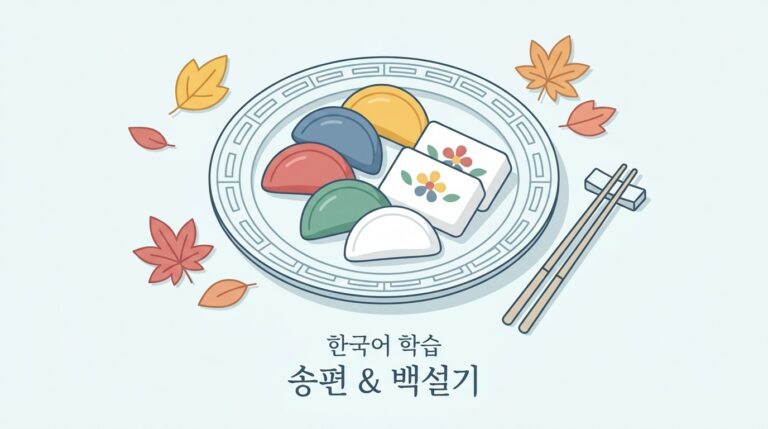
- 100 Days (백일) & 1st Birthday (돌): You will encounter pure white 백설기 (Baekseolgi), symbolizing immaculate innocence and long life, alongside 수수팥떡 (Susu-pat-tteok). The reddish hue of adzuki beans is traditionally believed to ward off harmful spirits and illnesses.
- Chuseok (추석 – Autumn Harvest): Korean families shape crescent moon-shaped 송편 (Songpyeon), stuffed with toasted sesame seeds, honey, and chestnut cream, steamed over fresh pine needles. Legend holds that anyone who pinches pretty songpyeon with neat contours will meet an attractive partner or give birth to a lovely child.
- Exams & Tests (수능/취업): 찹쌀떡 (Chapssaltteok) is the golden standard because it clings firmly. Conversely, Koreans strictly avoid eating slippery foods like seaweed soup (미역국) on exam mornings, dreading the superstition of “slipping” on test scores.
Phase 5: 실전 롤플레이 시나리오
- Setting: A bustling, fragrant neighborhood tteok bakery (방앗간/떡집) in Insa-dong, Seoul.
- Characters:
- Alex: An intermediate Korean learner planning an office relocation housewarming.
- Boss Park: A spirited, 65-year-old master rice cake artisan coated in light flour dust.
[Dialogue]
1. Alex: 사장님, 안녕하세요! 이번에 새 사무실로 이전해서 회사 동료들이랑 나눠 먹을 떡을 맞추고 싶은데요.
(Sajangnim, annyeonghaseyo! Ibeone sae samusillo ijeonhaeseo hoesa dongryeodeurirang nanwo meogeul tteogeul matchugo sipeundeyo.)
“Hello boss! We just relocated to a new office, so I’d like to custom order some rice cakes to share with my coworkers.”
🎭 Alex approaches the counter with an attentive 30-degree bow and a warm, inquisitive smile.
- Boss Park: 어이구, 개업 축하해요 총각! 사무실 이전이면 무조건 팥시루떡이지! 잡귀도 쫓고 액운을 막아주거든.
(Eoigu, gaeeop chukahaeyo chonggak! Samusil ijeon-imyeon mu-jogeon patsirutteog-iji! Japgwido jjotgo aegun-eul magajugeodeun.)
“Oh my, congratulations on the new office, young man! For an office move, red bean Sirutteok is a non-negotiable must! It drives away evil spirits and wards off misfortune.”
🎭 Boss Park wipes his floury hands on his apron and points proudly toward a steaming wooden chest. -
Alex: 아, 붉은 팥이 액운을 막아준다는 이야기를 들은 적 있어요! 그런데 개별 포장도 가능한가요?
(A, bulgeun pati aeguneul magajundaneun iyagireul deureun jeok isseoyo! Geureonde gaebyeol pojangdo ganeunghangayo?)
“Ah, I’ve heard that red adzuki beans fend off bad luck! By the way, is individual wrapping available?”
🎭 Alex nods thoughtfully, framing a miniature rectangle with his hands to show single-serving portions. -
Boss Park: 그럼, 당연하지! 요즘 회사원들은 손에 묻는 거 싫어하니까 먹기 좋게 소포장으로 딱 해줄게.
(Geureom, dangyeonhaji! Yojeum hoesawondeureun sone munneun geo sireohanikka meokgi joke sopojang-euro ttak haejulge.)
“Of course! Modern office workers hate sticky fingers, so I’ll wrap them up cleanly in single portions.”
🎭 Boss Park gives an energetic thumbs-up and clicks his tongue with confident craftsmanship. -
Alex: 정말 센스 있으세요! 팥시루떡 스무 개랑 달콤한 꿀떡도 반 말 같이 섞어주실 수 있나요?
(Jeongmal senseu isseuseyo! Patsirutteok seumu gaerang dalkomhan ggultteokdo ban mal gachi seokkeojusil su 있nayo?)
“You are so considerate! Could I get twenty pieces of red bean Sirutteok and half a ‘mal’ of sweet honey tteok mixed in?”
🎭 Alex glances down at his smartphone memo pad to cross-check his colleagues’ sweet cravings. -
Boss Park: 하하, 꿀떡까지? 젊은 친구들이 아주 환장하겠네! 내일 아침 9시까지 따끈하게 쪄놓을 테니 찾아가!
(Haha, ggultteok-kkaji? Jeolmeun chingudeuri aju hwanjanghagetne! Naeil achim ahop-si-kkaji ttakeunhage jjeonoeul teni chajaga!)
“Haha, honey tteok too? The youngsters are going to go crazy for that! I will steam them piping hot by 9 AM tomorrow, so come pick them up!”
🎭 Boss Park chuckles warmly, scribbling the order down onto his receipt pad with a thick pencil. -
Alex: 네, 내일 아침에 들를게요. 덕분에 회사 사람들과 찰떡같은 팀워크를 만들 수 있을 것 같아요!
(Ne, naeil achime deulleulgeyo. Deokbune hoesa saramdeulgwa chaltteokgateun timeowokeureul mandeul su isseul geot gatayo!)
“Perfect, I’ll stop by tomorrow morning. Thanks to you, I feel like we can build sticky, seamless teamwork with the crew!”
🎭 Alex hands over his corporate payment card with both hands while delivering the witty compliment. -
Boss Park: 말도 어쩜 이렇게 예쁘게 해! 내일 보너스로 맛보기 인절미도 듬뿍 챙겨줄 테니 기대해!
(Maldo eojjeom ireoke yeoppeuge hae! Naeil boneoseuro matbogi injeolmi-do deumpuk chaenggyeojul teni gidaehae!)
“How on earth do you speak so sweetly! Tomorrow I’ll toss in a generous bag of sample Injeolmi as a free bonus!”
🎭 Boss Park pats Alex on the shoulder with genuine grandfatherly affection.
🔀 인터랙티브 분기점 (Interactive Branching Decision)
Your Korean project partner hands you a pastel box of mini rice cakes at 10 AM, explaining it’s her baby’s 100-day celebration (백일). How do you respond?
- Option A: “와, 백일 떡이네요! 아기가 건강하게 무럭무럭 자라길 바랄게요. 맛있게 잘 먹겠습니다!”
- 👉 Feedback [Best]: Outstanding! You acknowledged the exact occasion, sent sincere blessings for the infant’s healthy growth, and accepted the gift with heartfelt appreciation. You nailed local emotional rapport.
- Option B: “저 지금 저탄수화물 다이어트 중이라 떡은 못 먹는데, 그냥 책상 위에 두고 가세요.”
- 👉 Feedback [Bad]: A major social misstep! Flatly declining ceremonial tteok due to personal dietary choices disregards the communal blessing. Always accept the gift warmly first.
- Option C: “감사합니다! 그런데 이거 떡집 어디서 맞추셨어요? 한 상자에 얼마예요?”
- 👉 Feedback [Risk]: Awkward! Inquiring about the retail expense right after receiving a ritual gift turns an emotional gesture into a transactional evaluation.
Phase 6: 10초 감정 섀도잉 드릴
[😊 기쁘고 신나게]
“새로 이사 와서 / 인사차 떡 좀 가져왔어요! / 맛있게 드세요!”
(Saero isa waseo / insacha tteok jom gajyeowasseoyo! / Masitge deuseyo! – I just moved in next door / and brought some rice cakes to introduce myself! / Please enjoy them!)-
[🥺 아쉽고 애교 섞어서]
“시험 보러 가는 친구한테 / 찹쌀떡을 못 챙겨줘서 / 너무 마음에 걸려요.”
(Siheom boreo ganeun chinguhante / chapssaltteogeul mot chaenggyeojwoseo / neomu maeume geollyeoyo. – I feel so bad / that I couldn’t get glutinous rice cakes / for my friend heading off to take the exam.) -
[😎 당당하고 호쾌하게]
“우리 팀 호흡이 / 아주 찰떡이라서 / 이번 프로젝트는 무조건 대박 납니다!”
(Uri tim hoheubi / aju chaltteogiraseo / ibeon peurojekteuneun mujogeon daebak namnida! – Our team synergy / is so sticky and perfect / that this project is bound to be a massive hit!)
Phase 7: K-Culture 미니 사전
- 백설기 (Baekseolgi) | Snow-white steamed rice cake | Crafted from non-glutinous rice flour and sugar. Its snowy white tone represents purity and spotless health, making it the signature food for a baby’s 100-day celebration (백일) and first birthday (돌).
- 송편 (Songpyeon) | Half-moon harvest rice cake | Steamed over pine needles and filled with roasted sesame seeds, honey, or sweetened chestnuts during Chuseok. Symbolizes a bountiful harvest and continual prosperity, evoking the waxing moon.
- 시루떡 (Sirutteok) | Layered red adzuki bean rice cake | Steamed in a traditional earthenware vessel (시루) layered with coarse adzuki beans. Crucial for housewarmings (이사) and business launches (개업) to ward off evil spirits (액운).
- 인절미 (Injeolmi) | Pounded glutinous rice cake coated in roasted soybean powder | Celebrated for its golden nutty aroma and chewy texture. Frequently served at weddings to symbolize enduring, unbreakable matrimonial affection.
Phase 8: 여행자를 위한 생존 키트
Essential Survival Phrases TOP 3
- “이 떡 오늘 아침에 만든 건가요?”
(I tteok oneul achime mandeun geongayo? – Were these rice cakes made this morning?)- Pro Tip: Traditional Korean tteok does not use artificial chemical preservatives. Asking this ensures you get the pillowy, soft texture before it firms up.
- “남은 떡은 냉동 보관하면 되나요?”
(Nameun tteok-eun naengdong bogwanhamyeon doenayo? – Can I freeze the leftovers?)- Pro Tip: Never store leftover fresh tteok in the refrigerator’s chill compartment! It hardens the starch into stone. Freeze it immediately, then defrost at room temperature.
- “선물용으로 보자기 포장 부탁드려요.”
(Seonmulyong-euro bojagi pojang butakdeuryeoyo. – Could you please wrap this in a Bojagi cloth for a gift?)- Pro Tip: Traditional bakeries carry exquisite silk Bojagi wrapping that transforms humble rice cakes into an upscale presentation.
Editor’s Travel Note
Skip generic web searches and open your Naver Map App Download instead. Search for terms like “방앗간” (Bang-at-gan) or “동네 떡집” (Dongne tteokjip) around historic neighborhood markets like Mangwon Market or Gwangjang Market. While most bakeries comfortably accept credit cards, carrying a crisp 5,000 KRW bill allows you to grab small grab-and-go plastic boxes fresh from the morning steam baskets!
Phase 9: “한 발 더 깊이” (생각 질문)
In our ultra-modern, high-rise cities where soundproof apartment doors often shut out human connections, handing someone a warm slice of Sirutteok is a quiet act of rebellion against isolation. Rice cake in Korea was never conceived as solitary nourishment; its creation demanded community hands to thresh, pound, and steam, and its consumption required collective distribution to unlock its protective power. When Koreans offer tteok, they are not simply sharing calories—they are circulating Jeong (정), vulnerability, and mutual safety.
💬 Your Turn: Does your culture feature a special traditional food that must be shared across the neighborhood or community rather than eaten alone? Leave your story in the comments below!
Phase 10: FAQ & 오해 방지
Q: Why shouldn’t I put fresh rice cakes in the regular refrigerator?
A: Refrigerating tteok triggers starch retrogradation, siphoning away moisture and turning the soft rice into a hard, crumbly brick. Keep whatever you can consume within 24 hours at room temperature, and instantly freeze the rest in airtight ziplock bags. To enjoy later, thaw at room temperature or pan-fry with a drizzle of sesame oil!
Q: Can I give seaweed soup (미역국) along with chapssaltteok to a friend taking an exam?
A: Definitely not! While Chapssaltteok (찹쌀떡) signifies sticking securely to your target, seaweed soup (미역국) is proverbially slippery. Korean cultural superstition links slippery textures with “slipping down” (미끄러지다) the scoring percentile. Stick exclusively to sticky rice cakes or malt candy (엿).
Q: How should I decline rice cakes politely if I have a dietary restriction or allergy?
A: Most authentic tteok is naturally gluten-free because it is made purely of rice flour, but fillings may contain sesame, red beans, or nuts. Rather than rejecting the box at the door, accept it with two hands and a bow: “축하해 주셔서 감사합니다!” (Thank you for celebrating with me!), and quietly share the pieces with your coworkers or friends afterward.
🚨 흔한 실수 (Common Mistakes) 경고판
- Mistake: Grabbing powdered rice cakes like Injeolmi with your bare hands from a communal office tray.
- Correct Action: Use provided skewers, toothpicks, or paper cups to keep roasted soybean dust from spilling across keyboards and desks.
- Mistake: Leaving warm, freshly steamed tteok enclosed inside airtight plastic bags on a heated floor (온돌).
- Correct Action: Preservative-free tteok ferments quickly in humid heat. Unseal the bag to let steam escape, or freeze it promptly.
- Mistake: Asking for colorful sweet honey rice cakes (꿀떡) at a solemn Korean funeral (장례식).
- Correct Action: Funerals observe austere decorum; celebratory, colorful tteok is strictly forbidden. Consume the muted side dishes provided quietly.
Phase 11: 액션 미션 & 참여 유도
- 🥉 Bronze Mission (Solo Practice): Stand before a mirror and rehearse saying: “새로 이사 와서 인사차 떡 좀 가져왔어요!” three times with a bright, friendly smile and a 15-degree head bow.
- 🥈 Silver Mission (Social Share): Snap a photo of a chewy Korean treat or local street pastry, post it on Instagram or Threads with the hashtag #찰떡궁합 (Sticky Chemistry), and tag @DailyHangul!
- 🥇 Gold Mission (Real Action): Visit a local Korean market or traditional Seoul tteok bakery, step up to the owner, and ask: “사장님, 오늘 만든 백설기 있나요?” (Boss, do you have Baekseolgi made today?).
- 🎮 K-Culture Mission: Watch an episode of a nostalgic neighborhood drama like Reply 1988 and count how many times metal bowls of rice cakes or side dishes are exchanged between neighboring households!
Phase 12: 인터랙티브 퀴즈 챌린지
1. 상황 판단 (Situational Judgment)
Your Korean project manager announces that your company has opened a new branch office and brought a tray of warm red-bean 시루떡 (Sirutteok) for the floor. Which response is the most culturally fitting?
* A) “저는 단 떡만 좋아하는데, 꿀떡은 없나요?”
* B) “이사 축하드립니다! 시루떡 먹고 새 사무실에서도 대박 나요!”
* C) “탄수화물이 너무 많아서 건강에 안 좋을 것 같아요.”
👉 Click to view Answer & Explanation
Answer: B
Explanation: Sirutteok is traditionally prepared for new beginnings and business openings to ward off misfortune. Pairing your appreciation with an encouraging cheer for prosperity (대박 나요!) demonstrates natural intermediate fluency and cultural empathy.
2. 빈칸 채우기 (Fill-in-the-Blank)
Complete the encouraging sentence for someone taking the university entrance exam:
* “내일 드디어 시험이네! 찹쌀떡 맛있게 먹고 원하는 학교에 [ ] 딱 붙어라!”
👉 Click to view Answer & Explanation
Answer: 찰떡같이 (Chaltteokgachi)
Explanation: “찰떡같이” means “firmly and stickily like glutinous rice cake,” capturing the wish that the test taker’s score will stick firmly to the university roster.
3. True / False 문화 퀴즈
- “Baekseolgi (백설기) is traditionally steamed in a pure white square and shared with 100 people at a baby’s 100-day celebration to gather blessings for health and longevity.” (True / False)
👉 Click to view Answer & Explanation
Answer: True
Explanation: The immaculate snow-white color of Baekseolgi symbolizes innocence and resilience. Sharing pieces with 100 different people (백 집) was believed to accumulate community blessings guaranteeing the child’s long, prosperous life.







