

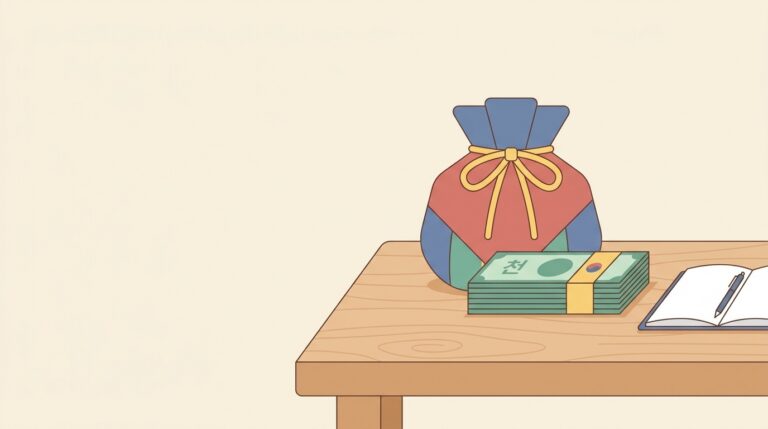
The Ultimate C2 Guide to Sebaetdon: Cash Etiquette and Bank Exchanges for Seollal
Phase 1: Empathy & Immersion
안녕하세요! 매일한글 에디터입니다.
Picture this: It is two days before Seollal (Lunar New Year), and you are standing inside a bustling commercial bank branch in Gwanghwamun. The air is tense with holiday urgency. Ahead of you, an impeccably dressed grandmother is negotiating the quota for freshly minted 50,000-won bills, while a young professional nervously checks his mobile banking balance. If you have spent significant time in Korea, you know that holiday cash gifts—세뱃돈 (Sebaetdon)—are far more than a casual token of affection. It is a nuanced cultural ritual governed by generational reciprocity, unspoken economic thresholds, and social standing.
Many advanced Korean learners hit a wall here. You may already understand the traditional deep bow (세배, Sebae), but do you know how to request crisp currency from a bank teller before branches run out of their holiday quota? Do you know the social friction created by slipping crumpled bills into a festive envelope, or how to navigate the modern dilemma of whether to gift 30,000 KRW, 50,000 KRW, or 100,000 KRW? This guide synthesizes field-tested cultural navigation and advanced sociolinguistic strategies gathered from years of guiding expats and multi-ethnic families across Korea.
Phase 2: Core Expressions Deep Dive
1. 신권으로 교환해 주세요 (Sin-gwoneuro gyohwanhae juseyo)
- Pronunciation: [Sin-gwon-eu-ro gyo-hwan-hae ju-se-yo] (Sounds like seen-gwon-oo-roh gyo-hwan-heh joo-seh-yo)
- Meaning: Literal: “Please exchange this for new currency.” / Nuance: “Could you swap these bills for crisp, uncirculated banknotes suitable for festive gifting?”
- K-Culture Moment: In the holiday special episodes of K-dramas like Reply 1988 or modern family sitcoms, family heads race to the bank at dawn because banks enforce strict daily caps on new notes.
- Editor’s Insight: Always specify the denomination. Say 신권 5만 원권으로 열 장 부탁드립니다 (Sin-gwon oman-wongwoneuro yeol jang butakdeurimnida – “Please give me ten 50,000-won notes in crisp bills”). The word 신권 (新券) carries prestige; handing over 헌 돈 (used, crumpled money) undermines the intentionality of the blessing.
- Situation Spectrum: Casual ⚠️ | Semi-formal ✅ | Formal ✅
- 🤔 Think About It: Why does the physical tactile state of currency carry moral weight in East Asian Confucian gift-giving cultures?
2. 체면치레는 해야죠 (Chaemyeonchire-neun haeyajyo)
- Pronunciation: [Chae-myeon-chi-re-neun hae-ya-jyo] (Sounds like cheh-myon-chee-reh-noon heh-ya-jyo)
- Meaning: Literal: “One must maintain face-saving rituals.” / Nuance: “I need to give at least an acceptable amount so I don’t look stingy or lose face.”
- K-Culture Moment: Working adults in contemporary workplace dramas like Misaeng complaining over coffee about the exorbitant cost of holiday envelopes for nieces and nephews.
- Editor’s Insight: 체면 (social face) and 치레 (ornamentation/maintenance) together form a vital sociolinguistic concept. Use this when humorously or pragmatically explaining why you cannot give small change to older teens.
- Situation Spectrum: Casual ✅ | Semi-formal ✅ | Formal ⚠️
- 🤔 Think About It: How does the burden of social face in Korea differ from personal pride in Western contexts?
3. 덕담 한마디 건네다 (Deokdam hanmadi geonneda)
- Pronunciation: [Deok-dam han-ma-di geon-ne-da] (Sounds like duhk-dahm hahn-mah-dee gun-neh-dah)
- Meaning: Literal: “To pass along a word of virtue/blessing.” / Nuance: “To offer uplifting words of wisdom and encouragement along with cash gifts.”
- K-Culture Moment: In family gatherings, an elder gives an envelope only after giving thoughtful wishes for employment, marriage, or health.
- Editor’s Insight: Never hand over an envelope silently like an ATM. The cash is merely a physical anchor for the verbal blessing. Pair the cash with healthy encouragement rather than intrusive interrogation.
- Situation Spectrum: Casual ✅ | Semi-formal ✅ | Formal ✅
- 🤔 Think About It: How does verbal blessing validate financial transactions between generations?
Phase 3: Textbook Korean vs. Real Korean
Situation 1: At the Bank Counter
- 📖 교과서 한국어: 새 돈으로 바꿔 주세요. (Sae doneuro bakkwo juseyo. / Please change to new money.)
- 🗣️ 진짜 한국어: 설 신권 교환 마감됐나요? 5만 원권 스무 장만 출금 부탁드립니다. (Seol sin-gwon gyohwan magam-dwaennayo? Oman-wongwon seumu jangman chulgeum butakdeurimnida. / Has the Seollal crisp currency exchange closed for the day? I’d like to withdraw twenty 50,000-won bills in crisp notes, please.)
- 💡 왜 다를까?: Native speakers use precise financial registers (신권, 출금) and ask whether bank quotas are depleted before requesting.
Situation 2: Handing Over the Envelope to a College Student
- 📖 교과서 한국어: 여기 세뱃돈이 있으니 받으세요. (Yeogi sebaetdoni isseuni badeuseyo. / Here is New Year’s money, please take it.)
- 🗣️ 진짜 한국어: 올 한 해 취업 준비하느라 고생 많았지? 부담 갖지 말고 필요한 데 보태 써. (Ol han hae chwieop junbihaneura gosaeng manatji? Budam gatji malgo piryohan de botae sseo. / You’ve worked so hard preparing for job interviews this year. Don’t feel burdened; put this toward what you need.)
- 💡 왜 다를까?: Adults alleviate psychological pressure by framing the cash as a supportive subsidy rather than charity.
Phase 4: K-Culture Deep Dive & Non-Verbal Etiquette
4-1. Nunchi & Physical Choreography
- The Envelope Protocol: Never give bare cash. Prepare designated festive envelopes (세뱃돈 봉투), ideally with simple calligraphy like 새해 복 많이 받으세요 (Saehae bok mani badeuseyo). Do not lick the envelope flap shut; fold it neatly.
- Two-Hand Coordination: Always deliver and receive the envelope using both hands. Keep your elbows tucked slightly inwards, maintaining modest posture without dominant eye contact.
- The Unwrapping Taboo: If you receive an envelope, never open it in front of the giver. Slide it discreetly into your inner coat pocket or bag with a bow and grateful expression.
4-2. The Economy of Denominations: Current Benchmarks
- Preschool to Elementary: 10,000 KRW to 30,000 KRW.
- Middle & High School: 50,000 KRW (The standard baseline).
- University & Job Seekers: 50,000 KRW to 100,000 KRW.
- Parents & Grandparents: 100,000 KRW to 300,000+ KRW (often categorized separately as 용돈 rather than 세뱃돈).
Phase 5: Real-World Roleplay Scenario
Setting: The living room of a Seoul apartment during Lunar New Year. Ji-hoon (your college-aged cousin) has just completed a bow (세배).
- 지훈: 삼촌, 새해 복 많이 받으시고 올해는 더욱 건강하세요! (Samchon, saehae bok mani badeusigo olhaeneun deouk geonganghaseyo! / Uncle, Happy New Year and stay even healthier this year!)
- 🎭 행동 지문: [지훈이 바닥에서 정중하게 일어서며 옷매무새를 가다듬는다.]
- 나: 그래, 지훈이도 새해 복 많이 받아라. 올 한 해도 원하는 바 다 이루고. (Geurae, Jihun-ido saehae bok mani badara. Ol han haedo wonhaneun ba da irugo. / Thank you, Ji-hoon, Happy New Year to you too. May you achieve all you hope for this year.)
- 🎭 행동 지문: [코트 안주머니에서 빳빳한 신권이 든 하얀 봉투를 두 손으로 꺼낸다.]
- 나: 이번 학기 졸업반이라 이래저래 들어갈 돈도 많을 텐데, 책값에 보태 쓰렴. (Ibeon hakgi joleopban-ira iraejeorae deureogal dondo maneul tende, chaekgapse botae sseuryeom. / You’re a graduating senior this semester so you must have plenty of expenses; use this toward your books.)
- 지훈: 어유, 삼촌! 매번 이렇게 챙겨주셔서 죄송하고 감사해요. (Eoyu, samchon! Maebeon ireoke chaenggyeojusyeoseo joesonghago gamsahaeyo. / Oh, Uncle! I feel bad that you look out for me every single time, but thank you so much.)
- 🎭 행동 지문: [양손으로 조심스럽게 봉투를 받아들며 살짝 고개를 숙인다.]
- 나: 마음 편히 받고, 취업 스트레스 너무 받지 말고 밥 잘 챙겨 먹어. (Maeum pyeonhi batgo, chwieop seuteureseu neomu batji malgo bap jal chaenggyeo meogeo. / Take it with an easy heart, don’t get too stressed over jobs, and eat well.)
- 지훈: 네! 기대에 부응하도록 열심히 하겠습니다! (Ne! Gidaee bueunghadorok yeolsimhi hagessseumnida! / Yes! I will work hard to live up to expectations!)
🔀 Interactive Choice Point
What should you do right after handing over the envelope to keep the conversation emotionally warm?
* Choice A: Ask: “그래서 지난번 지원한 대기업 최종 면접 결과는 어떻게 됐니?” (So how did the final interview go with that conglomerate?)
* Choice B: Smile and change the topic: “요즘 체력 관리는 어떻게 해? 무리하지 말고 건강이 우선이다.” (How are you managing your stamina lately? Don’t overwork; health comes first.)
* Choice C: Pull out your phone and check bank stocks.
Feedback:
* Choice A (Bad): 🚫 Triggers holiday anxiety (명절 스트레스). Korean youth dread holiday cross-examinations about employment and marriage.
* Choice B (Best): ✅ Perfect C2 social calibration. Shows deep empathetic care without boundary-crossing pressure.
* Choice C (Risk): ⚠️ Disconnects the relational bonding moment right after a ritual transaction.
Phase 6: 10-Second Emotion Shadowing Drill
[😊 따뜻하고 격려하듯]
올 한 해도 / 고생 많았지? / 필요한 데 / 보탬이 됐으면 좋겠다.
(Ol han haedo / gosaeng manatji? / piryohan de / botaemi dwaesseumyeon jokgetda.)-
[😌 겸손하고 정중하게]
신권 교환 한도가 / 남아 있다면 / 5만 원권으로 부탁드립니다.
(Sin-gwon gyohwan handoga / nama itdamyeon / oman-wongwoneuro butakdeurimnida.) -
[🥺 부담을 덜어주며]
다른 걱정은 덜어내고, / 맛있는 거 사 먹는 데 / 요긴하게 쓰렴.
(Dareun geokjeongeun deoreonaego, / masinneun geo sa meongneun de / yoginhage sseuryeom.)
Phase 7: K-Culture Mini Dictionary
- 세뱃돈 (Sebaetdon): Cash gifts given after the New Year’s deep bow. Beyond monetary value, it functions as dynamic relational fuel in extended families.
- 신권 (Sin-gwon): Freshly issued banknotes. In banking terms before holidays, branches face severe shortages, leading to rationing per customer.
- 빳빳하다 (Ppatppat-hada): Descriptive adjective for crisp, stiff, unwrinkled paper or fabric. “빳빳한 신권” represents maximum respect.
- 복주머니 (Bokjumeoni): Traditional silk fortune pouch used historically to store New Year gift coins and trinkets, now symbolized via elegant envelopes.
Phase 8: Survival Kit for Travelers & Expats
Top 3 Survival Expressions
- 신권 교환은 1인당 얼마까지 가능한가요?
(Sin-gwon gyohwaneun irindang eolmakkaji ganeunghangayo?)
Pro Tip: Bank branches usually cap new notes at 200,000 to 500,000 KRW per person before holidays. - 세뱃돈 봉투는 어디에 진열되어 있나요?
(Sebaetdon bongtuneun eodie jinyeoldoeeo innayo?)
Pro Tip: Buy high-quality envelopes at Daiso or convenience stores a week before Seollal. - 아이들에게 세뱃돈을 줄 때는 5만 원권이 적당할까요?
(Aideurege sebaetdoneul jul ttaeneun oman-wongwoni jeokdanghalkkayo?)
Pro Tip: Ask in-laws beforehand to align your gift budget with the rest of the family.
Editor’s Travel Note
Before major holidays, visit commercial banks at least 4 to 5 business days early between 10:00 AM and 1:00 PM. Locate your nearest branch efficiently via 네이버 지도 앱 다운로드 to check live branch operations and avoid holiday queues.
Phase 9: A Step Deeper (한 발 더 깊이)
In modern Korea, Sebaetdon sits at the crossroads of agrarian kinship ethics and hyper-capitalist realities. Once a seasonal exchange of rice cakes, fruit, and modest coins, the rapid rise of the 50,000-won note in 2009 inflated holiday expectations overnight. Yet beneath the anxiety over financial amounts lies an enduring longing for communal reassurance. The true spirit of Sebaetdon is not the denomination inside the envelope, but the generational bridge built through respectful gestures and warm words.
💬 Your Turn: What is the gift-giving etiquette for holidays in your home country? Do you exchange cash, and does crisp currency matter? Share your story in the comments below!
Phase 10: FAQ & Avoiding Misunderstandings
Q: Can I use bank transfer (계좌이체) or mobile gifting instead of cash?
A: While popular among immediate family, handing a tangible physical envelope with crisp notes remains the gold standard for in-laws, elders, and extended relatives.
Q: What if the local bank branch is completely out of 신권 (crisp notes)?
A: Withdraw normal notes from an ATM, select the cleanest uncreased bills, and place them inside a structured paper envelope with an apology note.
Q: Is giving 40,000 KRW considered bad luck because of the number four?
A: Yes. Avoid combinations totaling 40,000 KRW. Stick to clean units: 10,000, 30,000, 50,000, or 100,000 KRW.
🚨 Common Mistakes Alert
- Opening the Envelope Instantly: Opening an envelope in front of elders looks greedy. Put it away first.
- Handing Crumpled Cash: Never fish out crumpled bills from a wallet. Prepare an envelope in advance.
- Weaponizing Advice with Money: Never tie money to uncomfortable personal inquiries about marriages, weight, or grades.
Phase 11: Action Missions
- Bronze Mission: Rehearse asking for new bills: “신권으로 교환 부탁드립니다” until it rolls off your tongue smoothly.
- Silver Mission: Visit a stationary store or Daiso, buy 3 traditional decorative envelopes, and write “새해 복 많이 받으세요” on each.
- Gold Mission: Visit a Korean bank branch right before the holiday to successfully request crisp 10,000 and 50,000 won bills.
- 🎮 K-Culture Mission: Watch an episode of a family K-drama set during Seollal and note the body language when money envelopes are exchanged.
Phase 12: Interactive Quiz Challenge
1. Which denomination request at a bank counter is sociolinguistically the most natural?
(a) 새 돈 줘 보세요.
(b) 신권 5만 원권으로 교환 가능할까요?
(c) 빳빳한 종이 돈으로 바꿔 주시면 감사하겠습니다.
👉 Click to reveal Answer & Explanation
Correct Answer: (b)
(b) uses accurate financial terminology (신권, 5만 원권) and appropriate politeness levels. (a) is impolite, and (c) sounds awkward.
2. Fill in the Blank:
어른에게 세뱃돈 봉투를 건네거나 받을 때는 반드시 ______ 손을 사용해야 예의에 맞습니다.
👉 Click to reveal Answer & Explanation
Correct Answer: 두 (or 양)
Always use two hands (두 손 / 양손) when offering or receiving money with Korean elders.
3. True or False:
If a younger cousin bows to you, you must immediately give cash without saying anything to keep the interaction efficient.
👉 Click to reveal Answer & Explanation
Correct Answer: False
The financial envelope must be accompanied by heartwarming blessings (덕담), which forms the core of the holiday ritual.







