

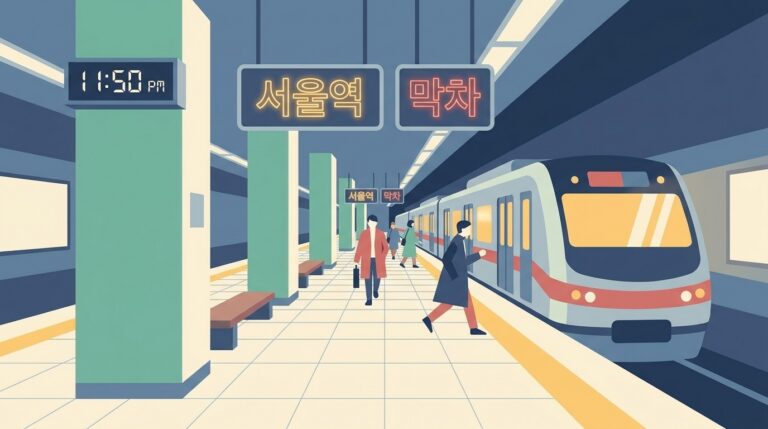
Don’t Turn into Cinderella in Seoul: How to Check the Last Train Like a Local
Phase 1: Empathy (Story-Driven Opening)
안녕하세요! It’s your Daily Hangul editor and your Seoul late-night navigation buddy.
Picture this: It’s 11:40 PM on a crisp Friday evening in Hongdae. The grilled pork belly (samgyeopsal) is sizzling, your Korean friends are clinking shot glasses, and the neon signs outside are buzzing with life. You are having the absolute time of your life—until suddenly, someone’s eyes widen, they grab their phone, and whisper a word that sends an immediate wave of adrenaline through the room: “막차 (Makcha)!”
Instantly, coats are grabbed, bills are split at lightning speed, and your group is sprinting down the subway stairs like athletes in an Olympic dash. If you’ve spent any time in Korea, you know the absolute terror of watching the subway gate shutter roll down at midnight. Taxis in Seoul late at night can be notoriously tough to hail, and an unexpected 50,000 KRW late-night taxi fare is the fastest way to ruin a great night out.
At the B1 intermediate level, you no longer just need textbook phrases like “Where is the station?” You need practical, dynamic expressions that help you check curfew cutoffs, coordinate with friends, and avoid turning into stranded Cinderellas. Based on real experiences from our global learners at Daily Hangul, this guide will arm you with the exact words and cultural intuition you need to conquer Korea’s late-night transit.
Phase 2: Core 3 Expressions Deep Dive
1. 막차 몇 시에 끊겨요? (Makcha myeot si-e kkeunkyeoyo?)
- Pronunciation: [Mak-cha myeot si-e kkeun-kyeo-yo] (Think of ‘mak-cha’ rhyming with ‘hot matcha’, and ‘kkeun-kyeo’ sounding like a sharp snapping sound)
- Meaning: Literal: “What time does the last train/bus get cut off?” | Nuance: “When does the last service stop running?”
- K-Culture Moment: Seen in almost every slice-of-life K-Drama when two coworkers realize over drinks that they are about to lose their ride home.
- Editor’s Insight: Instead of using the general verb “끝나다 (to finish)”, Koreans almost universally use “끊기다 (to be severed/cut off)” for public transit. It reflects how sharply and strictly the lines shut down!
- Situation Spectrum:
- Casual: 막차 몇 시에 끊겨? (⚠️ Friends only)
- Semi-formal: 막차 몇 시에 끊겨요? (✅ Safe for all everyday situations)
- Formal: 막차가 몇 시에 운행 종료되나요? (🚫 Too robotic for casual dining)
- 🤔 Think About It: Why does Korean describe transit ending as “being cut off” (끊기다)? How does viewing time as an abrupt thread change your urgency compared to your native language?
2. 막차 놓치면 택시 잡기 힘들어요. (Makcha notchimyeon taeksi japgi himdeureoyo.)
- Pronunciation: [Mak-cha no-chi-myeon taek-si jap-gi him-deu-reo-yo] (Softly roll the ‘him-deu-reo’ like a tired sigh)
- Meaning: Literal: “If we miss the last train, catching a taxi is difficult.” | Nuance: “We better wrap this up now, or we’re totally stranded.”
- K-Culture Moment: The classic line used to gracefully end a drinking gathering (hoesik) before midnight without offending the senior colleague.
- Editor’s Insight: This sentence functions as both a logistical fact and a polite social excuse. In Korea, “the last train” is the ultimate polite excuse to leave any gathering without hurting anyone’s feelings.
- Situation Spectrum:
- Casual: 막차 놓치면 택시 잡기 힘들어. (✅ With peers)
- Semi-formal: 막차 놓치면 택시 잡기 힘들어요. (✅ Friendly and respectful)
- Formal: 막차를 놓치실 경우 택시 탑승이 어렵습니다. (⚠️ Sounds like an announcement)
- 🤔 Think About It: In your culture, what is the universal “excuse” to leave a late gathering early without seeming rude?
3. 아직 첫차까지 시간 많이 남았어요? (Ajik cheotcha-kkaji sigan mani namasseoyo?)
- Pronunciation: [A-jik cheot-cha-kka-ji shi-gan ma-ni na-ma-sseo-yo] (Bounce gently on ‘cheot-cha’)
- Meaning: Literal: “Is there still a lot of time left until the first train?” | Nuance: “Did we officially miss the last train, and are we pulling an all-nighter?”
- K-Culture Moment: When 2:00 AM hits, you miss the last train, and your squad decides to sing noraebang or eat 24-hour haejangguk (hangover soup) until the 5:30 AM subway resumes.
- Editor’s Insight: When you miss the 막차 (makcha – last train), the only redemption is the 첫차 (cheotcha – first train). This phrase signals defeat—and the start of an unexpected midnight adventure.
- Situation Spectrum:
- Casual: 아직 첫차까지 시간 많이 남았어? (✅ With close friends)
- Semi-formal: 아직 첫차까지 시간 많이 남았어요? (✅ Polite tone)
- Formal: 첫차 출발 시각까지 시간이 많이 남았습니까? (🚫 Unnecessarily stiff)
- 🤔 Think About It: Does your hometown have 24-hour transit, or do people also share the collective ritual of “waiting for the first morning train”?
Phase 3: Textbook Korean vs. Real Korean
Situation 1: Asking when the subway line closes
- 📖 교과서 한국어 (Textbook): 마지막 지하철은 몇 시에 출발합니까? (Majimak jihacheoreun myeot si-e chulbalhamnikka? – “At what hour does the final subway depart?”)
- 🗣️ 진짜 한국어 (Real-World): 막차 몇 시예요? (Makcha myeot si-yeyo? – “What time is the last train?”)
- 💡 왜 다를까? (Why the difference?): Nobody says “마지막 지하철 (final subway)” in daily conversation. Koreans abbreviate it to the compound noun 막차 (mak-cha) for quick, punchy communication.
Situation 2: Realizing the bus has already stopped running
- 📖 교과서 한국어 (Textbook): 버스 운행이 이미 종료되었습니다. (Beoseu unhaeng-i imi jongnyodweeossseumnida. – “Bus operation has already concluded.”)
- 🗣️ 진짜 한국어 (Real-World): 버스 막차 이미 끊겼어요! (Beoseu makcha imi kkeunkyeosseoyo! – “The last bus already cut off!”)
- 💡 왜 다를까? (Why the difference?): “운행 종료 (service termination)” is formal terminology heard through speakers. Real locals use the active expression “막차가 끊기다 (the last ride got cut off)”.
Phase 4: K-Culture Deep Dive & Non-Verbal Manners
4-1. Nunchi & Gestures
When it’s 11:30 PM in Korea, you will see a subtle non-verbal dance called 눈치 (Nunchi). If someone taps their wrist, glances downward at their phone while rapidly unlocking their screen, or slightly adjusts their jacket on the back of the chair, they are doing the “Makcha Check.”
* Eye Contact: Avoid looking away distractedly; instead, lean slightly forward and show concern when checking the transit map together.
* Polite Departure: Never abruptly get up and run out of a dinner. Give a 15-minute warning: “저 막차 때문에 슬슬 일어나야 할 것 같아요 (Jeo makcha ttaemune seulseul ireonaya hal geot gatayo – I think I should slowly get moving because of the last train).”
4-2. Cultural Code: “The Cinderella Rush” (신데렐라 타임)
In major nightlife hubs like Gangnam, Hongdae, and Euljiro, midnight is known colloquially as 신데렐라 타임 (Cinderella Time). Missing the train doesn’t just mean waiting 10 minutes—it means subway station shutters are pulled shut until 5:30 AM!
Fortunately, Seoul offers the famous 올빼미 버스 (Owl Bus), late-night buses marked with an ‘N’ (such as N13, N26) that run between midnight and 4:30 AM. Knowing the difference between your normal line and the Owl Bus can save your night!
Phase 5: Real-World Roleplay Scenario
Setting: A vibrant Pocha (tented street pub) near Jongno 3-ga Station. It is currently 11:38 PM.
Characters: Minji (your Korean coworker who loves noraebang) and You (checking your phone anxiously).
- You: 민지 씨, 지금 몇 시예요? (Minji ssi, jigeum myeot si-yeyo? / “Minji, what time is it right now?”)
🎭 Checking phone battery - Minji: 벌써 11시 40분이네요! 시간 진짜 빠르다. (Beolsseo yeol-han-si sa-sip-bun-i-ne-yo! Sigan jinjja ppareuda. / “It’s already 11:40 PM! Time flies so fast.”)
🎭 Taking another bite of tteokbokki - You: 혹시 1호선 막차 몇 시에 끊겨요? (Hoksi il-ho-seon makcha myeot si-e kkeunkyeoyo? / “By any chance, what time does the Line 1 last train get cut off?”)
🎭 Frowning with slight worry - Minji: 어머, 1호선은 11시 55분이 막차예요! (Eomeo, il-ho-seon-eun yeol-han-si o-sip-o-bun-i makcha-yeyo! / “Oh dear, Line 1’s last train is at 11:55 PM!”)
🎭 Eyes widening in shock - You: 15분밖에 안 남았네요. 지금 바로 가야겠어요. (Sip-o-bun-bakke an nam-an-ne-yo. Jigeum baro gaya-gesseoyo. / “Only 15 minutes left. I have to go right now.”)
🎭 Reaching for bag and coat - Minji: 지금 뛰면 탈 수 있어요! 막차 놓치면 택시 잡기 힘들어요. (Jigeum ttwimyeon tal su isseoyo! Makcha notchimyeon taeksi japgi himdeureoyo. / “If you run now, you can catch it! If you miss the last train, catching a taxi will be tough.”)
🎭 Standing up to help hand your coat - You: 오늘 정말 즐거웠어요! 내일 연락할게요! (Oneul jeongmal jeulgeowosseoyo! Naeil yeollakhalgeyo! / “I had so much fun today! I will text you tomorrow!”)
🎭 Bowing briskly while waving - Minji: 조심히 가요! 얼른 뛰어요! (Josimhi gayo! Eolleun ttwieoyo! / “Get home safe! Run fast!”)
🎭 Waving enthusiastically
🔀 Interactive Decision Point
You reach the turnstile at 11:53 PM, but the screen says the last train toward your destination just departed 1 minute early due to schedule adjustments. What do you do?
- Choice A: Stand outside and wave your hand on the street for an orange taxi without opening any app.
- Feedback (Risk): Late at night in Jongno, taxis rarely stop for street hails because almost all drivers pick up fares via Kakao T. You might wait in the cold for an hour.
- Choice B: Walk back to the pocha and say, “첫차까지 놀아요! (Let’s hang out until the first train!)”
- Feedback (Best / Fun): If your company is up for it, 24-hour cafes or singing rooms await! But make sure your energy reserves are full for tomorrow.
- Choice C: Open your map app and search for the nearest 심야 올빼미 버스 (Night Owl Bus) stop.
- Feedback (Best / Practical): The smartest move! Owl buses run every 20-30 minutes and cost just a regular transit fare plus a small night surcharge.
Phase 6: 10-Second Emotion Shadowing Drill
Read these out loud with rhythm and authentic emotional inflection! Slash (/) marks a pause.
[😰 Anxious & In a Hurry]
저 / 막차 끊기기 전에 / 지금 나가야 해요!
(Jeo / makcha kkeun-gi-gi jeone / jigeum nagaya haeyo!)
“I / before the last train gets cut off / need to leave right now!”-
[😱 Panicked Realization]
잠깐만요, / 우리 막차 / 방금 지나갔어요?
(Jam-kkan-man-yo, / uri makcha / bang-geum jina-gasseoyo?)
“Wait a second, / did our last train / just pass?” -
[😅 Relieved & Laughing with Friends]
휴, / 다행히 / 막차 탔어요! 내일 봐요!
(Hyu, / dahaeng-hi / makcha tasseoyo! Naeil bwayo!)
“Phew, / luckily / I caught the last train! See you tomorrow!”
Phase 7: K-Culture Mini Dictionary
- 막차 (Makcha): The last train or bus of the scheduled day. Essential vocabulary for any evening activity in urban Korea.
- 첫차 (Cheotcha): The first morning train or bus (typically starts around 5:15 AM – 5:40 AM depending on the line).
- 막차 러시 (Makcha Rush): The frantic sprint of hundreds of commuters rushing down stairs between 11:40 PM and 12:10 AM.
- 올빼미 버스 (Olppaemi Beoseu): Seoul’s dedicated night owl buses (marked with an ‘N’ prefix) that operate between midnight and dawn.
Phase 8: Traveler’s Survival Kit
Survival Expressions TOP 3
- 막차 아직 있어요? (Makcha ajik isseoyo?)
- Pro Tip: Ask the station attendant or convenience store cashier if you’re unsure whether the platform is still accessible.
- 홍대 가는 심야 버스 어디서 타요? (Hongdae ganeun simya beoseu eodiseo tayo?)
- Pro Tip: Use this when subway gates close and you need the night owl bus stop.
- 택시가 진짜 안 잡히네요. (Taeksiga jinjja an jap-hiney-yo.)
- Pro Tip: A handy phrase to sympathize with friends when ride-hailing apps show high demand.
Editor’s Travel Note
- App Recommendations: Do not rely on international maps in Korea. Install the KakaoMap navigation app or Naver Map transit guide. Both apps display real-time live timetables with precise indicators showing whether the upcoming vehicle is the definitive “막차”.
- T-Money Caution: Make sure your physical T-money transit card has at least 5,000 KRW before 11:00 PM. Station reload machines occasionally reboot for maintenance right around midnight!
Phase 9: “One Step Deeper” (Reflective Cultural Essay)
In Western cities, leaving a party at 11:30 PM because you want to sleep is universally understood. In Korea, however, collective group bonding (jeong) makes stepping away from a gathering delicate. This is where 막차 (makcha) plays a fascinating social role. It is an unimpeachable, universally respected cultural boundary. No boss, senior classmate (seonbae), or party animal friend can argue with “I will miss the last train!”
It serves as a collective social grace that protects individuality within a tight-knit community. When you yell “막차!”, you aren’t being rude—you are participating in a shared cultural ritual that everyone in Seoul respects.
💬 Your Turn: Have you ever experienced a “midnight sprint” in your home country or while traveling? Share your wildest late-night transit story in the comments below!
Phase 10: FAQ & Common Mistakes
Q: Does the Seoul subway stop at the exact same minute at all stations?
A: No! Depending on whether a train terminates at an intermediate depot or runs all the way to the end of the line, last train times vary from 11:35 PM to 12:45 AM. Always check the destination on the display screen.
Q: Can I use Uber in Seoul if I miss the last train?
A: Yes, but in Korea, Uber operates as “Uber Taxi” (connecting with licensed local taxis). The most dominant local app is Kakao T. Be prepared for a 20% to 40% midnight surcharge (haljeung) between 10:00 PM and 4:00 AM.
Q: What is the difference between 막차 and 마지막 차?
A: Both refer to the last vehicle, but 막차 is the native, everyday conversational word everyone uses. 마지막 차 sounds more formal, descriptive, or literary.
🚨 Common Mistakes Warning Board
- Mistake: Saying “마지막 버스를 기다립니다” when talking to peers.
- Correct Action: Say “버스 막차 기다려요 (Beoseu makcha gidaryeoyo)” for natural B1 flow.
- Mistake: Confusing 막차 (makcha – last ride) with 막판 (makpan – final stage of a game/situation).
- Correct Action: Keep ‘차 (vehicle)’ at the end when talking about buses or trains!
- Mistake: Assuming all Korean transit runs 24 hours on weekends.
- Correct Action: Korean subways do NOT run all night, even on Saturdays! Always check your last train timetable.
Phase 11: Action Missions
- 🥉 Bronze Mission (Solo Practice): Say “막차 몇 시에 끊겨요?” out loud 5 times in front of a mirror with genuine urgency in your voice.
- 🥈 Silver Mission (Digital Application): Open Naver Map or KakaoMap right now, search for a route from Gangnam Station to your hotel, and locate the button that shows “막차 (Last Train)” departure times.
- 🥇 Gold Mission (Live Action): Next time you are eating or hanging out in Korea past 10:30 PM, politely ask your companion: “우리 막차 몇 시예요? (Uri makcha myeot si-yeyo?)”.
- 🎮 K-Culture Mission: Watch an episode of a modern Seoul-based drama (like My Liberation Notes or Itaewon Class) and spot characters hurrying to catch the last train!
Phase 12: Interactive Quiz Challenge
Test your real-world instincts!
- Situation Judgment: You are at a company dinner. You want to leave politely before midnight. Which sentence is best?
- (A) 집이 멀어서 먼저 집에 가겠습니다. 안녕히 계세요.
- (B) 막차 놓치면 택시 잡기 힘들어서 슬슬 일어나야 할 것 같아요.
- (C) 지하철 운행 종료 시각을 조사해야 합니다.
- Fill in the Blank:
“지하철 ( ) 끊기기 전에 빨리 뛰어요!” (Let’s run fast before the last subway gets cut off!)- (A) 첫차
- (B) 막판
- (C) 막차
- True or False Culture Quiz: Seoul subway lines run 24 hours on Friday and Saturday nights.
- (True / False)
클릭하여 정답 및 해설 확인 (Click for Answers & Explanations)
1. 정답: (B)
해설: (B) uses the natural, polite social phrasing that combines concern about transit with soft leave-taking (슬슬 일어나야 할 것 같아요). (A) is too blunt, and (C) sounds like an artificial robot!
2. 정답: (C) 막차
해설: “막차” is the exact intermediate vocabulary word for the last train or bus. “첫차” is the first morning train, and “막판” means the final phase of an event.
3. 정답: False
해설: Unlike New York or London’s Night Tube, Seoul subways close every night around midnight to 1:00 AM for safety inspections and maintenance. Late-night travelers rely on the Owl Bus (올빼미 버스) or taxis!







