

Korean Table Manners: Why You Shouldn’t Pick Up Your Spoon First
Phase 1: 공감 (The Awkward Sizzle at the BBQ Table)
안녕하세요! 매일한글 에디터입니다.
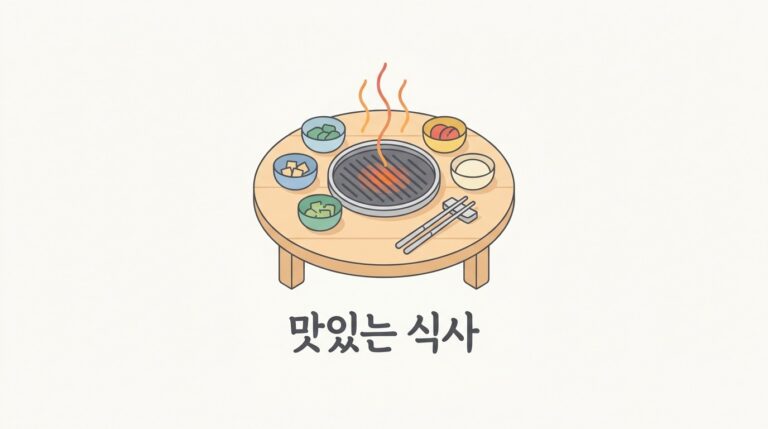
Imagine this classic K-drama scene: You are sitting at a cozy, bustling K-BBQ restaurant in Seoul with your Korean friend’s family or your friendly Korean manager. The marbled pork belly is sizzling with that irresistible aroma, the steamed egg is bubbling, and six colorful side dishes surround the grill. Your stomach is literally growling like a drum solo. Instinctively, your hand reaches for those shiny stainless steel chopsticks… but suddenly, an invisible freeze button hits the table. Everyone has their hands neatly resting on their laps, smiling warmly at the oldest elder at the table.
Panic sets in: Wait, did I do something wrong? Can’t I just take a bite while it’s hot?
Take a deep breath! Every single foreigner living in Korea has experienced this exact “chopstick hesitation.” In Korea, mealtime isn’t just about refueling; it is a warm social ritual of respect and mutual care. In this lesson, designed specially from real feedback of hundreds of A1 beginner learners, you will discover the magic phrases and subtle body language that will turn you from a nervous guest into the most polite, beloved dinner companion at any Korean table.
Phase 2: 핵심 표현 3선 심층 분석 (Top 3 Core Expressions)
1. 먼저 드세요 (Meonjeo deuseyo)
- Pronunciation: [Meon-jeo deu-se-yo] (Sounds like: Mun-juh as in “Monday” + Duh-say-yo)
- Meaning: Literal: “Please eat first” / Real Nuance: “After you, please enjoy ahead of me!”
- K-Culture Moment: You see this in almost every family drama when the younger sibling or daughter-in-law gestures towards the grandparents before picking up their own spoon.
- Editor’s Insight: 먼저 (meonjeo) means “first” or “ahead,” and 드세요 (deuseyo) is the honorific polite form of “to eat” (먹다). Saying this proves you are considerate and observant.
- Situation Spectrum: Casual: ⚠️ (Say 먼저 먹어 to close friends) | Semi-formal: ✅ | Formal: ✅
- 🤔 Think About It: In many Western cultures, hostesses say “Eat before it gets cold!” Why does Korean culture prioritize who eats first over the temperature of the food?
2. 잘 먹겠습니다 (Jal meokgetseumnida)
- Pronunciation: [Jal meok-get-seum-ni-da] (Sounds like: Jahl as in “jolly” + muck-get-seum-nee-da)
- Meaning: Literal: “I will eat well” / Real Nuance: “Thank you for this delicious meal, I’m ready to enjoy it!”
- K-Culture Moment: Watch any idol variety show or reality show like Three Meals a Day. Right before digging in, all members clap their hands or bow their heads slightly and chant this phrase together in unison.
- Editor’s Insight: It serves as an announcement of gratitude toward both the person who cooked/paid for the meal and the ingredients themselves.
- Situation Spectrum: Casual: ⚠️ (Say 잘 먹을게 to peers) | Semi-formal: ✅ | Formal: ✅
- 🤔 Think About It: How does verbally acknowledging the meal before taking your first bite change the energy of the dinner table?
3. 맛있게 드세요 (Mas-itge deuseyo)
- Pronunciation: [Ma-sit-ge deu-se-yo] (Sounds like: Mah-sheet-geh duh-say-yo)
- Meaning: Literal: “Eat deliciously” / Real Nuance: “Bon appétit! Enjoy your meal!”
- K-Culture Moment: The restaurant owner auntie (이모님, imonim) placing a steaming bowl of Kimchi stew in front of you with a beaming smile.
- Editor’s Insight: You can say this to an elder right after they take their first bite, wishing them a delightful culinary experience.
- Situation Spectrum: Casual: ⚠️ (Say 맛있게 먹어 to younger friends) | Semi-formal: ✅ | Formal: ✅
- 🤔 Think About It: Instead of just a generic “enjoy,” Koreans specifically wish for your food to taste full of flavor (맛).
Phase 3: 교과서 한국어 vs 진짜 한국어 (Textbook vs. Real Korean)
Situation 1: Inviting an elder to start eating
- 📖 교과서 한국어 (Textbook): 진지 잡수세요. (Jinji japsuseyo. – “Please partake of the meal.”)
- 🗣️ 진짜 한국어 (Real-life): 먼저 드세요! (Meonjeo deuseyo! – “Please eat first!”)
- 💡 왜 다를까? (Why the difference?): While 진지 잡수세요 is grammatically the highest honorific, it sounds like a Joseon Dynasty historical drama if used by modern young people at a casual diner! 먼저 드세요 is modern, respectful, and sweet.
Situation 2: The food has just arrived and everyone is seated
- 📖 교과서 한국어 (Textbook): 식사를 시작하겠습니다. (Siksareul sijakhagetseumnida. – “I will now commence the meal.”)
- 🗣️ 진짜 한국어 (Real-life): 잘 먹겠습니다! (Jal meokgetseumnida! – “Thank you for the meal!”)
- 💡 왜 다를까? (Why the difference?): The textbook sentence sounds like a corporate annual conference announcement. In real daily life, 잘 먹겠습니다 is the warm, universal standard.
Phase 4: K-Culture 딥다이브 & 비언어적 매너 (Deep Dive & Non-Verbal Manners)
4-1. 눈치 (Nunchi) & Table Gestures
- The Golden Spoon Rule: Never lift your spoon or chopsticks before the oldest person touches theirs. Keep an eye out using your 눈치 (nunchi – quick situational awareness). Once grandmother or the boss picks up their spoon and takes a sip of soup, green light! You are free to dig in.
- Two-Hand Rule: If an elder passes you a bowl or pours you water, receive it using both hands (or place your left hand supporting your right wrist/forearm).
- Pacing Yourself: Try not to finish eating 20 minutes before everyone else. Match the elder’s dining speed so they don’t feel rushed.
4-2. Culture Code: The Shared Table (정, Jeong)
In Korea, dining is fundamentally relational. Western individual plating gives each person their own boundary, but a traditional Korean table features shared stews (찌개, jjigae) and communal side dishes (반찬, banchan). Waiting for the elders to eat first symbolizes harmony and gratitude for the lineage and community that brought everyone together.
Phase 5: 실전 롤플레이 시나리오 (Real-Life Roleplay)
Setting: A warm galbi (ribs) restaurant in Insadong. You are having dinner with your Korean friend Minho and his grandfather (Hal-abeoji).
- 할아버지 (Grandfather): 음, 고기가 다 구워졌구나. (Eum, gogiga da guwojyeotguna. – “Mmm, the meat is completely cooked now.”)
🎭 [Looks gently at the grill] - You: 먼저 드세요, 할아버지! (Meonjeo deuseyo, hal-abeoji! – “Please eat first, Grandfather!”)
🎭 [Politely gesturing both open hands toward the grill] - 할아버지 (Grandfather): 허허, 고맙구나. 어디 한 점 먹어볼까. (Heoheo, gomapkuna. Eodi han jeom meogeobolkka. – “Haha, thank you. Let me try a piece.”)
🎭 [Picks up his chopsticks and takes the first bite of galbi] - 민호 (Minho): 할아버지, 맛있으세요? (Hal-abeoji, mas-isseuseyo? – “Grandfather, is it tasty?”)
🎭 [Smiling enthusiastically] - 할아버지 (Grandfather): 아주 부드럽고 맛있다. 자, 너희도 어서 먹어라. (Aju budeureopgo mas-itta. Ja, neohuido eoseo meogeora. – “Very tender and tasty. Go on, you two eat now as well.”)
🎭 [Nods warmly toward you] - You: 잘 먹겠습니다! (Jal meokgetseumnida! – “Thank you for the meal!”)
🎭 [Bowing head slightly with a bright smile] - 민호 (Minho): 맛있게 먹겠습니다! (Mas-itge meokgetseumnida! – “I will eat happily!”)
🎭 [Grabs chopsticks enthusiastically] - 할아버지 (Grandfather): 그래, 많이들 먹어라. (Geurae, manhideul meogeora. – “Yes, eat lots.”)
🎭 [Chuckles contentedly]
🔀 Interactive Decision Point
When the food is ready and Grandfather hasn’t picked up his spoon yet, what do you do?
* Choice A: Instantly grab a piece of meat with your fingers and say, “Wow, delicious!”
* Choice B: Gently smile, make eye contact, and say, “먼저 드세요!” (Meonjeo deuseyo!)
* Choice C: Stare at the ceiling in complete silence without moving a muscle for 10 minutes.
- Feedback:
- Choice A (Bad): Yikes! You broke the number one table rule. You might look impatient and rude.
- Choice B (Best!): Perfect! You showed respect, used great Korean, and delighted the grandfather.
- Choice C (Risk): While polite, it creates awkward table tension. Speaking up politely with 먼저 드세요 shows true confidence!
Phase 6: 10초 감정 섀도잉 드릴 (Shadowing Drill)
Practice reading these out loud with rhythm and emotion! Slash marks / indicate a micro-pause.
[😊 Polite and Warm]- 먼저 / 드세요! (Meon-jeo / deu-se-yo!)
[🙏 Heartfelt and Grateful]- 잘 / 먹겠습니다! (Jal / meok-get-seum-ni-da!)
[✨ Bright and Cheerful]- 맛있게 / 드세요! (Ma-sit-ge / deu-se-yo!)
Phase 7: K-Culture 미니 사전 (Mini Dictionary)
- 어른 (Eoreun): “Elder” or “Adult.” In Korean culture, it refers to parents, grandparents, seniors at work, or anyone significantly older than you.
- 수저 (Sujeo): A portmanteau of 수저 (spoon, 숟가락) and 젓가락 (chopsticks). Placing the 수저 on a napkin for elders before eating earns you instant brownie points!
- 눈치 (Nunchi): The art of gauging other people’s moods and the room’s atmosphere without words.
- 반찬 (Banchan): Traditional side dishes served alongside rice. They are refillable and meant to be shared cordially.
Phase 8: 여행자를 위한 생존 키트 (Traveler’s Survival Kit)
Survival Expressions TOP 3
- 먼저 드세요 (Meonjeo deuseyo) – “Please eat first.”
- Pro Tip: Use this when dining with older tour guides, homestay hosts, or Korean colleagues.
- 잘 먹겠습니다 (Jal meokgetseumnida) – “Thank you for the food.”
- Pro Tip: Say this right as the restaurant owner sets down your hot stone pot.
- 감사합니다 (Gamsahamnida) – “Thank you.”
- Pro Tip: Pair this with a polite 15-degree bow when leaving the counter.
Editor’s Travel Note
- Essential Navigation: Download the Naver Map application to find highly-rated traditional restaurants with authentic family-style seating.
- Table Utensil Drawer: Can’t find spoons? Check the side drawer built right beneath your restaurant table!
Phase 9: “한 발 더 깊이” (Reflective Cultural Thought)
In Western dining, autonomy is celebrated—everyone orders their own plate and eats at their own rhythm. In Korea, mealtime is a communal dance rooted in Confucian traditions of venerating elders and sharing 정 (jeong, emotional warmth). When you wait for an elder to eat first, you aren’t suppressing your hunger; you are acknowledging the care, wisdom, and life story of the person sitting across from you. It transforms eating from a biological necessity into a heartwarming human connection.
💬 Your Turn: Does your culture have a tradition about who starts eating first? Share your story in the comments below!
Phase 10: FAQ & 오해 방지 (FAQ & Common Mistakes)
Q: What if an elder insists: “Eat quickly while it’s hot!”?
A: You can smile warmly, say “감사합니다, 잘 먹겠습니다!” (Gamsahamnida, jal meokgetseumnida!), and start eating! If they explicitly grant permission, you don’t need to keep hesitating.
Q: Do I need to wait for elders in a fast-food restaurant or cafe?
A: Casual snacks and coffee are much more relaxed! However, saying “먼저 드세요” when handing your elder their latte or dessert is still considered super charming and sweet.
Q: Can I stick my metal chopsticks upright into my bowl of rice?
A: Absolutely never! Sticking chopsticks upright in rice resembles incense bowls used in ancestral memorial rituals (제사, jesa) for the deceased. Always rest them horizontally on the table or spoon rest.
🚨 Common Mistakes (흔한 실수) Warning Board
- ❌ Mistake 1: Picking up your chopsticks the second the food touches the table.
- 👉 Correct Action: Wait until the oldest person picks up their spoon and takes their first bite.
- ❌ Mistake 2: Holding your rice bowl in the air with one hand while eating.
- 👉 Correct Action: Keep your rice bowl resting on the table; use your spoon to lift rice to your mouth.
- ❌ Mistake 3: Starting to eat without saying 잘 먹겠습니다.
- 👉 Correct Action: Say the magic phrase with a pleasant nod before your first spoonful!
Phase 11: 액션 미션 & 참여 유도 (Action Missions)
- 🥉 Bronze Mission (Solo Practice): Stand in front of your mirror and practice saying “먼저 드세요!” and “잘 먹겠습니다!” 5 times with a bright, friendly smile.
- 🥈 Silver Mission (Social Connection): The next time you grab lunch with friends, jokingly say 잘 먹겠습니다 before taking a bite of your sandwich!
- 🥇 Gold Mission (Real Life): When visiting a Korean restaurant or meeting a Korean elder, let them pick their cutlery first and say “먼저 드세요.”
- 🎮 K-Culture Mission: Watch an episode of a family K-drama (like Reply 1988 or My Mister) and count how many times characters wait for an elder or say 잘 먹겠습니다 at the dining table!
Phase 12: 인터랙티브 퀴즈 챌린지 (Interactive Quiz)
Q1. [Situation Judgement] You are at dinner with your Korean boss. The food arrives. What is the most polite action?
1. Grab the biggest piece of barbecue right away.
2. Wait until your boss takes the first bite, and say 먼저 드세요.
3. Leave the table immediately.
Q2. [Fill in the Blank] Before eating a meal, you politely say: “잘 ________!” (I will eat well!)
Q3. [True or False] It is completely acceptable in Korea to stick your chopsticks straight up into your bowl of white rice.
👉 Click here to reveal answers & explanations!
- Q1 Answer: 2. Always wait for the elder or senior to start, and encourage them with 먼저 드세요!
- Q2 Answer: 먹겠습니다 (meokgetseumnida). The full phrase is 잘 먹겠습니다.
- Q3 Answer: False! Sticking chopsticks upright mimics funeral incense ceremonies and is considered bad luck. Always lay them flat beside your bowl.







