

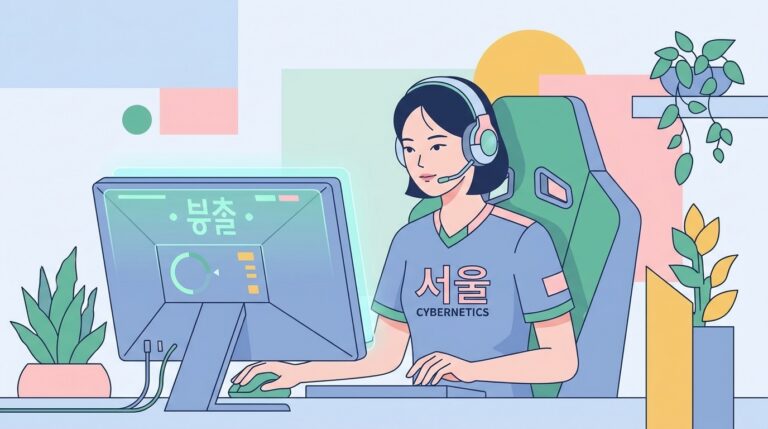
Phase 1: 공감 (Empathetic Storytelling Opening)
안녕하세요! 매일한글 에디터입니다.
Picture this: You step into an ultra-modern PC bang in the bustling heart of Gangnam or Sinchon. The air carries the faint scent of freshly cooked ramyeon and salted butter popcorn, punctuated by the rhythmic, mechanical clacking of blue switches and urgent tactical callouts echoing across the headsets. You log into your favorite ranked matchmaking queue in Overwatch 2 or Valorant, slip on your headset, and switch on the team voice channel. But as you speak up to coordinate an entry frag, an awkward silence settles over the lobby—or worse, a teammate condescendingly remarks on your gender rather than your crosshair placement.
For an increasingly dominant demographic of female gamers and progressive allies across South Korea, this exact scenario has long been a frustrating friction point. Historically steeped in hyper-competitive, predominantly male subcultures, Korean gaming environments are undergoing a profound, high-stakes cultural evolution. The myth that female gamers only play casual titles or passively main support roles has been systematically shattered by tier-one duelists and esports leaders demanding accountability. Yet, navigating these conversations in Korean—distinguishing between toxic microaggressions, gaming banter, and structurally rooted gender tropes—requires a sophisticated linguistic toolkit far beyond conventional textbook dialogues. Today, drawing directly on real competitive scrims and feedback from advanced bilingual players, we will master C2-level discourse to dissect, confront, and dismantle gaming stereotypes with absolute precision, elegance, and unshakeable confidence.
Phase 2: 핵심 표현 3선 심층 분석 (Top 3 Core Expressions)
1. 색안경을 벗고 실력으로 증명하다 (Saek-angyeong-eul beotgo sillyeok-euro jeungmyeonghada)
- Pronunciation: Saek-ang-gyeong-eul beot-go sil-lyeog-eu-ro jeung-myeong-ha-da (Sounds like “sehk-ahn-gyung-eul buht-go sheel-lyuhk-oo-ro joong-myung-hah-dah”)
- Meaning:
- Literal: Take off colored glasses and prove oneself through skill.
- Nuanced: To dispel deep-seated biases or prejudices by letting undeniable competence and performance speak for themselves.
- K-Culture Moment: Widely utilized in Korean esports media commentary and high-profile gaming interviews when an underrepresented pro player silences dismissive online chatter through flawless mechanical gameplay.
- Editor’s Insight: The phrase “색안경을 끼다” (to wear colored glasses) is the definitive Korean idiom for viewing someone through prejudiced lenses. Pairing it with “벗다” (to take off) transforms an abstract critique of bias into an active, empowering mandate centered on meritocracy.
- Situation Spectrum: Casual ⚠️ | Semi-formal ✅ | Formal ✅
- 🤔 Think About It: How does phrasing bias as a visual distortion (“colored lenses”) shift the burden of clarity onto the prejudiced observer rather than the person being judged?
2. 연대와 자정작용 (Yeondae-wa jajeong-jakyong)
- Pronunciation: Yeon-dae-wa ja-jeong-jag-yong (Think “yuhn-deh-wah jah-jung-jahk-yong”, echoing the crisp ‘j’ sound in ‘judge’)
- Meaning:
- Literal: Solidarity and self-purification action.
- Nuanced: Collective communal solidarity coupled with organic, bottom-up cultural reform to eradicate toxicity without relying purely on top-down bans.
- K-Culture Moment: Frequently featured in community manifesto threads on gaming portals like Inven or Ruliweb when players band together to report serial voice-chat harassers and establish wholesome lobby norms.
- Editor’s Insight: “자정작용” (self-purification) originates as an ecological term referring to a river cleansing its own ecosystem. In sociological discourse, using it implies that the gaming community recognizes its internal toxins and possesses the moral agency to heal itself.
- Situation Spectrum: Casual 🚫 | Semi-formal ✅ | Formal ✅
- 🤔 Think About It: In your native tongue, do community anti-toxicity movements rely more heavily on external legalistic policing or organic collective responsibility?
3. 건설적인 비판과 맹목적인 비난을 분별하다 (Geonseoljeokin bipan-gwa maengmokjeokin binan-eul bunbyeolhada)
- Pronunciation: Geon-seol-jeog-in bi-pan-gwa maeng-mog-jeog-in bi-nan-eul bun-byeol-ha-da (“gun-suhl-juhk-een bee-pahn-gwa meng-mohk-juhk-een bee-nahn-eul boon-byuhl-hah-dah”)
- Meaning:
- Literal: To distinguish constructive criticism from blind blame/vitriol.
- Nuanced: Drawing a crystal-clear boundary between legitimate gameplay tactical feedback and baseless, misogynistic venting disguised as gamer frustration.
- K-Culture Moment: Heard during post-match reviews (피드백 세션) when a team captain or streamer firmly halts a teammate from pivoting a gameplay mistake into ad hominem slurs against female players.
- Editor’s Insight: Notice the phonetic contrast between 비판 (bipan – analytical critique) and 비난 (binan – destructive slander). Mastery of this pairing instantly elevates your Korean from defensive reaction to authoritative conflict resolution.
- Situation Spectrum: Casual ⚠️ | Semi-formal ✅ | Formal ✅
- 🤔 Think About It: How does precise word choice prevent bad actors on voice channels from claiming their harassment was merely “game-related passion”?
Phase 3: 교과서 한국어 vs 진짜 한국어 (Textbook vs. Authentic Korean)
Situation 1: Calling out gender-based assumptions on voice chat
- 📖 교과서 한국어: 게임 내에서 성별과 관련된 편견 섞인 발언을 삼가 주십시오. (Geim nae-eseo seongbyeol-gwa gwanryeon-doen pyeon-gyeon seokkin bareon-eul samga jusipsio. / Please refrain from biased remarks related to gender within the game.)
- 🗣️ 진짜 한국어: 마이크 켜고 성별 프레임 씌우지 마시고, 브리핑이나 제대로 맞춰보죠. (Maikeu kyeogo seongbyeol peure-im ssieuji masigo, beuriping-ina jedaero matchwobojo. / Stop framing this through gender on voice comms and let’s actually focus on proper team callouts.)
- 💡 왜 다를까? Textbook Korean sounds like a robotic system TOS announcement. Native competitive players immediately shut down bad-faith rhetoric using active gaming terminology like “프레임 씌우다” (framing someone falsely) and “브리핑 맞추다” (aligning tactical callouts).
Situation 2: Discussing the long-term impact of diversifying player demographics
- 📖 교과서 한국어: 여성 유저의 참여가 많아져 게임 환경이 매우 긍정적으로 변화하고 있습니다. (Yeoseong yujeo-ui chamyeoga man-ajyeo geim hwan-gyeongi maeu geungjeongjeog-euro byeonhwahago itseumnida. / With increased participation of female users, the game environment is changing very positively.)
- 🗣️ 진짜 한국어: 유저층이 다변화되면서 고질적이던 악습과 혐오 표현에 확실히 제동이 걸리기 시작했죠. (Yujeocheungi dabyeonhwa-doemyeonseo gojiljeok-ideon akseup-gwa hyeomo pyohyeon-e hwaksilhi jedongi geolligi sijakhaetjyo. / As the player base diversifies, it is finally putting the brakes on chronic toxic habits and hateful rhetoric.)
- 💡 왜 다를까? C2-level proficiency avoids superficial generic praise (“매우 긍정적”) and deploys vivid idiomatic sociology: “고질적” (chronic/deep-rooted), “다변화” (diversification), and “제동을 걸다” (to apply the brakes).
Phase 4: K-Culture 딥다이브 & 비언어적 매너 (Cultural Nuance & Unwritten Codes)
4-1. 눈치 (Nunchi) & In-Game Communication Etiquette
In Korean competitive culture, Nunchi (tactful situational reading) in team voice channels is an art form. When discriminatory slurs surface, the most respected players do not respond with shrill anger (which toxic trolls often feed upon, labeled as 어그로 끌기). Instead, they deploy “단호한 정적” (composed, deadpan silence) followed by a chillingly professional tactical callout.
If you are playing in a mixed offline group at a PC bang, beware of unsolicited coaching known as 훈수 (Hunsu). Jumping over someone’s shoulder to dictate their item build under the assumption that a female player needs hand-holding is considered a massive social faux pas. Respecting autonomy and acknowledging skill without condescension is the cardinal rule of contemporary gaming nunchi.
4-2. Cultural Code Analysis: The Fall of In-Game Tropes
For years, Korean gaming forums were plagued by derogatory linguistic tropes like “혜지” (Hyeji—a derogatory meme labeling female gamers as passive support players who climb ranks by leeching off male carries). Today, a seismic shift has taken place. Prominent Korean platforms (such as Naver’s streaming platform Chzzk and AfreecaTV) and esports broadcasting panels maintain strict hate-speech guidelines. Top-tier female streamers openly debunk these stereotypes by achieving Challenger rank on demanding carry roles like jungle and top lane, redefining the narrative from passive dependency to undeniable mechanical domination.
Phase 5: 실전 롤플레이 시나리오 (Interactive Roleplay Scenario)
Setting: A high-tier competitive scrim lobby in an open discord channel. Ji-woo (지우), a veteran shot-caller, is playing alongside Min-seok (민석), who unintentionally drops a microaggression after losing a teamfight.
- 민석: 아, 방금 힐만 제때 들어왔어도 살았는데… 솔직히 마이크 목소리 들릴 때부터 서포팅 불안하더라. (A, banggeum hilman jette deureowasseodo saranneunde… soljikhi maikeu moksori deullil ttae-buteo seopoting buranhadeora.)
🎭 한숨을 깊게 내쉬며 키보드를 신경질적으로 두드린다
(Ah, if only the heal arrived on time I would’ve lived… Honestly, from the moment I heard a woman’s voice on mic, I had a bad feeling about the support play.) -
지우: 민석 님, 리플레이 돌려보세요. 본인이 무리하게 진입해서 퇴로 끊긴 거지, 힐 타이밍 문제가 아닙니다. (Minseok nim, ripeullei dollyeoboseyo. Bon-ini murihage jin-iphaeseo toero kkeunkin geoji, hil taiming munje-ga animnida.)
🎭 차분하고 흔들림 없는 목소리로 핑을 찍으며
(Minseok-ssi, watch the replay. You overextended and cut off your own retreat; it wasn’t an issue of healing timing.) -
민석: 아니, 뭐 꼭 그렇게 정색을 해요? 그냥 판세가 아쉬워서 한마디 한 건데. (Ani, mwo kkok geureoke jeongsaeg-eul haeyo? Geunyang pansae-ga aswiwoseo hanmadi han geonde.)
🎭 머쓱한 듯 목소리를 높이며 변명조로 얼버무린다
(Hey, why get so dead serious? I just said a word because the game state was frustrating.) -
지우: 아쉬운 플레이는 데이터로 분석하면 됩니다. 실력 문제를 성별 탓으로 돌리는 건 실례죠. (Aswiun peullei-neun deiteo-ro bunseokhamyeon doemnida. Sillyeok munje-reul seongbyeol taseuro dollineun geon sillye-jyo.)
🎭 헤드셋 마이크를 바짝 당기며 또박또박 짚어낸다
(Frustrating plays can be analyzed via match data. Blaming personal mechanical decisions on gender is completely out of line.) -
민석: …알겠습니다. 제가 말이 헛나왔네요. 다음 한타 설계 어떻게 가실 건데요? (Algetseumnida. Jega mari heotnawanneyo. Daeum hanta seolgye eotteoke gasil geondeyo?)
🎭 자세를 고쳐 앉으며 목소리 톤을 한층 낮춘다
(…Understood. That slipped out wrong. How are we structuring the next teamfight?) -
지우: 진영 갖추고 궁극기 연계만 맞추면 충분히 뒤집습니다. 집중하시죠. (Jin-yeong gatchugo gung-geukgi yeongye-man matchumyeon chungbunhi dwijipseumnida. Jipjunghasijyo.)
🎭 단호한 핑을 찍으며 팀원들의 사기를 북돋운다
(If we hold formation and chain our ultimates, we can easily turn this around. Let’s focus.)
🔀 인터랙티브 분기점 (Choose Your Response)
Min-seok tries to brush off the confrontation by saying: “아, 여자분이라 그런지 기분이 좀 예민하신가 보네.” (Ah, I guess she’s just being sensitive because she’s a woman.) How do you intervene as a bystander in voice chat?
- Option A: “야, 마이크 끄고 게임이나 해라. 게임 못하는 놈이 입만 살았네.” (Hey, mute your mic and just play. The worst player always talks the most.)
- Option B: “민석 님, 인신공격과 성별 갈라치기는 팀 승리에 전혀 도움 안 됩니다. 게임에 집중 못 하실 거면 차단하겠습니다.” (Minseok-ssi, ad hominem attacks and gender-baiting contribute nothing to our win. If you cannot focus on the match, we will mute and report you.)
- Option C: “그냥 넘어가죠. 게임인데 굳이 분위기 망칠 필요 없잖아요?” (Let’s just move on. It’s just a game, no need to ruin the mood.)
Feedback:
- Option A [BAD]: Escalates raw toxicity with vulgar gamer taunts (“입만 살았다”). This gives the bad actor an excuse to play the victim and derail the entire lobby into an argument.
- Option B [BEST]: Impeccable C2 professionalism. By using terms like “인신공격” (ad hominem) and “성별 갈라치기” (gender factionalism/baiting), you strip away his rhetorical leverage while prioritizing the objective (winning).
- Option C [RISK]: Toxic positivity that normalizes microaggressions. Passive bystander behavior allows discriminatory behavior to establish a dominant cultural precedent.
Phase 6: 10초 감정 섀도잉 드릴 (Emotional Shadowing Drill)
Practice reading these out loud, observing the slash marks (/) for tactical micro-pauses:
[🔥 단호하고 카리스마 있게 / Resolute & Authoritative]
실력에는 / 성별이 없습니다. / 오직 퍼포먼스로만 / 증명하세요.
(Sillyeog-eneun / seongbyeori eopseumnida. / Ojik peopomeonseuro-man / jeungmyeonghaseyo.)
(There is no gender / in skill. / Prove yourself / solely through performance.)-
[🛡️ 차분하지만 묵직하게 / Calm, Firm & Composed]
근거 없는 비난으로 / 팀 사기 꺾지 마시고, / 다음 턴 오더에 / 집중해 주십시오.
(Geongeo eomneun binan-euro / tim sagi kkeokji masigo, / daeum teon odeoe / jipjunghae jusipsio.)
(Don’t break team morale / with baseless vitriol; / please stay dialed in / on the next shot-call.) -
[🤝 성숙하고 설득력 있게 / Mature & Inspiring]
건강한 게임 문화는 / 유저 스스로의 / 자정작용에서 / 비롯됩니다.
(Geonganghan geim munhwaneun / yujeo seuseuro-ui / jajeong-jakyong-eseo / birot-doemnida.)
(A healthy gaming culture / originates from / the self-purification / of the players themselves.)
Phase 7: K-Culture 미니 사전 (Mini Gaming Dictionary)
-
갈라치기 (Galla-chigi)
Literal translation: Cleaving apart / divisive wedge-driving.
Contextual usage: Political and cultural term frequently used when malicious online actors pit groups against one another (e.g., gender factionalism in video games) rather than tackling system issues. -
미러링 (Mireoring)
Literal translation: Mirroring.
Contextual usage: Sociological tactic where marginalized groups replicate toxic male gamer comments verbatim back to the perpetrator to make them confront their own absurdity. -
캐리하다 (Kaeri-hada)
Literal translation: To carry.
Contextual usage: Originating from English “carry,” it has become an indispensable badge of honor in everyday Korean society, used whenever someone single-handedly shoulders a project or tournament match to victory. -
자정작용 (Jajeong-jakyong)
Literal translation: Self-cleansing mechanism.
Contextual usage: Applied across Korean editorial boards to describe internet communities actively rooting out bigotry and holding toxic members accountable without state censorship.
Phase 8: 여행자를 위한 생존 키트 (Gamer’s Survival Kit)
Top 3 Survival Phrases for Korean Gaming Spaces
- 성별 언급하지 마시고 게임에만 집중해 주세요.
(Seongbyeol eongeophaji masigo geim-eman jipjunghae juseyo.)
Pro Tip: Deploy this the moment an in-game teammate makes an inappropriate comment about your vocal pitch on microphone. - 비매너 유저 신고 넣고 차단하겠습니다.
(Bimaeneo yujeo sin-go neotgo chadan-hagetseumnida.)
Pro Tip: Professional warning phrase before completely cutting off an abusive player’s voice and text comms. - 클린한 매치 만들어봐요, 다들 파이팅!
(Keullin-han maechi mandeureobwayo, dadeul paiting!)
Pro Tip: High-morale icebreaker to set an inclusive, respectful tone right during the hero selection screen.
Editor’s Travel Note: Conquering Korean PC Bangs
When visiting premier gaming spaces like T1 Base Camp in Hongdae or Gen.G PC Cafes, remember that food ordering and account login happen seamlessly via custom desktop launchers. To stay updated with the scene or join regional gaming events, install the 네이버 지도 앱 다운로드 to pinpoint high-spec PC bangs with private booths (1인석/커플석), and download 치지직(Chzzk) 스트리밍 앱 다운로드 to observe real-time Korean streaming speech patterns.
Phase 9: “한 발 더 깊이” (Cultural Philosophical Essay)
South Korean gaming culture is a fascinating, double-edged mirror of the nation’s hyper-collectivist “우리” (Uri – We/Our) ethos. When channeled positively, this communal mindset produces world-class coordination, shared victory celebrations, and unmatched national pride on the global esports stage. However, when operating under digital anonymity, that same collectivism can morph into aggressive tribalism, where anyone deviating from the perceived “default” demographic—such as vocal female shot-callers—is defensively scapegoated for disrupting the status quo. The contemporary push against gender discrimination in gaming is therefore not merely a Western import; it is an organic, deeply Korean reckoning with equity, demanding that the communal “우리” expand to embrace all players equally under the banner of mutual respect.
💬 Your Turn: Have you ever experienced or witnessed linguistic microaggressions in your local gaming voice lobbies? How does your native language structure the balance between fierce gaming trash-talk and genuine harassment? Share your thoughts below in Korean!
Phase 10: FAQ & 오해 방지 (FAQ Schema Matching)
Q: Can casual trash-talk in Korean games simply be brushed off as “banter” without addressing gender?
A: While competitive bantering (티키타카 or 입털기) is normal in Korean multiplayer lobbies, attacking someone’s demographic traits, voice, or assumed gender is explicitly categorized as 비매너 (ill-mannered play) and is strictly penalizable under South Korea’s Game Industry Promotion Acts and platform terms of service.
Q: Is the term “혜지” (Hyeji) still considered acceptable gaming slang among friends?
A: Absolutely not. While it once circulated widely as an insensitive meme, using “혜지” today in public forums or mixed lobbies immediately marks one as out-of-touch and misogynistic. Modern polite gaming circles deliberately censure its usage.
Q: What is the most effective way to address bias without causing the entire lobby to throw the match (던지다)?
A: Frame your intervention strictly around match victory (승리 지향적 피드백). When you demonstrate that dismantling bias is essential to tactical cohesion and winning the match, the rest of the team will naturally rally behind your authority.
🚨 흔한 실수 (Common Mistakes) 경고판
- Mistake: Over-apologizing when making a minor gameplay error just because someone targeted your gender.
Correct Action: Acknowledge only factual tactical errors calmly: “진입 미스 인정합니다. 다음 턴에 맞추죠.” (I acknowledge the misentry. Let’s sync up next turn.) - Mistake: Responding with high-pitched, emotional shouting.
Correct Action: Drop your vocal cadence, speak at an even pace, and deploy concise corporate-level rhetoric (단호한 어조). - Mistake: Conflating constructive tactical feedback with discrimination.
Correct Action: Analyze whether the critique is directed at your cooldown management (스킬 쿨타임) or your identity. Learn to welcome tactical critiques while swiftly shutting down personal attacks.
Phase 11: 액션 미션 & 참여 유도 (Action Missions)
- 🥉 Bronze Mission: Record yourself shadowing Phase 6’s first drill with authoritative pacing and post your audio snippet to a language exchange partner.
- 🥈 Silver Mission: Write a 3-sentence critique on your social media about in-game voice harassment using the words “색안경”, “자정작용”, and “실력”.
- 🥇 Gold Mission: Log into a Korean multiplayer server (or mock scrim lobby) and use the phrase “성별 프레임 씌우지 마시고, 브리핑에 집중하죠” during a contentious moment.
- 🎮 K-Culture Mission: Watch a VOD of a professional Korean female streamer on Chzzk or YouTube and jot down three authentic tactical callouts she uses to lead her squad.
Phase 12: 인터랙티브 퀴즈 챌린지 (Interactive Quiz Challenge)
Quiz 1. Situational Judgment
A teammate loses an encounter and types: “아 서폿 여자였음? 어쩐지 플레이가 답답하더라.” What is the most sophisticated, C2-level intervention?
1. 너나 잘해라, 킬뎃 보니까 최하위구만.
2. 성별과 인게임 판단을 결부 짓는 건 비합리적인 편견입니다. 리플레이 확인하시죠.
3. 죄송합니다, 다음에는 더 잘해볼게요.
Quiz 2. Fill-in-the-Blank
게임 내 고질적인 혐오 문화를 없애기 위해서는 외부의 규제보다 유저 커뮤니티 내부의 강력한 (________)이/가 선행되어야 한다.
(Hint: Ecological term meaning organic self-purification).
Quiz 3. True / False Culture Check
In modern Korean esports journalism, attributing a player’s strategic support playstyle to their gender is recognized as professional and acceptable analysis. (True / False)
🔍 정답 및 해설 확인하기 (Click to expand answers)
- Quiz 1 정답: 2번.
해설: Option 1 devolves into petty toxicity. Option 3 validates unwarranted microaggressions. Option 2 demonstrates superior C2 sociolinguistic mastery by clinically separating factual gameplay performance from irrational prejudice. - Quiz 2 정답: 자정작용 (Jajeong-jakyong).
해설: This term encapsulates the communal, bottom-up moral agency required to purify toxic online subcultures. - Quiz 3 정답: False.
해설: Contemporary Korean esports media actively discourages and penalizes gender reductionism, maintaining strict standards that evaluate all athletes strictly through mechanical skill and macro strategy.







