

안녕하세요! 매일한글 에디터입니다.
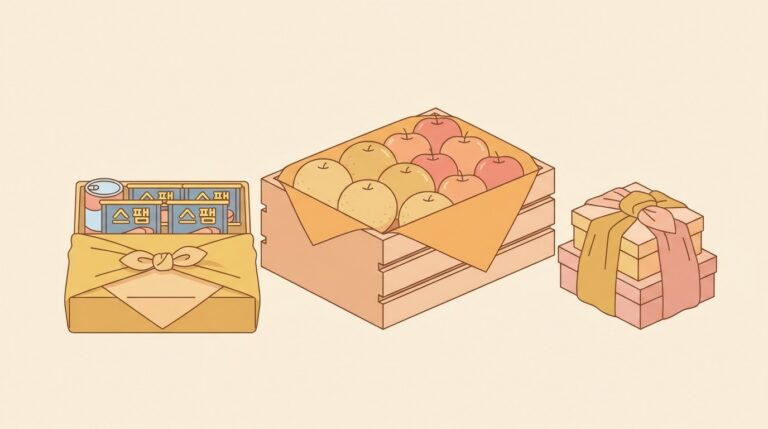
Have you ever walked into a large Korean supermarket like E-Mart, Homeplus, or a department store around late September, only to find yourself surrounded by towering pyramids of glossy boxes wrapped in silky gold fabric?
If so, you have experienced the vibrant madness of the Chuseok (추석) holiday season! But wait—as you walk closer to admire these lavish luxury packages, you stop in your tracks. Wait… is that a golden silk box containing… canned Spam? And next to it, bottles of cooking oil and gourmet toothpastes? Welcome to the fascinating world of Chuseok Gift Sets (추석 선물 세트)!
As an absolute beginner (A1) in Korean, holiday shopping can feel intimidating. Clerks are bustling, promotional jingles are blaring, and everyone is carrying armfuls of elaborate gift boxes. You want to pick something thoughtful for your Korean coworker, your language exchange partner, or your friendly landlord, but you freeze: How do I ask if this is a gift set? How do I politely ask for a recommendation without stumbling over complex grammar?
Take a deep breath! Our team at Daily Hangul has coached hundreds of expats through their very first Korean holiday. You do not need complex grammar to navigate Chuseok. With just three simple survival phrases and a peek into Korean gift etiquette, you will shop like a savvy local.
Phase 2: Core 3 Expressions Deep Dive
1. 이거 선물 세트예요? (Igeo seonmul seteuyeyo?)
- Pronunciation: [I-geo seon-mul se-teu-ye-yo?] (Think: “Ee-geo” like the letter ‘E’ + ‘go’, “sun-mool”, “set-uh-yay-yo”)
- Meaning: “Is this a gift set?” (Literal: This / gift set / is it?)
- K-Culture Moment: You will see this in every Korean family sitcom or workplace drama right before the holidays, where an overwhelmed junior employee checks the holiday inventory in the supply closet.
- Editor’s Insight: During Chuseok, stores sell regular items alongside special bundled versions that come with festive paper bags or cloth wraps. Using this short question immediately tells the clerk that you are looking for holiday packaging, not everyday groceries.
- Situation Spectrum: Casual: ⚠️ | Semi-formal: ✅ | Formal: ✅
- 🤔 Think About It: In many Western cultures, giving canned food as a holiday gift might seem casual or odd. Why do you think beautifully boxed, practical pantry goods became a symbol of care and prosperity in modern Korea?
2. 추천해 주세요. (Chucheonhae juseyo.)
- Pronunciation: [Chu-cheon-hae ju-se-yo.] (Sounds like: “Choo-chun-hae joo-say-yo” — like a friendly train “choo-choo”!)
- Meaning: “Please recommend something.” (Literal: Recommendation / please do)
- K-Culture Moment: Think of Reply 1988 or modern variety shows where someone stands undecided at a market stall, and the friendly store Ajoomma takes charge to pick the sweetest fruit box.
- Editor’s Insight: Koreans love giving recommendations! If you look overwhelmed by the hundreds of Spam, tuna, or wild honey sets, saying this phrase with a gentle smile hands the reins over to the clerk. They will happily point you toward the most popular choice for your budget.
- Situation Spectrum: Casual: 🚫 | Semi-formal: ✅ | Formal: ✅
- 🤔 Think About It: Asking for a recommendation shows humility and trust in the other person’s expertise. How does asking for advice bridge the gap between a buyer and a local seller?
3. 포장해 주세요. (Pojanghae juseyo.)
- Pronunciation: [Po-jang-hae ju-se-yo.] (Sounds like: “Poh-jahng-hae joo-say-yo”)
- Meaning: “Please wrap it for me.” (Literal: Packaging / please do)
- K-Culture Moment: A character delicately holding up a box wrapped in an elegant silk cloth (보자기) before bowing to their in-laws in a K-drama holiday special.
- Editor’s Insight: In Korea, 포장 (Pojang) means wrapping, packaging, or takeout for food. In the context of Chuseok gift corners, saying this tells the staff you want the special holiday carrier bag or ribbon wrapping.
- Situation Spectrum: Casual: 🚫 | Semi-formal: ✅ | Formal: ✅
- 🤔 Think About It: Why does the outer presentation of a gift often matter just as much as what is inside the box in Korean culture?
Phase 3: Textbook Korean vs. Real Korean
Scenario 1: Asking what is the most popular
- 📖 교과서 한국어 (Textbook Korean): 어느 것이 가장 인기가 있습니까? (Eoneu geosi gajang ingiga itseumnikka?)
- 🗣️ 진짜 한국어 (Real Korean): 어떤 게 제일 잘 나가요? (Eotteon ge jeil jal nagayo?)
- 💡 왜 다를까? (Why is it different?): Textbook phrases often use stiff grammar like “-습니까”. Real shoppers use 잘 나가요 (jal nagayo), which literally means “Which one flies out the door fastest?” It sounds natural, friendly, and instantly marks you as someone who knows daily conversational rhythm.
Scenario 2: Asking if there is a ‘Buy One Get One’ deal
- 📖 교과서 한국어 (Textbook Korean): 할인을 해 주실 수 있습니까? (Harineul hae jusil su itseumnikka?)
- 🗣️ 진짜 한국어 (Real Korean): 이거 원 플러스 원이에요? (Igeo won peulleoseu won-ieyo?)
- 💡 왜 다를까? (Why is it different?): Rather than asking generally about discounts in awkward formal speech, locals look directly at the promotional tag and ask for 원 플러스 원 (1+1) or 덤 (deom – free bonus).
Phase 4: K-Culture Deep Dive & Non-Verbal Manners
4-1. Nunchi & Physical Manners: The Two-Hand Rule
Gift-giving in Korea is a physical performance of respect and affection. When you purchase, receive, or present your Chuseok gift:
1. Use Two Hands: Always offer the gift using both hands. Lightly rest your left hand under your right wrist or forearm if the package is small, or hold the sides of the large box with both hands.
2. The Polite Bow: Make brief, warm eye contact, then nod your head in a 15-degree bow as you hand it over.
3. Do Not Tear It Open Immediately: Unlike in many Western households where you open presents on the spot, Koreans usually set the gift aside to open privately later, avoiding any awkward comparison of gift values.
4-2. The Golden Mystery: Why Spam & Hanwoo Reign Supreme
If you see a lavish $100 Spam set nestled inside a velvet box, do not laugh! After the Korean War, canned meats from US military bases were rare, cherished delicacies. Over decades, Spam evolved into a beloved soul food featured in dishes like 부대찌개 (Budae-jjigae) and paired with steaming white rice. For premium gifting, Koreans give 한우 (Hanwoo – native Korean beef) or 홍삼 (Hongsam – red ginseng) to symbolize health, longevity, and wealth.
Phase 5: Real-Life Roleplay Scenario
- Location: The bustling Chuseok festival corner at an E-Mart supermarket in Seoul.
- Characters: You (a friendly visitor) and the energetic Mart Clerk Auntie (Mart Imo).
- You: 안녕하세요! 이거 선물 세트예요? (Annyeonghaseyo! Igeo seonmul seteuyeyo?)
🎭 Action: You point with an open palm toward a neat tower of glossy gift boxes. - Clerk: 네, 맞아요! 추석 특별 세트예요. (Ne, majayo! Chuseok teukbyeol seteuyeyo.)
🎭 Action: She smiles brightly and taps the display with pride. - You: 어떤 게 제일 잘 나가요? (Eotteon ge jeil jal nagayo?)
🎭 Action: You lean in with a curious, friendly look. - Clerk: 이 스팸 세트가 제일 잘 나가요! 가격도 좋아요. (I seupaem seteuga jeil jal nagayo! Gagyeokdo joayo.)
🎭 Action: She lifts up a navy-blue boxed Spam & cooking oil combo. - You: 좋아요! 추천해 주세요. (Joayo! Chucheonhae juseyo.)
🎭 Action: You nod appreciatively at her choice. - Clerk: 이걸로 드릴까요? 쇼핑백도 챙겨 드릴게요. (Igeollo deurilkkayo? Syopingbaekdo chaenggyeo deurilgeyo.)
🎭 Action: She gently grabs a pristine box from the stack. - You: 네, 포장해 주세요. 감사합니다! (Ne, pojanghae juseyo. Gamsahamnida!)
🎭 Action: You bow slightly and hand your payment card with two hands. - Clerk: 풍성한 한가위 보내세요! (Pungseonghan Hangawi bonaeseyo!)
🎭 Action: She beams and hands you the festive carrier bag.
🔀 Interactive Choice Point: The Clerk Asks Which One You Want
What should you reply if you want to verify the price first?
* A) 이거 얼마예요? (Igeo eolmayeyo?)
* Feedback: BEST! Clear, natural, and polite A1 Korean to ask the price.
* B) 돈이 없어요. (Don-i eopseoyo.)
* Feedback: BAD! Saying “I have no money” sounds overly dramatic and puts the clerk in an awkward position.
* C) 깎아 주세요! (Kkakka juseyo!)
* Feedback: RISK! While common at traditional outdoor street markets, haggling inside large department stores or supermarkets is inappropriate.
Phase 6: 10-Second Emotion Shadowing Drill
Repeat these sentences out loud, pausing where you see / and matching the emotion in brackets!
[😊 Bright & Polite]안녕하세요! / 이거 / 선물 세트예요? (Annyeonghaseyo! / Igeo / seonmul seteuyeyo?)[🤔 Curious & Trusting]어떤 게 / 제일 / 잘 나가요? (Eotteon ge / jeil / jal nagayo?)[🙏 Heartfelt & Grateful]네, / 포장해 주세요. / 감사합니다! (Ne, / pojanghae juseyo. / Gamsahamnida!)
Phase 7: K-Culture Mini Dictionary
- 보자기 (Bojagi): Traditional square cloth used for wrapping gifts. High-end Chuseok gifts like Korean beef (한우) or fruit are wrapped in ornate silk Bojagi.
- 한가위 (Hangawi): The pure Korean ancestral name for Chuseok, meaning “the great middle of autumn.”
- 정 (Jeong): The uniquely Korean concept of deep warmth, bonding, and mutual empathy. Giving gifts during holidays is an expression of shared Jeong.
- 세트 할인 (Seteuhalin): “Set discount.” Look for this tag to find bundle deals such as buy-3-get-1-free promotions on holiday sets.
Phase 8: Survival Kit for Travelers
Top 3 Survival Phrases
- 카드 돼요? (Kadeu dwaeyo?) — Can I pay with a card? (Pro tip: Korea is virtually cashless; card payments work at 99% of gift booths).
- 영수증 주세요. (Yeongsujeung juseyo.) — Please give me the receipt. (Essential if you need tax refunds at department stores).
- 배송 돼요? (Baesong dwaeyo?) — Can this be delivered? (Mart clerks can often ship gift boxes directly to a Korean domestic address before the holiday deadline).
Editor’s Travel Note
- Check mart schedules! Search your destination on the Naver Map application for local supermarket locations. Note that major supermarkets (E-Mart, Lotte Mart, Homeplus) often close on the exact day of Chuseok.
- If you get stuck at the counter, pull up the Papago translation app download page to translate gift set ingredient labels easily.
Phase 9: “One Step Deeper” (Reflective Question)
In Korean culture, practical utility is considered the highest form of thoughtfulness. While a gift of bath towels, cooking oil, or canned ham might feel utilitarian in some societies, in Korea it embodies 실용성 (practicality) and heartfelt 정 (Jeong)—wishing that the recipient’s kitchen and home remain well-stocked and abundant throughout the year.
💬 Your Turn: What is the most practical holiday gift given in your culture? Would your family be delighted or surprised to receive a luxury box of canned Spam? Share your thoughts in the comments below!
Phase 10: FAQ & Common Mistakes
Q: Can I buy Chuseok gift sets as a tourist to take home in my suitcase?
A: Yes! However, avoid meat sets (like beef jerky or raw Hanwoo) and fresh fruit due to international customs regulations. Stick to packaged seaweed (김), Korean traditional cookies (한과), tea sets, or red ginseng extracts.
Q: Do I need to buy expensive gifts for casual friends during Chuseok?
A: Not at all! For casual friends or colleagues, smaller gift sets under 20,000 KRW (such as artisan cookie sets, hand creams, or traditional tea) are ideal and will not make them feel pressured to reciprocate.
Q: What does “풍성한 한가위 보내세요” mean when the clerk says it?
A: It translates to “Have an abundant and prosperous Hangawi (Chuseok)!” You can simply respond with “감사합니다! (Gamsahamnida!)” and a polite bow.
🚨 Common Mistakes Warning Board
- Mistake: Offering payment or gifts with only one hand.
Correct Action: Always hand over your credit card and gift box with both hands. - Mistake: Tearing open packaging right in front of the giver.
Correct Action: Thank them warmly and wait until you are home to open the box. - Mistake: Attempting heavy price bargaining at large department stores.
Correct Action: Check instead for official bundle tags like “3+1” or ask “할인 돼요? (Harin dwaeyo? – Is there a discount?)” politely.
Phase 11: Action Missions
- 🥉 Bronze Mission (Solo Practice): Stand in front of your mirror and practice saying: “이거 선물 세트예요?” three times while gesturing with both hands.
- 🥈 Silver Mission (Social Connection): Take a photo of an interesting bundled set at a grocery store and post it to your Instagram stories with the caption: “추석 선물 세트 준비 완료! (Chuseok gift set ready!)”
- 🥇 Gold Mission (Real-Life Mastery): Visit a Korean mart or an Asian supermarket in your city and ask the clerk: “추천해 주세요! (Chucheonhae juseyo!)” when choosing a holiday snack.
- 🎮 K-Culture Media Mission: Watch an episode of a Korean variety show (like I Live Alone or Omniscient Interfering View) around Chuseok season and spot someone carrying a yellow-handled Spam gift box!
Phase 12: Interactive Quiz Challenge
1. Situation Quiz: You want to ask the mart clerk to gift-wrap your purchased box. What do you say?
* A) 비싸요. (Bissayo.)
* B) 포장해 주세요. (Pojanghae juseyo.)
* C) 어디 가요? (Eodi gayo?)
2. Fill-in-the-Blank: You want to ask the clerk for their personal recommendation.
* “_____해 주세요.” (Recommendation, please.)
3. True or False: In Korea, giving canned Spam in a fancy gift box is considered cheap and disrespectful.
* (True / False)
👉 Click here to check the answers and explanations!
-
Answer: B (포장해 주세요.)
Explanation: “포장해 주세요” means “Please wrap this for me.” (A means “It’s expensive” and C means “Where are you going?”). -
Answer: 추천 (Chucheon)
Explanation: Combining 추천 (recommendation) with -해 주세요 (please do) creates 추천해 주세요 (Please recommend one). -
Answer: False
Explanation: Canned Spam is a premium, widely respected practical gift set during Chuseok, often packaged in luxury boxes with silk cloth wraps!






