

Sing Like a Local: Easy Korean Phrases for Pitch and Tempo at Noraebang
안녕하세요! 매일한글 에디터입니다. (Hello! I’m your Daily Hangul editor.)
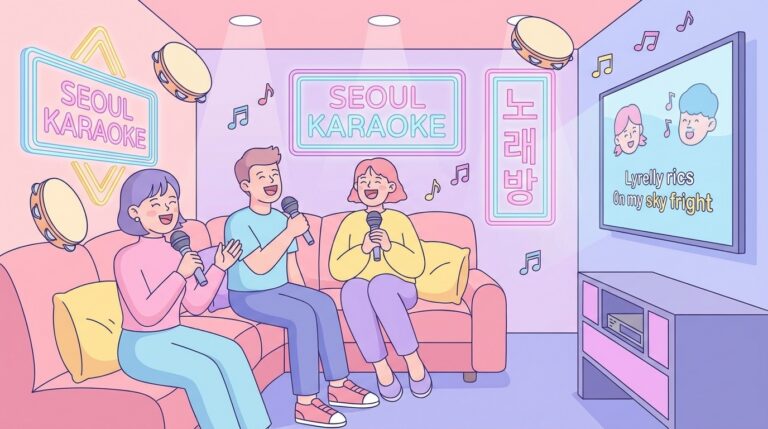
Picture this: You step into a neon-lit Coin Noraebang (코인노래방) in Hongdae with your Korean friends. The disco ball spins, the tambourine is shaking, and it is finally your turn to sing. You pick your favorite K-pop anthem—maybe an emotional ballad or an energetic idol track. But the moment the intro ends, panic strikes! The backing track is impossibly high, like an opera singer’s register, and the lyrics scroll past at lightning speed. You scramble to find the right buttons on the giant remote control, staring blankly at labels like 음정 (pitch) and 템포 (tempo).
If you have ever felt your voice crack on an unexpected high note or lost your rhythm while trying to match rapid Korean rap, you are definitely not alone. Nearly every beginner learner tells us: “I love singing in Korea, but I get terrified when the key doesn’t fit my voice!” That is why we built this friendly guide based on real student experiences. By the end of this mini-guide, you will know exactly what to say to lower the key, slow the rhythm, and laugh off any musical hiccups like a true local.
Phase 2: Core 3 Expressions In-Depth
1. 키 낮춰 줘요! (Ki natchwo jwoyo!)
- Pronunciation: [Ki na-chwo jwo-yo] (Sounds like: Key + not-chwo + jwo-yo)
- Meaning: Literal: “Lower the key, please!” | Actual Nuance: “This note is way too high for me, help me take it down!”
- K-Culture Moment: You will see this scene constantly in K-Dramas and variety shows like Running Man. Someone enthusiastically queues up a legendary high-note ballad (like Kim Bum-soo or Ailee), hits the chorus, feels their vocal cords give up, and frantically waves at the friend holding the remote control shouting: “키 낮춰 줘!”
- Editor’s Insight: The English word “key” is widely borrowed as 키 (ki) in Korean music and karaoke contexts. Adding 낮춰 줘요 (natchwo jwoyo, from 낮추다 meaning to lower) makes it an easy, natural request that spares your vocal cords.
- Situation Spectrum:
- Casual (Close friends): ✅ 키 낮춰 줘! (Ki natchwo jwo!)
- Semi-formal (Polite standard): ✅ 키 낮춰 줘요! (Ki natchwo jwoyo!)
- Formal (To elders/bosses): ⚠️ 키 좀 낮춰 주시겠어요? (Ki jom natchwo jusigesseoyo?)
- 🤔 Think About It: In English, we often say “Can you take it down a step?” Notice how Korean simplifies the borrowed word Key and focuses immediately on the action of lowering (낮추다).
2. 박자가 너무 빨라요! (Bakjaga neomu ppallayo!)
- Pronunciation: [Bak-ja-ga neo-mu ppal-la-yo] (Sounds like: Bahk-jah-gah nuh-moo pahl-lah-yo)
- Meaning: Literal: “The beat is too fast!” | Actual Nuance: “I can’t keep up with the tempo!”
- K-Culture Moment: K-pop songs often have speedy verses or rap breaks. When an international guest tries singing BTS or BLACKPINK, the scrolling syllables fly by. Shouting this expression immediately signals your crew to press the 템포 느리게 (tempo neurige, tempo slower) button.
- Editor’s Insight: 박자 (bakja) specifically refers to rhythm, beat, or meter. When combined with 너무 (neomu, “too much/so”) and 빨라요 (ppallayo, “is fast”), it clearly explains why you are struggling without feeling embarrassed.
- Situation Spectrum:
- Casual: ✅ 박자 너무 빨라! (Bakja neomu ppalla!)
- Semi-formal: ✅ 박자가 너무 빨라요! (Bakjaga neomu ppallayo!)
- Formal: ⚠️ 박자가 조금 빠른 것 같습니다. (Bakjaga jogeum ppareun geot gatseumnida.)
- 🤔 Think About It: Does your native language distinguish rhythm (박자) from melody pitch (음정) as strictly as Korean does in everyday karaoke banter?
3. 저 완전 음치예요! (Jeo wanjeon eumchi-yeyo!)
- Pronunciation: [Jeo wan-jeon eum-chi-ye-yo] (Sounds like: Juh wahn-juhn oom-chee-yay-yo)
- Meaning: Literal: “I am completely tone-deaf!” | Actual Nuance: “Don’t expect perfection—I’m just here to have fun!”
- K-Culture Moment: On music shows like I Can See Your Voice (너의 목소리가 보여), contestants are divided into skilled singers (실력자) and tone-deaf entertainers (음치). Owning up to being an eumchi is a beloved, self-deprecating way to break tension and bring laughter to the room.
- Editor’s Insight: The suffix 치 (-chi) denotes someone lacking a particular sense or coordination (e.g., 박치 for beat-deaf, 길치 for someone with no sense of direction). Calling yourself an 음치 softens expectations instantly.
- Situation Spectrum:
- Casual: ✅ 나 완전 음치야! (Na wanjeon eumchiya!)
- Semi-formal: ✅ 저 완전 음치예요! (Jeo wanjeon eumchi-yeyo!)
- Formal: 🚫 (Avoid in serious music auditions; safe in casual company gatherings).
- 🤔 Think About It: Humility is a cherished virtue in Korean social gatherings. Showing vulnerability early often earns you louder cheers and tambourine support!
Phase 3: Textbook Korean vs Real Korean
Situation 1: Asking someone to adjust the high pitch
- 📖 교과서 한국어 (Textbook Korean): 노래의 음정을 한 단계 내려 주실 수 있습니까? (Norae-ui eumjeong-eul han dangye naeryeo jusil su itsseumnikka? / “Could you lower the musical pitch of the song by one step?”)
- 🗣️ 진짜 한국어 (Real Korean): 키 하나만 내려 줘요! (Ki hanaman naeryeo jwoyo! / “Just drop the key by one, please!”)
- 💡 왜 다를까? (Why is it different?): In a noisy karaoke room, long grammar sentences get swallowed by loud speakers. Native speakers use the short loanword 키 (ki) plus 하나만 (hanaman, just one) for immediate action.
Situation 2: Confessing that you missed the beat
- 📖 교과서 한국어 (Textbook Korean): 제가 박자 감각이 부족하여 타이밍을 놓쳤습니다. (Jega bakja gamgagi bujokhayeo taiming-eul notchyeotseumnida. / “I missed the timing because my rhythmic perception is lacking.”)
- 🗣️ 진짜 한국어 (Real Korean): 아, 박자 놓쳤다! (A, bakja notchyeotda! / “Ah, I totally lost the beat!”)
- 💡 왜 다를까? (Why is it different?): Spontaneous exclamations like 놓쳤다 (notchyeotda, “I dropped/missed it!”) convey immediate playful frustration without sounding like an academic report.
Phase 4: K-Culture Deep Dive & Non-Verbal Manners
4-1. 눈치 (Nunchi) & Remote Control Etiquette
In a Korean karaoke room, holding the massive remote control (리모컨) comes with great responsibility. It is considered courteous Nunchi (social awareness) to keep an eye on your singing friend. If their veins are popping on their neck during high notes, do not wait for them to beg—hover your finger over the [키 낮춤] (Key Down) button or enthusiastically shake the tambourine to cover up their cracking voice!
4-2. The Culture of High Notes (고음) and “Heung” (흥)
K-pop ballads are notorious for demanding vocal acrobatics. But in Korea, Noraebang is rarely an audition; it is an emotional release of Heung (collective joy and passion). Nobody cares if your pitch wanders off into another dimension as long as you deliver genuine feeling. Learning to adjust the key or laugh off your eumchi moments proves you are present in the moment with everyone else.
Phase 5: Real Roleplay Scenario
Setting: Room 4 at a cozy Coin Noraebang in Sinchon. Neon pink lights reflect on the screen. Min-ji (민지), your bubbly Korean university classmate, holds the remote control.
- Turn 1 (Min-ji): 이 노래 시작한다! 준비됐어? (I norae sijakhanda! Junbidaesseo?)
- 🎭 Leaning forward, holding the microphone out to you with an encouraging grin.
- (The song is starting! Are you ready?)
- Turn 2 (You): 어… 그런데 키가 너무 높은 것 같아요! (Eo… geureonde kiga neomu nopeun geot gatayo!)
- 🎭 Eyes widening as the high intro melody plays on the speakers.
- (Uh… but I think the key is way too high!)
- Turn 3 (Min-ji): 그래? 그럼 얼른 말해! 얼마나 내릴까? (Geurae? Geureom eolleun malhae! Eolmana naerilkka?)
- 🎭 Finger poised directly over the remote control buttons.
- (Really? Tell me quick! How much should I lower it?)
- Turn 4 (You): 키 두 개만 낮춰 줘요! (Ki du gaeman natchwo jwoyo!)
- 🎭 Holding up two fingers pleadingly.
- (Please lower the key by two steps!)
- Turn 5 (Min-ji): 오케이, 두 키 다운! 이제 불러 봐! (Okei, du ki daun! Ije bulleo bwa!)
- 🎭 Tapping the button twice vigorously and nodding to the bassline.
- (Okay, two keys down! Now give it a try!)
- Turn 6 (You): 와, 훨씬 편해요! 그런데 박자가 조금 빨라요! (Wa, hwolssin pyeonhaeyo! Geureonde bakjaga jogeum ppallayo!)
- 🎭 Laughing nervously as rapid Korean lyrics scroll across the screen.
- (Wow, much more comfortable! But the tempo is a bit fast!)
- Turn 7 (Min-ji): 걱정 마, 템포 줄였어. 같이 부르자! (Geokjeong ma, tempo juryeosseo. Gachi bureuja!)
- 🎭 Lowering the speed button and grabbing the second microphone to sing harmony.
- (Don’t worry, I slowed the tempo. Let’s sing together!)
- Turn 8 (You): 고마워요! 저 완전 음치지만 열심히 할게요! (Gomawoyo! Jeo wanjeon eumchijiman yeolsimhi halgeyo!)
- 🎭 Smiling brightly and singing into the mic with all your heart.
- (Thank you! I’m totally tone-deaf, but I’ll do my best!)
🔀 Interactive Decision Point
When the verse suddenly accelerates into a difficult rap, what will you say to Min-ji?
* Choice A: “노래 취소해 주세요!” (Norae chwisohae juseyo! / Please cancel the song!)
* Feedback [Risk]: While valid, abruptly canceling the song kills the party vibe! It’s much more fun to power through.
* Choice B: “박자가 너무 빨라요! 템포 좀 줄여 줘요!” (Bakjaga neomu ppallayo! Tempo jom juryeo jwoyo!)
* Feedback [Best]: Perfect! Clear, natural, and keeps the performance rolling seamlessly.
* Choice C: “음악의 속도를 저하해 주시길 희망합니다.” (Eumagui sokdoreul jeohahae jusigil huimanghamnida.)
* Feedback [Bad]: Far too formal and robotic! In karaoke, quick and lively beats textbook syntax every single time.
Phase 6: 10-Second Emotional Shadowing Drill
Practice these quick phrases aloud. Pay attention to the pause markers (/) and emotional tone tags:
[🥺 Urgent and cute]키 낮춰 줘요! / 두 개만요! (Ki natchwo jwoyo! / Du gaemanyo!)[😲 Surprised and breathless]잠깐만! / 박자가 / 너무 빨라요! (Jamkkanman! / Bakjaga / neomu ppallayo!)[😆 Playful and humble]저 완전 / 음치니까 / 웃지 마세요! (Jeo wanjeon / eumchinikka / utji maseyo!)
Phase 7: K-Culture Mini Dictionary
- 음치 (Eumchi) | Tone-deaf person
- Common Usage: Widely used to excuse imperfect singing among friends or banter on entertainment broadcasts.
- 박치 (Bakchi) | Beat-deaf person (lacking rhythm)
- Common Usage: Used when someone claps off-beat or struggles to stay in sync with upbeat dance tracks.
- 간주 점프 (Ganju jeompeu) | Skip the musical interlude
- Common Usage: Noraebang remote controls feature a literal button called 간주 점프. Pressing this skips long instrumental sections to save precious minutes!
- 취소 (Chwiso) | Cancel / Stop song
- Common Usage: Pressing this stops the current track immediately. Use sparingly to preserve room morale!
Phase 8: Traveler Survival Kit
Top 3 Survival Expressions for Karaoke
- 키 올려 주세요 (Ki ollyeo juseyo) | [Key up, please]
- Pro Tip: If a song feels awkwardly deep for your vocal range, ask to bump the key up!
- 마이크 볼륨 좀 키워 줘요 (Maikeu bollyum jom kiwo jwoyo) | [Please turn up the mic volume]
- Pro Tip: Use this when your voice is getting drowned out by the thunderous backtrack.
- 템포 느리게 해 줘요 (Tempo neurige hae jwoyo) | [Please make the tempo slower]
- Pro Tip: Useful when singing Korean lyrics you haven’t fully memorized yet.
Editor’s Travel Note
When looking for spontaneous fun in Seoul or Busan, search for “코인노래연습장” on the Naver Map app navigation. Most coin noraebangs accept credit cards and T-money transit cards directly at machine kiosks, charging around 1,000 KRW for 2 to 3 songs. Look at the wall posters for English remote control diagrams if the buttons ever feel confusing!
Phase 9: “한 발 더 깊이” (A Deeper Cultural Reflection)
In many Western cultures, karaoke can feel like an audition where solo vocal ability is on display. In Korea, Noraebang is fundamentally an exercise in collective vulnerability and solidarity. Screaming off-key together, butchering the tempo of a legendary rap, and laughing until your stomach hurts dissolves hierarchical workplace stress and social tension.
When you admit “저 완전 음치예요!” (I’m totally tone-deaf!), you aren’t apologizing for a flaw; you are inviting your friends to join in your joyful imperfection.
💬 Your Turn: Have you ever tried singing a Korean song at karaoke? Which K-pop track was the hardest to match in pitch or tempo? Share your hilarious moments in the comments below!
Phase 10: FAQ & Avoiding Misunderstandings
Q: Can I use the word “Tone” instead of “Key” when asking to change pitch?
A: In Korean karaoke, loanwords have specific functions. While “tone” (톤) refers to vocal color or timbre, pitch range is almost universally referred to as 키 (Ki). Always ask for 키 낮춤 (lower key) or 키 올림 (raise key).
Q: What is the difference between 박자 (Bakja) and 템포 (Tempo)?
A: Bakja (박자) is the traditional Korean word for meter or beat, while Tempo (템포) specifically refers to speed control buttons on karaoke remotes. You can say 박자가 빨라요 (the beat is fast) and ask someone to press 템포 느리게 (slow down tempo).
Q: Is calling someone an “음치” (Eumchi) rude?
A: Calling someone an eumchi can be offensive if said seriously to an acquaintance. However, using it playfully about yourself (저 완전 음치예요) is considered endearing, modest, and humorous!
🚨 Common Mistakes Alert
- Saying “소리 낮춰 줘요” to mean lower pitch: 소리 (sori) means volume, not musical pitch! If you want lower notes, specify 키 낮춰 줘요 (Ki natchwo jwoyo).
- Pressing 취소 (Cancel) without asking: Abruptly stopping a song while someone else is singing is a major breach of Noraebang etiquette. Always ask first!
- Mumbling in silence when behind beat: If the words are scrolling too fast, just shout 박자가 너무 빨라요! and laugh along—never suffer in silence!
Phase 11: Action Missions & K-Culture Challenge
- 🥉 Bronze Mission (Solo): Stand in front of a mirror and practice saying “키 두 개만 낮춰 줘요!” smoothly in 3 seconds.
- 🥈 Silver Mission (Social): Record yourself saying “저 완전 음치예요!” with a dramatic, humorous expression and share it with a study buddy or language exchange partner.
- 🥇 Gold Mission (Real Life): Visit a local coin noraebang, find the [키 낮춤] button on the remote, and successfully adjust a song before the first verse ends.
- 🎮 K-Culture Mission: Watch an episode of a Korean variety show (like Knowing Bros or Running Man) during a singing segment and listen for when cast members shout “키 낮춰!” or complain about 박자!
Phase 12: Interactive Quiz Challenge
Question 1: Situational Judgment
You queued up an upbeat song, but the singer is rapping faster than you can read Korean syllables. What should you immediately yell to your friend near the machine?
* A) 키 높여 줘요! (Ki nopyeo jwoyo!)
* B) 박자가 너무 빨라요! (Bakjaga neomu ppallayo!)
* C) 노래 취소하지 마세요! (Norae chwisohaji maseyo!)
Question 2: Fill in the Blank
Complete the sentence to self-deprecatingly admit that you can’t hit musical notes properly:
“저 노래 진짜 못해요. 저 완전 [ ______ ]예요!”
* A) 길치 (Gilchi)
* B) 몸치 (Momchi)
* C) 음치 (Eumchi)
Question 3: True or False
In Korean noraebang culture, pressing “간주 점프” (Ganju jeompeu) is considered rude because people prefer listening to long instrumental pauses.
* (True / False)
👉 Click here for Answer & Explanation
- Question 1 Answer: B) 박자가 너무 빨라요! (Bakjaga neomu ppallayo!)
- Explanation: When lyrics flow too fast, the rhythm/tempo is the culprit! Option A raises the vocal pitch higher, which would only make things harder.
- Question 2 Answer: C) 음치 (Eumchi)
- Explanation: Eumchi means tone-deaf. (Bonus knowledge: Gilchi means someone with no sense of direction, and Momchi means someone who cannot dance!)
- Question 3 Answer: False
- Explanation: In fast-paced Korean karaoke gatherings, pressing 간주 점프 to skip long instrumental bridges is widely welcomed because it maximizes singing time for everyone in the room!
- Explanation: In fast-paced Korean karaoke gatherings, pressing 간주 점프 to skip long instrumental bridges is widely welcomed because it maximizes singing time for everyone in the room!







