Phase 1: 공감 (Story-Driven Opening)
안녕하세요! 매일한글 에디터입니다.
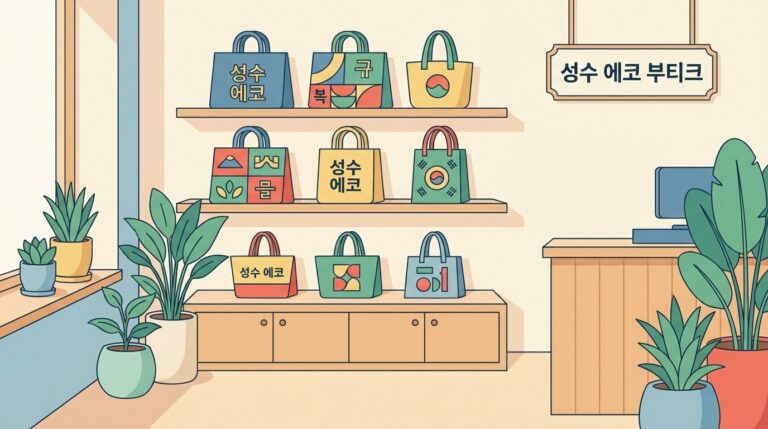
Picture this: You are strolling through the red-brick alleys of Seongsu-dong, Seoul’s undisputed epicenter of youth culture and hip concept stores. You step inside a sunlit boutique smelling of cedarwood and upcycled canvas. You spot an incredible messenger bag crafted from retired fire hoses. You want to ask the friendly designer about its origin, its durability, and whether it’s truly an upcycled piece. But your mind freezes. You search your memory: “Is this trash?” (이거 쓰레기예요?) sounds horribly rude! “이 제품은 폐기물을 재활용한 것입니까?” sounds like an official United Nations environmental audit report.
Many intermediate learners hit this exact wall. You have moved past beginner greetings, but you lack the chic, nuanced vocabulary to discuss sustainability naturally with Seoulites. Don’t worry—based on hundreds of real coaching sessions with learners just like you, this guide delivers the exact B2 phrases, non-verbal cues, and cultural depth you need to shop sustainably and sound like a thoughtful local.
Phase 2: 핵심 표현 3선 심층 분석 (Core Expressions)
1. 이거 폐현수막으로 만든 거 맞죠?
- Pronunciation: [Igeo pye-hyeonsumak-euro mandeun geo matjyo?] (Sounds like: ee-gaw pyeh-hyun-soo-mahk-oo-ro mahn-deun gaw maht-jyo? — smooth transition on ‘pye’)
- Meaning: “This is made from discarded banners, right?” (Literal) vs. “Oh, this is repurposed banner material, isn’t it?” (Actual nuance, showing educated curiosity)
- K-Culture Moment: Seen in eco-vlogs by indie K-indie musicians browsing weekend flea markets along the Han River.
- Editor’s Insight: Notice the prefix 폐- (pye-), derived from hanja 廢 (discarded/abandoned). In eco-shopping, pairing 폐- with items like 현수막 (banners), 타이어 (tires), or 소방호스 (fire hoses) shows sophisticated intermediate vocabulary.
- Situation Spectrum: Casual ✅ | Semi-formal ✅ | Formal ⚠️
- 🤔 Think About It: In English, we often just say “recycled material,” but Korean upcycling fans love identifying the exact former life of the object. What does this reveal about how Koreans value storytelling in design?
2. 새활용 제품이라 세상에 하나뿐이네요.
- Pronunciation: [Saehwalyong jepum-ira sesang-e hanappun-ineyo.] (Sounds like: seh-hwahl-yong jeh-poom-ee-rah seh-sahng-eh hah-nah-ppoon-ee-neh-yo)
- Meaning: “Because it is an upcycled item, it is the only one in the world.” (Literal) vs. “Since it’s upcycled, it’s truly one-of-a-kind!” (Actual nuance: High praise for the artisan)
- K-Culture Moment: Used by variety show hosts touring upcycled lifestyle exhibitions in DDP (Dongdaemun Design Plaza).
- Editor’s Insight: While ‘재활용’ (jaehwalyong) means standard recycling, ‘새활용’ (saehwalyong) is the official pure-Korean term coined specifically for upcycling (새로운 + 활용, creating new value). Using this word instantly tags you as an eco-insider.
- Situation Spectrum: Casual ⚠️ | Semi-formal ✅ | Formal ✅
- 🤔 Think About It: Why do you think Korean created a brand-new native word (새활용) instead of just using an English loanword? How does this elevate the perceived status of the craft?
3. 내구성이 좋아서 오래 쓸 수 있겠어요.
- Pronunciation: [Naeguseong-i joaseo orae sseul su itgesseoyo.] (Sounds like: neh-goo-sung-ee joh-ah-suh oh-reh ssul soo eet-get-ssuh-yo)
- Meaning: “Durability is good, so I can use it for a long time.” (Literal) vs. “It feels sturdy enough to last for years.” (Actual nuance: Practical appreciation of quality)
- K-Culture Moment: A classic phrase heard on consumer review channels on YouTube when reviewing high-end sustainable fashion brands like FREITAG or 119RESEO.
- Editor’s Insight: Eco-conscious Korean consumers (the MZ generation) prioritize both ethics and utility. Saying 내구성 (naeguseong – durability) demonstrates that you aren’t just buying out of novelty, but investing in sustainable longevity.
- Situation Spectrum: Casual ⚠️ | Semi-formal ✅ | Formal ✅
- 🤔 Think About It: How does complimenting the durability of a product bridge the gap between traditional thriftiness and modern environmental awareness?
Phase 3: 교과서 한국어 vs 진짜 한국어 (Textbook vs. Real-Life Korean)
Situation 1: Inquiring about the origin of the raw material
- 📖 교과서 한국어: 이 제품은 어떤 쓰레기를 재활용하여 생산되었습니까? (I jepum-eun eotteon sseuregi-reul jaehwalyong-hayeo saengsan-doe-eotseumnikka? / What waste was recycled to produce this product?)
- 🗣️ 진짜 한국어: 이거 원래 어떤 소재로 쓰이던 거예요? (Igeo wonrae eotteon sojae-ro sseu-ideon geoyeyo? / What was this material originally used for?)
- 💡 왜 다를까? (Why the difference?): Using the word 쓰레기 (garbage/trash) directly in front of an indie artisan or shop clerk can sound abrasive. Locals prefer the polished term 소재 (sojae – material/fabric) to honor the creative transformation of the craft.
Situation 2: Praising the unique texture or pattern
- 📖 교과서 한국어: 제품의 외관 디자인이 매우 독특하고 아름답습니다. (Jepum-ui oegwan dijain-i maeu dokteuk-hago areumdapseumnida. / The exterior design of the product is very unique and beautiful.)
- 🗣️ 진짜 한국어: 빈티지한 질감이 살아있어서 완전 힙해요! (Bintiji-han jilgam-i sara-isseoseo wanjeon hip-haeyo! / The vintage texture really stands out, it’s so hip!)
- 💡 왜 다를까? (Why the difference?): Textbook sentences rely on rigid descriptors like ‘외관 디자인’ (exterior design). Modern B2 Korean naturally combines aesthetic appreciation like 질감이 살아있다 (the texture is alive/distinct) with contemporary slang like 힙하다 (hip/cool).
Phase 4: K-Culture 딥다이브 & 비언어적 매너 (Deep Dive & Manners)
4-1. 눈치 (Nunchi) & Physical Manners in Upcycle Boutiques
Upcycling stores in places like Seongsu, Hannam-dong, or Yeonnam-dong operate more like art galleries than fast-fashion retail chains. Each item often possesses a distinct texture, weathering mark, or serial stamp.
* The Two-Handed Hold: When inspecting an upcycled wallet or tote bag, avoid dangling it with one finger. Pick it up with both hands gently. It signals to the owner that you view the piece as functional art.
* The Tag Nod: Upcycled products in Korea almost always feature a storytelling tag detailing the source (e.g., “Rescued from a 2022 mountaineering tent”). When the shopkeeper points this out, offer a gentle nod with a soft exclamation like “아, 진짜요?” (Ah, really?).
4-2. Cultural Code: ‘가치소비’ (Value-Driven Consumption)
In Korea, the shift toward sustainable shopping is spearheaded by the MZ generation under the banner of 가치소비 (Gachi-sobi)—literally “value-oriented consumption.” It means voting with your wallet. Walking into a store with an eco-bag and taking an interest in upcycled goods instantly positions you in Korean society as an enlightened, stylish, and socially responsible individual.
Phase 5: 실전 롤플레이 시나리오 (Interactive Roleplay)
Setting: Re:Seoul, a cozy upcycled design boutique tucked into an alley behind Seongsu Station.
NPC Character: Min-ji (민지), a passionate 28-year-old eco-designer with round glasses and an apron made of denim scraps.
- Turn 1 (Min-ji): 안녕하세요! 편하게 둘러보세요. 모든 제품은 업사이클링으로 제작되었어요.
(Annyeonghaseyo! Pyeonhage dulleoboseyo. Modeun jepum-eun eopsaikkeulling-euro jejag-doe-eosseoyo. / Hello! Feel free to look around. All items are crafted through upcycling.)
🎭 Warm smile, stepping slightly aside to give personal space - Turn 2 (You): 구경 좀 할게요! 혹시 이 가방은 원래 어떤 소재였어요?
(Gugyeong jom halgeyo! Hoksi i gabang-eun wonrae eotteon sojae-yeosseoyo? / I’ll look around! By the way, what was this bag made from originally?)
🎭 Gently lifting the strap of a durable yellow tote bag with two hands - Turn 3 (Min-ji): 아, 그거 알아봐 주셨네요! 버려진 군용 텐트를 수거해서 세척한 뒤에 다시 만든 제품이에요.
(A, geugeo arabwa jusyeotneyo! Beoryeojin gun-yong tenteu-reul sugeo-haeseo secheok-han dwi-e dasi mandeun jepum-ieyo. / Ah, you noticed! It’s made by collecting discarded military tents, washing them thoroughly, and rebuilding them.)
🎭 Eyes lighting up with pride as she taps the fabric surface - Turn 4 (You): 군용 텐트요? 그래서 그런지 내구성이 엄청 좋아 보여요.
(Gun-yong tenteuyo? Geuraeseo geureonji naeguseong-i eomcheong joa boyeoyo. / Military tents? No wonder the durability looks incredible.)
🎭 Nodding with mild admiration while inspecting the seams - Turn 5 (Min-ji): 맞아요. 방수도 완벽하고 찢어질 걱정이 전혀 없어요! 원단마다 얼룩이나 스크래치가 달라서 세상에 딱 하나뿐이에요.
(Majayo. Bangsu-do wanbyeokhago jjijeojil geokjeong-i jeonhyeo eopseoyo! Wondan-mada eolluk-ina seukeuraechi-ga dallaseo sesang-e ttak hanappun-ieyo. / Exactly. It’s completely waterproof and never tears! Since the weathering and scratches on each fabric differ, it’s strictly one-of-a-kind.)
🎭 Showing the unique serial number stamped inside the pocket - Turn 6 (You): 새활용 제품이라 더 의미가 깊네요. 마감 처리도 정말 깔끔하고요.
(Saehwalyong jepum-ira deo uimi-ga gimneyo. Magam cheori-do jeongmal kkalkkeumhagoyo. / It has even deeper meaning because it’s upcycled. The stitch finishing is also very neat.)
🎭 Stroking the clean seam line appreciatively - Turn 7 (Min-ji): 감사해요! 환경 생각하시는 분들이 알아봐 주실 때 제일 보람차요.
(Gamsahaeyo! Hwangyeong saenggak-hasineun bundeul-i arabwa jusil ttae jeil boramchayo. / Thank you! It’s most rewarding when eco-conscious shoppers recognize the effort.)
🎭 Bowing slightly with genuine gratitude - Turn 8 (You): 이거 정말 마음에 들어요. 이걸로 구매할게요! 포장은 따로 안 해주셔도 돼요.
(Igeo jeongmal maeum-e deureoyo. Igeol-ro gumae-halgeyo! Pojang-eun ttaro an hae-jusyeodo dwaeyo. / I really love this. I’ll take it! You don’t need to wrap it for me.)
🎭 Handing over your payment card while gesturing to your personal reusable canvas bag
🔀 인터랙티브 분기점 (Interactive Branching Point)
Imagine Min-ji tells you: “이 파우치는 폐낙하산 줄로 만든 키링이 포인트예요.” (This pouch features a key ring made from discarded parachute cords). How do you reply?
- Option A: “우와, 폐낙하산 줄이라니 완전 튼튼하겠네요! 디테일까지 친환경적이라 멋져요.”
(Woowa, pye-nakkahasan jul-irani wanjeon teunteun-hagetneyo! Diteil-kkaji chin-hwangyeong-jeok-ira meotjyeoyo. / Wow, parachute cord must be so sturdy! It’s so cool that even the details are eco-friendly.)
👉 [Best Choice] Feedback: 100/100! You complimented durability (튼튼하다), noticed small details (디테일), and affirmed their eco-ethos (친환경적). Min-ji will probably throw in an upcycled sticker set for free! -
Option B: “낙하산 쓰레기를 모아서 파는데 생각보다 가격이 비싸네요?”
(Nakkahasan sseuregi-reul moaseo paneunde saenggak-boda gagyeok-i bissaneyo? / You collected parachute trash to sell this, but isn’t it more expensive than expected?)
👉 [Bad Choice] Feedback: Instant mood killer! Calling upcycled components ‘쓰레기’ and publicly questioning the cost negates the artisan’s labor of collecting, sterilizing, and processing raw scrap materials. -
Option C: “그냥 일반 새 줄로 만드는 게 더 깨끗하지 않아요?”
(Geunyang ilban sae jul-ro mandeuneun ge deo kkaekkeut-haji anayo? / Wouldn’t it be cleaner to just make it with regular new cords?)
👉 [Risk Choice] Feedback: Grammatically fine, but socially awkward in an upcycling boutique. It ignores the core mission of the store and questions the hygienic standards of the merchandise.
Phase 6: 10초 감정 섀도잉 드릴 (Shadowing Drill)
Practice matching these rhythm breaks (/) and pitch contours to capture native emotional authenticity:
[😊 기쁘고 감탄하며 / Delighted & Impressed]
“이거 / 버려진 소재로 만든 거 맞아요? / 질감이 너무 유니크해요!”
(Igeo / beoryeojin sojae-ro mandeun geo majayo? / Jilgam-i neomu yunikeu-haeyo!)-
[🤔 호기심 가득하고 진지하게 / Curious & Engaged]
“새활용 제품이라 / 세상에 딱 하나뿐이라는 점이 / 정말 매력적이네요.”
(Saehwalyong jepum-ira / sesang-e ttak hanappun-iraneun jeom-i / jeongmal maeryeok-jeogineyo.) -
[🌿 차분하고 배려심 넘치게 / Thoughtful & Eco-Minded]
“제 가방에 바로 넣을게요. / 비닐이나 포장은 / 안 해주셔도 괜찮습니다!”
(Je gabang-e baro neoeulgeyo. / Binil-ina pojang-eun / an hae-jusyeodo gwaenchansseumnida.)
Phase 7: K-Culture 미니 사전 (Mini Dictionary)
-
새활용 (Saehwalyong) | Noun | Upcycling
Usage: Official Korean standard word combining ‘new’ (새) and ‘practical use’ (활용). Frequently seen in municipal names like “서울새활용플라자” (Seoul Upcycling Plaza). -
가치소비 (Gachi-sobi) | Noun | Value-driven consumption / Ethical shopping
Usage: Describes the trend where buyers willingly spend extra money on items aligned with environmental protection, social justice, or animal welfare. -
제로웨이스트 (Jero-we-i-seu-teu) | Noun | Zero Waste
Usage: Widely used in café and lifestyle contexts (e.g., “제로웨이스트 샵”). Often accompanied by bringing personal containers (용기내 챌린지). -
팝업스토어 (Pap-eop Seuto-eo) | Noun | Pop-up Store
Usage: Temporary brand stores dominating Seongsu and Hongdae. Upcycled fashion labels frequently debut limited-edition collections through these pop-ups.
Phase 8: 여행자를 위한 생존 키트 (Traveler’s Survival Kit)
Survival Expressions TOP 3
- 포장 안 해주셔도 돼요, 에코백 있어요.
(Pojang an hae-jusyeodo dwaeyo, ekobaek isseoyo.)
Pro Tip: Saves 100~500 KRW paper bag fees and earns instant respect from eco-friendly store clerks. - 이 브랜드의 다른 업사이클링 라인도 볼 수 있나요?
(I beuraendeu-ui dareun eopsaikkeulling rain-do bol su innayo?)
Pro Tip: Perfect when you love the concept but want a different colorway or accessory format. - 세탁할 때 특별히 주의할 점이 있을까요?
(Setak-hal ttae teukbyeolhi ju-ui-hal jeom-i isseulkkayo?)
Pro Tip: Essential for upcycled vinyl or industrial fabrics that cannot go into standard high-heat dryers.
Editor’s Travel Note
- Navigate Eco-Seoul: Download Naver Map App for Seongsu eco-store routes to save hidden pop-ups that do not appear on Google Maps.
- Cashless Society: Nearly all Korean concept boutiques are 100% cashless. Bring your international travel debit card or install local transit payment services.
- Packaging Etiquette: Seoul enforces strict plastic bans; bakeries and boutiques charge for disposable bags by law. Always carry a folded compact nylon bag!
Phase 9: “한 발 더 깊이” (Cultural Essay)
Korea’s passion for sustainability is not a modern marketing gimmick; it is rooted deep in collective cultural memory. During the 1997 Asian Financial Crisis, Koreans banded together under the famous national campaign known as ‘아나바다’ (Anabada)—an acronym for 아껴 쓰고, 나눠 쓰고, 바꿔 쓰고, 다시 쓰자 (Save, Share, Swap, and Reuse).
Today, this historical instinct has evolved from survival into pride. For modern Koreans, carrying a bag made from an old banner or an emergency vehicle canvas isn’t about being unable to afford luxury; it is a proud aesthetic statement saying, “I care about my planet, and I respect smart ingenuity.” When you engage with these shopkeepers using the right Korean terms, you aren’t merely buying a souvenir—you are validating their creative civic pride.
💬 Your Turn: Have you ever purchased an upcycled souvenir while traveling? If you could turn any discarded object into a fashion piece, what would it be? Share your thoughts below in Korean or English!
Phase 10: FAQ & 오해 방지 (FAQ Schema)
Q: Why are upcycled goods in Korea sometimes more expensive than brand-new factory items?
A: Upcycling requires collecting diverse raw scraps, sorting them manually, sanitizing industrial stains, and hand-cutting unique patterns. When you buy upcycled items in Seoul, you are paying for intensive artisanal labor and hygienic reprocessing, not cheap scrap metal or cloth.
Q: Is ‘재활용’ (Jaehwalyong) and ‘새활용’ (Saehwalyong) completely interchangeable?
A: Not quite! ‘재활용’ generally refers to conventional mechanical recycling (breaking plastic bottles down into pellets). ‘새활용’ specifically implies adding artistic and functional design value to elevate the discarded item into something superior (upcycling).
Q: Can I negotiate the price (깎아주세요) at an upcycling boutique?
A: Absolutely not! In vintage open flea markets, gentle haggling can occasionally happen, but in upcycle boutiques and design pop-ups in Seongsu or Yeonnam, prices are strictly fixed. Bargaining can offend the independent artisan.
🚨 흔한 실수 (Common Mistakes) 경고판
- ❌ Mistake 1: Calling the materials 쓰레기 (garbage) instead of 소재 (material) or 원단 (fabric).
Correct Action: Say버려진 소재(discarded materials) or재활용 원단(recycled textile). - ❌ Mistake 2: Assuming upcycled products are fragile or dirty.
Correct Action: Upcycled goods in Korea undergo rigorous industrial sterilization and sanitization before fabrication. - ❌ Mistake 3: Saying “이거 중고예요?” (Is this secondhand?).
Correct Action: Upcycled items are crafted anew from reclaimed raw material, so they are not categorized as used secondhand goods (중고). Use새활용 제품.
Phase 11: 액션 미션 & 참여 유도 (Action Missions)
- 🥉 Bronze Mission (Solo Practice): Stand in front of your mirror with any bag or accessory you own and rehearse this line out loud 3 times: “이거 내구성이 진짜 좋아서 오래 쓸 수 있겠어요!”
- 🥈 Silver Mission (Social Learning): Take a photo of an eco-friendly product in your home, post it to your Instagram story, and caption it: #새활용 #가치소비 세상에 하나뿐인 아이템! Tag us @DailyHangul.
- 🥇 Gold Mission (Real-Life Application): Next time you purchase anything at a convenience store or boutique in Korea, proudly refuse the plastic bag by saying: “포장은 안 해주셔도 괜찮아요!”
- 🎮 K-Culture Mission: Watch BTS’s United Nations General Assembly speech appearance from 2021. Notice the sharp black suits they wore? They were custom-tailored by the Korean upcycled fashion label RE;CODE using deadstock suit fabric! Look up the brand and check their catalog.
Phase 12: 인터랙티브 퀴즈 챌린지 (Interactive Quiz)
Test your intermediate eco-fluency below!
- [Situational Judgement] You are examining an upcycled pouch made from an old vinyl gym mat. What is the most culturally polished compliment you can give to the shop owner?
a) 쓰레기로 만들었는데 냄새가 안 나네요!
b) 마감도 깔끔하고 빈티지한 질감이 진짜 매력적이에요.
c) 중고품 치고는 디자인이 나쁘지 않네요.
d) 이거 공장에서 대량 생산한 거 아니죠? -
[Fill-in-the-Blank] Complete the sentence with the appropriate vocabulary:
“환경을 생각해서 가방을 구매하는 MZ세대의 ( ) 트렌드가 확산되고 있습니다.”
a) 과소비 (Gwasobi)
b) 충동구매 (Chungdong-gumae)
c) 가치소비 (Gachi-sobi)
d) 사재기 (Sajaegi) -
[True / False Cultural Check]
In Korea, upcycled products are usually called ‘중고’ (secondhand) because their materials were once previously used. (True / False)
👉 Click to reveal answers & explanations
-
Answer: b)
Explanation: Complimenting the neat stitching finish (마감도 깔끔하고) and vintage texture (빈티지한 질감) praises the artisan’s skills. Options a, c, and d use impolite terms like ‘쓰레기’ and ‘중고품’. -
Answer: c) 가치소비 (Gachi-sobi – Value-driven consumption)
Explanation: 과소비 means overspending, 충동구매 means impulse buying, and 사재기 means hoarding. -
Answer: False
Explanation: Upcycled products are classified as ‘새활용 제품’ (upcycled creations), not ‘중고’ (used/secondhand), because they have been re-engineered into brand-new functional items.