

Phase 1: Empathy (Immersive Storytelling Opening)
안녕하세요! 매일한글 에디터입니다. (Hello! I’m your Daily Hangul editor.)
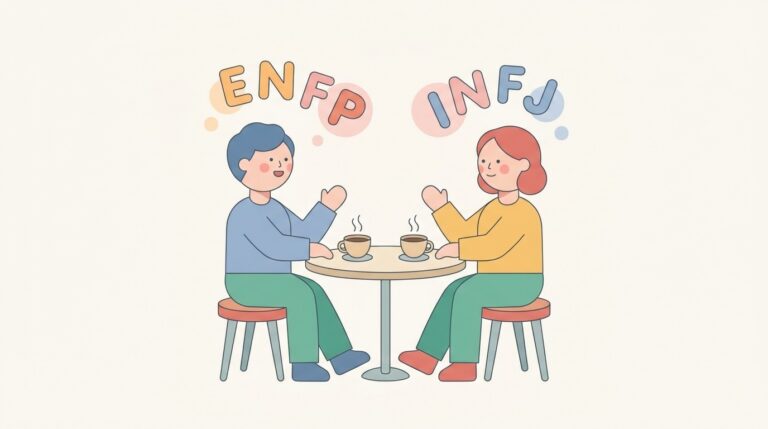
Picture this: You are sitting at a bustling cafe in Seongsu-dong with a group of new Korean friends. Within the first ten minutes of breaking the ice, someone leans in across the table and asks with sparkling eyes, “혹시 MBTI가 어떻게 되세요? (Hoksi MBTI-ga eotteoke doeseyo? / By the way, what is your MBTI?)”
In South Korea today, MBTI is far more than an HR personality test; it is the ultimate modern social catalyst. Whether you are watching K-dramas, tuning into K-pop idol livestreams, or going on a blind date (소개팅), people instantly use these four letters to gauge compatibility. But here is the real pain point for intermediate learners: once you tell them your type, how do you keep the banter rolling? How do you ask if you two are compatible without sounding like an academic psychologist reading a research paper? Many of our B1 students tell us they froze because their textbooks never taught them how to joke about personality chemistry.
Mastering these conversational nuances will instantly transform you from an awkward observer into an insider who can playfully bounce energy off anyone. Let’s dive into the authentic expressions that real Koreans use to check their chemistry!
Phase 2: Core Expressions Deep Dive
1. 우리 궁합 잘 맞을 것 같아요! (Uri gunghap jal majeul geot gat-ayo!)
- Pronunciation: [Uri gunghap jal majeul geot gat-ayo] (Sounds like: oo-ree goong-hahp jahl mah-jeul got gah-tah-yo)
- Meaning: Literal: “I think our marital compatibility matches well!” vs Real Nuance: “I feel like you and I will click really well!”
- K-Culture Moment: Frequently heard on Korean dating variety shows like Transit Love (환승연애) or Single’s Inferno when two contestants realize their complementary habits.
- Editor’s Insight: Originally, 궁합 (gunghap) referred to traditional marital fortune-telling based on birth charts. Today, young Koreans use it playfully for food pairings, friendships, and MBTI types.
- Situation Spectrum: Casual: ✅ | Semi-formal: ✅ | Formal: ⚠️
- 🤔 Think About It: In English, people say “We vibe together.” Why do you think Korean uses an ancient fortune-telling term (궁합) to describe casual social chemistry?
2. 너랑 나랑 완전 정반대네! (Neorang narang wanjeon jeongbandaene!)
- Pronunciation: [Neorang narang wanjeon jeongbandaene] (Sounds like: nuh-rahng nah-rahng wahn-juhn jung-bahn-deh-neh)
- Meaning: Literal: “You and I are complete opposites!” vs Real Nuance: “Wow, our personalities are night and day!”
- K-Culture Moment: Often blurted out by K-pop idols during behind-the-scenes vlogs when an extroverted ENFP tries to drag an introverted ISTP out for karaoke.
- Editor’s Insight: Adding 완전 (wanjeon / totally) emphasizes the contrast without any negative feeling. It actually invites the other person to share funny differences!
- Situation Spectrum: Casual: ✅ | Semi-formal: ⚠️ | Formal: 🚫
- 🤔 Think About It: Does pointing out differences in your home culture feel confrontational, or does it spark lighthearted curiosity like in Korea?
3. 우리 티키타카가 잘 되네요. (Uri tiki-takaga jal doeneyo.)
- Pronunciation: [Uri tiki-takaga jal doeneyo] (Sounds like: oo-ree tee-kee-tah-kah-gah jahl dweh-neh-yo)
- Meaning: Literal: “Our tiki-taka works well.” vs Real Nuance: “Our conversational rhythm and banter bounce back and forth effortlessly.”
- K-Culture Moment: Variety show hosts like Yoo Jae-suk use this whenever two guests trade quick-witted jokes without missing a beat.
- Editor’s Insight: Borrowed from the fast-paced Spanish football passing style (tiqui-taca), Koreans use it to describe effortless conversational chemistry.
- Situation Spectrum: Casual: ✅ | Semi-formal: ✅ | Formal: ⚠️
- 🤔 Think About It: When conversing in Korean, how much do you value the speed and rhythm of dialogue compared to grammatical perfection?
Phase 3: Textbook Korean vs Real Korean
Situation 1: Asking if your personalities get along
- 📖 교과서 한국어: 우리의 성격이 조화롭습니까? (Uri-ui seonggyeog-i johwaropseumnikka? / Are our personalities harmonious?)
- 🗣️ 진짜 한국어: 우리 성격 잘 맞을까요? (Uri seonggyeok jal majeulkkayo? / Do you think our personalities match well?)
- 💡 왜 다를까?: The word 조화롭다 (harmonious) is far too poetic and stiff for daily life. Real Koreans use the versatile verb 맞다 (to fit, to match) to express personal chemistry naturally.
Situation 2: Expressing that two types clash
- 📖 교과서 한국어: 우리는 성격이 전혀 맞지 않습니다. (Uri-neun seonggyeog-i jeonhyeo matji anseumnida. / Our personalities do not match at all.)
- 🗣️ 진짜 한국어: 우리 완전 상극인 거 아니에요? (Uri wanjeon sanggeuk-in geo anieyo? / Aren’t we total opposites who clash?)
- 💡 왜 다를까?: Stating mismatch directly can feel blunt and harsh. Using the cultural concept 상극 (sanggeuk / natural opposites) with a rhetorical question turns an awkward realization into a hilarious conversation topic.
Phase 4: K-Culture Deep Dive & Non-Verbal Manners
4-1. Nunchi & Body Language
When discussing MBTI in Korea, never treat it like a cold scientific diagnosis. Lean forward, tilt your head slightly with an amused smile, and clap your hands once lightly when you discover a shared trait (a classic Korean gesture called 맞장구 / clapping in agreement). If you find out you have contrasting letters (like T vs F), gasp playfully rather than debating logic. Keeping the atmosphere warm and self-deprecating is the golden rule of Korean 눈치 (nunchi).
4-2. Culture Code: The Evolution from Blood Types to MBTI
Before the MBTI boom, Koreans used blood types (혈액형) to categorize dating suitability (e.g., Type B men were considered mischievous bad boys, Type A people were gentle introverts). Today, MBTI has taken over because it gives sixteen colorful archetypes instead of four. It functions as an efficient social shortcut: in a collectivist culture where harmony matters, knowing someone’s MBTI helps Koreans adjust their interaction style quickly without overstepping boundaries.
Phase 5: Real-Life Roleplay Scenario
- Setting: A sunlit rooftop cafe in Yeonnam-dong. You are drinking iced Americanos with Minji, your Korean language-exchange partner.
- Characters:
- 민지 (Minji): A bubbly ENFP college student who loves K-pop.
- 나 (You): An observant learner trying to navigate MBTI banter.
- 민지: 있잖아요, 혹시 MBTI 검사 해봤어요? (Itjanh-ayo, hoksi MBTI geomsa haebwasseoyo? / By the way, have you ever taken the MBTI test?) 🎭 Leaning across the table with genuine curiosity
- 나: 네! 저 완전 파워 ‘ISTJ’ 나왔어요. (Ne! Jeo wanjeon pawo ‘ISTJ’ nawasseoyo. / Yes! I came out as a complete ‘ISTJ’.) 🎭 Smiling sheepishly while showing your phone screen
- 민지: 대박! 저 ENFP인데, 우리 알파벳이 완전 반대네요! (Daebak! Jeo ENFP-inde, uri alpabes-i wanjeon bandaeneyo! / Wow! I’m an ENFP, so our letters are completely opposite!) 🎭 Clapping hands together in surprise
- 나: 너랑 나랑 완전 정반대네! 우리 싸우는 거 아니에요? (Neorang narang wanjeon jeongbandaene! Uri ssauneun geo anieyo? / We are total opposites! Are we going to fight?) 🎭 Winking playfully
- 민지: 아녜요! 원래 ENFP랑 ISTJ가 은근히 찰떡궁합이래요. (Anyeyo! Wonlae ENFP-rang ISTJ-ga eungeunhi chaltteokgunghap-iraeyo. / No way! People say ENFP and ISTJ actually have secretly amazing chemistry.) 🎭 Waving hand to reassure you
- 나: 정말요? 우리 티키타카가 잘 돼서 그런가 봐요. (Jeongmalyo? Uri tiki-takaga jal dwaeseo geureon-ga bwayo. / Really? Maybe it’s because our banter flows so well.) 🎭 Nodding along warmly
- 민지: 맞아요! 계획은 그쪽이 세우고, 분위기는 제가 띄우면 되죠! (Maj-ayo! Gyehoegeun geujjogi se-ugo, bun-wigineun jega tti-umyeon dwejo! / Exactly! You make the plans, and I bring the hype!) 🎭 Giggling and raising her coffee cup for a toast
- 나: 좋아요, 우리 케미 기대해 볼게요! (Joayo, uri kemi gidaehae bolgeyo! / Sounds good, I’ll look forward to our chemistry!) 🎭 Clinking glasses together
🔀 Interactive Choice Point
Minji asks: “그런데 T 성향이면, 친구가 울 때 어떻게 반응해요? (Geureonde T seonghyang-imyeon, chin-guga ul ttae eotteoke baneunghaeyo? / But if you are a T type, how do you react when a friend cries?)”
- Option A: “왜 울어? 해결책을 찾아줄게.”라고 해요. (I say: “Why are you crying? Let me find a solution.”)
- Feedback [Best]: Honest and humorous! Self-identifying as a classic solution-oriented “T” matches Korean internet memes perfectly.
- Option B: “저는 울지 말라고 화내요.” (I get angry and tell them not to cry.)
- Feedback [Bad]: Too aggressive! It sounds cold and breaks the friendly rapport.
- Option C: “MBTI는 과학이 아니니까 상관없어요.” (MBTI is not science, so it doesn’t matter.)
- Feedback [Risk]: A conversation killer. Even if true, dismissing the game dampens the social energy.
Phase 6: 10-Second Emotional Shadowing Drill
Practice these natural rhythms out loud with emotion indicators and pause markers (/):
[😆 신나고 놀란 목소리로 / Excited & Astonished]
“헐, / 우리 성향이 / 완전 정반대네요!” (Heol, / uri seonghyang-i / wanjeon jeongbandaeneyo! / Whoa, / our traits / are complete opposites!)-
[🤝 다정하고 확신에 찬 목소리로 / Warm & Confident]
“반대라서 / 오히려 / 우리 궁합이 더 잘 맞아요.” (Bandaeraseo / ohiryeo / uri gunghap-i deo jal maj-ayo. / Because we’re opposites, / our chemistry / matches even better.) -
[😉 장난기 가득하고 유쾌하게 / Playful & Witty]
“우리 / 오늘 처음 만났는데 / 티키타카 대박인데요?” (Uri / oneul cheoeum mannanneunde / tiki-taka daebag-inde-yo? / We / just met today, / but our banter is amazing!)
Phase 7: K-Culture Mini Dictionary
- 궁합 (Gunghap) | Compatibility / Harmony
- Originally traditional fortune compatibility for marriage; now widely used in daily life to describe friendship, work synergy, or even food pairings like beer and fried chicken (치맥 궁합).
- 케미 (Kemi) | Chemistry
- Short for “chemistry.” Used identically to the English word to describe spark and mutual attraction between friends, drama co-stars, or coworkers.
- 상극 (Sanggeuk) | Polar Opposites / Mutual Clash
- From Eastern philosophy (the clash of elements). Used colloquially to describe two people whose tastes or habits are complete opposites.
- 과몰입 (Gwamorip) | Hyper-fixation / Over-immersion
- Composed of 과 (excessive) + 몰입 (immersion). When someone takes MBTI too seriously and analyzes every single action through test results, Koreans say: “MBTI 과몰입 금지! (No over-analyzing MBTI!)”
Phase 8: Traveler’s Survival Kit
Top 3 Survival Phrases for Social Outings
- MBTI가 어떻게 되세요? (MBTI-ga eotteoke doeseyo?)
- Pro Tip: The ultimate conversation opener at any youth hostel, social gathering, or language exchange.
- 저랑 잘 맞는 유형이 뭐예요? (Jeorang jal majneun yu-hyeong-i mwoyeyo?)
- Pro Tip: Turn the spotlight on your partner to ask what personality type matches best with yours.
- 우리 찰떡궁합이네요! (Uri chaltteokgunghap-ineyo!)
- Pro Tip: 찰떡 means sticky rice cake. Saying this means you stick together like delicious rice cakes!
Editor’s Travel Note
When meeting locals through casual community events in Seoul, download the Meetup platform app for Seoul social events or check youth gatherings in Mapo-gu. Also make sure you have the Naver Map navigation application ready to navigate Hongdae alley cafes where young crowds gather to exchange personality trends over dessert.
Phase 9: A Step Deeper (“한 발 더 깊이”)
Why is Korean society so deeply enamored with sorting people into sixteen types? In Western cultures, hyper-individualism often discourages putting people into predefined boxes. However, in Korean culture—where establishing quick social commonality and relational harmony is paramount—MBTI offers a socially acceptable shortcut to mutual understanding. It provides a non-threatening pretext to express personal quirks, forgive differences, and build rapid intimacy without prying too deeply into private backgrounds.
💬 Your Turn: What is your MBTI type, and have you ever felt an unexpected connection with someone who had the exact opposite personality? Share your thoughts below in the comments!
Phase 10: FAQ & Avoiding Misunderstandings
Q: Do older Koreans in professional offices care about MBTI?
A: While younger generations (20s-30s) discuss MBTI casually every day, older generations or traditional business settings may find it childish if brought up during formal meetings. Stick to using it in casual dinners (회식), language exchanges, or friendly coffee breaks.
Q: What if I don’t know or don’t believe in my MBTI?
A: You don’t have to pretend! You can say: “저는 아직 안 해봤는데, 무슨 유형 같아 보여요? (Jeoneun ajik an haebwanneunde, museun yu-hyeong gata boyeoyo? / I haven’t done it yet, which type do I look like?)” Koreans love guessing people’s types!
Q: Is calling someone a ‘T’ an insult in Korea?
A: Not an insult, but it has become a playful meme. If you analyze a sad story logically instead of comforting them emotionally, friends will tease you by asking: “너 T야? (Are you a T?)”
🚨 Common Mistakes Caution Board
- Mistake: Pronouncing MBTI as individual Korean letters literally.
- Correct Action: Pronounce it exactly as English letters “M-B-T-I” (엠비티아이).
- Mistake: Using formal dictionary words like 적합성 (suitability) instead of 궁합 (chemistry).
- Correct Action: Always use 궁합 or 케미 for interpersonal rapport.
- Mistake: Taking offense when someone calls your types 상극 (opposites).
- Correct Action: Laugh it off! In Korea, 상극 is often considered the foundation of cute chemistry.
Phase 11: Action Mission & Engagement
- 🥉 Bronze Mission (Solo Practice): Say your MBTI type aloud three times in Korean: “제 MBTI는 [Type]이고, 계획적인 편이에요! (My MBTI is [Type], and I tend to be organized!)”
- 🥈 Silver Mission (Social Media): Post an Instagram story or language journal asking your followers: “우리 MBTI 궁합 맞을까요? (Do our MBTIs match?)”
- 🥇 Gold Mission (Real Life): At your next language exchange or meetup, ask a Korean speaker: “혹시 어떤 유형이랑 잘 맞으세요? (What type do you usually match well with?)”
- 🎮 K-Culture Mission: Watch a YouTube variety video of your favorite K-pop group doing an MBTI test and spot how many times the word 궁합 or T/F appears in the Korean subtitles!
Phase 12: Interactive Quiz Challenge
1. Situation Check
Your Korean friend just told you that their MBTI letters are the exact opposite of yours. What is the most natural, witty response?
* A) 우리는 절대로 친구가 될 수 없습니다. (We can never be friends.)
* B) 완전 정반대네요! 그래도 우리 케미 좋을 것 같아요. (Complete opposites! But I still think our chemistry will be great.)
* C) MBTI 검사를 다시 받으세요. (Take the MBTI test again.)
👉 View Answer & Explanation
Answer: B
Saying “완전 정반대네요! 그래도 우리 케미 좋을 것 같아요” shows conversational wit, acknowledges the difference playfully, and sets a positive tone for friendship!
2. Fill in the Blank
우리 오늘 처음 만났는데 대화가 너무 잘 통하네요. 우리 ( )가 잘 되는 것 같아요! (We just met today, but our conversation flows so well. I think our banter bounces back and forth great!)
* Hint: Think of the football passing term used for conversational rhythm!
👉 View Answer & Explanation
Answer: 티키타카 (tiki-taka)
우리 티키타카가 잘 되는 것 같아요 is the go-to Korean modern slang for effortless conversational synergy.
3. True or False Cultural Quiz
True or False: In Korean social culture, calling someone a “T (Thinking)” always means you find them rude and cold.
👉 View Answer & Explanation
Answer: False
While “너 T야?” pokes gentle fun at someone being hyper-logical instead of empathetic, it is almost always delivered as affectionate banter rather than a genuine insult!







