

안녕하세요! 매일한글 에디터입니다.
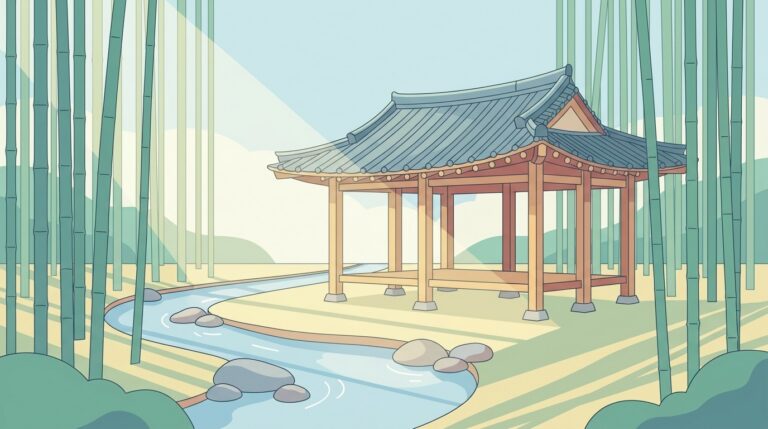
Have you ever stood in the middle of a traditional Korean garden like Damyang’s Soswaewon (소쇄원) and felt an odd sense of disorientation? Unlike the manicured, razor-sharp symmetry of Versailles or the pristine, meticulously raked gravel of Kyoto’s Zen temples, Korean gardens can almost look… unfinished at first glance. Streams tumble over jagged, uncarved rocks, wooden pavilion pillars follow the natural bent curves of tree trunks, and low mud walls stop abruptly just to let a bamboo grove peek through.
When advanced Korean learners visit these heritage sites with Korean friends or curators, they often get tongue-tied. You want to express deep admiration for this organic design, but you find yourself repeating basic adjectives like “자연스러워요” (It’s natural) or “예뻐요” (It’s pretty). That gap between your intellectual depth and your spoken Korean can be frustrating! Today, drawing from years of architectural field trips and feedback from our advanced learners, we are unlocking the profound aesthetic vocabulary of Joseon garden architecture. By the end of this guide, you will articulate high-register architectural philosophy with effortless cultural nuance.
Phase 2: Core Expressions In-Depth (핵심 표현 3선)
1. 자연을 거스르지 않다 (Jayeon-eul geoseureuji anta)
- Pronunciation: [Jayeon-eul geoseureuji anta] (Think of jah-yeun like ‘giant’ without the ‘t’, and geo-seu-reu-ji sounding like a flowing current: ‘guh-ssoo-ree-jee’).
- Meaning: Literally “To not go against nature”; nuances an active design philosophy of yielding to and harmonizing with natural topography without imposing human will.
- K-Culture Moment: In the historical drama Mr. Sunshine, when scholar Go Sa-hong sits in his ancestral estate courtyard, the architecture does not flatten the mountain; it embraces the slope. A character might note: “이 집은 터의 기운과 자연을 거스르지 않고 지어졌소.” (This house was built without defying the spirit of the site and nature.)
- Editor’s Insight: While beginners say “자연 친화적이다” (eco-friendly), C2 speakers use the verb “거스르다” (to defy/resist) in the negative to express the Taoist and Neo-Confucian virtue of non-interference (wu wei / 무위자연).
- Situation Spectrum:
- Casual: ⚠️ (Sounds overly philosophical for daily chat)
- Semi-formal: ✅
- Formal: ✅
- 🤔 Think About It: In Western classical architecture, humans master and order the wilderness. Why does Korean aesthetics equate supreme architectural mastery with “leaving things unshaped”?
2. 차경(借景)을 취하다 (Chagyeong-eul chwihada)
- Pronunciation: [Chagyeong-eul chwihada] (Cha sounds like ‘tea’ in Korean or ‘cha-cha’, and gyeong rhymes with ‘young’ with a soft ‘g’: chah-gyung).
- Meaning: Literally “To borrow scenery”; architecturally, framing the distant mountain, valley, or sky through a pavilion window or open wall so the outer world becomes part of the interior.
- K-Culture Moment: In art documentaries discussing Changdeokgung’s Secret Garden (Huwon), art historians remark: “담장을 낮춰 먼 무등산을 정원으로 끌어들이는 차경의 미학입니다.” (It is the aesthetics of borrowed scenery, lowering the wall to draw Mount Mudeung into the courtyard.)
- Editor’s Insight: “차경” embodies profound humility. Instead of owning or transplanting an exotic tree into one’s private yard, you simply open a wooden window frame (창호) and “borrow” the horizon without possessing it.
- Situation Spectrum:
- Casual: 🚫
- Semi-formal: ✅
- Formal: ✅
- 🤔 Think About It: Does your native language have a single poetic word for enjoying a landscape without claiming legal ownership over it?
3. 물아일체의 경지 (Mura-ilche-ui gyeongji)
- Pronunciation: [Mura-ilche-ui gyeongji] (Moo-rah-il-cheh-ui gyung-jee—flow cleanly through the four Chinese characters without pausing).
- Meaning: Literally “The state where the external object and the self become one”; philosophically, experiencing absolute unity between the observer and the surrounding cosmos.
- K-Culture Moment: In historical period films featuring Joseon literati (사림/선비) reciting sijo poetry at Soswaewon’s Gwangpunggak Pavilion, scholars describe reaching this transcendent spiritual harmony while listening to water cascading over stones.
- Editor’s Insight: Use this when an environment completely dissolves modern stress and mental boundaries. It elevates your compliment from mere tourist praise to profound existential contemplation.
- Situation Spectrum:
- Casual: ⚠️ (Can be used humorously when you are glued to your bed on a Sunday)
- Semi-formal: ✅
- Formal: ✅
- 🤔 Think About It: How does the linguistic concept of “unity with nature” redefine the boundary between the private self and public space in Korea?
Phase 3: Textbook Korean vs. Real Native Korean (교과서 vs. 진짜 한국어)
Situation 1: Praising the seamless harmony between a wooden pavilion and a rocky stream
- 📖 교과서 한국어 (Textbook):
“이 정원은 자연 환경과 아주 잘 어울리게 지어졌습니다.”
(I jeong-won-eun jayeon hwangyeong-gwa aju jal eoullige jieojyeotseumnida. / This garden was built to match the natural environment very well.) - 🗣️ 진짜 한국어 (Native C2):
“인공미를 극도로 절제하고 지형의 굴곡을 그대로 살려낸 조경이 감탄스럽네요.”
(Ingongmireul geukdoro jeoljehago jihyeong-ui gulgog-eul geudaero sallyeonaen jogyeong-i gamtanseureopneyo. / The landscaping is breathtaking—it shows extreme restraint in artificial embellishment while honoring every contour of the topography.) - 💡 왜 다를까?: Native scholars and design connoisseurs prefer terms like “절제” (restraint) and “지형의 굴곡을 살리다” (bring the contours of the terrain to life) rather than the generic “잘 어울리다” (matches well).
Situation 2: Commenting on how the open pavilion frames the outer mountain
- 📖 교과서 한국어 (Textbook):
“창문 밖으로 산이 보여서 경치가 참 좋습니다.”
(Changmun bakk-euro san-i boyeoseo gyeongchiga cham joseumnida. / You can see the mountain outside the window, so the view is very nice.) - 🗣️ 진짜 한국어 (Native C2):
“창살 너머로 풍경을 한 폭의 산수화처럼 품어내는 차경의 미가 일품이네요.”
(Changsal neomeoro punggyeong-eul han pog-ui sansuhwacheoreom pumeonaeneun chagyeong-ui miga ilpum-ineyo. / The aesthetics of borrowed scenery here are exquisite—embracing the landscape beyond the wooden lattice like a brush-painted landscape scroll.) - 💡 왜 다를까?: High-level Korean uses visual metaphors like “한 폭의 산수화” (a spread of landscape painting) and the evocative verb “품어내다” (to embrace/hold within) to articulate refined sensory perception.
Phase 4: K-Culture Deep Dive & Non-Verbal Manners (문화 딥다이브)
4-1. 눈치 (Nunchi) & Gestural Etiquette at Pavilions
When stepping onto a traditional pavilion wooden floor (maru, 마루) in heritage gardens like Soswaewon or Buyongjeong:
1. Footwear & Voice Modulations: Always look down first. If slippers are not provided and it is an accessible heritage platform, step out of your shoes leaving the toes pointing away from the pavilion (toward your departure direction). Lower your vocal volume by half. Traditional pavilions were acoustic echo chambers designed for wind and running water, not loud banter.
2. The Seated Eye-Level (좌식 시선): Never judge a Korean pavilion standing up. Sit cross-legged on the wooden floorboard. The horizontal roof eaves (cheoma, 처마) and half-height railings are calibrated specifically to cut off the glaring sky and frame the distant hills only when your eyes are positioned roughly 90 to 110 centimeters above the floor.
4-2. Cultural Code Analysis: The Joseon Sarim’s Anti-Monumentalism
Western aristocratic gardens (like the gardens of Versailles) were monuments of absolute monarchy—proclaiming human domination over chaotic nature through linear canals, fountain hydraulics, and topiary geometry. In contrast, 16th-century Joseon scholars (Sarim, 사림) built gardens like Soswaewon after retreating from cutthroat factional court politics (sahwa, 사화).
To them, building an artificial or lavish garden was considered vulgar (chohada, 초하다) and morally corrupt. Nature was the ultimate moral standard. Thus, they built retaining walls around tree roots, channeled streams under buildings without straightening their course, and kept garden structures unpainted (baekgol, 백골) so the pine and zelkova wood would weather naturally into silver-grey. To praise a Korean garden correctly, you must praise its ethical restraint, not its luxury.
Phase 5: Real-World Roleplay Scenario (실전 롤플레이)
- Setting: Autumn afternoon at Soswaewon in Damyang. Crisp leaves fall across the stone ditch. You are sitting at Gwangpunggak Pavilion with Master Architect Han (한 명장), an architectural preservation specialist.
- 한 명장: “선생님, 먼 길 오시느라 고생하셨습니다. 소쇄원에 발을 들이시니 첫인상이 어떠십니까?”
(Seonsaengnim, meon gil osineura gosaenghasyeotseumnida. Soswaewon-e bal-eul deurisini cheot-insang-i eotteosimnikka?)
🎭 Gazing calmly at the unhewn stone retaining wall across the stream.
“Master, thank you for making the long journey. Now that you’ve stepped into Soswaewon, what is your initial impression?” -
학습자: “화려한 기교 없이도 주변 암반과 계곡을 있는 그대로 품어 안은 모습이 무척 깊은 울림을 줍니다.”
(Hwaryeohan gigyo eopsido jubyeon amban-gwa gyegog-eul inneun geudaero pumeo aneun moseub-i mucheok gipeun ullim-eul jumnida.)
🎭 Speaking in a quiet, measured voice while scanning the landscape.
“Without flamboyant contrivances, the way it embraces the surrounding bedrock and stream just as they are resonates deeply with me.” -
한 명장: “허허, 제대로 보셨군요. 저기 담장 아래 트인 구멍이 보이시지요? 보통은 개울을 메우기 마련인데 말입니다.”
(Heoheo, jedaero bosyeotgunyo. Jeogi damjang arae teuin gumeong-i boisijiyo? Botong-eun gaeur-eul meugi maryeon-inde marimnida.)
🎭 Pointing with an open palm toward the stone wall spanning the creek.
“Haha, you see it accurately. Do you notice the opening beneath that mud wall? Usually, builders would fill in or redirect the stream.” -
학습자: “맞습니다. 담장이 물길을 가로막지 않고 자연스레 흘러가도록 돌다리처럼 터놓은 지혜가 경이롭습니다.”
(Matseumnida. Damjang-i mulgil-eul garomakji anko jayeonseure heulleogadorok doldari-cheoreom teonoeun jihyega gyeong-iropseumnida.)
🎭 Nodding slightly with genuine reverence.
“Indeed. The wisdom of opening the wall like a stone bridge so it does not obstruct the waterway but lets it flow naturally is wondrous.” -
한 명장: “그렇지요. 이곳을 지은 양산보 선생은 인공의 손길을 최소화하여 자연의 섭리를 거스르지 않고자 했습니다.”
(Geureochiyo. Igot-eul jieun Yang San-bo seonsaeng-eun ingong-ui songir-eul choesohwahayeo jayeon-ui seoblireul geoseureuji ankoga haetseumnida.)
🎭 Pouring warm fermented tea into celadon cups.
“Precisely. Scholar Yang San-bo, who built this sanctuary, sought to minimize artificial touches and never defy the providence of nature.” -
학습자: “이 마루에 앉아 바깥 계곡 물소리를 듣고 있으니, 진정 물아일체의 경지가 무엇인지 온몸으로 와닿는 듯합니다.”
(I marue anja bakkat gyegok mulsorireul deutgo isseuni, jinjeong murailche-ui gyeongjiga mueos-inji onmom-euro wadatneun deut-hamnida.)
🎭 Closing eyes briefly, feeling the cool mountain breeze.
“Sitting here on this wooden floor listening to the creek outside, I feel in my bones what the state of oneness with nature truly means.” -
한 명장: “외국인 연구자분께서 이처럼 한국 조경의 은근한 여백을 깊이 통찰하시니 제 마음이 다 벅찹니다.”
(Oeguk-in yeon-gujabunkkeseo icheoreom hanguk jogyeong-ui eungeunhan yeobaeg-eul gipi tongchalhasini je maeum-i da beokchamnida.)
🎭 Handing over a teacup with both hands, eyes wrinkling with warm delight.
“Seeing a foreign scholar discern the subtle blank spaces of Korean landscaping with such depth makes my heart swell.” -
학습자: “과찬이십니다. 자연을 소유하지 않고 그저 빌려 감상하는 차경의 미학을 직접 체감할 수 있어 외려 제가 영광입니다.”
(Gwachan-isimnida. Jayeon-eul soyuhaji anko geujeo billyeo gamsanghaneun chagyeong-ui mihag-eul jikjeop chegaml su isseo oeryeo jega yeong-gwang-imnida.)
🎭 Bowing head slightly while holding the teacup with both hands.
“You flatter me. It is rather my honor to directly experience the aesthetics of borrowed scenery, admiring nature without possessing it.”
🔀 Interactive Branching Point
Master Han asks you: “만약 이 정원에 현대식 조명이나 편의 시설을 더 설치한다면 어떻게 생각하십니까?” (What would you think if modern lighting or convenience facilities were installed in this garden?)
- Option A: “관람객의 편의도 중요하니, 야간 개장을 위해 바닥에 은은한 매립형 조명 정도는 설치해도 무방하다고 봅니다.”
Feedback: [⚠️ Risk] While practical, this answer leans too heavily toward commercial tourism utility, slightly clashing with the ascetic preservation ethos of traditional Korean literati gardens. - Option B: “자연 그대로의 어둠과 고요함이야말로 이 정원의 본질이니, 어떠한 인위적 시설도 덧대지 않는 ‘무위(無爲)’의 태도를 지키는 것이 온당하다고 생각합니다.”
Feedback: [🌟 Best] Flawless C2-level response. You reference the philosophical concept of Muwi (non-action/non-intervention) and demonstrate deep aesthetic integrity that will deeply impress any Korean traditional master. - Option C: “어차피 낮에만 보고 가면 되니까 조명 같은 건 돈 낭비라고 봅니다.”
Feedback: [🚫 Bad] Too blunt and utilitarian. Dismissing the question as a mere waste of money lacks cultural refinement and sounds rude in an intellectual discussion.
Phase 6: 10-Second Emotional Shadowing Drill (감정 섀도잉)
Practice these intonation units. The slash (/) indicates a natural breath/rhythm pause.
[🌿 깊은 여운과 차분한 관조적 어조로]
“인공의 손길을 덜어내고 / 지형의 결을 그대로 살린 공간이라 / 마음이 절로 비워집니다.”
(Ingong-ui songir-eul deoreonaego / jihyeong-ui gyeor-eul geudaero sallin gonggan-ira / maeum-i jeollo biwojimnida.)
(Because this space removes artificial manipulation / and honors the grain of the terrain / my mind empties effortlessly.)-
[💡 지적인 감탄과 격조 높은 어조로]
“담장을 둘러 영역을 가두기보다 / 먼 산세를 정원 안으로 빌려온 / 차경의 혜안이 돋보입니다.”
(Damjang-eul dulleo yeong-yeog-eul gadugi-boda / meon sanse-reul jeong-won an-euro billyeoon / chagyeong-ui hye-an-i dotboimnida.)
(Rather than penning in territory with boundary walls / the keen insight of borrowed scenery / drawing distant mountain contours into the garden shines through.)
Phase 7: K-Culture Mini Dictionary (핵심 어휘 4선)
-
차경 (借景, Chagyeong)
Literal: Borrowed scenery.
Usage: Used frequently in fine art, architecture, and luxury interior design when a window frames an unbuilt outdoor vista. To describe an upscale Hanok cafe with an open glass wall facing Inwangsan, Koreans say: “차경이 근사한 공간” (A space with marvelous borrowed scenery). -
풍류 (風流, Pungryu)
Literal: The flowing of the wind and water.
Usage: The refined pursuit of art, poetry, nature, and wine without vulgar worldly ambition. Used when taking a tranquil stroll with acoustic music or sipping tea in a secluded mountain valley. -
무위자연 (無爲自然, Muwijayeon)
Literal: Doing nothing artificial, letting nature take its spontaneous course.
Usage: A core Taoist-Confucian aesthetic principle. Applied whenever appreciating furniture made from twisted wood, unglazed buncheong pottery, or garden paths left unpaved. -
여백의 미 (餘白의 美, Yeobaek-ui mi)
Literal: The beauty of empty space / blank margins.
Usage: Ubiquitous in high-end design, Korean minimalist fashion, fine dining plating, and classical painting. Refers to the deliberate restraint of leaving canvas or physical space empty so the mind can wander.
Phase 8: Traveler’s Survival Kit (여행자 생존 키트)
Top 3 Expressions for Heritage Garden Explorers
-
“이곳 정원의 백미(白眉)는 어느 각도에서 바라보는 풍경인가요?”
(I-got jeong-won-ui baengmi-neun eoneu gakdo-eseo baraboneun punggyeong-ingayo?)
Pro Tip: Asking for the baengmi (the absolute highlight/crowning stroke) will immediately prompt Korean docents to escort you to the secret viewing vantage point. -
“마루에 잠시 신발을 벗고 올라가서 좌식 경관을 감상해도 될까요?”
(Maru-e jamsi sinbal-eul beotgo ollagaseo jwasik gyeonggwan-eul gamsanghaedo doelkkayo?)
Pro Tip: Demonstrates that you understand Korean gardens are designed to be enjoyed seated from the floorboard, earning you instant respect from site caretakers. -
“자연 지형을 훼손하지 않고 암반 위에 기둥을 세운 덤벙주초의 모습이 참 인상적입니다.”
(Jayeon jihyeong-eul hwesonhaji anko amban wie gidung-eul seun deombeongjucho-ui moseub-i cham insangjeog-imnida.)
Pro Tip: Deombeongjucho (덤벙주초) refers to foundation stones left completely unshaped, with pillar bottoms carved to fit the stone’s irregularities. Using this word will shock cultural heritage guides!
Editor’s Travel Note: Getting to Soswaewon & Etiquette
- Navigation: Google Maps fails in rural Jeollanam-do. Make sure to download the Naver Map app to search for “소쇄원” (Soswaewon) and check intercity bus schedule routes from Gwangju Station.
- Audio Guides: Prior to visiting, browse the Korea Heritage Service audio guide website to download English and Korean audio files on classical pavilion heritage.
- Local Manners: Damyang is famous for bamboo forest valleys. Do not scratch names into bamboo trunks (낙서 금지) or step onto moss-covered rock steps (ikki-bawi), which take decades to form.
Phase 9: “한 발 더 깊이” (One Step Deeper: Philosophical Essay)
In Western classical geometry, straight lines and right angles signify the triumph of human intellect over the disordered wilderness. Yet, when you look at the retaining wall of Soswaewon, you see stones of wildly irregular shapes fitted together without mortar, allowing water to trickle freely through the crevices. To Joseon intellectuals, subduing nature was not a sign of triumph, but of profound spiritual arrogance. The unstraightened pillar and the winding watercourse reflect an epistemology where humanity is not the master architect of the world, but merely a humble guest passing through an eternal, breathing ecosystem.
💬 Your Turn: Does your culture celebrate architecture that dominates the landscape, or buildings that surrender to it? Share your thoughts below in Korean!
Phase 10: FAQ & Common Misconceptions (자주 묻는 질문)
Q: Isn’t a garden that looks completely wild just a sign of negligence or lack of architectural skill?
A: Not at all. Korean traditional gardens employ what landscape scholars term “the highest stage of artificiality—concealing all traces of human intervention” (인공을 가하되 인공의 흔적을 지우다). To make a pavilion appear as though it sprouted organically from the bedrock requires far more intricate stone-fitting (geuraeng-ijil) and water management than simply bulldozing a terrace flat.
Q: Can I use “차경” (Chagyeong) when talking about modern high-rise apartments?
A: Yes! In upscale contemporary Korean interior architecture, if an apartment living room has a wide floor-to-ceiling window framing the Han River or Mount Namsan without distracting high-rise obstacles, it is frequently marketed as enjoying chagyeong. It sounds infinitely more poetic and sophisticated than simply saying “좋은 전망” (good view).
Q: What is the difference between Soswaewon (소쇄원) and Changdeokgung’s Secret Garden (후원)?
A: Changdeokgung’s Huwon is a royal rear garden (gungwon, 궁원) designed for kings, featuring magnificent landscaped ponds (like Buyongji) and royal library pavilions. Soswaewon is a private literati garden (byeolseo wonrim, 별서원림) built by an exiled scholar in the countryside, characterized by rustic simplicity, philosophical solitude, and an utter lack of colorful decorative paint (dancheong).
🚨 흔한 실수 (Common Mistakes to Avoid)
- Calling Korean gardens “Zen gardens” (젠 스타일 / 일본식 정원):
Wrong: “여기 자갈이랑 돌 배치가 젠 스타일 같네요.”
Correct: “인위적인 축경(縮景)을 추구하는 일본 정원과 달리, 자연을 원형 그대로 포용하는 한국 전통 원림의 멋이 있네요.” (Unlike Japanese miniature gardens, this embraces unadorned nature.) - Overusing “자연스러워요” (It’s natural) as your sole critique:
Correct Action: Upgrade your adjectives to C2 terms like 순응적이다 (nature-conforming), 소박하다 (rustic/unpretentious), or 단아하다 (graceful and neat). - Confusing ‘원림’ (Wonrim) with ‘정원’ (Jeongwon):
Insight: Jeongwon implies a modern fenced garden plot; scholars refer to sites like Soswaewon as Wonrim (원림), emphasizing the preservation of the surrounding forest and valley.
Phase 11: Action Missions (액션 미션)
- 🥉 Bronze Mission (Solo Shadowing): Record yourself reading the C2 phrase: “자연의 순리를 거스르지 않고 지형을 온전히 품어낸 조경입니다.” Focus on natural breath pauses.
- 🥈 Silver Mission (Social Media Engagement): Take a photo of a window view framing nature in your city. Post it on Instagram or Threads with the Korean caption using #차경 and #여백의미.
- 🥇 Gold Mission (Live Immersion): Visit a traditional Hanok village, palace pavilion, or tea house. Sit on the wooden floor and deliver the compliment: “이곳은 마루에서 바라보는 차경의 미학이 참으로 각별하군요.” to the host or curator.
- 🎮 K-Culture Mission: Watch an episode of a historical K-drama like The Red Sleeve (옷소매 붉은 끝동) or Mr. Sunshine. Spot a scene where characters converse inside a pavilion overlooking a garden. Notice how the camera frames the background through the open wooden windows!
Phase 12: Interactive Quiz Challenge (인터랙티브 퀴즈)
Test your mastery of Korean traditional garden aesthetics!
1. Situational Judgment
You are visiting a historic Hanok garden with an architectural curator. Which comment demonstrates the highest C2 aesthetic appreciation?
* (A) “정원 관리를 안 해서 풀이 제멋대로 자란 것 같아요.”
* (B) “인공적인 손길을 최소화하고 지형의 결을 온전히 살려낸 태도가 무척 경이롭습니다.”
* (C) “베르사유 궁전처럼 나무를 반듯하게 깎으면 훨씬 예쁠 텐데요.”
🔍 정답 및 해설 확인하기 (Click to reveal answer)
정답: (B)
해설: (B) beautifully articulates the core philosophy of Joseon landscaping—minimizing artificial intervention while honoring topographical contours. (A) and (C) reveal an ethnocentric misunderstanding of Korean organic aesthetics.
2. Fill-in-the-Blank
담장을 높이 쌓아 풍경을 가두는 대신, 먼 산과 하늘을 창호 너머로 정원 안으로 빌려오는 전통 조경 기법을 ( )이라고 합니다.
🔍 정답 및 해설 확인하기 (Click to reveal answer)
정답: 차경 (Chagyeong / 借景)
해설: ‘Borrowing scenery’ from outside the boundary walls is the defining hallmark of traditional Korean pavilions and Hanok architecture.
3. Cultural True/False
Traditional Korean literati pavilions (nugak) were deliberately painted with vivid, multicolored dancheong mineral pigments to outshine the surrounding mountain trees. (True / False)
🔍 정답 및 해설 확인하기 (Click to reveal answer)
정답: False
해설: While royal palaces and Buddhist temples used colorful dancheong (단청), private literati gardens like Soswaewon left the wood unpainted (baekgol) so it would naturally age and harmonize with the muted earth tones of the forest.







