

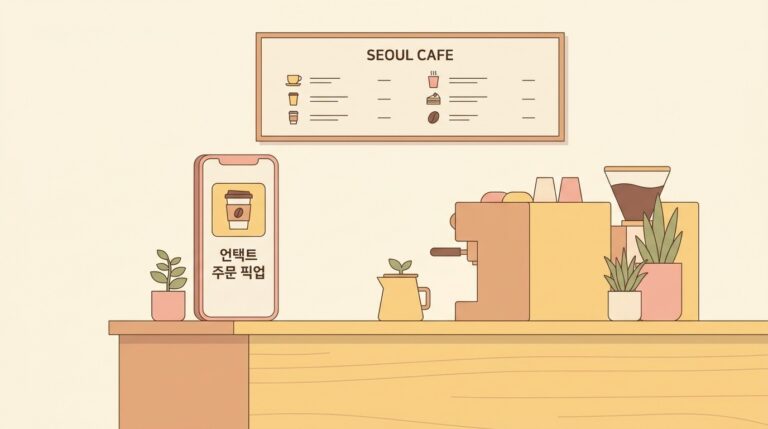
Beyond the Kiosk: Mastering Korean Untact Cafe Culture and Siren Orders Like a Local
Phase 1: Empathy (Story-Driven Opening)
안녕하세요! 매일한글 에디터입니다. Have you ever stepped into a bustling Starbucks in Gangnam or Yeouido during the 8:30 AM morning rush, braced yourself to speak with the cashier, only to realize the entire counter line has evaporated? Instead, dozens of impeccably dressed professionals stand silently around the pickup counter like air traffic controllers, eyes darting between their smartphones and the barista’s station, waiting for a specific nickname or receipt number to flash across the display.
Welcome to Korea’s ultra-streamlined ‘untact’ (비대면 – non-face-to-face) cafe reality. If you have ever felt paralyzed when faced with a digital touch kiosk where the timer times out while you look for an English button, or felt intimidated trying to customize an oat-milk latte through the Starbucks Korea Siren Order interface, you are far from alone. In modern Korea, cafe culture is no longer merely about savoring a roast; it is an orchestrated ritual of hyper-efficiency, social courtesy, and algorithmic precision.
This guide is crafted for high-level learners who refuse to settle for rudimentary textbook phrases. Rooted in real feedback from our advanced Daily Hangul community and years of navigating Seoul’s cafe culture, this lesson will elevate your discourse from functional survival to sophisticated, culturally nuanced mastery. Let’s bridge the gap between classroom Korean and real-world urban agility.
Phase 2: Core Expressions Deep Dive
1. 사이렌 오더로 미리 넣어뒀어요
- Pronunciation: [Sairen odeoro miri neoeodwoesseoyo] (Sounds like Sigh-ren oh-der-ro mee-ree nuh-uh-dwoss-uh-yo — imagine ‘sigh’ gliding into ‘ren’, followed by a light tap of ‘miri’)
- Meaning: Literal: I already put it in via Siren Order. | Pragmatic Nuance: I planned ahead and submitted our order remotely so we don’t have to wait. It conveys urban savvy, considerate foresight, and respect for the other person’s time.
- K-Culture Moment: Seen in contemporary K-Dramas like Work Later, Drink Now or Business Proposal, where an efficient junior associate or empathetic romantic lead hands over an iced drink before the other person even realizes they needed one.
- Editor’s Insight: The compound verb construction -아/어 두다 (to do something in advance and maintain that state) combined with 미리 (in advance) creates an aura of organizational competence. In Korea’s fast-paced society, doing something ‘미리’ is the ultimate everyday love language.
- Situation Spectrum:
- Casual: ✅ (사이렌 오더로 미리 넣어뒀어)
- Semi-formal: ✅ (사이렌 오더로 미리 넣어뒀어요)
- Formal: ⚠️ (사이렌 오더로 미리 접수해 두었습니다 — slightly overly formal for coffee, but acceptable in professional debriefs)
- 🤔 Think About It: In many Western cafe environments, ordering coffee is treated as a social interaction with the barista. In modern Korea, taking the initiative to eliminate transaction friction is viewed as the height of social consideration. How does your native language reflect foresight and time management in casual settings?
2. 텀블러 에코별 적립해 주세요
- Pronunciation: [Teombeulleo ekobyeol jeongnibhae juseyo] (Sounds like Tum-buhl-ler eh-ko-byuhl jung-neep-hae joo-seh-yo — pronounce ‘별’ with a snappy ‘byuhl’, like ‘pure’ with a ‘b’)
- Meaning: Literal: Please accumulate the eco-star for my tumbler. | Pragmatic Nuance: I am taking advantage of the rewards ecosystem while being environmentally conscious. It indicates an insider’s command over the Starbucks Korea ‘Star’ (별) loyalty gamification.
- K-Culture Moment: Frequently spotted in YouTube urban lifestyle vlogs or office commute shorts where influencers flash their sleek personal tumblers at the counter while double-checking their Starbucks app balance.
- Editor’s Insight: In Korea, eco-discounts at mega-chains allow you to choose between a direct 400 won discount or an extra ‘Eco Star’ (에코별). Knowing this distinction and using the business noun 적립 (accumulation/credit) instantly marks you as an urban insider rather than a passing tourist.
- Situation Spectrum:
- Casual: 🚫 (텀블러 에코별 적립해 줘 — odd unless speaking to a close friend who is the barista)
- Semi-formal: ✅ (텀블러 에코별 적립해 주세요)
- Formal: ✅ (텀블러 에코별로 적립 부탁드립니다)
- 🤔 Think About It: Why has eco-conscious action become intricately bound with digital gamification in Korea’s consumer sphere? What does this reveal about institutional incentive design in modern Korea?
3. 비대면 주문이 대세긴 하네요
- Pronunciation: [Bidaemyeon jumuni daesegin haneyo] (Sounds like Bee-dae-myun joo-moon-ee dae-seh-geen ha-neh-yo — note the rhythmic inflection on ‘dae-se’)
- Meaning: Literal: Non-face-to-face ordering is indeed the mainstream trend. | Pragmatic Nuance: It really strikes me how untact ordering has become the uncontested norm everywhere we look. A socially astute observation used to initiate polite conversation in waiting areas.
- K-Culture Moment: Often heard on reality talk shows like You Quiz on the Block when guests remark on changing social landscapes and technological shifts across generations.
- Editor’s Insight: The term 대세 (prevailing trend) paired with the concessive/confirming ending -긴 하다 (-gin hada) gives your speech an analytical, reflective tone typical of mature, educated speakers.
- Situation Spectrum:
- Casual: ✅ (비대면 주문이 대세긴 하네)
- Semi-formal: ✅ (비대면 주문이 대세긴 하네요)
- Formal: ✅ (확실히 비대면 주문이 대세로 자리 잡은 것 같습니다)
- 🤔 Think About It: Notice how the Korean language incorporates socio-technological portmanteaus like ‘비대면’ (untact) directly into daily idioms. How rapidly do emergent digital habits enter colloquial speech in your culture?
Phase 3: Textbook Korean vs. Real Korean
Situation 1: Checking if a kiosk/app order has been received
- 📖 교과서 한국어 (Textbook Korean):
제 주문이 기계에 잘 들어갔습니까? (Je jumuni gigyee jal deureogasseumnikka?)
Did my order enter the machine properly? - 🗣️ 진짜 한국어 (Real Korean):
방금 키오스크로 주문 넣었는데, 잘 들어갔을까요? (Banggeum kioseukeuro jumn neoeonneunde, jal deureogasseulkkayo?)
I just submitted an order on the kiosk; did it come through on your end? - 💡 왜 다를까? (Why the difference?):
Textbook Korean relies on robotic interrogatives like ‘잘 들어갔습니까?’. Real Korean conversational masters use the idiomatic verb 주문을 넣다 (to put in an order) and soften the check with the speculative polite ending -을까요?, which avoids sounding demanding.
Situation 2: Asking a colleague to order in advance while on the way
- 📖 교과서 한국어 (Textbook Korean):
당신이 먼저 커피를 사 주시겠어요? (Dangsini meonjeo keopireul sa jusigesseoyo?)
Will you buy the coffee first? - 🗣️ 진짜 한국어 (Real Korean):
가는 길에 사이렌 오더로 픽업만 하게 찍어둘게요. (Ganeun gire sairen odeoro pik-eomman hage jjigeodulgeyo.)
I’ll just tap it through on Siren Order on my way so we can grab it right as we arrive. - 💡 왜 다를까? (Why the difference?):
The textbook version commits two cardinal sins: using the unnatural second-person pronoun ‘당신’ and phrasing the collaborative action as an awkward transaction. Real urban Koreans describe the physical touchscreen tap with 찍어두다 (to tap/place an order beforehand) to convey effortless cooperation.
Phase 4: K-Culture Deep Dive & Non-Verbal Manners
4-1. 눈치 (Nunchi) & Pickup Etiquette
In an untact-dominated cafe, eye contact and physical positioning follow strict unwritten codes:
* The Pickup Hover (픽업 존 눈치): Do not crowd the counter while your status is ‘제조 중’ (Preparing). Hovering too close creates unnecessary pressure for the barista. Stand 2-3 meters back, glancing up periodically at the digital display.
* The Nickname Call Response: In Starbucks Korea, your custom nickname (e.g., ‘압구정미식가님’ or ‘달리는호랑이님’) will be called alongside your order number. Acknowledge with a crisp slight head nod (목례) rather than an exuberant wave, show your screen receipt if asked, and say a brisk:
감사합니다, 수고하세요! (Gamsahamnida, sugohaseyo!) — Thank you, keep up the great work!
* Kiosk Queue Awareness: If someone is struggling with a kiosk screen ahead of you, avoid tapping your card audibly against your hand or sighing. Maintain a polite two-step distance so they don’t feel monitored.
4-2. Cultural Code: The ‘빨리빨리’ Engine & ‘Untact’ Cafes
Why did Korea become the international launchpad for advanced untact cafe operations? The intersection of 빨리빨리 (haste and efficiency) culture with high smartphone penetration turned physical lines into an unacceptable operational bottleneck. Korean office workers view iced Americanos (얼죽아 – ‘iced americano even if I freeze to death’) as liquid fuel for their day. Siren Order and touch kiosks transform the cafe from an unpredictable wait into a predictable, optimized micro-routine.
Phase 5: Real-World Roleplay Scenario
Setting: A bustling Starbucks branch in central Seoul at 8:45 AM.
Characters:
* You (C2 Korean Speaker): Stopping by on your way to an important seminar.
* Min-jun (민준 – Barista): Fast, sharp, professional, handling dozens of tickets per minute.
Turn 1: Barista (Min-jun)
🎭 Checking the display screen, calling out into the waiting crowd
민준: C-24번 고객님, 주문하신 아이스 오트 라테 두 잔 나왔습니다!
(C-isipsabeon gogaeknim, jumunhasin aiseu oteu rate du jan nawasseumnida!)
Customer C-24, your two iced oat lattes are ready!
Turn 2: You
🎭 Stepping forward smoothly with phone showing your order status
나: 저, 실례지만 제가 사이렌 오더로 텀블러 수령 체크를 해뒀는데요.
(Jeo, sillyejiman jega sairen odeoro teombeulleo suryeong chekeureul haedwonneundeyo.)
Excuse me, but I checked the personal tumbler pickup option on Siren Order.
Turn 3: Barista (Min-jun)
🎭 Reaching for two rinsed eco-cups behind the counter
민준: 아, 텀블러 가져오셨어요? 바코드 한번 찍어주시고 텀블러 이쪽에 올려주세요.
(A, teombeulleo gajyeo-osyeosseoyo? Bakodeu hanbeon jjigeojusigo teombeulleo ijjoge ollyeojuseyo.)
Ah, did you bring your tumblers? Please scan your barcode here and place the tumblers right this way.
Turn 4: You
🎭 Placing two clean thermal tumblers on the designated mat
나: 네, 여기요. 혹시 에코별 적립도 자동으로 연동되는 거 맞죠?
(Ne, yeogiyo. Hoksi ekobyeol jeongnibdo jadong-euro yeondongdoeneun geo matjyo?)
Yes, here you go. Eco Stars are automatically linked and credited through the app, right?
Turn 5: Barista (Min-jun)
🎭 Tapping the POS interface swiftly
민준: 네, 설정에서 에코별로 지정해 두셨으면 음료 수령 완료 처리될 때 바로 들어갑니다.
(Ne, seoljeong-eseo ekobyeollo jijeonghae dusyeosseumyeon eumryo suryeong wanryo cheoridoel ttae baro deureogamnida.)
Yes, if you set your preferences to Eco Stars, they’ll credit immediately once the pickup is confirmed.
Turn 6: You
🎭 Confirming drink customization with a warm smile
나: 확인 감사합니다. 하나는 샷 추가된 거 맞는지 한 번만 확인 부탁드릴게요.
(Hwagin gamsahamnida. Hananeun syat chugadoen geo manneunji han beonman hwagin butakdeurilgeyo.)
Thanks for confirming. Could you double-check that one of them has the extra shot added?
Turn 7: Barista (Min-jun)
🎭 Inspecting the digital sticker on the pitcher before pouring
민준: 네, 오른쪽 텀블러에 들어간 음료가 샷 추가된 라테입니다. 리드 닫아드릴까요?
(Ne, oreunjjok teombeulleoe deureogan eumryoga syat chugadoen rate-imnida. Rideu dadadeurilkkayo?)
Yes, the drink going into the right tumbler has the extra shot. Shall I secure the lids for you?
Turn 8: You
🎭 Receiving the tumblers carefully with both hands
나: 아뇨, 제가 닫을게요. 바쁘신데 신경 써 주셔서 감사합니다!
(Anyo, jega dadeulgeyo. Bappeusinde singyeong sseo jusyeoseo gamsahamnida!)
No worries, I’ll close them myself. Thank you for your careful attention during the rush!
🔀 Interactive Decision Branch
The barista just noticed the branch has run out of oat milk for your second drink and asks if regular whole milk is okay. How do you respond?
- Option A: “그냥 환불해 주세요. 오트 밀크 없으면 안 마셔요.” (Just give me a refund. If there’s no oat milk I won’t drink it.)
- Feedback [Bad]: Overly abrasive. While grammatically correct, it snaps the professional harmony during a rush and marks you as needlessly combative.
- Option B: “아, 오트가 다 떨어졌군요. 그럼 두유로 변경 가능한가요? 추가금 있으면 앱으로 결제할게요.” (Ah, you’re fresh out of oat milk. Could I switch to soy milk instead? If there’s a difference I can pay via the app.)
- Feedback [Best]: Polite, flexible, and pragmatic. Acknowledging the shortage with -군요 followed by an alternative solution keeps the workflow smooth and shows deep linguistic grace.
- Option C: “네… 그럼 아무거나 알아서 해 주세요.” (Yes… well, just do whatever you think.)
- Feedback [Risk]: ‘아무거나’ (anything) puts unwanted decision burden back onto an already busy barista and may result in an option you genuinely dislike.
Phase 6: 10-Second Emotion Shadowing Drill
[⚡ 다급하지만 정중하게 - Urgent yet Courteous]
저기요, / 주문 번호 35번인데요, / 사이렌 오더 픽업 / 바로 가능한가요?
(Jeogiyo, / jumun beonho samsibo-beon-indeyo, / sairen odeor pik-eop / baro ganeunghangayo?)
Excuse me, / order number 35, / can I pick up / my Siren Order right away?-
[😊 당당하고 세련되게 - Confident and Refined]
텀블러 가져왔는데, / 에코별 대신 / 음료 할인으로 적용해 주세요.
(Teombeulleo gajyeowanneunde, / ekobyeol daesin / eumryo harin-euro jeok-yonghae juseyo.)
I brought my tumbler, / but instead of an Eco Star, / please apply the direct drink discount. -
[🤝 공감하며 부드럽게 - Empathetic and Smooth]
출근 시간대라 / 주문이 엄청 밀렸네요. / 천천히 주셔도 괜찮아요!
(Chulgeun sigandaera / jumuni eomcheong millyeonneyo. / Cheoncheonhi jusyeodo gwaenchannayo!)
Since it’s morning rush hour, / orders are backed up. / No rush at all, take your time!
Phase 7: K-Culture Mini Dictionary
-
얼죽아 (Eol-juk-ah)
Translation: ‘Iced Americano even if I freeze to death’ (얼어 죽어도 아이스 아메리카노).
Usage: Reflects Korea’s cultural devotion to rapid iced caffeine consumption year-round. Used casually among peers: “영하 10도지만 오늘도 얼죽아 갑니다.” (It’s minus ten degrees, but I’m sticking to iced Americano.) -
스벅 별 사냥 (Seubeok Byeol Sanyang)
Translation: ‘Starbucks Star Hunting’.
Usage: The strategic art of stacking rewards points through targeted seasonal menu purchases, Siren Orders, and eco-discounts to earn free drink vouchers as quickly as possible. -
비대면 (Bi-dae-myeon)
Translation: Untact / Non-face-to-face.
Usage: A staple societal keyword in modern Korea describing transactions, meetings, kiosk interfaces, and mobile orders where human-to-human physical interaction is deliberately minimized. -
기프티콘 (Gifticon)
Translation: Mobile gift barcode / voucher.
Usage: Commonly gifted via KakaoTalk. In cafes, you scan them directly at kiosks or register them into your Starbucks Korea app to pay for custom orders.
Phase 8: Survival Kit for Travelers
Top 3 Survival Phrases
- 키오스크 주문이 잘 안 넘어가는데 도와주실 수 있나요?
(Kioseukeu jumuni jal an neomeoganeunde dowajusil su innayo?)
Pro Tip: Use this when a touchscreen freezes or payment fails. It signals respect while asking for technical assistance. - 앱 영수증 바코드로 주차 등록 가능한가요?
(Aep yeongsujeung bakodeuro jucha deungnok ganeunghangayo?)
Pro Tip: Essential for drivers visiting suburban or drive-thru stores in Gyeonggi-do or Jeju. - 포장으로 주문 넣었는데 매장 이용으로 바꿀 수 있을까요?
(Pojang-euro jumun neoeonneunde maejang iyong-euro bakkul su isseulkkayo?)
Pro Tip: Korea strictly regulates single-use disposable cups inside cafes by law. Changing from takeout to dine-in requires swapping to reusable glassware.
Editor’s Travel Note
Before stepping out into Seoul, set up your mobile arsenal:
* Download the 네이버 지도 앱 다운로드 to pinpoint nearby stores and check real-time seat availability or opening hours.
* If you possess a domestic payment method or Korean alien registration card, installing the Starbucks Korea app enables you to register gifticons, track seasonal promotions, and bypass counters via Siren Order.
* When using physical kiosks, international credit cards with IC chips occasionally experience read delays. Firmly push your card in until the bottom green light stays steady.
Phase 9: “One Step Deeper” (Sociolinguistic Insight)
The rise of untact ordering in Korea is often viewed by outside observers as an acceleration of urban hyper-individualism. Yet beneath the silent kiosks and rapid phone pickups lies a distinct manifestation of collective consideration (배려). In high-density metropolitan ecosystems like Seoul, choosing not to monopolize a frontline worker’s attention with casual small talk during peak hours is perceived as a form of social courtesy. Efficiency is not coldness; it is an unspoken agreement to protect everyone’s time and collective rhythm.
💬 Your Turn: Does your culture interpret digital kiosks as a barrier to authentic connection, or as an empowering efficiency tool? Drop your thoughts and experiences in the comments below!
Phase 10: FAQ & Common Mistakes
Q: Can foreign tourists use Starbucks Siren Order in Korea without a domestic credit card?
A: While the full Starbucks Korea mobile app traditionally requires domestic SMS phone verification and local payment cards, international visitors can still load purchased physical Starbucks prepaid cards onto their account or use global credit cards directly at branch kiosks and POS registers.
Q: What is the single biggest etiquette rule when picking up untact orders?
A: Never take an order off the counter based solely on the cup size or drink color. Always cross-reference the label or receipt number. In peak morning hours, five identical iced Americanos can be placed within seconds of each other.
Q: Why do baristas ask if I am drinking inside when I order at the counter?
A: Due to government environmental regulations, Korean cafes are legally prohibited from serving beverages in disposable plastic or paper cups to customers seated inside the store. Violating this triggers financial penalties for the store owner.
🚨 Common Mistakes Top 3
- Mistake: Taking a disposable takeout cup and sitting down at a cafe table to drink.
Correct Action: If you intend to stay, always order 매장 이용 (Dine-in) to receive your drink in a ceramic mug or reusable plastic glass. - Mistake: Speaking exclusively in abrupt imperative phrases to kiosks or baristas (e.g., “라테 하나 줘”).
Correct Action: Even in fast-paced untact environments, maintain politeness: “라테 한 잔 부탁드립니다.” - Mistake: Confusing the Starbucks Korea app with your home country’s Starbucks app.
Correct Action: The Starbucks Korea digital ecosystem is geographically separated. Reward points and apps do not carry across borders.
Phase 11: Action Missions
- 🥉 Bronze Mission (Solo Practice): Stand in front of a mirror and smoothly say:
“사이렌 오더로 픽업할게요. 텀블러 에코별 적립 부탁드립니다.” within 4 seconds. - 🥈 Silver Mission (Social Share): Snap a photo of a cafe kiosk in your city or during your Korea trip and post it with the caption:
“비대면 주문이 대세긴 하네요! #DailyHangul #KCafeCulture” - 🥇 Gold Mission (Real Action): Visit a Korean-run cafe or local branch in Korea, order using a personal tumbler, and negotiate the discount or reward point using today’s target phrases.
- 🎮 K-Culture Media Mission: Watch an episode of an office-based K-Drama (such as Misaeng or Agency) and identify whether characters bring physical receipts, app screens, or cardboard cup carriers back to their desk.
Phase 12: Interactive Quiz Challenge
1. Situation Judgment Quiz
You ordered an iced latte through a self-ordering kiosk, but the receipt paper jammed and did not print. How should you address the barista at the pickup counter in natural, polite C2 Korean?
👉 Click to reveal Answer & Explanation
Best Response:
“저기요, 키오스크에서 주문 번호가 출력이 안 됐는데, 혹시 결제 내역 확인해 주실 수 있을까요?”
(Excuse me, the order number didn’t print from the kiosk; could you possibly check the transaction history on your side?)
Explanation: Explaining the mechanical breakdown clearly while using the deferential -해 주실 수 있을까요? allows the barista to look up your order without feeling accused.
2. Fill-in-the-Blank Quiz
Complete the sentence to show you prefer taking proactive steps in advance:
“사람 몰리기 전에 사이렌 오더로 [_______] 둘게요.” (Hint: Compound verb for doing something in advance)
👉 Click to reveal Answer & Explanation
Answer:
넣어 (or 주문해)
Sentence:
“사람 몰리기 전에 사이렌 오더로 넣어 둘게요.” (I’ll put the order in via Siren Order before the crowd builds up.)
3. True / False Cultural Check
In Korea, it is completely legal and culturally accepted to sit at an indoor cafe table for an hour drinking from a disposable single-use plastic takeout cup. (True / False)
👉 Click to reveal Answer & Explanation
Answer:
False
Explanation:
South Korean environmental legislation heavily regulates in-store disposable cup usage. Unless you intend to leave immediately, drinks consumed on the premises must be served in multi-use mugs or glasses.






