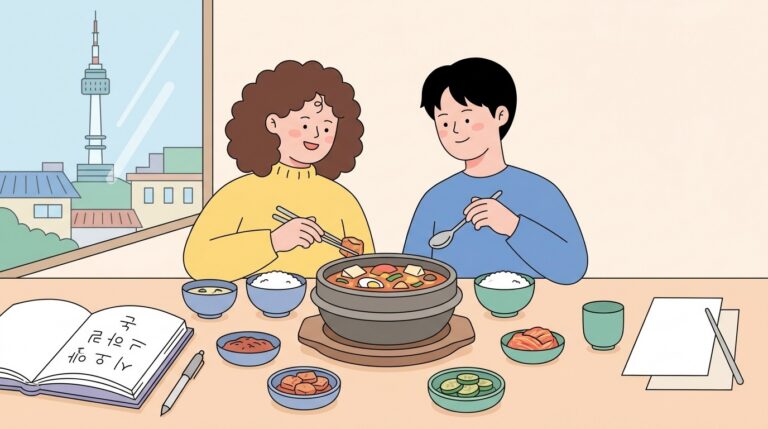
How to Ask Someone to Dinner in Korean Without Feeling Awkward
Phase 1: Empathy (Story-Driven Opening)
안녕하세요! 매일한글 에디터입니다. (Hello! I’m your Daily Hangul editor.)
Picture this: It is 6:30 PM on a crisp Friday in Seoul. You’ve spent months binging K-dramas, dreaming of sitting at a bustling Korean barbecue joint, clinking glasses, and sizzling samgyeopsal over charcoal. You’re standing right next to your Korean coworker, classmate, or language partner. You desperately want to say, “Hey, do you want to grab dinner together?”
Your palms sweat. You open your notes app, search through dictionary entries, and find robotic translations like “우리 함께 식사합시다” (Shall we dine together?). It sounds like a proposal from a 1980s corporate boardroom! You freeze, laugh nervously, mutter an awkward “Bye!”, and end up eating convenience store triangle kimbap alone in your room.
Don’t worry—you are not alone. Almost every Korean learner I have tutored over the last decade has faced this exact wall. In Korean culture, food isn’t just fuel; it’s the ultimate love language and the fastest expressway to building genuine friendship. But asking someone to eat dinner together can feel intimidating because Korean polite verb endings can seem like a puzzle.
Today, we’re changing that. In this beginner-friendly (A1) guide, you will master the single most charming, natural, and versatile sentence to ask someone out for a meal: 저녁 같이 먹을래요? (Jeonyeok gachi meogeullaeyo?). By the end of this guide, you will walk into any Seoul evening ready to make plans effortlessly.
Phase 2: Core 3 Expressions In-Depth
1. 저녁 같이 먹을래요? (Jeonyeok gachi meogeullaeyo?)
- Pronunciation: Jeo-nyeok ga-chi meo-geul-lae-yo? (Sounds like: “Juh-nyuk gah-chee muh-geul-lay-yo?” Note that 같이 sounds like gah-chee, not gah-tee!)
- Meaning: Literal: “Evening together eat-want-to?” | Real Nuance: “Would you like to grab dinner together?” (Warm, polite, and gently inviting)
- K-Culture Moment: The classic scene in romantic K-dramas where the characters linger outside the office or subway station, shyly tossing this line to turn a work day into their first unofficial date.
- Editor’s Insight: The ending -을래요? (-eullaeyo?) is a magic wand for A1 learners. It politely asks for the listener’s preference or intention without sounding demanding or bossy.
- Situation Spectrum: Casual: ⚠️ (too polite for a childhood bestie) | Semi-formal: ✅ (Perfect for peers, coworkers, acquaintances) | Formal: ⚠️ (Use -시겠어요? with your CEO)
- 🤔 Think About It: In English, we often ask “Are you free for dinner?” In Korean, asking “Will you eat together?” prioritizes the shared action of dining as bonding.
2. 오늘 시간 있어요? (Oneul sigan isseoyo?)
- Pronunciation: Oh-neul shi-gan ee-sseo-yo? (Sounds like: “Oh-neul she-gahn ee-so-yo?” The double ‘ss’ produces a crisp, energetic ‘s’ sound like hiss.)
- Meaning: Literal: “Today time exists?” | Real Nuance: “Do you have time today? / Are you free today?”
- K-Culture Moment: The ultimate precursor question. Before dropping the food invite, K-drama protagonists always test the waters with this line to respect the other person’s schedule.
- Editor’s Insight: Dropping this question first shows 눈치 (nunchi)—Korean social tact. It gives the other person space to politely say they are busy before you make a specific suggestion.
- Situation Spectrum: Casual: ⚠️ (Drop the ‘yo’ to make it 오늘 시간 있어?) | Semi-formal: ✅ (Golden standard for daily life) | Formal: 🚫 (Say 오늘 시간 괜찮으십니까?)
- 🤔 Think About It: Notice how Korean doesn’t use the verb “to have” (가지다). Instead, it states that time “exists” (있어요). How does viewing time as an existing condition change how you ask for someone’s attention?
3. 뭐 먹고 싶어요? (Mwo meokgo sipeoyo?)
- Pronunciation: Mwo meok-go shi-peo-yo? (Sounds like: “Mwo muck-go she-puh-yo?” Blend mwo quickly like muh-woh.)
- Meaning: Literal: “What eating want-to?” | Real Nuance: “What would you like to eat?”
- K-Culture Moment: When a group of friends gather in a buzzing Hongdae alleyway debating between Korean fried chicken, tteokbokki, or pork belly.
- Editor’s Insight: -고 싶어요 (-go sipeoyo) is the foundational grammar for “I want to / Do you want to…”. Pairing it with 뭐 (mwo – what) makes you sound considerate and easygoing.
- Situation Spectrum: Casual: ⚠️ (Use 뭐 먹고 싶어? with close friends) | Semi-formal: ✅ (Natural & friendly) | Formal: 🚫 (Use 어떤 음식을 드시겠어요?)
- 🤔 Think About It: Korean dining is heavily communal. Asking the other person what they want first is the highest mark of mealtime manners in Korea!
Phase 3: Textbook Korean vs. Real Korean
Situation 1: Suggesting dinner to a classmate or friendly colleague
- 📖 교과서 한국어 (Textbook Korean): 우리 함께 식사합시다. (Uri hamkke siksa-hapsida. / Let us dine together.)
- 🗣️ 진짜 한국어 (Real Korean): 저녁 같이 먹을래요? (Jeonyeok gachi meogeullaeyo? / Would you like to eat dinner together?)
- 💡 왜 다를까? (Why is it different?): The textbook ending -ㅂ시다 (-psida) sounds stiff, like an army commander giving an order or an executive launching a campaign. Native speakers soften invitations using -을래요? to sound warm and approachable.
Situation 2: Asking if someone has plans after work
- 📖 교과서 한국어 (Textbook Korean): 오늘 저녁에 일정이 어떻게 되십니까? (Oneul jeonyeoge iljeongi eotteoke doesimnikka? / What is your schedule this evening?)
- 🗣️ 진짜 한국어 (Real Korean): 오늘 저녁에 시간 돼요? (Oneul jeonyeoge sigan dwaeyo? / Do you have time this evening?)
- 💡 왜 다를까? (Why is it different?): 일정 (schedule) is reserved for business meetings and corporate calendars. In regular life, Koreans simply use 시간 돼요? (Does time work? / Are you free?).
Phase 4: K-Culture Deep Dive & Non-Verbal Manners
4-1. 눈치 (Nunchi) & Body Language
When asking someone to hang out in Korea, your physical posture carries as much weight as your words:
* The Head Tilt & Soft Smile: Never stare intensely while asking “저녁 같이 먹을래요?” Tilt your head slightly to the side with an open, inquiring smile. This softens the question and relieves any pressure.
* The Two-Handed Gesture: When looking at menus or recommending a food spot on your phone, hold your device with two hands or support your right forearm with your left hand. This subtle gesture instantly radiates Korean politeness.
* Reading the Reluctance: If the person pauses, touches the back of their neck, and says, “아… 오늘은 조금…” (Ah… today is a little bit…), they are politely saying no. Don’t press for reasons! Respond cheerfully: “아, 괜찮아요! 다음에 먹어요!” (Ah, that’s totally fine! Let’s eat next time!).
4-2. Cultural Code: The Sacred “밥 (Bap)” Equation
Foreigners are often startled when a Korean friend’s first question upon meeting is: 밥 먹었어요? (Bap meogeosseoyo? / Have you eaten?).
Is it an immediate invitation to eat? Usually, no!
Historically, Korea endured times of scarcity, making sure someone had eaten a sign of deep affection and care. Today, asking about someone’s meal is equivalent to “How are you?”. However, when paired with a future timeframe—like “오늘 저녁 같이 먹을래요?” (Shall we eat dinner together tonight?)—it shifts from a greeting into a genuine, bonding invitation. In Korea, sharing a warm stew (찌개) or wrapping grilled meat (쌈) is the fastest way to turn an acquaintance into a lifelong friend.
Phase 5: Real-World Roleplay Scenario
Setting: 6:15 PM outside an office building near Gangnam Station. The autumn breeze is cool, street lamps are flickering on, and delicious aromas of grilled meat drift from nearby alleys. You approach Minji (민지), your friendly Korean project partner.
- Turn 1 (You): 민지 씨, 오늘 일 끝났어요? (Minji ssi, oneul kkeutnasseoyo?)
🎭 [Smiling gently while closing your backpack zipper]
“Minji, are you done with work for today?” -
Turn 2 (Minji): 네! 방금 다 끝났어요. 퇴근해요! (Ne! Banggeum da kkeutnasseoyo. Toe-geun-hae-yo!)
🎭 [Stretching her arms with a relieved sigh]
“Yes! Just finished everything. Off work now!” -
Turn 3 (You): 오늘 저녁에 시간 있어요? (Oneul jeonyeoge sigan isseoyo?)
🎭 [Asking with a curious, friendly head tilt]
“Do you have time this evening?” -
Turn 4 (Minji): 네, 특별한 약속 없어요. 왜요? (Ne, teukbyeolhan yaksok eopseoyo. Wae-yo?)
🎭 [Looking at you with genuine curiosity]
“Yes, I have no special plans. Why?” -
Turn 5 (You): 저녁 같이 먹을래요? (Jeonyeok gachi meogeullaeyo?)
🎭 [Showing a bright, inviting smile]
“Would you like to eat dinner together?” -
Turn 6 (Minji): 와, 좋아요! 저 배고파요. (Wa, jo-a-yo! Jeo bae-go-pa-yo.)
🎭 [Clapping hands together happily]
“Wow, sounds great! I’m starving.” -
Turn 7 (You): 뭐 먹고 싶어요? 삼겹살 어때요? (Mwo meokgo sipeoyo? Samgyeopsal eottaeyo?)
🎭 [Pointing towards a popular restaurant down the street]
“What do you want to eat? How about Samgyeopsal?” -
Turn 8 (Minji): 대박! 삼겹살 너무 좋아요. 가요! (Daebak! Samgyeopsal neomu jo-a-yo. Ga-yo!)
🎭 [Laughing excitedly and nodding]
“Awesome! I love Samgyeopsal. Let’s go!”
🔀 Interactive Decision Branch
What if Minji hesitates at Turn 4 and says: “오늘 조금 피곤해서요…” (I’m a bit tired today…)? How should you respond?
- Choice A: “안 돼요! 꼭 같이 먹어야 해요!” (You can’t! You must eat with me!)
- Feedback: 🚫 Bad! Extremely aggressive and violates Korean boundary etiquette. This will make future hangouts awkward.
- Choice B: “아, 피곤하시군요! 그럼 쉬세요. 다음에 같이 먹어요!” (Ah, you’re tired! Please rest then. Let’s eat together next time!)
- Feedback: ✅ Best! Demonstrates incredible nunchi. You acknowledge their condition, relieve social pressure, and keep the door open for future plans.
- Choice C: “알겠어요. 안녕.” (Okay. Bye.)
- Feedback: ⚠️ Risk! Too abrupt and dry. While not directly offensive, it sounds cold and disappointed.
Phase 6: 10-Second Emotion Shadowing Drill
Practice these lines aloud, copying the exact rhythm, pause (/), and emotional intent!
[😊 Cheerful & Inquiring]
저녁 / 같이 / 먹을래요?
(Jeo-nyeok / ga-chi / meo-geul-lae-yo?)-
[🤔 Polite & Respectful]
오늘 / 저녁에 / 시간 있어요?
(Oh-neul / jeo-nyeok-e / shi-gan ee-sseo-yo?) -
[🎉 Enthusiastic & Friendly]
삼겹살 어때요? / 제가 맛집 알아요!
(Sam-gyeop-sal eo-ttae-yo? / Je-ga mat-jip al-a-yo! – How about pork belly? I know a great spot!) -
[🥺 Understanding & Sweet]
괜찮아요! / 다음에 / 꼭 같이 먹어요.
(Gwaen-chan-a-yo! / Da-eum-e / kkok ga-chi meo-geo-yo. – No problem! Let’s definitely eat together next time.)
Phase 7: K-Culture Mini Dictionary
-
밥약 (Bap-yak)
- Meaning: A meal appointment / dining plan (Short for 밥 약속).
- Usage: University students constantly say: “오늘 선배랑 밥약 있어!” (I have a meal appointment with a senior today!).
- 맛집 (Mat-jip)
- Meaning: Famous restaurant / Top-tier eatery.
- Usage: Essential for finding food. Always ask: “여기 근처에 맛집 있어요?” (Is there a famous delicious restaurant near here?).
- 뿜빠이 / N분의 1 (Ppumpai / N-bun-ui-il)
- Meaning: Splitting the bill evenly.
- Usage: Among peers, someone will say: “우리 N분의 1 해요!” (Let’s split this bill equally among us!).
- 2차 (I-cha)
- Meaning: “Round Two” of a gathering (moving from dinner to a dessert cafe, pub, or karaoke).
- Usage: After dinner, Koreans almost always ask: “우리 2차 갈까요?” (Shall we go for Round 2?).
Phase 8: Traveler’s Survival Kit
TOP 3 Survival Phrases for Making Plans
- 여기 자리 있어요? (Yeogi jari isseoyo?)
- Pronunciation: Yeo-gi ja-ri ee-sseo-yo?
- Pro Tip: When scoping out a busy restaurant with your friend, ask the staff this phrase to check if seats are open.
- 뭐가 제일 맛있어요? (Mwoga jeil masisseoyo?)
- Pronunciation: Mwo-ga je-il ma-shi-sseo-yo?
- Pro Tip: Once seated, ask the waiter or your Korean friend what their #1 recommendation is.
- 계산해 주세요! (Gyesanhae juseyo!)
- Pronunciation: Gye-san-hae joo-seh-yo!
- Pro Tip: Say this with a polite hand raise when you are ready to pay at the counter.
📱 Editor’s Travel Note
- Navigation: Never rely on Google Maps in Korea—walking routes do not update properly! Be sure to install the Naver Map navigation app before your trip to find real-time opening hours and local reviews.
- Table Bookings: For viral, trendy food spots in Seongsu or Yeonnam-dong, download the Catch Table restaurant reservation app to jump past 2-hour waiting lines.
- Paying Culture: In casual gatherings with friends, the person who invites often offers to pay first, and the other person buys coffee/dessert for “Round 2”. If you’re both students, split-billing via mobile payment is the norm.
Phase 9: “A Step Deeper” (Reflective Mini-Essay)
In Western cultures, dinner invitations are often logistical—it’s about setting a calendar date, syncing schedules, and enjoying cuisine. But in Korea, eating together is an act of weaving 정 (Jeong)—an invisible, warm thread of communal bonding and empathy. Sharing a table means you are stepping out of the role of a stranger and entering someone’s inner circle. When you utter that simple phrase, “저녁 같이 먹을래요?”, you aren’t merely asking for food; you are saying, “I want to share my time, my warmth, and my stories with you tonight.”
💬 Your Turn: Who is the first person you want to say 저녁 같이 먹을래요? to? Drop their nickname or your dream Korean dinner menu in the comments below!
Phase 10: FAQ & Avoiding Misunderstandings
Q: Can I use this phrase with an older person or a boss at work?
A: It’s better to elevate the politeness for seniors! Instead of 저녁 같이 먹을래요?, say “오늘 저녁 식사 같이 하시겠어요?” (Oneul jeonyeok siksa gachi hasigesseoyo?). Replacing 먹다 (to eat) with the honorific 식사하다 shows maximum respect.
Q: What is the difference between “밥 (bap)” and “저녁 (jeonyeok)”?
A: 밥 literally means cooked rice, but colloquially means any meal. 저녁 specifically means the evening or dinner. Saying “밥 같이 먹을래요?” is slightly more casual and works for any meal of the day, while “저녁 같이 먹을래요?” specifically points to dinner.
Q: If someone asks me “밥 먹었어요?”, should I invite them to eat?
A: Not necessarily! If you bump into someone at 2 PM and they ask “밥 먹었어요?”, they are usually just showing caring concern. Simply answer “네, 먹었어요! (Yes, I ate!)” with a smile, unless they follow it up with a specific time plan.
🚨 Common Mistakes Alert
- Mistake: Pronouncing 같이 as “ga-ti”.
- Correct Action: In Korean phonology, when ㅌ meets 이, it turns into a 치 sound. Always pronounce it as [가치 – ga-chi]!
- Mistake: Using 반말 (casual talk like 먹을래?) with someone you just met.
- Correct Action: Always keep the polite -요 (-yo) on the end (먹을래요?) until you have mutually agreed to drop honorifics.
- Mistake: Asking “너 시간 있어?” (Do you have time?).
- Correct Action: Avoid using the pronoun 너 (you). It sounds confrontational! Use their name with 씨 (e.g., 민지 씨, 오늘 시간 있어요?) or drop the pronoun entirely.
Phase 11: Action Missions
- 🥉 Bronze Mission (Solo Mastery): Record yourself on your phone voice memo saying “저녁 같이 먹을래요?” three times with a smiling tone. Listen back and check your ga-chi pronunciation!
- 🥈 Silver Mission (Social Connection): Send a text message to your Korean language exchange partner or classmate: “[Name] 씨, 이번 주에 저녁 같이 먹을래요?” (Would you like to eat dinner together this week?).
- 🥇 Gold Mission (Real Life Execution): Next time you visit a Korean town or restaurant, greet a Korean acquaintance in person and ask them out for a meal using the full Turn 3 & Turn 5 formula from Phase 5.
- 🎮 K-Culture Mission: Watch any episode of a contemporary drama (like Business Proposal or Weightlifting Fairy Kim Bok-joo) and spot how many times characters say “밥 먹으러 가자” or “저녁 먹을래요?”.
Phase 12: Interactive Quiz Challenge
1. Situational Judgment: You want to ask your friendly Korean classmate out for dinner after class. Which phrase is the most natural and polite?
* A) 우리 함께 식사합시다.
* B) 저녁 같이 먹을래요?
* C) 너 밥 먹어라.
2. Fill-in-the-Blank: Complete the polite question asking if someone has free time:
오늘 저녁에 [ ] 있어요?
3. True or False: When a Korean coworker passes by your desk at 1:30 PM and asks “밥 먹었어요?”, they are always expecting you to go eat lunch with them right that second.
* (True / False)
👉 Click to reveal answers & explanations!
- Answer: B (저녁 같이 먹을래요?)
- Explanation: Choice A is overly rigid and textbook-like. Choice C is a rude command in casual language. Choice B strikes the ideal balance of warmth and respect!
- Answer: 시간 (sigan – time)
- Explanation: The full sentence is 오늘 저녁에 시간 있어요? (Do you have time this evening?).
- Answer: False
- Explanation: “밥 먹었어요?” is often used purely as a greeting of care and affection, similar to “How are you doing today?”.
- Explanation: “밥 먹었어요?” is often used purely as a greeting of care and affection, similar to “How are you doing today?”.