

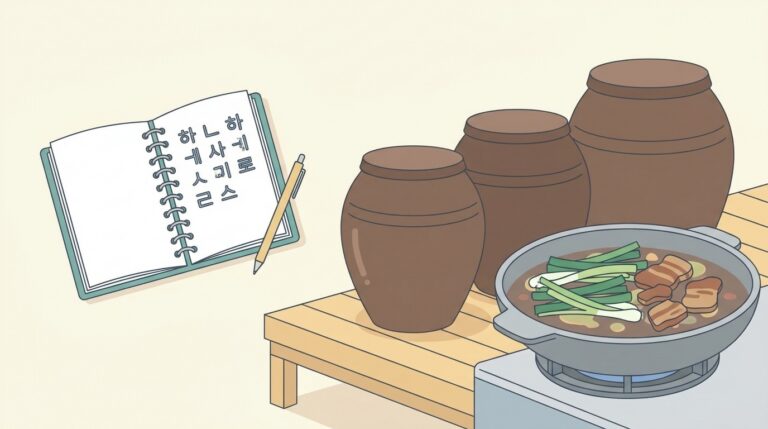
Phase 1: 공감 (The Kitchen Panic That Every K-Food Enthusiast Knows)
안녕하세요! 매일한글 에디터입니다. (Hello! This is your Daily Hangul editor.)
Have you ever stood completely paralyzed in the condiment aisle of an Asian supermarket, staring down twenty distinct brands of Korean soy sauce? You just finished binge-watching an episode of Street Food Fighter or Home Food Rescue, and your heart was set on crafting that glistening, savory braised pork belly you saw on screen. You bought the freshest ingredients, but once in front of the stove, self-doubt crept in: Do I need Guk-ganjang, Jin-ganjang, or Yangjo-ganjang? How do Korean home cooks pull off that addictive, deep umami glaze without spending six hours reducing stocks from scratch?
If you have ever ended up with a stir-fry that tasted aggressively salty rather than deeply savory, you are not alone. As an editor coaching C2-level Korean learners for a decade, I see advanced students hit a peculiar wall: you can dissect complex sociopolitical articles in Korean, yet deciphering the intuitive, spoken shorthand of a Korean kitchen feels like an impenetrable code.
This guide resolves that culinary and linguistic impasse. Today, we will decode the revolutionary culinary blueprint popularized by South Korea’s favorite mentor-chef, Baek Jong-won (백종원): his iconic 만능 간장 (Manneung Ganjang, or All-Purpose Soy Sauce). By mastering this mother sauce, you unlock both effortless Korean home-cooked excellence (Jipbap) and the high-tier native idioms that define authentic culinary fluency.
Phase 2: 핵심 표현 3선 심층 분석 (Core Advanced Culinary Expressions)
1. 간을 맞추다 (Ganeul matchuda)
- Pronunciation: Ganeul matchuda (Think of tuning a violin: gah-neul ma-choo-dah).
- Meaning: Literal: “To match the saltiness/seasoning” | Nuanced: To achieve harmonious, multi-dimensional sensory balance across savory, sweet, and umami profiles.
- K-Culture Moment: On variety shows like Delicious Rendezvous, whenever a rookie idol panics over a bland stew, Baek Jong-won tastes a spoonful, pauses, and calmly advises: “물 더 붓지 말고 간을 다시 맞춰봐.” (Don’t just pour in more water; dial in the seasoning balance again.)
- Editor’s Insight: At the C2 level, recognize that 간 (gan) is not merely salt; it is the ontological essence of savory calibration. Idiomatically, Koreans also say 간을 보다 (ganeul boda) outside the kitchen to describe discreetly “testing the waters” or taking the room’s temperature in boardroom negotiations.
- Situation Spectrum: Casual: ✅ | Semi-formal: ✅ | Formal: ✅
- 🤔 Think About It: Why does Korean culture frame seasoning with the collaborative verb 맞추다 (“to harmonize/fit together”) rather than an aggressive unilateral action like “to salt”? What does this imply about the Korean philosophy of communal balance?
2. 뜸을 들이다 (Tteumeul deurida)
- Pronunciation: Tteumeul deurida (Rhythmic cadence: tteum-eul deu-ree-dah).
- Meaning: Literal: “To let cooked rice or stews rest under trapped residual steam” | Nuanced: To patiently let complex flavors marry and settle; metaphorically, to build dramatic suspense or intentionally hesitate before dropping important news.
- K-Culture Moment: In food-centric K-Dramas like Let’s Eat, when a host dramatically refuses to reveal a secret ingredient, a ravenous guest will protest: “뜸 들이지 말고 빨리 말해줘!” (Stop beating around the bush and spill it already!).
- Editor’s Insight: This expression reflects an irreplaceable culinary phase where heat is turned off, yet chemical refinement accelerates under the surface. Use it playfully in business when a colleague delays announcing quarterly results.
- Situation Spectrum: Casual: ✅ | Semi-formal: ✅ | Formal: ⚠️
- 🤔 Think About It: In a society famously characterized by the Ppalli-ppalli (빨리빨리, rush-rush) mindset, how does the reverence for 뜸 reveal Korea’s profound, quiet appreciation for patience and stillness?
3. 킥으로 넣다 (Kigeuro neota)
- Pronunciation: Kigeuro neota (Punchy cadence: kik-eu-ro neo-tah).
- Meaning: Literal: “To insert as a kick” | Nuanced: To incorporate a game-changing, defining secret ingredient that elevates an ordinary dish into an extraordinary culinary experience.
- K-Culture Moment: On his mega-hit YouTube channel Paik’s Cuisine, Chef Baek flashes his signature grin, tossing chopped chili into a simmering soy reduction: “여기에 청양고추를 킥으로 넣으면 풍미가 완전히 달라져유.” (If you throw in Cheongyang chili as the kick right here, the depth transforms completely).
- Editor’s Insight: Although borrowed from the English word “kick,” its Korean syntactic integration is distinct. It does not refer to generic spiciness; it signifies the decisive linchpin of culinary identity.
- Situation Spectrum: Casual: ✅ | Semi-formal: ⚠️ | Formal: 🚫
- 🤔 Think About It: How does the Korean culinary lexicon effortlessly domesticate foreign loanwords to fill subtle stylistic niches that formal vocabulary cannot capture?
Phase 3: 교과서 한국어 vs 진짜 한국어 (Textbook vs Real Korean)
Situation 1: Describing irresistible, tongue-coating umami richness
- 📖 교과서 한국어: 이 소스는 감칠맛이 아주 풍부합니다. (I soseuneun gamchilmasi aju pungbuhamnida. / “This sauce is very rich in umami flavor.”)
- 🗣️ 진짜 한국어: 입에 쫙쫙 달라붙는 감칠맛이 아주 예술이에요. (Ibe jwakjwak dallabeonneun gamchilmasi aju yesurieyo. / “The savoriness clings right to your palate—it is absolute art.”)
- 💡 왜 다를까? Textbook language relies on static descriptive adjectives (풍부하다), whereas natural C2 Korean employs sensory mimetic words (쫙쫙) and dramatic artistic metaphor (예술이다) to express mouthfeel and unctuous decadence.
Situation 2: Recommending a lightning-fast weeknight meal solution
- 📖 교과서 한국어: 간장에 고기를 넣고 졸이면 요리하기 쉽습니다. (Ganjange gogireul neoko jorimyeon yorihagi swipsumnida. / “If you braise meat in soy sauce, it becomes easy to cook.”)
- 🗣️ 진짜 한국어: 만능 간장 한 국자만 슥 둘러서 볶아내면 한 끼 뚝딱이죠. (Manneung ganjang han gukjaman seuk dulleoseo bokkanaemyeon han kki ttukttagijyo. / “Just swirl in a ladle of all-purpose soy sauce, flash-fry it, and a hearty meal is sorted in a snap.”)
- 💡 왜 다를까? High-proficiency speech leans heavily on visceral motion adverbs like 슥 (effortless gliding stroke) paired with idiomatic completion markers like 뚝딱 (instant, effortless assembly).
Phase 4: K-Culture 딥다이브 & 비언어적 매너 (Cultural Nuances & Etiquette)
4-1. 눈치(Nunchi) & Cooking Gestures
When stepping into an authentic Korean kitchen, your non-verbal etiquette speaks before your tongue does. If an elder or host is adjusting a braising sauce, observe their rhythm with keen Nunchi. When offered a taste of simmering sauce directly from the ladle, never lean straight down into the steam. Instead, gently cup your non-dominant hand underneath the taster spoon or forearm as a protective gesture of hygiene and deference. After tasting, wait three deliberate seconds, exhale gently through the nose, and nod before pronouncing your verdict. Instantaneous praise can read as superficial; a measured pause shows you possess the palate to appreciate simmering depths.
4-2. The Baek Jong-won Phenomenon & The Modern Banchan Culture
For generations, Korean domestic cooking was shrouded in the mystique of maternal 손맛 (Son-mat, artisanal “hand-taste”)—an intuitive, non-standardized method of seasoning passed down through generational muscle memory. While romantic, this created culinary anxiety for the exploding demographic of young single-person households (일인 가구) in Seoul.
Baek Jong-won dismantled this gatekeeping by treating gastronomy like transparent, accessible design. By standardizing measurements into universal paper cups (종이컵 계량) and formulating the pork-infused 만능 간장 (Manneung Ganjang), he democratized home-cooked comfort. In contemporary South Korea, keeping a jar of this base in your fridge is no longer viewed as cutting corners; it is celebrated as modern domestic ingenuity.
Phase 5: 실전 롤플레이 시나리오 (Kitchen Roleplay Scenario)
Setting: A modern apartment kitchen in Mapo-gu, Seoul. 8:30 PM. You and your foodie Korean friend Min-woo (민우) are making dinner after an exhausting workday.
Turn 1
민우: 오늘 저녁 뭐 해 먹을까? 냉장고에 남은 돼지고기 다짐육이랑 두부밖에 없는데.
(Oneul jeonyeok mwo hae meogeulkka? Naengjanggoe nameun dwaejigogi dajimyuk-irang dububakke eomneunde.)
“What should we make for dinner? We only have ground pork and tofu left in the fridge.”
🎭 냉장고 문을 연 채 턱을 괴며 고민스러운 표정을 짓는다.
Turn 2
You: 우리 지난번에 만들어 둔 만능 간장 있잖아. 그걸로 마파두부풍 두부조림 하면 딱이겠는데?
(Uri jinanbeone mandeureo dun manneung ganjang itjana. Geugeollo mapa-dubu-pung dubujorim hamyeon ttagigenneunde?)
“We still have that all-purpose soy sauce we prepped earlier. Wouldn’t a Mapo-style braised tofu hit the spot?”
🎭 찬장에서 유리병에 담긴 특제 만능 간장을 꺼내 보여준다.
Turn 3
민우: 오, 역시 맛잘알! 근데 백종원 레시피 고기랑 간장 비율이 살짝 헷갈린다. 몇 대 몇이었지?
(O, yeoksi matjaral! Geunde Baek Jong-won resipigeon gogirang ganjang biyuri saljjak hetgallinda. Myeot dae myeochieotji?)
“Oh, spoken like a true culinary connoisseur! But I’m blanking on Chef Baek’s ratio of meat to soy sauce. What was it again?”
🎭 프라이팬에 불을 올리며 호기심 어린 눈빛으로 쳐다본다.
Turn 4
You: 고기 두 컵에 간장 여섯 컵, 설탕 한 컵이야. 고기 기름이 간장에 충분히 우러나야 제대로거든.
(Gogi du keobe ganjang yeoseot keop, seoltang han keobiya. Gogi gireumi ganjange chungbunhi ureonaya jedeorogeodeun.)
“Two cups of meat to six cups of soy sauce and one cup of sugar. The pork fat has to thoroughly render into the soy sauce to work its magic.”
🎭 계량컵으로 능숙하게 시늉을 하며 미소를 짓는다.
Turn 5
민우: 맞아! 끓어오를 때 거품을 살살 걷어내야 기름지지 않고 국물이 깔끔해지지.
(Maja! Kkeureo-oreul ttae geopumeul salsal geodeonaeya gireumjiji anko gukmuri kkalkkeumhaejiji.)
“Right! You have to gently skim the scum off the top as it simmers so the sauce stays crisp and not overly greasy.”
🎭 숟가락으로 냄비 표면을 걷어내는 시늉을 한다.
Turn 6
You: 두부 넣고 한소끔 바글바글 끓인 다음에 불 끄고 뜸을 좀 들이자.
(Dubu neoko hansokkeum bageul-bageul kkeurin da-eume bul kkeugo tteumeul jom deurija.)
“Let’s drop the tofu in, let it come to a rolling boil once, and then cut the heat to let the flavors settle under residual steam.”
🎭 냄비 뚜껑을 덮으며 타이머를 확인한다.
Turn 7
민우: 완벽해. 마지막에 매콤하게 파기름이랑 청양고추를 킥으로 넣는 센스, 잊지 마!
(Wanbyeokhae. Majimage maekomhage pagireum-irang cheongyang-gochureul kigeuro neonneun senseu, itji ma!)
“Spot on. Don’t forget that master touch of adding scallion oil and Cheongyang chili at the very end as our kick!”
🎭 썰어둔 청양고추를 접시에 담아 흔들어 보인다.
Turn 8
You: 당연하지. 단짠의 밸런스가 제대로 잡혀서 밥 두 공기는 거뜬히 비우겠어.
(Dangyeonhaji. Danjjan-ui baelleonseu-ga jedeoro japhyeoseo bap du gong-gineun geotteunhi bi-ugetseo.)
“Of course. The sweet-salty balance is so locked in, we will easily polish off two bowls of rice each.”
🎭 갓 지은 밥솥 뚜껑을 열며 자신만만하게 웃는다.
🔀 인터랙티브 분기점 (Interactive Choice)
Min-woo looks at the simmering tofu stew and worries: “The color looks slightly paler than the restaurant version. Should we pour another tablespoon of raw soup soy sauce (Guk-ganjang) right now?”
- Option A: “이미 만능 간장으로 간을 맞췄으니까, 졸아들면 딱 맞아. 더 넣으면 짜서 못 먹어!” (We already balanced it with all-purpose soy sauce; it will intensify as it reduces. If we add more, it’ll be too salty to eat!)
- Feedback: [Best Choice] Exceptional grasp of culinary science! Baek Jong-won’s sauce concentrates rapidly as water evaporates. Trusting your base ratio prevents a sodium disaster.
- Option B: “싱거워 보이니까 진간장이랑 소금 한 숟가락 더 팍팍 넣자!” (It looks bland, let’s dump in another heaping spoonful of dark soy sauce and salt!)
- Feedback: [Bad Choice] Catastrophic error. Korean braises darken and intensify significantly upon cooling. Adding salt unilaterally turns a balanced dinner into brine.
- Option C: “국간장으로 밸런스를 맞추면 색은 안 진해지면서 딱 맞지 않을까?” (If we balance it with soup soy sauce, won’t it keep the color pale while adjusting the salt?)
- Feedback: [Risk] Risky gamble. Guk-ganjang has a sharp, fermented funky undertone meant for clear broths. Adding it to a sweet meat-soy reduction creates an unpleasant flavor clash.
Phase 6: 10초 감정 섀도잉 드릴 (10-Second Emotional Shadowing Drill)
Practice these lines out loud, obeying the slash marks (/) for authentic native cadence and pauses.
Drill 1 [😋 군침을 삼키며 경탄하듯 / Drooling with genuine gastronomic delight]
와, / 만능 간장 한 스푼 넣었을 뿐인데 / 깊은 풍미가 확 살아나네요!
(Wa, / manneung ganjang han seupun neoeosseul ppuninde / gipeun pungmiga hwak sara-naneyo!)
“Wow, I merely introduced a single spoon of all-purpose soy sauce, but that profound depth exploded to life!”
Drill 2 [🧐 조리법을 전수하며 신중하게 / Imparting culinary secrets with measured gravity]
불을 끄고 / 뜸을 충분히 들여야 / 양념이 속까지 쏙 배어들어요.
(Bureul kkeugo / tteumeul chungbunhi deuryeoya / yangnyeomi sokkkaji ssok bae-eodeureoyo.)
“Cut the flame and let it rest under residual heat; that is how the marinade penetrates right to the core.”
Drill 3 [😎 셰프 같은 여유와 자신감을 담아 / Oozing charismatic culinary confidence]
이 요리의 화룡점정은 / 마지막에 킥으로 얹은 / 알싸한 청양고추죠!
(I yori-ui hwaryongjeomjeongeun / majimage kigeuro eonjeun / alssahan cheongyang-gochujyo!)
“The crowning jewel of this creation is unmistakably that zesty Cheongyang chili added at the end as our kick!”
Phase 7: K-Culture 미니 사전 (Mini Culinary Lexicon)
- 단짠 (Danjjan) | Noun | The sweet-and-salty flavor harmony. A modern compound word representing the addictive axis of contemporary South Korean street foods and braises.
- 감칠맛 (Gamchilmat) | Noun | Deep, savory umami richness. The round, glutamic satisfaction derived naturally from fermented soybean paste, seaweed broths, or rendered animal fats.
- 손맛 (Son-mat) | Noun | Artisanal hand-taste. The subjective culinary intuition and care infused into food through tactile mastery rather than mechanical measuring spoons.
- 파기름 (Pagireum) | Noun | Scallion-infused aromatic oil. The foundational cooking oil made by gently frying chopped green onions over low heat, acting as the bedrock of Baek Jong-won recipes.
Phase 8: 여행자를 위한 생존 키트 (Traveler’s Culinary Survival Kit)
Top 3 Market & Restaurant Survival Lines
- “덜 짜게 조리해 주실 수 있나요?” (Deol jjage jorihae jusil su innayo?)
- Pro Tip: Use this at bustling local braise specialty joints (Jorim-jip) if your sodium tolerance leans mild.
- “여기에 비법 만능 양념장이 들어가나요?” (Yeogie bibeop manneung yangnyeomjang-i deureoganayo?)
- Pro Tip: Flatter neighborhood food-stall owners by asking if their signature recipe uses a secret house-made master sauce.
- “남은 음식 포장할 용기 좀 부탁드릴게요.” (Nameun eumsik pojanghal yonggi jom butakdeurilgeyo?)
- Pro Tip: Portions for Korean family-style braises are generous. Take remnants back to your Airbnb kitchen to revive with fresh rice!
Editor’s Travel Note
Before roaming traditional hubs like Mangwon Market or Gyeongdong Market, remember that independent spice and dry-goods grocers won’t always register on international map platforms. Prioritize installing the Naver Map application navigation guide to uncover local, mom-and-pop vegetable and seasoning vendors. When purchasing soy sauce in Korea, glance at the TN (Total Nitrogen) index on the back label: a rating of 1.5% or higher denotes premium, naturally fermented depth perfect for your DIY Manneung Ganjang base.
Phase 9: “한 발 더 깊이” (Cultural Reflection)
Traditional Korean culinary identity historically revered ancestral patience, immortalized in centuries-old earthen jars (Onggi) holding irreplaceable 씨간장 (Ssi-ganjang, or heritage seed soy sauce). In vivid contrast, Baek Jong-won’s Manneung Ganjang reflects dynamic post-industrial pragmatism: demystifying ancient fermentation and translating it into a pantry-accessible formula designed for modern life. Yet, underneath this fast-paced contemporary shortcut beats the eternal heart of Korean culinary tradition—the desire to transform modest pantry staples into a warm, deeply comforting meal shared around the family table.
💬 Your Turn: Have you experimented with cooking Korean braises at home? What is the one quintessential sauce or secret base in your culture that acts as an all-purpose kitchen miracle? Drop your culinary stories in the comments below!
Phase 10: FAQ & 오해 방지 (FAQ Schema)
Q: How long does homemade Baek Jong-won All-Purpose Soy Sauce stay fresh in the fridge?
A: Because of its conservative balance of high sodium, sugar, and rendered cooked pork fat, it maintains peak flavor in an airtight, sterilized glass jar for 2 to 3 weeks. Always let the boiled sauce cool down completely to ambient room temperature before sealing, and invariably utilize clean, dry wooden or stainless spoons when scooping to prevent spoilage.
Q: Can I substitute Jin-ganjang (진간장) with Guk-ganjang (국간장) for this recipe?
A: Absolutely not. Guk-ganjang (soup soy sauce) is a byproduct of fermenting soybean blocks (Meju) in brine; it is sharply salty, pale in color, and carries a pungent artisanal funk designed exclusively for clear soups. Using it here will completely overturn the intended rich, glossy, sweet-savory profile provided by Jin-ganjang or naturally brewed Yangjo-ganjang.
Q: What should I do with the solid white fat layer that forms on top after refrigeration?
A: Do not throw that white layer away! That is pure, rendered pork fat (Lard) packed with concentrated soy umami. When you ladle the sauce straight into a searing-hot wok or pan with tofu, mushrooms, or noodles, that fat instantly liquifies, imparting a rich, glossy sheen and restaurant-caliber savory depth.
🚨 Common Mistakes Alert
- Mistake 1: Boiling over aggressive high heat. Scorches the sugars in the soy sauce, resulting in an acrid, bitter finish. -> Correct Action: Bring the sauce to a rolling boil over medium heat, then immediately dial back to low heat to let the pork fat render gently.
- Mistake 2: Neglecting the surface foam during boiling. Leaving the bubbling grey froth creates a cloudy appearance and gamier aftertaste. -> Correct Action: Skim off the bubbling scum using a fine mesh strainer during the initial five minutes of simmering.
- Mistake 3: Throwing in fresh garlic or scallions into the master jar. Simmering raw aromatics inside the master base drastically slashes its refrigerator shelf-life. -> Correct Action: Keep the foundational sauce restricted strictly to pork, soy sauce, and sugar; add freshly minced scallions, garlic, and chilies on the day you cook your individual meals.
Phase 11: 액션 미션 & 참여 유도 (Action Missions)
- 🥉 Bronze Mission (Solo Mastery): Memorize the golden ratio of Baek Jong-won’s sauce by heart: Pork 2 : Soy Sauce 6 : Sugar 1. Recite the phrase “간을 딱 맞췄어요” aloud five times while preparing dinner.
- 🥈 Silver Mission (Community Share): Cook any dish using your soy sauce base (like braised quail eggs or stir-fried shishito peppers), snap a picture, and post it online tagging
@DailyHangulwith the caption: “오늘 저녁은 만능 간장으로 간을 맞췄어요!” - 🥇 Gold Mission (Real-World Deployment): When visiting a Korean grocery store or speaking with a native Korean speaker, describe your favorite cooking shortcut using the slang “킥으로 넣다” in complete sentences!
- 🎮 K-Culture Quest: Stream an episode of The Backpacker Chef (백패커) or Home Food Rescue (집밥 백선생), spot the moment Chef Baek adjusts a seasoning balance, and log his precise phrasing in your language journal!
Phase 12: 인터랙티브 퀴즈 챌린지 (Interactive Quiz Challenge)
Test your mastery of advanced Korean culinary communication!
1. Situational Judgment: You are braising potatoes with your Korean partner and want to articulate like a native chef that you are pausing the stove to let the flavors settle. What is the most refined C2 expression?
* a) 국물이 튀니까 불을 끄고 도망갑시다.
* b) 간이 다 끝났으니 뚜껑을 덮고 뜸을 들입시다.
* c) 양념이 싱거우니 소금을 한 바가지 붓겠습니다.
2. Fill-in-the-Blank:
“이 볶음밥의 느끼함을 잡아주는 비장의 무기는 마지막에 ( )으로 넣은 청양고추예요.”
3. True or False:
Baek Jong-won’s original Manneung Ganjang incorporates raw minced garlic directly into the master boiling pot to preserve it for several months. (True / False)
👉 Click to Reveal Answer Key & In-Depth Explanations
- Answer: b — “간이 다 끝났으니 뚜껑을 덮고 뜸을 들입시다.” Using 뜸을 들이다 accurately captures the resting period required for sauces to permeate ingredients.
- Answer: 킥 — 킥으로 넣다 is the definitive slang phrase indicating a transformative secret ingredient.
- Answer: False — Fresh aromatics spoil quickly in liquid storage! Chef Baek insists on keeping the master sauce strictly to pork, soy sauce, and sugar, adding fresh garlic and scallions only when cooking individual dishes.







