

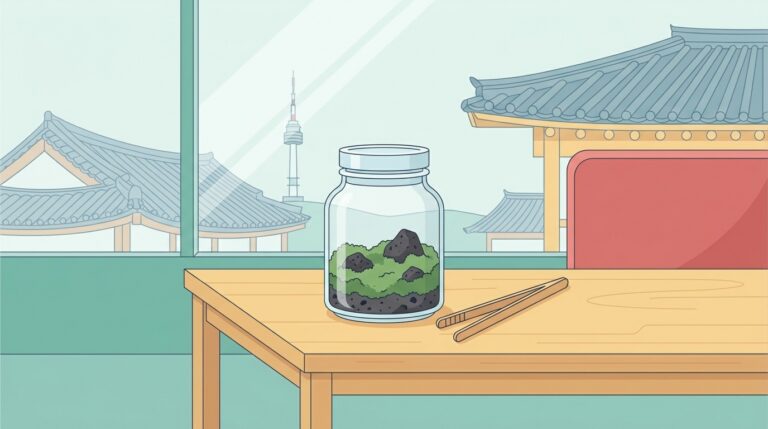
Master the Art of Korean Terrarium Workshops: Your Advanced C1 Botanical Guide
Phase 1: Empathy & Storytelling Opening
안녕하세요! 매일한글 에디터입니다.
Picture this: It is a drizzly Saturday afternoon in Seongsu-dong. You step into a secluded botanical atelier hidden away in an alleyway, where the air smells intoxicatingly of petrichor, damp forest moss, and warm espresso. Around a shared reclaimed-wood workbench, stylish locals clad in linen aprons are delicately manipulating tiny tufts of cushion moss and miniature ferns using surgical-grade stainless tweezers. You came here eager to craft your very own glass ecosystem—a miniature world inside a sleek cylinder.
Then, the instructor breezes over and begins explaining the layers: “배수층을 넉넉히 깔아 흙이 숨을 쉬게 해주고, 가운데는 여백의 미를 살려 배치해주세요.” (Lay a generous drainage layer so the soil can breathe, and arrange the center keeping the beauty of empty space in mind.) Suddenly, your textbook Korean hits a wall. You know the word for plant, but how do you discuss soil aeration? How do you ask if delicate moss will rot without sounding clumsy or kindergarten-simple? You freeze, worried you might accidentally suffocate a Fittonia under three scoops of crushed volcanic rock while nodding politely.
Learning botanical Korean at a C1 level isn’t just about memorizing plant taxonomy; it is about entering the cultural frequency of modern Korea’s booming planterior and companion plant (반려식물) lifestyle. This guide is built directly on real feedback from advanced learners who wanted to bridge the gap between classroom fluency and authentic, aesthetic workshop banter. By the end of this guide, you will command the nuanced terminology, aesthetic concepts, and polite studio manners necessary to navigate any boutique gardening atelier in Seoul with effortless poise.
Phase 2: Core 3 Expressions In-Depth Breakdown
1. 여백의 미를 살려볼게요 (Yeobaeg-ui mireul sallyeobolgeyo)
- Pronunciation: [Yeo-baeg-ui mi-reul sal-lyeo-bol-ge-yo] (Think: “Yaw-beck-we” + “me” + “sal-lyaw-bowl-geh-yo”)
- Meaning: Literally: “I will revive the beauty of empty margins.” / Actual Nuance: “I will arrange this with deliberate negative space rather than overcrowding it.”
- K-Culture Moment: Heard constantly on architectural design shows like Where is My Home (구해줘! 홈즈) or lifestyle vlogs when styling minimalist living rooms, ikebana, or terrarium dioramas.
- Editor’s Insight: At the C1 level, saying “단순하게 할게요” (I’ll keep it simple) sounds juvenile. Invoking “여백의 미” touches on a deeply rooted East Asian aesthetic ideal where untouched space holds as much emotional weight as decorated areas. It signals artistic refinement.
- Situation Spectrum:
- Casual (Friends): ✅ “여백의 미 좀 살려봐!” (Leave some breathing room!)
- Semi-formal (Studio/Workshop): ✅ “여백의 미를 좀 살려서 식재해 볼게요.”
- Formal (Broadcast/Academic): ✅ “전통적인 여백의 미를 현대적으로 재해석했습니다.”
- 🤔 Think About It: In Western design, the instinct is often to fill space to showcase abundance. Why does Korean culture revere “untouched space” as an active design element rather than an empty void?
2. 과습이 오지 않게 신경 쓰는 편이에요 (Gwaseub-i oji anke singyeong sseuneun pyeon-ieyo)
- Pronunciation: [Gwa-seu-bi o-ji an-ke sin-gyeong sseu-neun pyeon-i-e-yo] (Think: “Gwah-soup-ee” + “oh-jee” + “ahn-keh”)
- Meaning: Literally: “I tend to pay mind so that over-humidity/overwatering does not come.” / Actual Nuance: “I am vigilant about preventing root rot and excess moisture.”
- K-Culture Moment: A staple phrase among Korean “Plant Butlers” (식집사) sharing indoor gardening care tips on Instagram and YouTube.
- Editor’s Insight: Notice the verb: overwatering isn’t just something you do; it “comes” like an uninvited affliction (과습이 오다), much like a cold (감기가 오다). Using “~신경 쓰는 편이에요” softens your claim, demonstrating humble confidence.
- Situation Spectrum:
- Casual: ✅ “물 너무 많이 주면 과습 와!”
- Semi-formal: ✅ “밀폐형 용기라 과습이 오지 않게 바닥 배수층을 두껍게 깔았어요.”
- Formal: ✅ “밀폐 생태계의 특성상 과습 방지가 핵심 과제입니다.”
- 🤔 Think About It: Why do Koreans often personify plant ailments using the verb “to come” (오다) instead of attributing direct active fault to the gardener?
3. 흙이 숨을 쉴 수 있게 톡톡 다져주세요 (Heulgi sumeul swil su itge toktok dajyeojuseyo)
- Pronunciation: [Heul-gi su-meul swil su it-ge tok-tok da-jyeo-ju-se-yo] (Think: “Hool-ghee” with a guttural ‘eu’ + “toke-toke”)
- Meaning: Literally: “Please tamp it down ‘tok-tok’ so the soil can breathe.” / Actual Nuance: “Gently firm down the substrate without compressing it rock-solid.”
- K-Culture Moment: Common in artisan craft videos and ASMR potting reels where tactile precision and soothing onomatopoeia create sensory satisfaction.
- Editor’s Insight: The mimetic word “톡톡” (tok-tok) describes light, rhythmic tapping, like rain pattering against glass. C1 mastery hinges on deploying these sensory adverbs naturally to replace cumbersome descriptive clauses.
- Situation Spectrum:
- Casual: ✅ “흙 너무 세게 누르지 말고 톡톡만 쳐!”
- Semi-formal: ✅ “뿌리 다치지 않게 톡톡 다져주시면 됩니다.”
- Formal: ⚠️ “토양의 통기성을 확보하기 위해 적절한 압력으로 진압하십시오.” (Technical/Instructional manual only)
- 🤔 Think About It: English uses technical jargon like “substrate compaction.” What does the poetic metaphor “soil breathing” reveal about Korean animistic views toward nature?
Phase 3: Textbook Korean vs. Real Korean
Situation 1: Inquiring About Optimal Hydration in a Glass Vessel
- 📖 교과서 한국어 (Textbook):
- “이 식물에 물을 얼마나 주어야 합니까?”
- (I sikmure mureul eolmana jueoya hamnikka? – How much water must I give to this plant?)
- 🗣️ 진짜 한국어 (Native C1):
- “겉흙이 바짝 말랐을 때 분무기로 겉면만 살짝 축여주면 될까요?”
- (Geotheulgi bajjak mallasseul ttae bunmugiro geommyeonman saljjak chugyeojumyeon doelkkayo? – When the topsoil is bone-dry, should I just lightly mist the surface with a spray bottle?)
- 💡 왜 다를까? (Cultural Insight):
Advanced gardeners never ask for static measurements like “once every three days.” Plants respond to ambient humidity, sunlight, and ventilation. Asking conditionally based on the substrate state (“겉흙이 말랐을 때”) proves you understand microclimates.
Situation 2: Expressing Concern Over Mold and Ventilation in a Closed Terrarium
- 📖 교과서 한국어 (Textbook):
- “공기가 통하지 않아서 곰팡이가 생길 위험이 있습니까?”
- (Gonggiga tonghaji anaseo gompang-iga saenggil wieomi isseumnikka? – Because air does not circulate, is there a danger of mold forming?)
- 🗣️ 진짜 한국어 (Native C1):
- “아무래도 밀폐 돔 형태라 통풍이 취약할 텐데, 이끼가 무르거나 곰팡이가 슬지 않게 관리하는 팁이 있을까요?”
- (Amuraedo milpye dom hyeongtaera tongpungi chwiyakhal tende, ikkiga mureugeona gompang-iga seulji anke gwanlihaneun tibi isseulkkayo? – Since it’s a closed dome shape, ventilation will inevitably be weak; do you have tips to keep the moss from turning soggy or developing mold?)
- 💡 왜 다를까? (Cultural Insight):
Instead of stating a blunt binary problem, sophisticated speakers frame the architectural reality first (“아무래도 ~ 형태라”), use specialized botanical verbs like “이끼가 무르다” (moss decaying into mush) and “곰팡이가 슬다” (mold creeping up), and solicit expert tips collaboratively.
Phase 4: K-Culture Deep Dive & Non-Verbal Manners
4-1. 눈치 (Nunchi) & Studio Workshop Etiquette
Korean craft ateliers (공방) are communal sanctuaries defined by quiet concentration, warm aesthetics, and ambient indie lo-fi playlists. Applying nunchi in this space ensures harmony:
* The Shared Tool Protocol: Terrarium classes share long stainless tweezers (핀셋), soil scoops, and sprayers. Never hog tools. When you finish anchoring a moss ball, place the tweezers back in the central tray with the handles pointing toward your table mates. When passing scissors or tweezers, hand them over using both hands, holding the blunt end while offering the handle.
* The Gaze of Modesty: When the instructor inspects your progress, avoid defensiveness. Tilt your head slightly, observe their hands, and utter receptive backchannel cues like “아, 그렇게 각도를 트니까 입체감이 확 사네요!” (Ah, angling it like that really brings out the three-dimensional depth!).
4-2. Cultural Code: The Rise of the ‘Sik-jipsa’ (Plant Butler)
In dense metropolitan hubs like Seoul, compact studio apartments (원룸, 오피스텔) offer scarce green space. Young Koreans who experience chronic career fatigue have embraced “반려식물” (companion plants) as quiet roommates that demand care without judgment. Terrariums represent personal micro-universes where one can assert complete, peaceful control. When someone calls themselves a “식집사” (Plant Butler—a playful portmanteau of 식물 and 집사, the word for a cat owner/butler), they aren’t just engaging in a hobby; they are practicing self-soothing emotional therapy (식물 테라피).
Phase 5: Real-World Roleplay Scenario
- Setting: A sun-drenched private plant atelier in Yeonnam-dong. Long oak counter covered in glass vessels, pumice stones, volcanic rocks, and live moss trays.
- Characters:
- 민지 (Min-ji): The calm, detail-oriented atelier master wearing a washed linen apron.
- Alex (You): An advanced Korean learner crafting a closed moss terrarium.
1. 민지:
오늘 준비해 드린 유리 볼은 입구가 좁은 편이라, 핀셋을 다루실 때 섬세한 손길이 필요해요. 먼저 마사토와 활성탄으로 배수층부터 차근차근 다져볼까요?
(Oneul junbihae deurin yuri boreun ipguga jobeun pyeon-ira, pinseoseul darusil ttae seomseh-han songiri piryohaeyo. Meonjeo masatowa hwalseongtaneuro baesucheungbuteo chageunchageun dajyeobolkkayo?)
“The glass bowl prepared for today has a relatively narrow opening, so you’ll need delicate hands with the tweezers. Shall we begin by steadily building up the drainage layer with coarse sand and activated charcoal?”
2. Alex:
🎭 (Nodding gently while picking up the stainless scoop)
네, 작가님. 활성탄이 정수 역할을 해서 물이 고여도 썩지 않게 돕는 거죠? 층이 너무 두꺼워지지 않게 1센티 정도만 깔면 될까요?
(Ne, jakganim. Hwalseongtani jeongsu yeokhwareul haeseo muri goyeodo sseokji anke domneun geojo? Cheungi neomu dukkeowojiji anke il-senti jeongdoman kkalmyeon doelkkayo?)
“Yes, artist. The activated charcoal purifies the water so stagnant moisture doesn’t rot, right? Should I lay about one centimeter so the stratum doesn’t get too thick?”
3. 민지:
정확해요! 역시 기본기를 잘 알고 계시네요. 배수층 위로 수태를 얇게 얹어 흙이 아래로 유실되지 않게 분리막을 만들어 주세요.
(Jeonghwakhaeyo! Yeoksi gibon-gireul jal algo gyesineyo. Baesucheung wiro sutae-reul yalbge eonjeo heulgi araero yusildoeji anke bunrimageul mandeureo juseyo.)
“Spot on! You really know the fundamentals. Now, lay a thin layer of sphagnum moss over the drainage tier to create a barrier preventing soil from washing down.”
4. Alex:
🎭 (Carefully spreading the moistened sphagnum moss with tweezers)
수태를 꼼꼼히 펴 발라야 나중에 상토를 부었을 때 층이 무너지지 않겠네요. 손끝에 힘을 빼고 살살 밀착시켜 볼게요.
(Sutae-reul kkomkkomhi pyeo ballaya najung-e sangtoreul bueosseul ttae cheungi muneojiji angetneyo. Sonkkeute himeul ppaego salsal milchaksikyeo bolgeyo.)
“I should spread the sphagnum thoroughly so the layer doesn’t collapse when pouring the potting soil later. I’ll relax my grip and gently adhere it.”
5. 민지:
아주 훌륭해요. 이제 메인 소재를 결정할 시간이에요. 여기 거친 질감의 화산석을 중앙에 배치해서 웅장한 산수화 느낌을 낼 수도 있고, 유목을 비스듬히 눕혀 깊이감을 줄 수도 있어요. 어떤 구도를 구상하고 계세요?
(Aju hullyunghaeyo. Ije mein sojaereul gyeoljeonghal sigan-ieyo. Yeogi geochin jilgkamui hwasanseogeul jung-ang-e baechihaeseo ungjanghan sansuhwa neukkimeul nael sudo itgo, yumogeul biseudeumhi nupyeo gip-igameul jul sudo isseoyo. Eotteon gudoreul gusanghago gyeseyo?)
“Splendid. Now it is time to choose your main feature. You could place this rough volcanic stone in the center for a majestic landscape painting vibe, or lay driftwood at an angle to create depth. What kind of composition are you envisioning?”
6. Alex:
🎭 (Tilting head thoughtfully, examining both materials under the workbench light)
화산석의 울퉁불퉁한 질감이 이끼의 부드러움과 대비를 이뤄서 매력적일 것 같아요. 다만 너무 답답해 보이지 않게 비대칭으로 포인트를 주고 싶어요.
(Hwasanseogui ultungbultunghan jilgami ikkiui budeureoum-gwa daebireul irwoseo maeryeokjeogil geot gatayo. Daman neomu dapdaphae boiji anke bidaeching-euro pointeureul jugo sipeoyo.)
“The jagged texture of the volcanic rock would create a charming contrast against the softness of the moss. However, to keep it from feeling cramped, I’d like to set it off-center as an asymmetric focal point.”
7. 민지:
감각이 정말 남다르시네요! 그렇다면 큰 돌을 좌측 뒤편으로 밀어 원근감을 살리고, 앞쪽은 비단이끼로 완만한 구릉을 만들어 볼까요?
(Gamgagi jeongmal namdareusineyo! Geureotdamyeon keun doreul jwacheuk dwipyeoneuro mireo won-geun-gameul salligo, apjjogeun bidan-ikkiro wanmanhan gureung-eul mandeureo bolkkayo?)
“Your aesthetic sense is truly exceptional! In that case, shall we push the larger rock toward the back left to emphasize perspective, and sculpt a gentle hill in the front with cushion moss?”
8. Alex:
🎭 (Smiling brightly and beginning to position the stone)
네, 그렇게 하면 시선이 뒤에서 앞으로 자연스럽게 흐르겠네요. 여백의 미를 살려 차분한 무드로 완성해 보겠습니다!
(Ne, geureoke hamyeon siseoni dwieseo apeuro jayeonseureopge heureugetneyo. Yeobaeg-ui mireul sallyeo chabunhan mudeuro wanseonghae bogetseumnida!)
“Yes, that will allow the eye to flow naturally from back to front. I will complete it with a calm mood, honoring the beauty of empty space!”
🔀 Interactive Branching Choice
Right after Turn 5, if the instructor asks whether you want a dramatic center stone, how do you respond?
- Option A: “네, 큰 화산석으로 중심을 잡되, 주변은 비워두어 여백의 미를 살리고 싶어요.” (Yes, let’s anchor the center with a large stone, but keep the surroundings open to preserve negative space.)
- Outcome (Best): Demonstrates high aesthetic literacy and nuanced C1 vocabulary. The instructor smiles and offers you premium imported moss varieties.
- Option B: “돌은 너무 무겁고 어두워서 싫으니까 그냥 식물만 잔뜩 채워주세요.” (I hate stones because they are heavy and dark; just cram it full of plants.)
- Outcome (Bad): Blunt, disregards compositional advice, and using “잔뜩 채우다” (cram full) runs counter to refined gardening atelier culture.
- Option C: “선생님이 보시기에 예쁜 걸로 그냥 아무렇게나 넣어주세요.” (Whatever looks pretty to you, just throw anything in.)
- Outcome (Risk): Misses the entire point of a DIY workshop. While grammatically acceptable, it suggests passivity and disinterest.
Phase 6: 10-Second Emotion Shadowing Drill
Sharpen your prosody, tone, and musical cadence with these native-tempo drills. Pay attention to breath stops (/) and emotional cues.
Drill 1: [🌱 차분하고 학구적인 톤 – Calm and Inquisitive]
“밀폐형 용기라 / 과습이 오기 쉬울 텐데, / 환기는 며칠 주기로 시켜주는 게 안전할까요?”
(Milpyehyeong yong-gira / gwaseubi ogi swiul tende, / hwan-gineun myeochil jugiro sikyeojuneun ge anjeonhalkkayo?)
“Since it’s a sealed vessel / overwatering could easily occur, / so how many days apart would it be safe to ventilate?”
Drill 2: [✨ 감탄하며 미적 디테일을 칭찬할 때 – Awe and Aesthetic Appreciation]
“돌의 거친 텍스처와 / 깃털이끼의 결이 어우러져서 / 마치 작은 원시림을 축소해 놓은 것 같아요!”
(Dorui geochin tekseucheowa / gitteorikkiui gyeori eoureojyeoseo / machi jageun wonsirimeul chuksohae noeun geot gatayo!)
“The rough texture of the stone / and the grain of the feather moss harmonize so well / that it feels just like a miniature primeval forest!”
Drill 3: [ осторож 심혈을 기울이며 조심스럽게 – Delicate and Mindful Concentration]
“뿌리가 상하지 않도록 / 핀셋 끝으로 흙을 살살 긁어내며 / 자리를 잡아볼게요.”
(Ppuriga sanghaji antorok / pinset kkeuteuro heulgeul salsal geulgeonaemyeo / jarireul jababolgeyo.)
“So the roots aren’t damaged / I’ll gently scrape away the soil with the tweezer tip / and settle it into place.”
Phase 7: K-Culture Mini Dictionary
1. 반려식물 (Ban-ryeo-sik-mul) [Noun]
- Literal Translation: Companion Plant
- Cultural Usage: Evolved from the term 반려동물 (companion animal/pet). In Korean society, plants are no longer passive decor (화초); they are treated as life companions that receive daily greetings, names, and emotional care.
2. 물마름 (Mul-ma-reum) [Noun]
- Literal Translation: Water-drying / Substrate evaporation rate
- Cultural Usage: Refers to how swiftly soil dries after watering. In Korean plant forums, high “물마름” is celebrated because good drainage and airflow keep root systems thriving.
3. 분갈이 (Bun-ga-ri) [Noun / Verb: 분갈이하다]
- Literal Translation: Repotting / Changing pots
- Cultural Usage: A major seasonal ritual in spring and autumn. When someone says, “주말에 분갈이하느라 허리 나가는 줄 알았어요” (I nearly broke my back repotting plants this weekend), it is universally recognized as the ultimate badge of plant-parent dedication.
4. 식멍 (Sik-meong) [Noun]
- Literal Translation: Plant-daze / Zonin’ out while staring at plants
- Cultural Usage: Part of Korea’s “멍때리기” (spacing out) subculture (e.g., 불멍 for campfires, 물멍 for aquariums). 식멍 means entering a meditative, tranquil trance by admiring your plants’ quiet leaves.
Phase 8: Traveler’s Atelier Survival Kit
Top 3 Workshop Survival Expressions
1. 포자나 잎이 유리에 닿지 않게 배치하는 게 낫겠죠?
- Romanization: Po-ja-na ip-i yu-ri-e dat-ji an-ke bae-chi-ha-neun ge nat-get-jyo?
- Pro Tip: In closed terrariums, leaves touching the glass rot instantly from condensation. Using this line shows you anticipate problems before making them.
2. 피펫으로 벽면을 타고 흐르도록 물을 주면 될까요?
- Romanization: Pi-pe-seu-ro byeok-myeon-eul ta-go heu-reu-do-rok mu-reul ju-myeon doel-kkayo?
- Pro Tip: Spraying water directly into moss can displace fine sand. Watering via a pipette along the glass wall is the hallmark technique of veteran terrarium crafters.
3. 장마철에는 뚜껑을 열어두는 빈도를 늘려야 하나요?
- Romanization: Jang-ma-cheor-e-neun ttu-kkeong-eul yeor-eo-du-neun bin-do-reul neul-lyeo-ya ha-na-yo?
- Pro Tip: Korea’s monsoon season (장마철) has 90%+ relative humidity. Asking how seasonal climatic shifts impact indoor terrariums guarantees a deep, admiring smile from your instructor.
Editor’s Travel Note: Navigating Seoul’s Plant Atelier Scene
If you want to experience an authentic terrarium one-day class (원데이 클래스), skip the commercial tourist hubs. Head to the artistic backstreets of Yeonnam-dong, Mullae-dong, or Mangwon-dong.
* How to Book: Most boutique ateliers do not take walk-ins. Search for “테라리움 원데이 클래스” on the Naver Map app booking portal or browse verified artisan accounts on Instagram using the hashtag #테라리움공방.
* Purchasing Materials: If you wish to purchase specialized porous volcanic stone, Akadama soil (적옥토), or live moss to build your own at home, take the subway to the massive Yangjae Flower Market wholesale depot early on a weekday morning.
Phase 9: Think Deeper (한 발 더 깊이)
Traditional Korean aesthetics have long pursued harmony through 산수화 (traditional landscape paintings) and 수석 (scholar’s rocks), where nature is not subjugated or forcefully bent, but contemplated in miniature. The contemporary Seoul craze for DIY terrariums is not merely an imported interior trend; it is the modern apartment-dweller’s reinterpretation of centuries-old contemplative traditions. In a fast-paced society dominated by the “Palli-Palli” (빨리빨리 – hurry, hurry) ethos, a sealed glass vessel forces time to slow down. Inside that jar, moss grows at its own unyielding pace, entirely unconcerned with subway timetables or corporate deadlines.
💬 Your Turn: Does your native culture emphasize “controlling nature to perfection” (like a formal French garden) or “curating nature to look untouched” (like a Korean terrarium)? Share your thoughts in Korean in the comments below using the expression 여백의 미!
Phase 10: FAQ & Common Mistakes
Q: Can I use 일반 흙 (ordinary garden soil) from outside for my terrarium?
A: Absolutely not. Garden soil contains wild microbes, larvae, and organic decomposition agents that will erupt into an uncontrollable mold and bacterial disaster inside a humid, enclosed glass ecosystem. Always ask the workshop for 멸균 배양토 (sterilized potting mix) or specialized 테라리움 전용 흙 (terrarium-specific substrate).
Q: What is the difference between 양지이끼 (sun moss) and 음지/비단이끼 (shade/cushion moss)?
A: Terrariums thrive under indirect ambient light or plant grow-lights (식물등). 양지이끼 requires intense, baking direct sunlight and open-air winds, meaning it will swiftly rot or turn brown inside a closed glass vessel. Closed terrariums almost exclusively rely on 음지성 이끼 (shade-tolerant mosses) like 비단이끼 (Leucobryum glaucum) and 깃털이끼 (Hypnum plumaeforme).
Q: How do I tell if my terrarium has 과습 (overwatering) versus good humidity?
A: Look at the glass condensation pattern. If light mist forms on the upper glass in the morning and clears by afternoon, the ecosystem is breathing balanced moisture. If thick water droplets constantly run down the glass walls like rain and the moss turns dark brown or translucent (물러짐), it is in severe 과습 and must be aired out immediately.
🚨 Common Mistakes Warning Board
| Mistake | Why It Happens | Correct Action |
|---|---|---|
| Saying “물을 많이 붓다” instead of “축이다” | Learners think of watering house plants with a watering can. | Terrariums require precision misting. Use “분무기로 촉촉하게 축여주다” (lightly dampen with a spray bottle). |
| Over-compressing the soil with heavy pressure | Anxious students think soil must be packed like cement. | Roots and rhizoids suffocate. Press gently: “공기층이 유지되도록 톡톡 다져주세요.” |
| Using informal commands with the workshop master | Confusion between friendly DIY vibes and polite distance. | Always use 하십시오체 / 해요체 with honorifics: “선생님, 이 유목 배치가 자연스러워 보이나요?” |
Phase 11: Action Missions
- 🥉 Bronze Mission (Solo Practice): Stand before your indoor plant or a photo of a terrarium. Record a 30-second voice memo describing the composition using at least two core terms: 여백의 미 and 배수층.
- 🥈 Silver Mission (Social Media Engagement): Find an Instagram post featuring a Korean terrarium atelier (
#테라리움). Leave a natural Korean comment: “화산석과 비단이끼의 질감 대비가 너무 멋져요! 여백의 미가 느껴지네요.” - 🥇 Gold Mission (Real-World Application): Attend a Korean gardening workshop, florist shop, or online masterclass. Inquire about humidity management using the exact phrase: “밀폐형 용기라 과습이 오지 않을까 걱정되는데, 물주기 주기와 환기 팁을 알 수 있을까요?”
🎮 K-Culture Discovery Mission: Watch an episode of an urban healing drama (such as Little Forest or YouTube channel 식물집사 TV). Listen closely for the word 분갈이 or 과습, and observe how native speakers react to the changing health of their foliage.
Phase 12: Interactive Quiz Challenge
Quiz 1: Situational Judgment
You are halfway through planting your terrarium in a Seongsu studio. Your glass jar is getting crowded, and the instructor looks at your container with a slight tilt of her head. What is the most refined C1 response to acknowledge this and seek guidance?
* (A) “선생님, 풀이 너무 많으니까 다 뽑아버릴까요?”
* (B) “선생님, 보시기에 식재가 다소 과해 보이나요? 여백의 미를 살려서 몇 개는 덜어낼까요?”
* (C) “선생님이 알아서 예쁜 것만 골라서 다시 심어주세요.”
Quiz 2: Fill-in-the-Blank
Complete the sentence with the appropriate botanical term and mimetic adverb:
* “테라리움 바닥에 활성탄으로 ( )을 만들어 준 뒤, 흙이 숨을 쉴 수 있도록 손끝으로 ( ) 다져주었습니다.”
Quiz 3: True or False Cultural Insight
- In Korean botanical culture, closed terrariums should be placed on sunny south-facing balconies in mid-summer to ensure maximum sunlight for the moss.
- [ True / False ]
👉 정답 및 해설 확인하기 (Click to reveal answers)
Quiz 1 Answer: (B)
Explanation: Option (B) uses sophisticated botanical vocabulary (식재 – planting/planting design; 덜어내다 – to take out/lighten) and invokes the aesthetic ideal of 여백의 미. Option (A) is overly crude (뽑아버리다), and Option (C) is unacceptably passive.
Quiz 2 Answer: 배수층 / 톡톡
Explanation: “배수층” (drainage layer) is essential to prevent stagnant water rot, and “톡톡” is the natural mimetic adverb for gentle, rhythmic tamping.
Quiz 3 Answer: False
Explanation: Enclosed glass terrariums placed in harsh, direct summer sunlight will experience the “greenhouse magnifying effect” (온실 효과), literally cooking and steaming the moss to death within hours. They must be kept in cool, bright indirect light (반양지) or under LED grow lights.







