

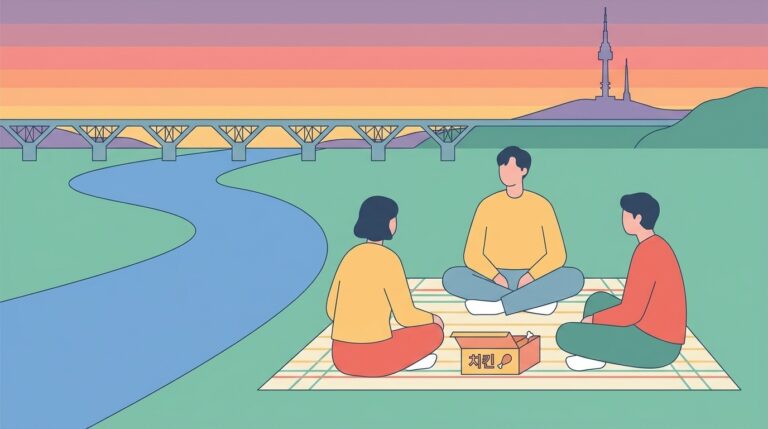
Master the Han River Picnic: How to Spread Your Mat and Order Like a Local
Phase 1: Empathy (Story-Driven Opening)
안녕하세요! 매일한글 에디터입니다. (Hello! Daily Hangul Editor here!)
Picture this: It is a breezy Saturday afternoon in Seoul. The golden sun dips across the shimmering Han River. Around you, hundreds of locals are laughing on colorful picnic mats, clinking cold beer cans, and happily unboxing crispy Korean fried chicken. You want to join the magic. You bought a picnic mat, walked down to the grass, but suddenly panic strikes: Can I actually sit here? Why are there no delivery riders driving onto the grass? Where do I pick up the food?
If you have ever felt frozen holding a rolled-up mat while everyone else looks like a seasoned K-drama protagonist enjoying their weekend, you are not alone! Over 80% of our beginner students tell us that ordering delivery to a giant public park like Yeouido or Banpo is one of the most intimidating real-life challenges in Korea. But do not worry. This guide was crafted with real feedback from beginner learners just like you. By the end of this mini-guide, you will know exactly what to say to secure the best grass spot, pick up your sizzling delivery, and soak in the picnic vibes like a true Seoulite.
Phase 2: Top 3 Core Expressions
Here are three essential A2-level phrases you will use the moment your feet touch the park lawn.
1. 여기 돗자리 펴도 돼요? (Yeogi dotjari pyeodo dwaeyo?)
- Pronunciation: Yeo-gi dot-jah-ree pyeo-doh dway-yo? (Rhymes with “dwae” like “deck” without the k + “yo”)
- Meaning:
- Literal: “Here, picnic mat, may I spread?”
- Real Nuance: “Is it okay if I lay down my picnic mat here?”
- K-Culture Moment: Seen in romantic variety shows like Heart Signal or weekend vlog segments where couples politely ask people nearby before laying down their cute mat.
- Editor’s Insight: The pattern
-도 돼요?(-do dwaeyo?) is the holy grail for A2 learners asking for permission. In Han River parks, some lawn sections are protected or reserved for tent zones with strict hours. Asking this prevents park rangers from asking you to pack up later! - Situation Spectrum:
- Casual (Friends): 여기 돗자리 펴도 돼? (Yeogi dotjari pyeodo dwae?) ✅
- Semi-formal (Polite stranger/Ranger): 여기 돗자리 펴도 돼요? (Yeogi dotjari pyeodo dwaeyo?) ✅
- Formal (Official setting): 이곳에 돗자리를 펴도 됩니까? (Igos-e dotjari-reul pyeodo doebnikka?) ⚠️ (Too stiff for a picnic!)
- 🤔 Think About It: In English, we often say “Can we sit here?” But Koreans specify “spreading the mat” (돗자리를 펴다). Why do you think Korean culture focuses on the physical mat establishing a private personal bubble in public parks?
2. 배달존이 어디예요? (Baedaljon-i eodiyeyo?)
- Pronunciation: Bae-dal-john-ee uh-dee-yay-yo? (“Bae” like “bay”, “dal” like “dull”)
- Meaning:
- Literal: “Delivery zone, where is it?”
- Real Nuance: “Where is the designated delivery pick-up point?”
- K-Culture Moment: The iconic delivery rider scene in K-dramas where a scooter stops at a crowded gate, and hungry park-goers rush over waving their phone screens.
- Editor’s Insight: Han River parks are vast car-free sanctuaries. Delivery scooters cannot drive across the grass to your mat! Instead, parks have numbered “Delivery Zones” (배달존 1, 배달존 2). You must meet the driver at this exact spot.
- Situation Spectrum:
- Casual (Close buddy): 배달존 어디야? (Baedaljon eodiya?) ✅
- Semi-formal (Park staff / Passerby): 배달존이 어디예요? (Baedaljon-i eodiyeyo?) ✅
- Formal (Broadcast): 배달존의 위치가 어디입니까? (Baedaljon-ui wichi-ga eodi-imnikka?) 🚫 (Nobody talks like this outdoors!)
- 🤔 Think About It: How does your home city manage outdoor food deliveries compared to Korea’s ultra-organized, numbered pickup hubs?
3. 여기 자리 있어요? (Yeogi jari isseoyo?)
- Pronunciation: Yeo-gi jah-ree ees-suh-yo? (“Jari” sounds like “jar-ee”)
- Meaning:
- Literal: “Here, seat/space exists?”
- Real Nuance: “Is this spot taken? / Is anyone sitting here?”
- K-Culture Moment: Walking into a packed cafe or a crowded riverside lawn with an empty patch of grass, gently double-checking with the people on the next mat.
- Editor’s Insight: Depending on your intonation, this phrase works two ways! With a rising tone (?): “Is this spot taken?” With a flat or falling tone (.): “There is space here!”
- Situation Spectrum:
- Casual (Friends): 여기 자리 있어? (Yeogi jari isseo?) ✅
- Semi-formal (Strangers nearby): 여기 자리 있어요? (Yeogi jari isseoyo?) ✅
- Formal: 이곳에 자리가 있습니까? (Igos-e jari-ga isseumnikka?) ⚠️ (A bit too dramatic for the grass)
- 🤔 Think About It: Notice how Korean omits pronouns like “you” or “someone”. Just “Space exists?” Context does all the heavy lifting!
Phase 3: Textbook Korean vs. Real Korean
Let us bridge the gap between academic textbooks and the actual buzzing banks of the Han River.
Situation 1: Asking if you can spread your mat on the grass
- 📖 교과서 한국어 (Textbook): 여기에 돗자리를 깔아도 되겠습니까? (Yeogi-e dotjari-reul kkarado doegesseumnikka? – May I spread a mat at this location?)
- 🗣️ 진짜 한국어 (Real Life): 여기 돗자리 펴도 돼요? (Yeogi dotjari pyeodo dwaeyo? – Can I spread a mat here?)
- 💡 왜 다를까? (Why the difference?): While “깔다” (kkal-da) and “펴다” (pyeo-da) both mean laying something out, everyday conversational Korean overwhelmingly prefers the light, friendly verb
펴다(to unfold/spread) combined with the approachable-도 돼요?grammar.
Situation 2: Asking which pickup gate the delivery driver is heading to
- 📖 교과서 한국어 (Textbook): 배달 기사님은 어느 장소로 오십니까? (Baedal gisa-nim-eun eoneu jangso-ro osimnikka? – To which location is the respected delivery driver arriving?)
- 🗣️ 진짜 한국어 (Real Life): 배달존 몇 번으로 가요? (Baedaljon myeot beon-euro gayo? – Which Delivery Zone number are you going to?)
- 💡 왜 다를까? (Why the difference?): Real-world Han River parks designate numeric hubs (Zone 1, Zone 2, Zone 3). Native speakers skip long bureaucratic questions and zoom straight into the specific zone number:
몇 번(what number).
Phase 4: K-Culture Deep Dive & Non-Verbal Manners
4-1. 눈치 (Nunchi) & Non-Verbal Manners: The Sacred Mat Etiquette
- Shoe Boundary (신발 매너): The moment you unfold a 돗자리 (picnic mat), it is treated as an extension of an indoor Korean floor! Never step onto a mat with your outdoor shoes on. Always slip them off at the edge, placing them facing outward.
- The Personal Bubble Buffer: On crowded weekends, space is tight, but Koreans use subtle 눈치 (nunchi – situational awareness). Leave at least one arm’s length (about 50–70cm) between your mat and your neighbor’s. Setting your mat corner directly touching a stranger’s mat will make them uncomfortable.
- Eye Contact upon Sitting: Before throwing down your mat right in front of someone’s riverside view, a quick friendly nod and asking
여기 펴도 돼요?shows top-tier social grace.
4-2. Cultural Code Analysis: The Mat Rental Phenomenon & 치맥 (Chimaek)
In Korea, having a picnic does not require lugging heavy camping gear on the subway. Step outside subway exits near the Han River (like Yeouido Station Exit 2 or Ttukseom Resort Station), and you will find pop-up rental shops offering the legendary 돗자리 대여 세트 (mat rental sets). For around 10,000 to 15,000 KRW, you get an embossed mat, a collapsible picnic table, wet wipes, and even Bluetooth mood lamps! This convenience culture pairs seamlessly with Korea’s legendary delivery speed—allowing anyone to feast on hot 치맥 (chicken + beer) under the night breeze within 30 minutes.
Phase 5: Real-Life Roleplay Scenario
Setting: A sunny 4:00 PM at Yeouido Hangang Park. You are with your Korean friend, Minji, looking for a patch of green grass with an unobstructed view of the river.
Characters:
* You (A2 Korean Explorer)
* Minji (Your chill Korean best friend)
* Park Neighbor (A relaxing local on the next mat)
Turn 1 (Minji):
와, 오늘 날씨 진짜 좋다! 사람 진짜 많네.
(Wa, oneul nalssi jinjja jota! Saram jinjja manne.)
"Wow, the weather is amazing today! There are so many people."
🎭 Pointing at the sunny grass near the water line

Turn 2 (You):
저기 비어 있어요! 저기 가요.
(Jeogi bieo isseoyo! Jeogi gayo.)
"Over there is empty! Let's go there."
🎭 Walking quickly toward the grassy patch with your rental mat

Turn 3 (You):
(To the neighbor sitting nearby) 실례지만, 여기 자리 있어요?
(Sillyejiman, yeogi jari isseoyo?)
"Excuse me, is this spot taken?"
🎭 Giving a polite, friendly micro-bow with a warm smile

Turn 4 (Park Neighbor):
아, 아니요! 비어 있어요. 돗자리 펴셔도 돼요.
(A, aniyo! Bieo isseoyo. Dotjari pyeosyeodo dwaeyo.)
"Oh, no! It's empty. You can spread your mat."
🎭 Smiling and slightly pulling their picnic basket closer to make room

Turn 5 (You):
감사합니다! 민지야, 여기 돗자리 펴자!
(Gamsahamnida! Minji-ya, yeogi dotjari pyeoja!)
"Thank you! Minji, let's unfold the mat here!"
🎭 Unrolling the picnic mat carefully without flicking grass at neighbors

Turn 6 (Minji):
좋아! 치킨 시키자. 너 배달존 어디인지 알아?
(Joa! Chikin sikija. Neo baedaljon eodi-inji ara?)
"Awesome! Let's order chicken. Do you know where the delivery zone is?"
🎭 Unlocking her delivery app on her phone

Turn 7 (You):
응! 아까 편의점 옆에서 봤어. 배달존 2번이야.
(Eung! Akka pyeon-uijeom yeop-eseo bwasseo. Baedaljon ibeon-iya.)
"Yeah! I saw it earlier next to the convenience store. It's Delivery Zone 2."
🎭 Pointing toward the big marked blue banner in the distance

Turn 8 (Minji):
오~ 한국 사람 다 됐네! 바로 주문할게!
(O~ Hanguk saram da dwaenne! Baro jumunhalge!)
"Oh~ you're practically a local now! I'll order right away!"
🎭 Laughing happily and tapping the order button
🔀 Interactive Decision Point!
The delivery driver calls Minji saying: “배달존 2번 도착했습니다!” (Arrived at Delivery Zone 2!). You offer to go pick up the chicken. When you reach the crowd of 30 people waiting by the scooter rider, what do you say?
- Option A: “저기요! 제 치킨 주세요!” (Jeogiyo! Je chikin juseyo! – Hey! Give me my chicken!)
- Option B: “혹시 [Your Phone’s Last 4 Digits]번 교촌치킨 맞으세요?” (Hoksi [0123]beon Gyochon-chikin majeuseyo? – Excuse me, are you Kyochon Chicken for phone digits [0123]?)
- Option C: “치킨 어디 있어요?” (Chikin eodi isseoyo? – Where is chicken?)
Decision Feedback:
* Option A (Risk): Rude and vague! There are likely 10 different chicken orders on that bike rack. Demanding “my chicken” without proof causes awkward confusion.
* Option B (BEST! ⭐): Perfection! Drivers manage multiple orders simultaneously. Asking gently with 혹시 (by any chance) and confirming the last 4 digits of your phone number makes you look like an ultra-smooth pro.
* Option C (Bad): Way too blunt. The rider will look at you with total bewilderment.
Phase 6: 10-Second Emotion Shadowing Drill
Practice reading these out loud! Follow the rhythm pauses (/) and embody the emotion tags.
- [😊 Cheerful & Inquisitive]
여기 / 돗자리 펴도 돼요?
(Yeogi / dotjari pyeodo dwaeyo?)
Editor’s Tip: Keep the end “dwae-yo?” light and floating upwards like a friendly question mark. -
[🏃 Quick & Urgent]
라이더님! / 배달존 몇 번이에요?
(Ra-i-deo-nim! / baedaljon myeot beon-i-e-yo?)
Editor’s Tip: Say “Ra-i-deo-nim” crisply before the quick breath pause/. -
[😋 Relieved & Hungry]
자리 잡았다! / 치킨 시키자!
(Jari jab-at-da! / chikin si-ki-ja!)
Editor’s Tip: Burst with excitement on “jab-at-da!” (We got a spot!).
Phase 7: K-Culture Mini Dictionary
| Korean Keyword | Romanization & Meaning | Real-Life Practical Usage |
|---|---|---|
| 돗자리 | Dotjari (Picnic mat) | The waterproof silver or patterned mat sold at Han River convenience stores or rented at park exits. Essential for any park outing. |
| 배달존 | Baedal-zon (Delivery Zone) | Clearly numbered meeting pavilions near park entrances where food delivery motorcycles park to hand off meals. |
| 치맥 | Chimaek (Chicken + Beer) | The iconic Korean cultural portmanteau (Chikin + Maekju). The undisputed national food pairing for riverside picnics. |
| 한강라면 | Hangang Ramyun (Instant Park Noodles) | Foil-container instant ramen cooked on high-tech induction machines inside park convenience stores. Tastes twice as good on a mat! |
Phase 8: Traveler’s Survival Kit
Top 3 Survival Phrases
- 돗자리 대여 세트 있어요? (Dotjari daeyeo seteu isseoyo?)
- English: Do you have the picnic mat rental set?
- Pro Tip: Say this at tents outside subway exits near Yeouido or Ttukseom.
- 쓰레기 버리는 곳이 어디예요? (Sseuregi beorineun gos-i eodiyeyo?)
- English: Where is the trash disposal area?
- Pro Tip: Han River parks have massive recycling and food-waste sorting bins. Leaving trash behind carries hefty fines!
- 물티슈 하나만 주세요. (Mulsiti-syu hana-man juseyo.)
- English: Please give me one pack of wet wipes.
- Pro Tip: Keep sticky chicken fingers clean when you don’t want to run to the restroom.
Editor’s Travel Note
- App Navigation: Do not rely on Google Maps in Korea—it lacks walking details! Instead, download Naver Map for exact walking directions to Yeouido Hangang Park Delivery Zones.
- Delivery Ordering Without a Local Card: If you lack a Korean bank card or resident registration number for the Baemin app, head directly to the Delivery Zone gates! Many riders carry card readers, or you can order take-out at the on-site food trucks and convenience stores.
- Rental Return Time: Most rental shops give you 3 to 4 hours. Keep an eye on your watch, as rental extensions cost around 3,000 KRW per hour.
Phase 9: “A Step Deeper” (Reflective Cultural Essay)
In densely populated Seoul, compact apartment living means private backyards are an extreme luxury. The Han River parks act as the city’s shared living room. When Koreans spread out a simple 돗자리 (dotjari), that thin piece of plastic foam instantly becomes a sacred, temporary home where shoes come off, ties loosen, and communal meals are shared. It represents a delightful blend of hyper-modern logistics (ordering hot fried chicken to a GPS point on the grass) and traditional community spirit.
💬 Your Turn: How does public park culture in your hometown compare to Korea’s Han River “open-air living room”? Have you ever had hot food delivered outdoors? Share your stories in the comments below!
Phase 10: FAQ & Common Mistakes
Q: Can I pitch an actual camping tent instead of a simple picnic mat?
A: Only in designated “Tent Zones” (그늘막 텐트 구역) and only during specific daylight hours (usually 9:00 AM – 7:00 PM). Also, tents must keep at least two sides completely unzipped and open by law! A simple 돗자리 (flat mat), however, can be laid out almost anywhere on general lawns without time restrictions.
Q: Can I drink alcohol on my picnic mat at the Han River?
A: Yes, moderate alcohol consumption (like beer with chicken) is currently permitted in Han River parks. However, excessive drunkenness or causing public disturbance will result in police intervention and fines. Keep it respectful!
Q: What if I don’t speak enough Korean to answer the phone when the delivery rider calls?
A: When ordering, put in the delivery notes: “외국인입니다. 배달존 도착하시면 문자 주세요!” (I am a foreigner. Please text me when you arrive at the Delivery Zone!). Drivers are happy to send a quick text with their photo or bike description!
🚨 Common Mistakes Warning Board
- Mistake: Stepping onto the picnic mat with sneakers on.
- Correct Action: Treat the mat like a Korean home entrance. Slip shoes off at the edge and keep the sitting area pristine.
- Mistake: Pinning your exact GPS pin on the grass and waiting for a motorcycle to drive up to you.
- Correct Action: Look for the nearest blue/white overhead banner labeled
배달존(Delivery Zone) and meet the courier at the road gate.
- Correct Action: Look for the nearest blue/white overhead banner labeled
- Mistake: Dumping all picnic trash into one bag and throwing it anywhere.
- Correct Action: Separate clear plastic cups, beer cans, paper food boxes, and food remnants into the designated park sorting bins.
Phase 11: Action Missions
- 🥉 Bronze Mission (Solo Practice): Stand in front of your mirror and practice saying:
여기 돗자리 펴도 돼요?three times with a bright, welcoming smile. - 🥈 Silver Mission (Social Connection): Take a photo of your favorite outdoor picnic spot or your local park. Post it on Instagram or your study journal, tagging
@DailyHangulwith the caption: “여기 돗자리 펴고 치맥 먹고 싶어요!” (I want to spread a mat and eat chimaek here!) - 🥇 Gold Mission (Real-World Test): Next time you visit Seoul, successfully find a Han River Delivery Zone, order food, and say: “[Phone digits]번 맞으세요?” to pick up your meal!
🎮 K-Culture Mission: Watch an episode of Home Alone (나 혼자 산다) or Hospital Playlist. Spot how characters unfold mats and eat out of convenience store foil ramyeon containers. Notice how natural they make it look!
Phase 12: Interactive Quiz Challenge
Test your new Han River street-smarts! Check your answers below.
1. Situation Judgment
You find a lovely grassy spot near the river, but a couple is sitting on a mat 2 meters away. What should you politely ask before laying out your blanket?
* A) “여기 앉지 마세요!” (Do not sit here!)
* B) “여기 돗자리 펴도 돼요?” (Can I spread a mat here?)
* C) “치킨 어디 있어요?” (Where is the chicken?)
2. Fill-in-the-Blank
Complete the sentence to ask where the food pickup area is located:
* “___________이 어디예요?” (Where is the delivery zone?)
3. Cultural True or False
- Statement: “In Han River parks, delivery scooters will drive directly across the grass to your picnic mat if you wave at them.”
- (True / False)
👉 Click to reveal answers & explanations!
- Answer: B
- Explanation: Asking
여기 돗자리 펴도 돼요?is the polite, natural way to ensure the area isn’t claimed or blocking someone’s access.
- Explanation: Asking
- Answer: 배달존 (Baedaljon)
- Sentence:
배달존이 어디예요?(Where is the delivery zone?)
- Sentence:
- Answer: FALSE
- Explanation: Scooters are strictly prohibited from driving onto the lawns and walking paths for safety. You must walk to the designated numbered
배달존(Delivery Zone) to meet your driver!
- Explanation: Scooters are strictly prohibited from driving onto the lawns and walking paths for safety. You must walk to the designated numbered







