

안녕하세요! 매일한글 에디터입니다.
Have you ever walked past a trendy hair salon in Hongdae or Seongsu-dong, wishing you could walk in and experience that luxurious Korean scalp treatment you saw on Instagram or in your favorite K-Drama? But then panic sets in: What if I lie down on the wash chair, they cover my eyes with that mysterious cloth, and I have no clue how to answer when they start asking questions in rapid Korean?
You are definitely not alone. One of our beginner students, Sarah, once told me she spent an entire wash session clenching her fists because the water was boiling hot, but she didn’t know how to ask the stylist to adjust the temperature! Getting your hair washed in Korea—known as a ‘shampoo’ service—is one of the most relaxing, affordable luxury experiences you can have while traveling or living here.
Today, we are going to unlock the essential phrases you need so you can lay back, close your eyes, and enjoy every single second of that heavenly scalp massage without a drop of anxiety.
Phase 2: Top 3 Core Expressions
1. 샴푸 해주세요 (Syampu hae-juseyo)
- Pronunciation: [Syampu hae-juseyo] (Sounds like: Shahm-poo heh-joo-seh-yo)
- Meaning: Literal: “Please do shampoo” | Real Nuance: “I’d like a hair wash / shampoo, please.”
- K-Culture Moment: In K-Dramas, whenever characters want a quick refresh before a romantic date or after a chaotic night out, they casually pop into a salon just saying this line.
- Editor’s Insight: In Korean culture, you don’t say “wash my hair” (머리 감겨주세요) to service staff; using the loanword 샴푸 (shampoo) with 해주세요 (please do for me) is the most natural, polite, and universally understood request.
- Situation Spectrum: Casual (⚠️) / Semi-formal (✅) / Formal (✅)
- 🤔 Think About It: In English, “shampoo” is mostly a noun or a quick verb, but Korean turns foreign loanwords into polite actions with 하다 (hada). How does borrowing words make everyday service interactions simpler?
2. 물 온도 어떠세요? / 좋아요 (Mul ondo eotteoseyo? / Jo-ayo)
- Pronunciation: [Mul on-do eo-tteo-se-yo? / Jo-a-yo] (Sounds like: Mool on-doh uh-ttoh-seh-yo? / Joh-ah-yo)
- Meaning: Literal: “How is the water temperature? / It is good.”
- K-Culture Moment: The golden rule of Korean customer service (친절)! As soon as the showerhead touches your scalp, the stylist will ask this exact question with gentle concern.
- Editor’s Insight: You don’t need a complex sentence in response. If the temperature is fine, a soft 좋아요 (Jo-ayo / It’s good) or 괜찮아요 (Gwaenchanayo / It’s fine) is all they need to hear.
- Situation Spectrum: Casual (⚠️) / Semi-formal (✅) / Formal (✅)
- 🤔 Think About It: Korean service staff ask for temperature feedback instantly to avoid discomfort before you even have to complain. Does your home culture ask proactively or wait for customer feedback?
3. 더 헹구고 싶은 곳 있으세요? (Deo henggugo sipeun got isseuseyo?)
- Pronunciation: [Deo heng-gu-go si-peun got it-seu-se-yo?] (Sounds like: Duh heng-goo-go she-poon got ees-suh-seh-yo?)
- Meaning: Literal: “Is there a place you want rinsed more?” | Real Nuance: “Would you like me to rinse anywhere else?”
- K-Culture Moment: Near the end of the wash, right before they wrap your head in a warm towel, the stylist will pause the water and softly check this with you.
- Editor’s Insight: If you feel completely clean, just reply 괜찮아요 (Gwaenchanayo / It is okay). If shampoo bubbles linger on the back of your neck, point gently and say 뒤쪽이요 (Dwijjok-i-yo / In the back, please).
- Situation Spectrum: Casual (⚠️) / Semi-formal (✅) / Formal (✅)
- 🤔 Think About It: Attention to detail (디테일) is the hallmark of Korean beauty culture. Notice how specific their questions are to guarantee zero residue!
Phase 3: Textbook Korean vs. Real-Life Korean
Scenario 1: Requesting Only a Hair Wash
- 📖 교과서 한국어 (Textbook): 제 머리를 감겨 주십시오. (Je meorireul gamgyeo jusipsio. – Please wash my hair.)
- 🗣️ 진짜 한국어 (Real-Life): 샴푸만 받을 수 있나요? (Syampu-man badeul su innayo? – Can I just get a shampoo?)
- 💡 왜 다를까?: The textbook phrasing sounds like an imperial command from a historical drama! Real Koreans use the lightweight loanword 샴푸 combined with ~만 (only) to clarify they aren’t getting a haircut.
Scenario 2: When the Water is Too Hot
- 📖 교과서 한국어 (Textbook): 물이 대단히 뜨겁습니다. (Muri daedanhi tteugeopseumnida. – The water is exceedingly hot.)
- 🗣️ 진짜 한국어 (Real-Life): 조금 뜨거워요! (Jogeum tteugeowoyo! – It’s a little hot!)
- 💡 왜 다를까?: Using dramatic textbook adverbs like 대단히 makes the stylist feel like they caused a medical emergency! A gentle 조금 (a little) keeps the tone soft and friendly while clearly solving the problem.
Phase 4: K-Culture Deep Dive & Non-Verbal Manners
4-1. 눈치 (Nunchi) & Wash Chair Body Language
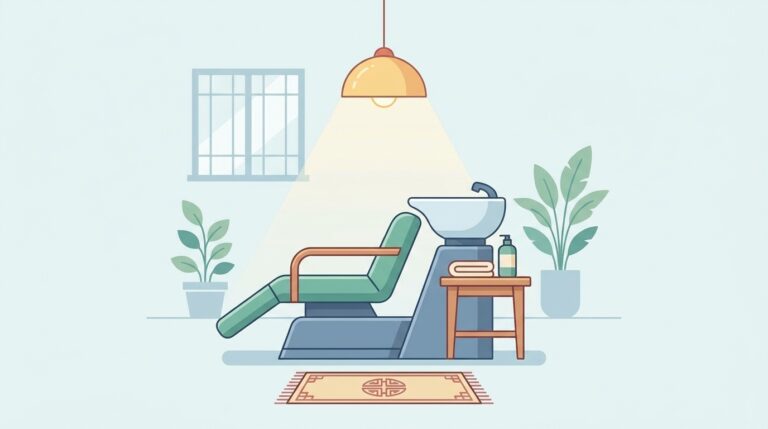
When you sit down on the wash bed (샴푸대), Korean salons place a tiny paper sheet or fabric mask over your eyes (눈가리개). Don’t panic! It is designed to protect your eye makeup from water splashes and spare you the awkwardness of staring into your stylist’s eyes from 10 centimeters away.
The Biggest Mistake Beginners Make: Trying to lift your head to help the stylist! In Korea, raising your neck makes water spill down your back collar. Just let your head fall heavy and relaxed onto the sink rest. If your stylist says “힘 빼세요~ (Him ppaeseyo~ / Relax your neck)”, that’s your cue to completely let go!
4-2. Culture Code: The Korean “Head Spa” Trend
A shampoo in Korea is rarely just a shampoo. It almost always includes a 2-minute acupressure head and neck massage (지압), followed by a cold water rinse or refreshing scalp tonic. It reflects Korea’s hyper-focus on stress relief (힐링) for exhausted students and office workers.
Phase 5: Real-World Roleplay Scenario
Setting: You are visiting Miso Hair in Hongdae. Stylist Minji guides you to the shampoo chair.
- Turn 1 (Minji): 편하게 누우실게요. 눈 가려 드릴게요. (Pyeonhage nu-usilgeyo. Nun garyeo deurilgeyo. / 🎭 Gently guides your shoulders back and drapes a soft white cloth over your eyes.)
- Turn 2 (You): 네, 감사합니다. (Ne, gamsahamnida. / 🎭 Relaxing your neck completely onto the headrest.)
- Turn 3 (Minji): 물 온도 어떠세요? (Mul ondo eotteoseyo? / 🎭 Turns on the warm water spray over your hair.)
- Turn 4 (You): 좋아요, 딱 맞아요. (Jo-ayo, ttak majayo. / 🎭 Speaking with a gentle, calm smile.)
- Turn 5 (Minji): 가려우신 곳이나 더 헹구고 싶은 곳 있으세요? (Garyeousin gosina deo henggugo sipeun got isseuseyo? / 🎭 Massaging your temples with citrus-scented foam.)
- Turn 6 (You): 목 뒤쪽 조금만 더 헹궈주세요. (Mok dwijjok jogeumman deo henggwojuseyo. / 🎭 Tapping your back neck area softly.)
- Turn 7 (Minji): 네, 시원하게 헹궈드릴게요. 마무리할게요! (Ne, siwonhage henggwodeurilgeyo. Mamurihalgeyo! / 🎭 Rinsing the back thoroughly and wrapping a towel around your hair.)
- Turn 8 (You): 정말 시원해요. 감사합니다! (Jeongmal siwonhaeyo. Gamsahamnida! / 🎭 Sitting up slowly and blinking happily.)
🔀 Interactive Choice Point: The water suddenly feels scalding hot! What do you say?
- Option A: “물이 너무 뜨거워요! 차갑게 해주세요!” (Muri neomu tteugeowoyo! Chagapge hae-juseyo!)
- Option B: “아, 조금 뜨거워요.” (Ah, jogeum tteugeowoyo.)
- Option C: (Stay completely silent and endure the heat until it finishes.)
Feedback:
* Option A [Risk]: While understandable, shouting 차갑게 해주세요 might cause the stylist to flip it to ice water, and 너무 sounds slightly critical.
* Option B [Best!]: Perfection! Starting with a mild 아 (Ah) and using 조금 뜨거워요 (A little hot) signals the stylist immediately to adjust the dial by a couple of degrees.
* Option C [Bad]: Never suffer in silence! Salons want you to be comfortable, and hot water can irritate your scalp.
Phase 6: 10-Second Emotion Shadowing Drill
Repeat these aloud with matching emotional energy! Look at the pause slashes / for natural pacing.
- [😊 Relaxed & Satisfied]
좋아요, / 딱 맞아요!
(Jo-ayo, / ttak majayo! – It’s good, / it’s just right!) -
[😅 Polite & Mildly Cautious]
조금 / 뜨거워요.
(Jogeum / tteugeowoyo. – It’s a little / too hot.) -
[✨ Refreshed & Grateful]
정말 / 시원해요!
(Jeongmal / siwonhaeyo! – That feels so / refreshing!)
Phase 7: K-Culture Mini Dictionary
- 샴푸대 (Syampudae) | Shampoo recliner/station | The ergonomic reclining wash station where all the salon magic takes place.
- 눈가리개 (Nungarigae) | Eye cover cloth | The small paper or cloth mask put over your forehead and eyes during washing.
- 지압 (Jiap) | Acupressure massage | Finger-pressure massage on the temples and scalp during the conditioning stage.
- 시원하다 (Siwonhada) | Cool / Refreshing | Used for cold drinks, but also when a scalp massage or hot shower feels deeply relieving!
Phase 8: Traveler’s Survival Kit
Survival TOP 3 Phrases
- 샴푸만 예약할 수 있나요? (Syampu-man yeyak-hal su innayo?)
Pro Tip: Can I book just a shampoo? Great when you want a blowout before taking profile photos in Seoul. - 조금 차가워요 (Jogeum chagawoyo)
Pro Tip: “It’s a bit cold.” Use this instantly if winter tap water gives you chills. - 목에 힘 빼세요 (Moge him ppaeseyo)
Pro Tip: This is what the stylist says to you! If you hear 힘 빼세요, consciously loosen your neck muscles.
Editor’s Travel Note
Before stepping into a trendy salon in Mapo or Gangnam, download the Naver Map app download to check customer reviews and salon operating hours. Most neighborhood hair shops welcome walk-in shampoo visits on weekday mornings, costing around 10,000 to 15,000 KRW, credit card accepted!
Phase 9: Going Deeper
In Korean culture, the word 시원하다 (Siwonhada) is a linguistic marvel. It literally translates to “cool” or “refreshing,” yet Koreans will close their eyes in a piping hot bath or during a vigorous scalp massage and groan, “Ah, siwonhada!” It describes that sublime sensation of internal tension evaporating from your body. Experiencing a Korean shampoo is the fastest way to understand this unique mind-body concept firsthand.
💬 Your Turn: Have you ever experienced a salon wash in another country? How does the service compare to what you’ve seen in K-Dramas? Share in the comments below!
Phase 10: FAQ & Avoiding Misunderstandings
Q: Can I go to a Korean salon just for a wash without getting a cut?
A: Absolutely yes! Simply walk in and ask, “샴푸만 가능한가요? (Syampu-man ganeunghangayo? – Is shampoo only possible?)”. It usually includes a quick rough dry or basic styling.
Q: Why do they place a paper sheet over my eyes?
A: To protect you from splashes and prevent the awkwardness of prolonged eye contact while they wash your bangs.
Q: Do I need to tip the shampoo assistant?
A: No! Tipping does not exist in South Korea. The price listed on the counter menu is all-inclusive with VAT.
🚨 Common Mistakes Alert Board
- Mistake 1: Craning your neck upward to help the stylist wash your nape.
- Correct Action: Keep your neck flat and heavy against the neck cushion.
- Mistake 2: Opening your eyes while the eye cover is on.
- Correct Action: Keep your eyes gently closed under the cover so shampoo suds don’t seep in.
- Mistake 3: Saying 아파요 (Apoyo / It hurts) when you only mean the water is warm.
- Correct Action: Say 조금 뜨거워요 (Jogeum tteugeowoyo) for temperature, and save 아파요 only for excessive fingernail pressure.
Phase 11: Action Missions
- 🥉 Bronze Mission (Solo): Practice saying “좋아요, 딱 맞아요!” three times in front of your bathroom mirror.
- 🥈 Silver Mission (Community): Leave a comment below using the word 시원해요 (It’s refreshing!) in your own sentence.
- 🥇 Gold Mission (Real World): Next time you visit a Korean salon or meet a Korean friend, talk about your favorite haircut or ask for salon recommendations using 미용실 (Miyongsil)!
- 🎮 K-Culture Mission: Watch an episode of a recent K-Drama and spot whether the characters visit a beauty salon before a major event.
Phase 12: Interactive Quiz Challenge
1. Situational Judgment: The stylist tests the water on your head and asks “물 온도 어떠세요?” The temperature feels great. What do you reply?
* (A) 아파요! (Apoyo!)
* (B) 좋아요. (Jo-ayo.)
* (C) 샴푸 해주세요. (Syampu hae-juseyo.)
2. Fill in the Blank: When the water is slightly chilly, you say: “조금 ______.” (cold)
* (A) 뜨거워요 (tteugeowoyo)
* (B) 차가워요 (chagawoyo)
* (C) 맛있어요 (masisseoyo)
3. True or False: In Korea, you should tilt and raise your head up when they wash the back of your neck.
* (True / False)
👉 Click here to reveal the answers and explanations!
- Answer: (B) 좋아요 (Jo-ayo). 좋아요 means “It’s good,” the ideal response to confirm comfortable water temperature.
- Answer: (B) 차가워요 (Chagawoyo). 조금 차가워요 means “It’s a little cold.” (뜨거워요 is hot, 맛있어요 is delicious!).
- Answer: False! Lifting your head breaks the seal between your neck and the basin rim, causing water to soak your clothes. Relax your neck completely!







