

Phase 1: Empathy & Story Opening
안녕하세요! 매일한글 에디터입니다. (Hello! I’m your Daily Hangul editor.)
Picture this: You are curled up on your sofa after binge-watching your favorite K-drama. You’ve dreamed of strolling along the Han River with instant ramen, shopping in Hongdae, and taking the scenic flight down to Jeju Island. You open up an airline website or walk right up to a domestic counter at Gimpo Airport, ready to turn your dream into reality. But suddenly, your palms get sweaty. Is booking a flight ticket called yeyak or yemae? What if the ground attendant asks you something about your flight path and you freeze up, accidentally booking a one-way trip when you needed a return flight?
Take a deep breath! As your 10-year cultural navigator, I have guided countless beginners through this exact panic moment. Booking flights in Korean isn’t about memorizing complex legal airline jargon—it only takes three core phrases, a few key travel nouns, and a polite smile. By the end of this guide, you will master the exact words Korean travelers use every day, navigate ticketing counters with cool confidence, and earn delighted smiles from airport staff before your Korean adventure even takes off!
Phase 2: Core Expressions (3 Essential Phrases)
1. 서울행 비행기표 예매하고 싶어요. (Seoul-haeng bihaeng-gipyo yemaehago sipeoyo.)
- Pronunciation: [Seoul-haeng bi-haeng-gi-pyo ye-mae-ha-go si-peo-yo] (Sound analogy: Think of “say-wool” + “hang” + “bee” + “hang” + “pyo”)
- Meaning: Literal: “Seoul-bound flight ticket want to pre-purchase.” / Real Nuance: “I’d like to book a flight ticket to Seoul, please.”
- K-Culture Moment: The iconic rom-com scene where the protagonist rushes into the airport ticketing counter at the eleventh hour, buying a ticket to Seoul to catch their first love before the gate closes.
- Editor’s Insight: The suffix ~행 (-haeng) means “bound for” (e.g., 제주행 = Jeju-bound, 부산행 = Busan-bound). Also, pay attention to 예매 (yemae)—in Korean, purchasing tickets in advance (airplanes, movies, concerts) is called yemae, whereas reserving a seat or a hotel room is yeyak.
- Situation Spectrum: Casual: ⚠️ | Semi-formal: ✅ | Formal: ✅
- 🤔 Think About It: In English, we use “book” for hotels, tables, and flights interchangeably. Why do you think Korean creates a clear distinction between buying a ticket in advance (예매) versus holding a spot without purchasing upfront (예약)?
2. 왕복으로 하시겠어요, 편도로 하시겠어요? (Wangbogeuro hasigesseoyo, pyeondoro hasigesseoyo?)
- Pronunciation: [Wang-bo-geu-ro ha-si-get-seo-yo, pyeon-do-ro ha-si-get-seo-yo?]
- Meaning: Literal: “Will you do round-trip, will you do one-way?” / Real Nuance: “Would you like a round-trip or a one-way ticket?”
- K-Culture Moment: In travel variety shows like Youth Over Flowers or Earth Arcade, the production crew asks the cast this question right before handing them mystery boarding passes to exotic locations!
- Editor’s Insight: You’ll hear this question from airline staff. Memorize the two answers: 왕복 (wangbok = round-trip) and 편도 (pyeondo = one-way). You can simply answer: “왕복이요!” (Wangbogi-yo! / Round-trip, please!)
- Situation Spectrum: Casual: 🚫 | Semi-formal: ✅ | Formal: ✅
- 🤔 Think About It: Notice the polite honorific ending -시겠어요 (-sigesseoyo). Korean customer service elevates the listener by adding this marker to ensure courteous interactions.
3. 창가 자리로 부탁드려요. (Chang-ga jariro butakdeuryeoyo.)
- Pronunciation: [Chang-ga ja-ri-ro bu-tak-deu-ryeo-yo] (Chang sounds like “sparkling change”, ga like “garden”)
- Meaning: Literal: “Window-side seat please request.” / Real Nuance: “Could I have a window seat, please?”
- K-Culture Moment: Looking out the airplane window while snapping an aesthetic cloud shot for Instagram while listening to IU’s relaxing ballads during descent.
- Editor’s Insight: 창가 (chang-ga) is the window seat, while 통로 (tong-no) is the aisle seat. Ending requests with 부탁드려요 (butakdeuryeoyo) sounds much softer, humble, and polite than a direct command.
- Situation Spectrum: Casual: ⚠️ | Semi-formal: ✅ | Formal: ✅
- 🤔 Think About It: Instead of saying “주세요 (give me)”, Koreans often say “부탁드려요 (I entrust this favor to you)”. What does this reveal about mutual respect and interdependence in Korean culture?
Phase 3: Textbook Korean vs. Real Korean
Situation 1: Inquiring if seats are left
- 📖 교과서 한국어 (Textbook): 좌석이 남아 있습니까? (Jwaseogi nama isseumnikka? / Are seats remaining?)
- 🗣️ 진짜 한국어 (Real-life): 혹시 남은 자리 있어요? (Hoksi nameun jari isseoyo? / By any chance, are there seats left?)
- 💡 왜 다를까?: 좌석 (jwaseok) is written and formal; native speakers naturally say 자리 (jari) for “seat”. Adding 혹시 (hoksi) softens your question so it sounds friendlier and less demanding.
Situation 2: Asking for the cheapest option
- 📖 교과서 한국어 (Textbook): 가장 저렴한 항공권 가격이 얼마입니까? (Gajang jeoryeomhan hanggong-gwon gagyeogi eolma-imnikka? / What is the price of the most inexpensive air ticket?)
- 🗣️ 진짜 한국어 (Real-life): 제일 싼 표 얼마예요? (Jeil ssan pyo eolmayeyo? / How much is the cheapest ticket?)
- 💡 왜 다를까?: Words like 항공권 (airline ticket) feel like official flight regulations. In spoken Korean, simply using 표 (pyo) and 제일 싼 (jeil ssan – the cheapest) is quick, crisp, and everyday-natural.
Phase 4: K-Culture Deep Dive & Non-Verbal Manners
4-1. 눈치 (Nunchi) & Gestures
At ticketing counters in Korea, body language speaks volumes:
* The Two-Hand Rule (두 손): When handing over your passport, credit card, or receiving your boarding pass, hold the item with both hands. If one hand is occupied, gently rest your left hand beneath your right wrist or elbow. This subtle gesture signals high politeness.
* The Head Nod (목례 – Mok-rye): You don’t need a deep 90-degree bow! A slight 15-degree nod with warm eye contact when the counter clerk says 안녕하세요 (Annyeonghaseyo) breaks the ice instantly.
4-2. Cultural Code: The Domestic “Jeju Weekend Escape”
Have you ever noticed in K-Dramas how characters casually say, “Let’s go to Jeju this weekend!”? Gimpo (Seoul) to Jeju Island is famously the busiest air route on the planet! Because Koreans live in an ultra-efficient 빨리빨리 (ppalli-ppalli / quick-quick) digital society, booking flights is streamlined. Knowing how to confirm your ticket quickly and choose your seat with grace is considered an essential adult survival skill.
Phase 5: Real-World Roleplay Scenario
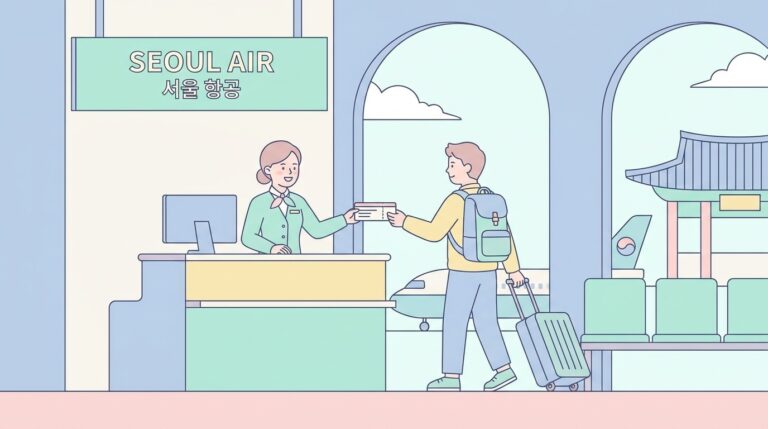
Setting: Domestic ticketing counter at Gimpo Airport. Min-ji (a friendly airline agent wearing a name tag that reads ‘친절’) welcomes Liam (a traveler planning a weekend getaway to Jeju).
- 민지 (Min-ji): 안녕하세요! 어디로 가시나요? (Annyeonghaseyo! Eodiro gasinayo? / Hello! Where are you traveling to?)
🎭 Smiling politely with her hands folded in front of the counter. - 리암 (Liam): 제주도로 가려고 하는데요. 표 있어요? (Jejudoro garyeogo haneundeyo. Pyo isseoyo? / I want to go to Jeju. Are there tickets available?)
🎭 Handing his passport across the desk using both hands. - 민지 (Min-ji): 네, 오늘 오후 2시 비행편이 있어요. 왕복으로 하시겠어요, 편도로 하시겠어요? (Ne, oneul ohu dusi bihaengpyeoni isseoyo. Wangbogeuro hasigesseoyo, pyeondoro hasigesseoyo? / Yes, we have a flight today at 2 PM. Would you like a round-trip or one-way ticket?)
🎭 Checking her desktop screen and typing briskly. - 리암 (Liam): 왕복으로 부탁드려요. 일요일에 돌아올 거예요. (Wangbogeuro butakdeuryeoyo. Ilyoire doraol geoyeyo. / Round-trip, please. I will return on Sunday.)
🎭 Nodding gently with a pleasant tone. - 민지 (Min-ji): 알겠습니다. 선호하시는 자리가 있으신가요? (Algesseumnida. Seonhohasineun jariga isseusingayo? / Understood. Do you have a preferred seat?)
🎭 Turning the seat selection monitor toward Liam. - 리암 (Liam): 창가 자리로 부탁드려요! (Chang-ga jariro butakdeuryeoyo! / Window seat, please!)
🎭 Pointing toward the window row with an excited smile. - 민지 (Min-ji): 네, 12A 창가 자리로 배정해 드렸습니다. 총 14만 원입니다. (Ne, sibi-A chang-ga jariro baejeonghae deuryeotseumnida. Chong sipsaman won-imnida. / Yes, I’ve assigned you seat 12A by the window. That comes to 140,000 won in total.)
🎭 Preparing the paper receipt and boarding pass. - 리암 (Liam): 감사합니다! 카드 여기 있어요. (Gamsahamnida! Kadeu yeogi isseoyo. / Thank you! Here is my card.)
🎭 Passing the credit card with both hands respectfully.
🔀 Interactive Branch Point
Min-ji looks up and asks you: “수하물 부치실 짐 있으신가요? (Do you have luggage to check in?)”
How will you answer?
* Option A: “네, 캐리어 하나 부칠게요.” (Ne, kaerieo hana buchilgeyo. / Yes, I will check in one suitcase.)
👉 [Best Choice!] Clear, natural, and uses the exact loanword Koreans use for luggage (캐리어 = wheeled suitcase) and the verb 부치다 (to check luggage).
* Option B: “가방 버려주세요!” (Gabang beoryeojuseyo!)
👉 [Bad Choice!] 버리다 means “to throw away in the trash”! You just asked the agent to dispose of your beloved luggage!
* Option C: “짐 없어요, 그냥 탈게요.” (Jim eopseoyo, geunyang talgeyo. / No luggage, I’ll just board.)
👉 [Risk Choice!] Grammatically understandable, but sounds slightly abrupt or casual without polite honorific softeners.
Phase 6: 10-Second Emotional Shadowing Drill
Read these sentences out loud, pausing briefly at the / marks, matching the emotional tags:
[😊 기쁘고 설레는 마음으로 / Excited & cheerful]
제주도행 / 왕복 표 / 한 장 주세요!
(Jejudohaeng / wangbok pyo / han jang juseyo!)
“One round-trip ticket to Jeju, please!”-
[🥺 아쉽고 조심스럽게 / Gentle & tentative]
혹시 / 창가 자리 / 남아 있나요?
(Hoksi / chang-ga jari / nama innayo?)
“By any chance, is there a window seat remaining?” -
[✈️ 당당하고 깔끔하게 / Confident & clear]
편도 말고 / 왕복으로 / 계산해 주세요.
(Pyeondo malgo / wangbogeuro / gyesanhae juseyo.)
“Not one-way, please ring it up as round-trip.”
Phase 7: K-Culture Mini Dictionary
- 예매 (Yemae) | Advance ticket purchase | Used for booking flights, KTX trains, movies, and K-Pop concerts where an entrance ticket is purchased before the event.
- 탑승권 (Tapseunggwon) | Boarding pass | The paper or digital barcode ticket you scan at the gate before boarding your plane.
- 수하물 (Suhamul) | Luggage / Baggage | Essential travel term. Separated into 기내 수하물 (carry-on baggage) and 위탁 수하물 (checked baggage).
- 직항 / 경유 (Jik-hang / Gyeong-yu) | Direct flight / Layover (Transfer) | In daily travel conversations, Koreans frequently ask: “직항으로 가요?” (Are you taking a direct flight?).
Phase 8: Survival Kit for Travelers
Top 3 Survival Phrases
- 학생 할인 돼요? (Haksaeng hal-in dwaeyo?)
(Is there a student discount?)
💡 Pro Tip: If you have an International Student Identity Card (ISIC) or study at a Korean university, domestic travel discounts often apply! - 모바일 탑승권 어디서 받아요? (Mobail tapseunggwon eodiseo badayo?)
(Where can I receive my mobile boarding pass?)
💡 Pro Tip: Skip counter lines by having airline KakaoTalk or email barcodes ready on your phone. - 짐 몇 킬로까지 돼요? (Jim myeot killokkaji dwaeyo?)
(How many kilograms of luggage are allowed?)
💡 Pro Tip: Korean budget airlines (Jeju Air, Jin Air, T’way) usually have strict 15kg limits for domestic checked baggage.
Editor’s Travel Note
Before stepping into Korean airports, ensure you install the 네이버 지도 앱 다운로드 to find airport express train (AREX) schedules and gate connections. Also, keep the app of your respective carrier installed for real-time gate change alerts. Credit cards are accepted everywhere in Korea, but keep your physical passport handy at all times for quick domestic identification checks.
Phase 9: “One Step Deeper” (Cultural Reflection)
In Korean society, communication at service counters is rooted in empathy and communal mindfulness (정 / Jeong and 눈치 / Nunchi). When booking tickets, you’ll notice how native speakers soften their requests with words like 혹시 (by any chance) and endings like 부탁드려요 (I kindly request). You are not treating the service counter as a purely transactional vending machine, but rather inviting the staff into a friendly partnership to send you safely on your journey. When you speak with this considerate nuance, Korean service workers will bend over backward to find you that dream window seat!
💬 Your Turn: Have you ever experienced a nerve-wracking airport moment while traveling abroad? And when you fly, are you strictly Team Window Seat (창가) or Team Aisle Seat (통로)? Tell me in the comments below!
Phase 10: FAQ & Avoiding Common Mistakes
Q: What is the exact difference between 예약 (Yeyak) and 예매 (Yemae)?
A: Think of 예약 (yeyak) as reserving a space, table, or service without an actual admission ticket (e.g., reserving a table at a K-BBQ restaurant or a hotel room). 예매 (yemae) contains the Chinese character 買 (mae, meaning to buy)—so it specifically means buying an entrance or travel ticket in advance (flights, trains, concerts).
Q: How do I ask for an aisle seat if window seats are full?
A: Swap 창가 (chang-ga) for 통로 (tong-no)! Simply say: “통로 자리로 부탁드려요.” (Tong-no jariro butakdeuryeoyo. / Aisle seat, please.)
Q: Can I use English at airport counters in Korea?
A: Yes! Airport staff at Incheon and Gimpo speak English. However, opening the conversation with a cheerful Korean phrase like “안녕하세요! 비행기표 예매하고 싶어요” immediately breaks the ice, shows genuine respect, and often leads to warmer, personalized assistance.
🚨 Common Mistakes TOP 3
- Mistake: Saying “예약 샀어요” (I bought a reservation).
Correct Action: Say “예매했어요” (Yemaehaesseoyo). Tickets purchased in advance are always paired with the term 예매. - Mistake: Addressing the counter staff as “너 (neo)” or “당신 (dangsin)”.
Correct Action: Avoid second-person pronouns altogether! Speak politely using honorific verb endings like ~해 주세요 or address staff as 직원분 (jig-won-bun). - Mistake: Tossing payment cards onto the counter with one hand.
Correct Action: Always hand over your card or passport using two hands or supporting your right arm with your left hand.
Phase 11: Action Mission & Engagement
- 🥉 Bronze Mission (Solo): Look into your mirror and practice saying: “창가 자리로 부탁드려요!” (Chang-ga jariro butakdeuryeoyo!) with a warm smile three times.
- 🥈 Silver Mission (Social): Leave a comment below or share a post tagging your dream Korean destination: “[Jeju / Busan / Seoul]행 비행기표 예매하고 싶어요!”
- 🥇 Gold Mission (Real World): Visit a Korean airline website (such as Korean Air or Asiana Airlines), switch the language to Korean for 3 minutes, and locate the buttons for 예매 (Booking), 왕복 (Round-trip), and 편도 (One-way)!
- 🎮 K-Culture Mission: Watch any travel K-variety episode and listen carefully for when cast members arrive at Gimpo or Incheon Airport. See if you can spot the words 비행기표 (plane ticket) or 출발 (departure)!
Phase 12: Interactive Quiz Challenge
1. Situational Judgment
You are flying from Seoul to Busan, but you plan to return by KTX high-speed train. Which phrase should you say at the ticketing desk?
* A) 부산행 왕복으로 주세요. (Busan-haeng wangbogeuro juseyo.)
* B) 부산행 편도로 부탁드려요. (Busan-haeng pyeondoro butakdeuryeoyo.)
* C) 서울행 편도로 주세요. (Seoul-haeng pyeondoro juseyo.)
2. Fill-in-the-Blank
I want to look at the blue sky and clouds outside, so I asked for a window seat:
“구름을 보고 싶어서 [ _____ ] 자리로 부탁드렸어요.”
3. True or False
Reserving a room at a traditional Hanok hotel in Jeonju is called 호텔 예매 (Hotel Yemae).
* True
* False
🔍 Click here to reveal answers and explanations!
-
Answer: B
Explanation: Since you are only flying one way and taking the train back, you need a one-way ticket: 편도 (pyeondo) to Busan (부산행). -
Answer: 창가 (Chang-ga)
Explanation: 창가 literally means “window-side”. (통로 means aisle). -
Answer: False
Explanation: Booking a hotel or room without an admission ticket is called 예약 (Yeyak), not 예매. You would say 호텔 예약 (Hotel Yeyak)!







