

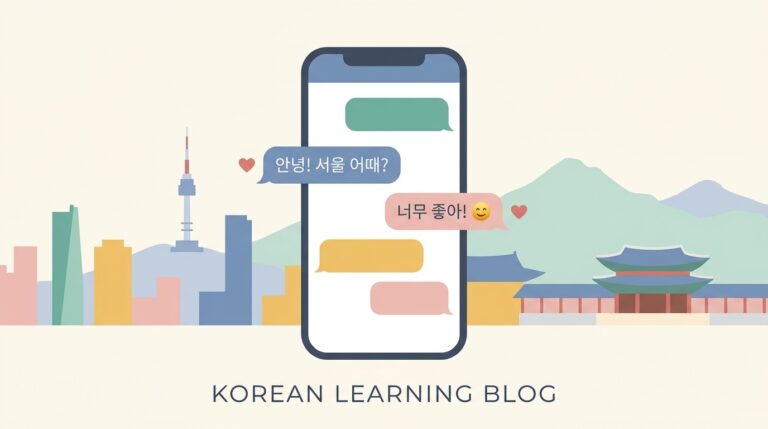
How to Send a DM in Korean Without Feeling Awkward
Phase 1: Empathy (Real-World Opening)
안녕하세요! 매일한글 에디터입니다. (Hello! I’m your Daily Hangul editor.) Picture this: You’re scrolling through Instagram at 11 PM and stumble across the dreamiest vintage boutique in Seongsu-dong, Seoul. Their bio reads: “All vintage pieces are one-of-a-kind. DM for inquiries!”
You want to ask if that oversized wool cardigan is still available, or perhaps message a lovely Korean indie artist whose music has kept you company all week. Your thumbs hover over the keyboard. Your palms start sweating. You open a translation app, type “I am sending you a direct message to inquire about an item,” and end up with a robotic sentence that sounds like an official treaty signed in 1910.
Relax! As your personal Korean culture navigator for over ten years, I’ve seen countless bright learners freeze up the moment social media etiquette enters the picture. In Korea, sending a DM (Direct Message) isn’t just about vocabulary—it’s about striking the perfect balance between casual warmth and respectful distance. By the end of this friendly guide, tailored just for A1 beginners, you’ll be sliding into DMs on Instagram, Weverse, and X (Twitter) like a natural local friend!
Phase 2: Core 3 Expressions Deep Dive
Let’s unpack three essential phrases every beginner needs before tapping “Send.”
1. 디엠 보낼게요 (DM bonaelgeyo)
- Pronunciation: DM boh-nael-geh-yo (Think of “bo” like a bow tie, and “nael” like nail).
- Meaning: Literal: “I will send a DM.” / Real Nuance: “I’m sending you a DM now!” or “I’ll DM you right away!”
- K-Culture Moment: You’ll constantly see this in the comment sections of Korean influencers, marketplace sellers, or K-pop fan communities right before someone initiates a private chat.
- Editor’s Insight: Koreans simply pronounce the letters “D” and “M” as 디엠 (di-em). Adding -ㄹ게요 (-l-ge-yo) expresses your clear intention to do something in a sweet, considerate tone.
- Situation Spectrum: Casual ✅ | Semi-formal ✅ | Formal ⚠️
- 🤔 Think About It: In English, we casually say “DMing you!” but Korean adds a respectful sentence-ender (-요, yo) even when talking on trendy apps. Why does politeness stay important even in digital spaces?
2. 디엠 확인해 주세요 (DM hwag-in-hae ju-se-yo)
- Pronunciation: DM hwa-gin-hae joo-seh-yo (“Hwag-in” rhymes with login with an ‘h’).
- Meaning: Literal: “Please check your DM.” / Real Nuance: “Could you kindly check your inbox?”
- K-Culture Moment: Korean fans often comment this under their favorite creator’s post after sending important fan-art or project inquiries.
- Editor’s Insight: 확인 (hwag-in) means “check” or “confirm.” Pairing it with -해 주세요 (-hae ju-se-yo) creates a polite request without sounding demanding or bossy.
- Situation Spectrum: Casual ⚠️ | Semi-formal ✅ | Formal ✅
- 🤔 Think About It: Does your native language have different verbs for “check” depending on how polite you want to be? Korean lets you turn almost any action polite with ju-se-yo.
3. 답장 기다릴게요 (Dap-jang gi-da-ril-ge-yo)
- Pronunciation: Dap-jang gee-dah-ril-geh-yo (“Dap” sounds like the first syllable of dapper).
- Meaning: Literal: “I will wait for your reply.” / Real Nuance: “Looking forward to hearing from you!”
- K-Culture Moment: Commonly placed at the very end of a polite message sent to an indie shop owner, a tutor, or an online friend.
- Editor’s Insight: 답장 (dap-jang) means “reply” or “response.” Ending your note with 기다릴게요 (gi-da-ril-ge-yo) shows patience and softens the whole message so the other person doesn’t feel pressured.
- Situation Spectrum: Casual ✅ | Semi-formal ✅ | Formal ⚠️
- 🤔 Think About It: Ending a text with anticipation (“I’ll wait”) shows you respect the recipient’s personal time. How do you close friendly inquiry messages in your culture?
Phase 3: Textbook Korean vs. Real Korean
Situation 1: Letting someone know you sent a message
- 📖 교과서 한국어 (Textbook): 직접 메시지를 전송하였습니다. (Jik-jeop me-si-ji-reul jeon-song-ha-yeot-seum-ni-da.) — “I have transmitted a direct message.”
- 🗣️ 진짜 한국어 (Real-Life): 디엠 보냈어요! (DM bo-naess-eo-yo!) — “Sent you a DM!”
- 💡 왜 다를까? (Why the difference?): Old-school textbooks translate “direct message” literally into jik-jeop me-si-ji, but nobody on Seoul’s subway says that! Real Koreans just say 디엠 (DM).
Situation 2: Asking someone to check their inbox
- 📖 교과서 한국어 (Textbook): 메시지를 읽어 주시기 바랍니다. (Me-si-ji-reul ilg-eo ju-si-gi ba-ram-ni-da.) — “It is requested that you inspect the message.”
- 🗣️ 진짜 한국어 (Real-Life): 디엠 확인 부탁드려요~ (DM hwag-in bu-tak-deu-ryeo-yo~)
- 💡 왜 다를까? (Why the difference?): Real social media users use 부탁드려요 (bu-tak-deu-ryeo-yo) (“I kindly request”) topped with a friendly tilde (~) to sound breezy and approachable.
Phase 4: K-Culture Deep Dive & Digital Manners
4-1. Digital Nunchi (눈치) & Keyboard Manners
Even inside an Instagram inbox, Nunchi (social intuition) is alive and well! When messaging a stranger, a creator, or a small business in Korea:
1. The Magic Tilde (~): Writing just “감사합니다.” can look cold and strict. Adding a wavy tilde—“감사합니다~”—instantly adds a warm smile to your tone.
2. The Polite Trio: Never start a DM with just “저기요” (Excuse me). Always start with: 안녕하세요! (An-nyeong-ha-se-yo! / Hello!).
3. Emoji Restraint: In Korea, the praying hands emoji (🙏) or bowing smiley (🙇) conveys deep gratitude and politeness when asking for a favor.
4-2. The Culture Code: Pop-ups & Indie Brands
South Korea boasts one of the most vibrant popup and flea market scenes in the world, especially around Hongdae, Seongsu, and Yeonnam-dong. Independent designers often don’t have large e-commerce websites; instead, they conduct reservations and custom orders entirely through Instagram DMs. Knowing these basic A1 phrases allows you to access exclusive, authentic Korean treasures that standard travel guidebooks never cover!
Phase 5: Real-Life Roleplay Scenario
Setting: You are chatting via Instagram DM with Jiwoo, the owner of a trendy vintage thrift studio in Seongsu-dong.
- Turn 1 (You): 안녕하세요, 사장님! (An-nyeong-ha-se-yo, sa-jang-nim!)
🎭 Typing with a polite smile, tapping the send button.
“Hello, shop owner!” -
Turn 2 (Jiwoo): 안녕하세요! 문의 주셔서 감사합니다~ (An-nyeong-ha-se-yo! Mun-ui ju-syeo-seo gam-sa-ham-ni-da~)
🎭 Replying quickly with warm emojis.
“Hello! Thank you for reaching out~” -
Turn 3 (You): 이 가방 아직 있어요? (I ga-bang a-jik iss-eo-yo?)
🎭 Sharing a post screenshot into the chat.
“Is this bag still available?” -
Turn 4 (Jiwoo): 네! 방금 들어온 제품이에요. (Ne! Bang-geum deul-eo-on je-pum-i-e-yo.)
🎭 Adding a sparkle emoji.
“Yes! It’s an item that just arrived.” -
Turn 5 (You): 구매하고 싶어요. (Gu-mae-ha-go sip-eo-yo.)
🎭 Excitedly tapping the keyboard.
“I would like to purchase it.” -
Turn 6 (Jiwoo): 계좌 정보 디엠으로 보내드릴게요! (Gye-jwa jeong-bo DM-eu-ro bo-nae-deu-ril-ge-yo!)
🎭 Typing payment instructions.
“I will send you the account details via DM!” -
Turn 7 (You): 네, 확인해 볼게요! (Ne, hwag-in-hae bol-ge-yo!)
🎭 Checking the message.
“Okay, I will check it!” -
Turn 8 (Jiwoo): 감사합니다. 답장 기다릴게요~ (Gam-sa-ham-ni-da. Dap-jang gi-da-ril-ge-yo~)
🎭 Wrapping up politely.
“Thank you. I’ll wait for your reply~”
🔀 Interactive Decision Point
Jiwoo just sent you the payment link in the DM! What do you reply?
- Option A: “야, 링크 확인했어.” (Ya, ring-keu hwag-in-haess-eo.)
- Option B: “네, 사장님! 디엠 확인했습니다. 입금할게요!” (Ne, sa-jang-nim! DM hwag-in-haess-seum-ni-da. Ip-geum-hal-ge-yo!)
- Option C: “보냈어?” (Bo-naess-eo?)
Feedback:
- Option A (Bad): 야 (Ya) means “Hey dude!” and using informal speech (반말) with a shop owner will completely shock them! 🚫
- Option B (Best!): Perfect! Respectful address (사장님), polite acknowledgement (확인했습니다), and clear intention (입금할게요 – I’ll transfer the money). ⭐
- Option C (Risk): Dropping honorifics completely when you don’t know the person creates awkward friction. Avoid unless speaking to a childhood best friend! ⚠️
Phase 6: 10-Second Emotional Shadowing Drill
Read these aloud while feeling the emotion! Practice pausing at each slash (/).
[😊 Cheerful and polite]
안녕하세요! / 디엠 보냈어요~
(An-nyeong-ha-se-yo! / DM bo-naess-eo-yo~)-
[🥺 Gentle request]
시간 되실 때 / 디엠 확인해 주세요.
(Si-gan doe-sil ttae / DM hwag-in-hae ju-se-yo.) -
[🌸 Hopeful & friendly]
감사합니다! / 답장 기다릴게요~
(Gam-sa-ham-ni-da! / Dap-jang gi-da-ril-ge-yo~)
Phase 7: K-Culture Mini Dictionary
Here are 4 must-know SNS buzzwords used every single day in Korea:
- 디엠 (Di-em) | Direct Message (DM)
The universal term for private messages across Instagram, Twitter, and TikTok.
Usage: “디엠 주세요!” (Please send a DM!) -
인친 (In-chin) | Instagram Friend
A portmanteau of 인스타그램 (Instagram) + 친구 (Friend).
Usage: “우리 인친해요!” (Let’s be Instagram mutuals!) -
맞팔 (Mat-pal) | Mutual Follow
Short for 맞 (mutual) + 팔로우 (follow).
Usage: “맞팔 환영해요!” (Mutual follows welcome!) -
칼답 (Kal-dap) | Instant / Lightning-fast Reply
Combines 칼 (knife/sharp) + 답장 (reply)—meaning a reply so sharp and quick it feels instant!
Usage: “우와, 칼답 고마워요!” (Wow, thanks for the lightning-fast reply!)
Phase 8: Traveler’s Survival Kit
When exploring Seoul, Busan, or Jeju, you might want to message a trendy local cafe or tattoo studio. Keep these 3 lines handy:
- 1. 예약 디엠 보냈어요. (Ye-yak DM bo-naess-eo-yo.)
Translation: “I sent a reservation request via DM.”
Pro Tip: Use this in the comments if a popular restaurant asks for reservations via DM. -
2. 가격 디엠으로 알려주실 수 있나요? (Ga-gyeok DM-eu-ro al-ryeo-ju-sil su issn-a-yo?)
Translation: “Could you let me know the price via DM?”
Pro Tip: Great for flea markets and customized K-beauty services. -
3. 영어 가능할까요? (Yeong-eo ga-neung-hal-kka-yo?)
Translation: “Is English available?”
Pro Tip: A polite, humble way to ask before switching languages.
💡 Editor’s Travel Note
Before heading to Korea, make sure to set up your tools properly. In Korea, Instagram is the primary platform for booking boutique hair salons and browsing indie vintage drops. When finding locations, pair Instagram with the Naver Map navigation tool instead of Google Maps for pinpoint accuracy. Remember: most pop-up sellers prefer bank transfers (계좌이체) or cash, so ask about payment methods in your DM before visiting!
Phase 9: “One Step Deeper” (Cultural Reflection)
In Western social media culture, the internet is often viewed as an equalizer where everyone defaults to first names and casual slangs. In Korean digital spaces, however, 존댓말 (polite honorific language) is the golden standard among strangers. Calling someone you’ve never met 사장님 (shop owner) or 작가님 (artist/creator) isn’t seen as stiff or cold; it’s considered an act of warmth that protects everyone’s dignity online. When you use polite Korean in a DM, Koreans immediately see you as someone who is thoughtful and emotionally intelligent.
💬 Your Turn: Have you ever hesitated to message a creator or brand in another language? What is the polite way to ask a question on social media in your hometown? Share your story in the comments below!
Phase 10: FAQ & Avoiding Misunderstandings
Q: Can I use the word “메시지 (Message)” instead of “디엠 (DM)”?
A: Absolutely! 메시지 (me-si-ji) is completely understood. However, 디엠 (DM) is far more common, faster to type, and sounds much more natural among everyday users.
Q: How should I address a creator or seller whose name I don’t know?
A: Never address them as “너 (you)” or “당신 (you)”! If they sell things or run a venue, call them 사장님 (sa-jang-nim). If they make art, photos, or videos, call them 작가님 (jak-ga-nim) or 크리에이터님 (keu-ri-e-i-teo-nim).
Q: Is it rude to send a DM late at night in Korea?
A: Yes, if it’s an inquiry to a small independent business or creator! While social media runs 24/7, messaging between 10 PM and 8 AM can be seen as intrusive. It’s polite to add: “늦은 시간에 죄송합니다” (Neuj-eun si-gan-e joe-song-ham-ni-da / Sorry for the late hour).
🚨 Common Mistakes Warning Board
- Mistake: Starting a DM with “안녕!” (Informal Hi).
Correct Action: Always start with “안녕하세요!” unless you are mutual close friends. - Mistake: Translating “Check your DM” using imperative command forms like “확인해라”.
Correct Action: Soften your request with “확인해 주세요” or “확인 부탁드려요”. - Mistake: Leaving the chat without a closing remark.
Correct Action: Wrap up cleanly with “감사합니다! 좋은 하루 보내세요~” (Thank you! Have a nice day~).
Phase 11: Action Missions & Engagement
Put your skills into action right now!
- 🥉 Bronze Level (Solo Whisper): Stand in front of your mirror and practice saying: “디엠 확인해 주세요!” with a bright smile 3 times.
- 🥈 Silver Level (Social Explorer): Go to your favorite Korean food or travel account, find a post you like, and leave a sweet comment: “사진 너무 예뻐요! 디엠 보낼게요~” (The photo is so pretty! I will send a DM~).
- 🥇 Gold Level (Real Interaction): Send a gentle 2-sentence DM to an indie Korean creator or musician you love: Introduce yourself and tell them you support them (“안녕하세요! 항상 응원해요!”).
🎮 K-Culture Mission: Next time you watch a modern K-Drama (like Business Proposal or Celebrity), look closely at how characters text on their phones. Spot whether they type 디엠 or use tildes (~)! Write down what you spot.
Phase 12: Interactive Quiz Challenge
Test what you learned today before you slide into any DMs!
Question 1: Situational Judgment
You want to ask an independent handmade jewelry shop owner on Instagram to check their inbox. Which sentence is the most natural and polite?
* A) 디엠 당장 봐! (DM dang-jang bwa!)
* B) 디엠 확인 부탁드려요~ (DM hwag-in bu-tak-deu-ryeo-yo~)
* C) 디엠 읽으십시오. (DM ilg-eu-sip-si-o.)
👉 Click to view answer and explanation
Correct Answer: B
Explanation: Option A is an aggressive informal command (“Look at the DM right now!”). Option C is overly military and rigid. Option B strikes the gold standard of friendly politeness!
Question 2: Fill in the Blank
Complete this natural sentence:
“메시지 보냈어요. 답장 _________!” (I sent a message. I will wait for your reply!)
👉 Click to view answer and explanation
Correct Answer: 기다릴게요 (gi-da-ril-ge-yo)
Explanation: 기다릴게요 means “I will wait.” Together, 답장 기다릴게요 means “Looking forward to your reply!”
Question 3: Cultural True or False
“In Korean social media comments, adding a tilde (~) at the end of a sentence makes you sound arrogant and angry.” (True / False)
👉 Click to view answer and explanation
Correct Answer: False!
Explanation: The tilde (~) is the ultimate digital softener in Korea! It adds a warm, sing-song tone and makes you sound genuinely friendly.







