

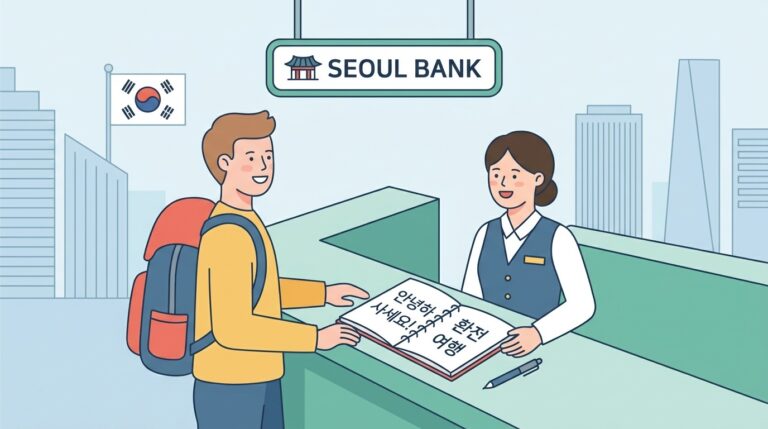
Never Panic at Korean Banks: How to Check Your Account Balance Like a Local
Phase 1: Empathy (Real-World Opening)
안녕하세요! 매일한글 에디터입니다. Have you ever stood in front of a shiny Korean ATM in Hongdae or sat nervously in front of a polite bank teller in Gangnam, your heart doing a mini K-drama suspense scene? You went out for samgyeopsal with friends, and now you want to check if you have enough funds before your card gets declined in front of everyone! Checking your bank balance sounds simple, but when the automated machine only shows screens of formal banking terms or the teller asks you formal honorifics, panic kicks in. Don’t worry! This guide is built directly from real learner struggles and curated by your 10-year Korean culture navigator. Master these handy phrases, and you’ll manage your money smoothly, confidently, and with authentic Korean flair!
Phase 2: Core Expressions Deep Dive (Top 3)
1. 잔액 조회하고 싶어요. (Janaek johuihago sipeoyo.)
- Pronunciation: [Janaek johuihago sipeoyo] (Think: “Jah-neck jo-hee-ha-go she-poh-yo”)
- Meaning: Literal: “I want to look up my remaining amount.” / Actual Nuance: “I’d like to check my balance, please.”
- K-Culture Moment: You’ll hear this polite, standard line in office dramas like Misaeng whenever an intern visits the corporate branch.
- Editor’s Insight:
잔액(Janaek) refers specifically to the remaining financial balance. Adding-고 싶어요(-go sipeoyo) softens the statement into a polite, natural request suitable for customer service desks. - Situation Spectrum: Casual: ⚠️ | Semi-formal: ✅ | Formal: ✅
- 🤔 Think About It: In English, we casually say “Can I see my balance?”, but Korean banking prefers stating your intended action with
-고 싶어요to remain respectful.
2. 통장에 얼마 남아 있어요? (Tongjange eolma nama isseoyo?)
- Pronunciation: [Tongjange eolma nama isseoyo] (Think: “Tohng-jahng-eh eol-mah nah-mah ee-ssuh-yo”)
- Meaning: Literal: “How much remains in my bankbook?” / Actual Nuance: “How much money do I have left in my account?”
- K-Culture Moment: Classic slice-of-life drama scene where a character opens their bankbook at a counter and whispers nervously before rent day.
- Editor’s Insight: Koreans often use
통장(bankbook/account book) interchangeably with “bank account.” It sounds warm and conversational. - Situation Spectrum: Casual: ✅ | Semi-formal: ✅ | Formal: ⚠️
- 🤔 Think About It: Notice the focus on “what remains” (
남아 있어요) rather than “what do I possess.” How does this reflect the dynamic nature of money flow in Korean daily life?
3. 잔액 좀 확인해 주시겠어요? (Janaek jom hwaginhae jusigesseoyo?)
- Pronunciation: [Janaek jom hwaginhae jusigesseoyo] (Think: “Jah-neck johm hwa-geen-hae joo-she-gess-uh-yo”)
- Meaning: Literal: “Could you please verify the remaining balance?” / Actual Nuance: “Could you check my balance for me, please?”
- K-Culture Moment: When a polite customer visits a cozy neighborhood bank branch and asks the clerk with a respectful nod.
- Editor’s Insight: The magic word
좀(jom – “a little/please”) instantly dissolves stiffness and makes the request feel sweet and well-mannered. - Situation Spectrum: Casual: 🚫 | Semi-formal: ✅ | Formal: ✅
- 🤔 Think About It: Why does adding a small modifier like
좀make such a huge difference in politeness across Korean service culture?
Phase 3: Textbook Korean vs. Real-World Korean
Situation 1: Asking the teller at the bank counter
- 📖 교과서 한국어 (Textbook Korean): 계좌의 잔여 금액을 조회해 주십시오. (Gyejwaui janyeo geumaekeul johuihae jusipsio. / “Please inquire into the remaining sum of the account.”)
- 🗣️ 진짜 한국어 (Real Korean): 잔액 조회 좀 부탁드려요. (Janaek johui jom butakdeuryeoyo. / “Balance check, please.”)
- 💡 왜 다를까? (Why is it different?): Textbook phrases often use hyper-formal imperatives like
-십시오(-sipsio), which sound like a robotic legal manual. Real native speakers use soft request forms like부탁드려요(butakdeuryeoyo).
Situation 2: Checking your balance casually with a friend or to yourself
- 📖 교과서 한국어 (Textbook Korean): 제 예금 잔고가 부족합니다. (Je yegeum jangoga bujokhamnida. / “My deposit balance is insufficient.”)
- 🗣️ 진짜 한국어 (Real Korean): 나 잔고 얼마 안 남았어! (Na jango eolma an namasseo! / “I barely have any balance left!”)
- 💡 왜 다를까? (Why is it different?): In everyday chats over tteokbokki, Koreans swap rigid words like
예금 잔고(deposit balance) for quick colloquial terms like잔고(jango) with the negative verb form얼마 안 남다(hardly anything left).
Phase 4: K-Culture Deep Dive & Non-Verbal Manners
4-1. 눈치 (Nunchi) & Polite Banking Gestures
When handing over your bank card, alien registration card (ARC), or passbook to a Korean bank teller, always use two hands (or support your right forearm with your left hand). This shows respect! Also, step back behind the bright yellow safety line (대기선, daegiseon) until the teller calls your ticket number (번호표, beonhopyo). When typing your 4-digit PIN on the mini key-pad, casually cup your other hand over it; this is not considered rude—it is considered smart etiquette (센스, sense).
4-2. Cultural Code: The Age of “Tongjang” vs. “Teongjang”
In Korea, young people joke that on payday, their bankbook (통장, tongjang) instantly becomes an empty shell called a 텅장 (teongjang, from teong-bi-da meaning completely hollowed out), because automated utility bills, transit fees, and café subscriptions drain it immediately! When you master balance checking, you join this beloved national joke.
Phase 5: Real-World Roleplay Scenario
- Location: A brightly lit Woori Bank branch near Sinchon Station.
- Characters: Min-jun (A cheerful, patient 20-something bank clerk) & You (An eager international student).
-
Turn 1 (Min-jun): 어서 오세요! 고객님, 어떤 업무 도와드릴까요? (Eoseo oseyo! Gogaengnim, eotteon eommu dowadeurilkkayo? / “Welcome! Customer, what business may I help you with?”)
🎭 Smiling warmly as you approach the counter. - Turn 2 (You): 안녕하세요! 잔액 조회하고 싶어요. (Annyeonghaseyo! Janaek johuihago sipeoyo. / “Hello! I’d like to check my balance.”)
🎭 Handing your bank card with both hands. - Turn 3 (Min-jun): 네, 카드 이쪽에 꽂아 주시겠어요? (Ne, kadeu ijjoge kkoja jusigesseoyo? / “Sure, could you insert your card right here?”)
🎭 Pointing towards the card reader machine on the desk. - Turn 4 (You): 네, 꽂았어요. (Ne, kkojasseoyo. / “Yes, I inserted it.”)
🎭 Gently inserting the card with a light nod. - Turn 5 (Min-jun): 화면에 비밀번호 네 자리 눌러 주세요. (Hwamyeone bimilbeonho ne jari nulleo juseyo. / “Please enter your four-digit PIN on the screen.”)
🎭 Turning his eyes away politely so you have privacy. - Turn 6 (You): 입력했어요. 통장에 얼마 남아 있어요? (Imnyeokhaesseoyo. Tongjange eolma nama isseoyo? / “I entered it. How much is left in my account?”)
🎭 Shielding the keypad with your free hand. - Turn 7 (Min-jun): 현재 오만 원 남아 있습니다. (Hyeonjae oman won nama itseumnida. / “Currently, there is 50,000 won remaining.”)
🎭 Showing the receipt screen discreetly. - Turn 8 (You): 확인 감사합니다! 좋은 하루 보내세요. (Hwagim gamsahamnida! Joeun haru bonaeseyo. / “Thank you for checking! Have a nice day.”)
🎭 Taking your card back with both hands and bowing 15 degrees.
🔀 Interactive Decision Point!
What should you do if you also want a printed paper receipt with your updated balance?
* Option A: “영수증도 한 장 출력해 주세요!” (Yeongsujeungdo han jang chullyeokhae juseyo! / “Please print a receipt for me too!”)
* Outcome (Best!): Perfect! Polite, clear, and native-level natural for A2 learners.
* Option B: “종이 주세요!” (Jongi juseyo! / “Give me paper!”)
* Outcome (Bad): Too blunt. The teller might hand you scrap paper or wonder why you are demanding paper without context.
* Option C: “돈 주세요!” (Don juseyo! / “Give me money!”)
* Outcome (Risk!): Danger! This means “Give me cash!” The clerk might think you want an unplanned cash withdrawal or mistake it for a robbery scenario!
Phase 6: 10-Second Emotion Shadowing Drill
Read these out loud, pausing briefly at the / marks to catch the true Korean cadence:
[😊 Polished & Friendly]저기요, / 잔액 조회 좀 / 부탁드려요! (Jeogiyo, / janaek johui jom / butakdeuryeoyo!)[🤔 Curious & Modest]지금 / 통장에 / 얼마 남아 있어요? (Jigeum / tongjange / eolma nama isseoyo?)[😅 Relieved & Warm]아, / 생각보다 많이 남았네요! / 감사합니다. (A, / saenggakboda mani namanneyo! / Gamsahamnida!)
Phase 7: K-Culture Mini Dictionary
- 잔액 (Janaek): Balance / Remaining balance. Found on every ATM main screen as
잔액조회(Balance Inquiry). - 통장 (Tongjang): Bankbook / Physical account booklet. Symbolizes adulthood and financial independence in Korean culture.
- 텅장 (Teongjang): Empty bankbook (Slang). A witty pun combining teong (empty) and tongjang to describe being broke after shopping or payday.
- 계좌번호 (Gyejwabeonho): Account number. Often exchanged via KakaoTalk for split billing (
더치페이, Dutch pay).
Phase 8: Traveler’s Survival Kit
Survival Expressions TOP 3
- 잔액만 확인할게요. (Janaengman hwaginhalkkeyo. / “I’ll just check the balance.”)
- Pro Tip: Use this if an ATM or teller asks if you want to withdraw cash right away.
- ATM 영어가 돼요? (ATM yeongeoga dwaeyo? / “Does this ATM have English?”)
- Pro Tip: Most Korean ATMs offer a prominent “English” or “Global ATM” button on the start screen.
- 명세표 안 나와도 돼요. (Myeongsepyo an nawado dwaeyo. / “I don’t need a printed transaction slip.”)
- Pro Tip: Great for saving paper if you already checked the balance on the digital screen!
Editor’s Travel Note
Need to manage money on the go? Download the official mobile apps directly before heading out: check the Toss Mobile Banking App Download or review the KakaoBank Foreigner Service Guide. For seamless public transit and card transactions, make sure your card is tagged as a “Global Card” at convenience store ATMs!
Phase 9: “One Step Deeper” (Reflective Question)
In Korea, discussing detailed personal wealth can be considered sensitive, yet asking casual balance questions among close peers—like “Do you have enough balance for lunch?” (점심 먹을 잔액 있어?)—is viewed as caring and considerate. The widespread practice of dividing bills down to 100 won using split transfers illustrates a unique balance between financial precision and collective dining harmony.
💬 Your Turn: In your home country, is checking and talking about your account balance completely private, or do close friends discuss it openly? Share your stories in the comments below!
Phase 10: FAQ & Common Mistakes
Q: Can I check my Korean bank account balance from an ATM without a physical card?
A: If you have set up cardless transactions (무카드 거래, mukadeu georae) or mobile pay beforehand, yes! Otherwise, you will need either your physical check card or your bankbook.
Q: What is the difference between 잔액 (Janaek) and 잔고 (Jango)?
A: Both mean “balance,” but 잔액 refers directly to the numerical amount of money left, while 잔고 is a broader accounting term often used in business or informal speech (잔고 바닥났어, “My balance hit rock bottom”).
Q: Does the ATM screen button say “잔액 조회” or something else?
A: Yes! Almost all Korean ATMs display a big button labeled 잔액조회 (Balance Inquiry), often placed on the right-hand column of the screen.
🚨 Common Mistakes Warning Board
- Mistake: Confusing
잔액(Janaek – balance) with금액(Geumaek – amount of money/cost).- Correct Action: If you ask for
금액, the teller might ask, “Which cost are you paying?” Stick to잔액!
- Correct Action: If you ask for
- Mistake: Handing documents or cards over with only one hand.
- Correct Action: Always hold your card with two hands and a slight bow for warm etiquette.
- Mistake: Forgetting that Korean account PINs are strictly 4 digits.
- Correct Action: Never enter a 6-digit passcode unless prompted specifically for an international debit PIN.
Phase 11: Action Missions
- 🥉 Bronze Mission (Solo): Stand in front of your bathroom mirror and repeat
"잔액 조회하고 싶어요"three times with a confident smile. - 🥈 Silver Mission (Social): Comment on our post with the slang word
텅장in a sample sentence of your own! - 🥇 Gold Mission (Real Life): Visit a local Korean convenience store ATM or bank branch, switch the machine to Korean, locate the
잔액조회button, and check your balance successfully! - 🎮 K-Culture Mission: Watch an episode of a modern Korean drama (like King the Land or Business Proposal) and spot a character using a card or checking their banking app notification!
Phase 12: Interactive Quiz Challenge
1. Situation Challenge: You are standing in front of a bank teller. How do you politely say, “Could you check my account balance for me, please?”
* A) 잔액 좀 확인해 주시겠어요? (Janaek jom hwaginhae jusigesseoyo?)
* B) 돈 내놔! (Don naenwa!)
* C) 영수증 버려 주세요. (Yeongsujeung beoryeo juseyo.)
2. Fill in the Blank: “통장에 돈이 하나도 없어서 제 통장은 [ ______ ]이 되었어요!” (Hint: The popular slang for an empty bankbook!)
3. True or False: When entering your PIN at a bank counter, it is considered polite and smart manners to shield the keypad with your free hand.
* (True / False)
👉 Click to Reveal Answers & Explanations
- Answer: A!
잔액 좀 확인해 주시겠어요?is the gold standard for polite, natural Korean banking dialogue. (Option B means “Give me the money!” which is robbery language, and C means “Please throw away the receipt.”) - Answer: 텅장 (Teongjang)! This comes from teong-bi-da (empty) + tongjang (account booklet).
- Answer: True! In Korea, covering your PIN number subtly is considered good personal security sense (
센스) rather than suspicion!







