

Master Late-Night Street Tteokbokki and Sundae Like a Seoul Local
Phase 1: Empathy (Story-Driven Opening)
안녕하세요! 매일한글 에디터입니다.
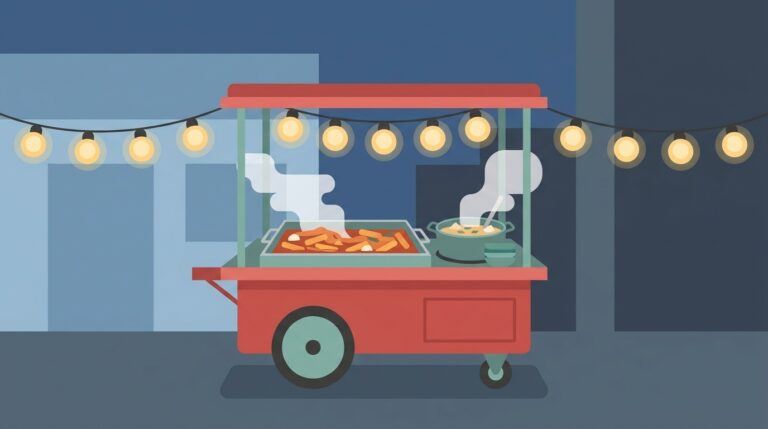
Picture this: It is 11:45 PM on a crisp autumn evening in Seoul. You are strolling down the alleys near Jongno 3-ga, and your senses are suddenly awakened by the unmistakable aroma of rich, red gochujang simmering alongside a massive steel vat of steaming broth. You step up to the plastic-draped stall—a classic Korean pojangmacha (street cart). The vendor, an energetic Imo (auntie), rhythmically slices deep-purple steamed sundae (blood sausage) while balancing skewers of fish cakes.
You have studied Korean grammar for years and passed your intermediate tests, but standing under those yellow halogen lights, your mind abruptly hits a wall. How do you specify that you want liver and lung mixed with your sundae without sounding like a formal robot? How do you ask for that complimentary cup of piping-hot fish cake broth without feeling intrusive? Many advanced learners report this exact pain point: “I knew the textbook words for food, but the lightning-fast, rhythmic cadence of street food culture completely paralyzed me, so I just nodded and ate whatever was handed to me.”
This guide is crafted directly from real learner feedback and ten years of street-level navigation in Seoul. By mastering the C1-level nuances, unspoken social codes, and idiomatic vernacular of Korean late-night street dining (yasik), you will transform from an awkward onlooker into a confident, culturally attuned insider.
Phase 2: In-Depth Analysis of 3 Core Expressions
1. 순대 1인분에 내장 골고루 섞어 주세요 (Sundae il-inbune naejang golgoru seokkeo juseyo)
- Pronunciation: [Sun-dae il-in-bun-e nae-jang gol-go-ru seok-keo ju-se-yo] (Think of ‘sundae’ like ‘sun-day’ with an earthy ‘deh’, and ‘gol-go-ru’ bouncing smoothly like ‘goal-go-roo’)
- Meaning:
- Literal: Please give me 1 serving of sundae, mixing internal organs evenly.
- Nuance: “I’d like one order of sundae with an assortment of organ meats (liver, lung, heart), please.”
- K-Culture Moment: Seen in nearly every slice-of-life K-Drama (such as Weightlifting Fairy Kim Bok-joo or Hospital Playlist) where exhausted protagonists unwind late at night, asking for organ cuts to pair with their comfort meal.
- Editor’s Insight: If you merely order “순대 주세요,” many vendors will either omit the organs (naejang) assuming foreigners might dislike the texture, or give you whatever cut is left over. By asking for them “골고루 섞어서” (evenly mixed), you project the confidence of a seasoned local foodie who appreciates liver (gan), lung (heopa), and heart (yeomtong).
- Situation Spectrum:
- Casual: ✅
- Semi-formal: ✅
- Formal: ⚠️ (Unlikely context; street dining relies on polite semi-formal ‘-요’ style)
- 🤔 Think About It: In many Western culinary traditions, offal is sidelined or treated as an exotic novelty. Why do you think Korean street culture considers internal organs an indispensable, complimentary partner to blood sausage?
2. 떡볶이 국물에 순대 찍어 먹게 국물 좀 넉넉히 주세요 (Tteokbokki gungmure sundae jjigeo meokge gungmul jom neongneokhi juseyo)
- Pronunciation: [Tteok-bok-ki gung-mu-re sun-dae jji-geo meok-ge gung-mul jom neong-neok-hi ju-se-yo] (Pronounce ‘tteok’ with a tight, popping ‘T’, and glide through ‘neong-neok-hi’ smoothly)
- Meaning:
- Literal: Please give generous sauce so I can dip my sundae in the tteokbokki broth.
- Nuance: “Could you give me extra tteokbokki sauce so I have plenty to dip my sundae in?”
- K-Culture Moment: The holy trinity of late-night snacks—Tteok-bokki, Sundae, and Twigim (fried snacks)—relies heavily on cross-dipping. Korean variety shows often spotlight guests debating whether they prefer dipping sundae in salt (geogeum), ssamjang, or spicy tteokbokki sauce.
- Editor’s Insight: Using the adverb “넉넉히” (generously/abundantly) rather than simply saying “많이” (a lot) elevates your speech. It signals an appreciation for the food’s sauce profile without sounding demanding. Alternatively, if you want the vendor to douse your sundae directly in the sauce on the plate, say: “국물에 버무려 주세요” (Please coat it in the sauce).
- Situation Spectrum:
- Casual: ✅
- Semi-formal: ✅
- Formal: 🚫
- 🤔 Think About It: Contrast this with dining cultures where asking for extra sauce or altering plate presentation can be viewed as insulting to the chef. What does the Korean street vendor’s willingness to customize sauce say about relational hospitality (jeong)?
3. 오뎅 국물은 종이컵에 셀프로 떠 마시면 되나요? (Odeng gungmureun jong-ikeobe selpeuro tteo masimyeon doenayo?)
- Pronunciation: [O-deng gung-mu-reun jong-i-keo-be sel-peu-ro tteo ma-si-myeon doe-na-yo] (Emphasize the smooth ‘sel-peu-ro’ borrowed from English ‘self’)
- Meaning:
- Literal: May I scoop fish cake broth into a paper cup myself?
- Nuance: “Should I just grab a paper cup and help myself to the fish cake broth?”
- K-Culture Moment: Characters standing on a freezing Seoul night, wrapping both hands around a steaming paper cup of clear broth, blowing gently before taking a sip while conversing about life.
- Editor’s Insight: At street carts, fish cake broth (odeng gungmul) is universally free and virtually bottomless if you are ordering food. However, asking politely before plunging your ladle into the simmering broth shows exceptional street manners (nunchi), distinguishing you from thoughtless patrons.
- Situation Spectrum:
- Casual: ✅
- Semi-formal: ✅
- Formal: ⚠️
- 🤔 Think About It: Why does the complimentary distribution of warm broth serve as an emotional icebreaker in fast-paced urban Korea?
Phase 3: Textbook Korean vs. Real Native Korean
Situation 1: Inquiring About the Heat Level of the Tteokbokki
- 📖 교과서 한국어: 이 떡볶이는 매우 맵습니까? (I tteokbokkineun maeu maepseumnikka?) — “Is this tteokbokki very spicy?”
- 🗣️ 진짜 한국어: 사장님, 이거 신라면보다 많이 매워요? (Sajangnim, igeo Sinramyeonboda mani maewoyo?) — “Boss, is this significantly spicier than Shin Ramyun?”
- 💡 왜 다를까?: In everyday Korea, “spiciness” (maewoon-mat) is deeply subjective. Using the national benchmark—Shin Ramyun—gives the vendor an objective baseline to accurately gauge the heat for you.
Situation 2: Ordering the Duo Together Efficiently
- 📖 교과서 한국어: 떡볶이와 순대를 한 접시씩 포장해 주십시오. (Tteokbokkiwa sundaereul han jeopsissik pojanghae jusipsio.) — “Please package one plate each of tteokbokki and sundae for takeout.”
- 🗣️ 진짜 한국어: 이모님, 떡순이 1인분씩 포장해 주세요! (Imonim, tteoksun-i il-inbunsik pojanghae juseyo!) — “Auntie, please pack one order of tteok-sun (tteokbokki + sundae) to go!”
- 💡 왜 다를까?: Native speakers love brisk portmanteaus (jul-im-mal). Combining tteokbokki and sundae into tteoksun-i (or tteok-twi-sun when adding fried snacks) fits the fast, dynamic street tempo.
Phase 4: K-Culture Deep Dive & Non-Verbal Manners
4-1. 눈치 (Nunchi) & Street Cart Body Language
- The Stance: Pojangmacha are narrow communal spaces. Stand slightly angled (at a 45-degree angle to the counter) so newcomers can step up beside you.
- The Toothpick/Skewer Rule: You will be handed long wooden skewers instead of chopsticks. Never wave your skewer while talking. When finished, discard used skewers into the dedicated metal can on the counter, never back onto the prep surface.
- Broth Etiquette: Grab a small paper cup from the dispenser stack yourself, use the communal long-handled ladle to scoop the hot broth, and return the ladle immediately without letting the rim touch your cup.
4-2. Cultural Code: The Late-Night “Yasik” (야식) Sanctuary
In high-pressure metropolitan Korea, yasik is not merely late-night fuel; it is a ritual of psychological decompression. When corporate hierarchy, high-stakes university study, or long commuting hours drain the spirit, the street food stall serves as an egalitarian sanctuary. Beneath the orange canopy, corporate executives in bespoke suits and gig-economy workers lean over the same bubbling pans. Here, pretense is stripped away. The warmth of the food, combined with the motherly banter of the vendor, offers restorative solace (wiro).
Phase 5: Real-World Roleplay Scenario
Setting: 11:30 PM outside Exit 4 of Jongno 3-ga Station. Rain is lightly misting. Steam billows from the cart. Vendor Imo is swiftly chopping sundae on a wooden cutting board with a rhythmic thwack-thwack-thwack.
- Turn 1 (Vendor): 어서 와요! 뭐 줄까? (Eoseo wayo! Mwo julkka?)
🎭 Wiping the prep counter with a clean cloth, looking up with a welcoming grin.
“Welcome! What can I get for you?” -
Turn 2 (Learner): 안녕하세요, 이모님! 떡볶이랑 순대 1인분씩 먹고 갈게요. (Annyeonghaseyo, imonim! Tteokbokkirang sundae il-inbunsik meokgo galgeyo.)
🎭 Stepping under the canopy, folding an umbrella neatly to the side.
“Hello, Auntie! I’ll eat here: one order of tteokbokki and one order of sundae, please.” -
Turn 3 (Vendor): 순대에 내장도 섞어줘요? 간이랑 허파 다 먹어? (Sundaee naejangdo seokkeojwoyo? Gan-irang heopa da meogeo?)
🎭 Lifting the metal lid off the steamer, revealing a coil of dark sausage surrounded by offal.
“Do you want organs mixed in? Do you eat liver and lung too?” -
Turn 4 (Learner): 네, 간이랑 허파 골고루 섞어 주시고요, 떡볶이 국물도 넉넉하게 부탁드려요! (Ne, gan-irang heopa golgoru seokkeo jusigoyo, tteokbokki gungmuldo neongneokhage butakdeuryeoyo!)
🎭 Gesturing politely with two hands toward the cutting board.
“Yes, please mix in liver and lung evenly, and I’d really appreciate generous tteokbokki sauce as well!” -
Turn 5 (Vendor): 알았어, 듬뿍 담아줄게. 저기 국물은 컵에 셀프로 떠 마셔! (Arasseo, deumpuk damajulge. Jeogi gungmureun keobe selpeuro tteo masyeo!)
🎭 Skilfully slicing the sausage on the diagonal, scooping a heap of glossy tteokbokki into an oval plate.
“Got it, I’ll give you a generous portion. Help yourself to the broth over there with a cup!” -
Turn 6 (Learner): 와, 감사합니다! 혹시 순대를 떡볶이 국물에 아예 버무려 주실 수 있나요? (Wa, gamsahamnida! Hoksi sundaereul tteokbokki gungmure aye beomuryeo jusil su innayo?)
🎭 Taking a paper cup and scooping broth carefully without spilling.
“Wow, thank you! By any chance, could you coat the sundae completely in the tteokbokki sauce?” -
Turn 7 (Vendor): 당연하지! 버무려 먹으면 훨씬 맛있지. 자, 여기 있어요. (Dang-yeonhaji! Beomuryeo meogeumyeon hwolssin masitji. Ja, yeogi isseoyo.)
🎭 Tossing the freshly sliced sundae directly into the red sauce on the plate and sliding it across.
“Of course! It tastes so much better coated. Here you go!” -
Turn 8 (Learner): 진짜 맛있겠네요! 잘 먹겠습니다! (Jinja masitgenneyo! Jal meokgetseumnida!)
🎭 Receiving the skewer, bowing slightly from the waist before taking the first bite.
“This looks incredible! Thank you for the meal!”
🔀 Interactive Decision Point
The vendor hands you your plate, but you realize you also crave a crispy fried seaweed roll (gimmari). What do you say?
- Choice A: “야! 김말이 하나 더 던져 줘!” (Ya! Gimmari hana deo deonjyeo jwo!)
Feedback (Bad): Highly disrespectful. Using “야” and casual low-register commands to an older vendor will destroy rapport instantly. - Choice B: “저기요 사장님, 김말이 튀김도 1인분 추가 가능한가요?” (Jeogiyo sajangnim, gimmari twigimdo il-inbun chuga ganeunghangayo?)
Feedback (Risk): Grammatically flawless, but overly stiff and textbook-like. Street carts prefer warmer, punchier requests. - Choice C (Best): “이모님, 여기에 김말이 두 개만 국물에 같이 범벅해 주실 수 있어요?” (Imonim, yeogie gimmari du gaeman gungmure gachi beombeokhae jusil su isseoyo?)
Feedback (Best): Perfect C1 street proficiency! Using Imo, specifying item count instead of full portions, and deploying the culinary slang beombeok (sauce-smothered) will earn you genuine vendor admiration.
Phase 6: 10-Second Emotional Shadowing Drill
Practice reading these out loud, observing the pause marks (/) and feeling the annotated emotion.
[🤤 군침을 삼키며 / Anticipatory & Hungry]
“이모님, / 순대 내장 섞어서 1인분만 / 떡볶이 국물에 버무려 주세요!”
(Imonim, / sundae naejang seokkeoseo il-inbun-man / tteokbokki gungmure beomuryeo juseyo!)-
[🥶 추위에 떨다가 국물을 마시며 / Relieved & Cozy]
“으아, / 오뎅 국물 진짜 칼칼하고 시원하네요… / 온몸이 싹 녹아요.”
(Eua, / odeng gungmul jinja kalkal-hago siwon-haneyo… / on-momi ssak nogayo.) -
[😊 정중하면서도 넉살 좋게 / Friendly & Charming]
“사장님 손이 진짜 크시네요! / 이렇게 많이 주시면 / 남는 게 있으세요?”
(Sajangnim son-i jinja keusineyo! / ireoke mani jusimyeon / namneun ge isseuseyo?)
Phase 7: K-Culture Mini Dictionary
- 떡순튀 (Tteok-Sun-Twi): Acronym for Tteokbokki + Sundae + Twigim. The canonical holy trinity combo of Korean street snacking.
- 범벅 (Beombeok): A culinary technique where fried food or sundae is thoroughly tossed and soaked directly in viscous tteokbokki sauce before serving.
- 모둠 내장 (Modum Naejang): Assorted offal pieces accompanying sundae, typically comprising gan (dense liver), heopa (spongy, tender lung), and yeomtong (chewy heart muscle).
- 칼칼하다 (Kalkal-hada): A sensory taste descriptor indicating a clean, throat-warming, peppery spice (often attributed to red pepper flakes or black pepper in fish cake broth), distinct from sticky gochujang heat.
Phase 8: Survival Kit for Travelers
Top 3 Survival Expressions
- “포장해 갈게요.” (Pojanghae galgeyo.)
Pro Tip: Say this immediately upon stepping up if you want takeout, as vendors plate dine-in orders instantly on reusable oval dishes wrapped in protective film. - “계좌이체 되나요?” (Gyejwai-che doenayo?)
Pro Tip: Many authentic outdoor stalls do not have card terminals. If you lack physical cash, nearly all vendors prominently display their bank account numbers for instant local bank transfers. - “간 위주로 많이 주세요.” (Gan wiju-ro mani juseyo.)
Pro Tip: Use this if you adore liver and prefer less lung or ear cartilage.
Editor’s Travel Note
Before embarking on your late-night food exploration, check operating hours and crowd reviews on the Naver Map app download. Street stalls frequently change locations or close on bad-weather days. Keep 10,000 KRW cash in your wallet at all times, as international credit cards are frequently declined at small unlicensed carts.
Phase 9: “One Step Deeper” (Reflective Essay)
At a traditional Korean pojangmacha, the artificial boundaries of modern social stratification dissolve. Addressing an older female vendor as Imo (maternal aunt) is not a linguistic glitch; it is an active invocation of familial warmth that converts a commercial transaction into a relational bond. When the vendor slips an extra piece of fried squid into your plate (service or jeong), you are reminded that in Korea, food has never been mere caloric sustenance. It is an emotional currency of care, vulnerability, and communal solidarity shared under an orange plastic canopy against the chill of the city.
💬 Your Turn: Have you ever experienced a late-night street food culture that bridges social divides like Korea’s pojangmacha? Share your thoughts and culinary memories in the comments below!
Phase 10: FAQ & Avoiding Misunderstandings
Q: Can I sit at the plastic tables inside the tent if I only order tteokbokki and sundae?
A: Be careful! Many large outdoor tents with tables are designated as pocha (street drinking bars). These venues expect you to order alcoholic beverages and higher-priced main dishes (like spicy stir-fried cartilage or clam soup). If you only want street snacks (bunsik), you are generally expected to stand up and eat at the front counter.
Q: How do I season sundae correctly? Why did the vendor give me salt instead of ssamjang?
A: Regional seasoning varies across Korea! In Seoul and Gyeonggi, sundae is paired with chili-spiced salt (so-geum). In Busan and Gyeongsangnam-do, it is served with savory soybean paste (ssamjang). In Jeolla-do, it is served with sweet-tangy vinegar chili paste (cho-gochujang). You are experiencing authentic regional culture!
Q: What should I do if I am given way too much food?
A: Never feel guilty if you cannot finish the heavy broth or extra sauce. However, leaving behind heaps of meat organs after specifically requesting them can look wasteful. It is customary to say: “양이 정말 많아서 조금 남겼어요, 너무 맛있었습니다!” (You gave such a generous portion that I left a little, but it was delicious!).
🚨 Common Mistakes (경고판)
- ❌ Mistake 1: Double-dipping your bitten fish cake or skewer into the communal soy sauce trough.
➡️ Correct Action: Use the small silicone brush provided to paint soy sauce directly onto your skewer, or spoon a little sauce onto a paper plate. - ❌ Mistake 2: Demanding a credit card payment for a 4,000 KRW snack without asking first.
➡️ Correct Action: Prepare cash beforehand or use instant mobile bank transfer. - ❌ Mistake 3: Calling an elderly stall owner “아줌마” (Ajumma).
➡️ Correct Action: Always elevate the social tone by using the affectionate “이모님” (Imonim – maternal aunt) or professional “사장님” (Sajangnim – boss).
Phase 11: Action Mission & Engagement
- 🥉 Bronze Level: Practice saying “순대 1인분에 내장 골고루 섞어 주세요” three times out loud in front of a mirror with natural cadence in under 5 seconds.
- 🥈 Silver Level: Post an Instagram Story of your next street food adventure with the caption: “오늘 야식은 떡순튀 범벅! 이모님 국물 더 주세요!”
- 🥇 Gold Level: Visit an outdoor street cart in Seoul, order sundae with at least two organ cuts, and successfully initiate self-service fish cake broth using the C1 expressions from this lesson!
- 🎮 K-Culture Mission: Watch an episode of a Korean street reality show (like Street Alcohol Fighter or Seojin’s Korean Street Food) and write down two colloquial phrases the guests use when ordering snacks.
Phase 12: Interactive Quiz Challenge
Test your real-world cultural readiness!
1. Situational Judgment
You are standing at a busy street food cart in Seoul. The vendor asks you: “내장은 어떻게 해줄까?” You love liver, but strongly dislike lungs and other chewy organs. Which response is the most natural and accurate?
* (A) “내장 전부 다 버려 주세요.”
* (B) “허파는 빼고 간만 섞어서 주세요.”
* (C) “저는 내장을 극도로 혐오합니다.”
2. Fill-in-the-Blank
Fill in the missing native Korean term for sauce-smothered styling:
“이모님, 튀김을 떡볶이 국물에 완전히 ( )해 주실 수 있나요?”
3. True or False
- Statement: Fish cake broth (odeng gungmul) at a standing street cart is strictly tallied and charged per cup at the end of the meal. (T / F)
👉 Click to Reveal Answers & Explanations
-
Answer: (B)
Explanation: “허파는 빼고 간만 섞어서 주세요” (Please leave out the lung and mix in only liver) is polite, concise, and clear. Choice (A) sounds like you are ordering garbage disposal, and (C) is overly dramatic and awkward. -
Answer: 범벅 (Beombeok)
Explanation: Beombeok refers to thoroughly coating or stewing items in a thick sauce. You can say “범벅해 주세요!” -
Answer: False
Explanation: Fish cake broth is traditionally complimentary and self-serve for patrons ordering food at the stall. Just scoop cleanly with the provided ladle into a paper cup!







